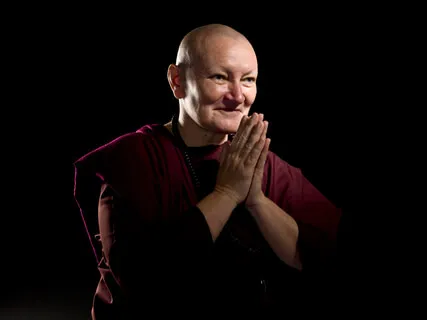
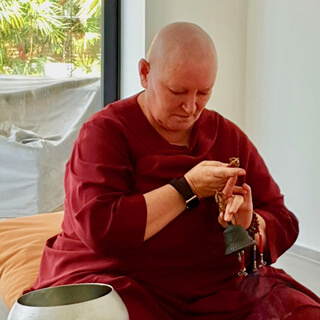
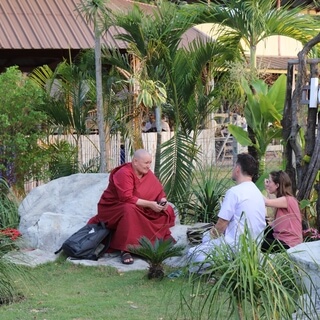
Here find a comfortable posture.
Try to have a straight back,
Straight neck,
But you don't have to be stiff.
Still try to be relaxed.
Usually if you pull your shoulders up one or two times and let them fall down then you're in a natural posture.
Your hands lie on your lap,
Right hand on top of the left hand and if you can right leg on top of the left leg.
If this is uncomfortable you just sit with crossed legs or however you feel it's comfortable and you can stay in that posture for a long time for about 50 minutes.
And first of all we see yourself in that posture.
You can move from your head,
Know your head,
Move down to your neck,
Know both shoulders,
Both upper arms,
Elbows,
Lower arms,
Hands,
Your straight back,
Your lower body.
You feel how you touch the floor or the mat you sit on and your crossed legs.
You know you're sitting in meditation now.
You try to calm the mind and you try to let go of everything that arises there in the mind.
Make up your mind that nothing is important now.
Whatever arises there,
Whatever thought may come,
You just know them as what they really are.
It's only thinking.
You can make a mental note.
That means in your mind you note what is really there.
For example you note thinking,
Thinking and then let the thought go and bring your attention to your breath.
The breath is our main object while sitting and we fix the attention on our abdomen.
You know the point about two fingers above your navel and see how your abdomen is rising and falling while you are breathing.
When you breathe in you see this movement of rising,
Of expanding.
When you breathe out the abdomen is falling and we make a mental note.
When you see your abdomen is rising you note in your mind rising and your abdomen is falling,
Not falling,
Rising,
Falling.
Try to be with that movement and note it.
Don't speak it out loud.
We only note it in the mind.
When you start with your meditation then you might see the rising and falling one times,
Two times and then the thought is coming.
Your mindfulness doesn't want to stay just with that rising and falling.
The thoughts come.
It's natural.
It's the nature of the mind that it sinks.
Don't get upset with yourself.
Don't get too agitated about that.
Just know.
Know there are thoughts.
Note in your mind sinking,
Sinking,
Two times or three times and then let the thoughts go and bring the attention back to the abdomen.
Know the rising and the falling.
Not long and then again thoughts come.
Never mind.
In the moment you know that you're sinking,
In that moment you're 100% mindful and that's why we practice to develop that mindfulness.
So you know there are thoughts again and you note it.
Sinking,
Sinking,
Let it go and bring the attention back to the breath,
To the rising and falling.
We need a lot of patience in the beginning to bring the mindfulness back again and again but slowly then thoughts will reduce and concentration will increase.
So we just go on.
Know the rising,
Falling.
There's a very simple method how you can check if meditation goes right.
Just check where you are.
Are you within yourself,
Within your body and mind?
Then it's correct.
If you're outside of yourself then it's not correct.
If the mind wanders outside yourself then you know that.
Make a note,
Wandering,
Wandering or sinking,
Sinking or perhaps dreaming,
Dreaming and then let go.
Let go of whatever arises there,
Of whatever you experience there and bring the attention back to the rising and falling.
That's the main work you have to do when you start meditating.
Bring the mindfulness back to the breath again and again.
That's the main work you have to do when you start meditating.
That's the main work you have to do when you start meditating.
And again you check where you are.
And again you check where you are.
And again bring the attention back.
Make clear that whatever you want to know,
All the wisdom,
All the knowledge you want to reach,
It's all within yourself,
Within that very body and mind.
So there is no need to worry about anything outside yourself.
If this is clear then we do not take the thoughts so important.
We do not identify ourselves with whatever thoughts arise there.
Just see them as what they really are.
They are just thoughts.
It's just thinking,
Thinking.
Thoughts come,
You do not ask for them,
They arise by themselves and you don't have to ask them to go,
They go by themselves.
They come and go.
We try to only watch that.
We see them coming,
Staying for a while and then they go.
This is the nature of thoughts but also of everything else we experience.
Things arise,
Stay for a while and then they cease.
This is the characteristic of impermanence.
The Buddha taught that absolutely everything has this characteristic of anicca,
Of impermanence.
Everything is born,
Stays for a while and then it has to go,
Has to die,
Has to cease.
So watch your breath.
You see it also very clear.
It comes and goes.
Thoughts come and go.
Feelings,
Pleasant feelings,
Unpleasant feelings.
They come and they go.
They do not stay.
They are not permanent.
If we see that,
See that in our meditation,
Very clear,
Then wisdom arises.
We see the true nature of this body and mind.
We see it's impermanent.
The true nature of impermanence is also suffering because we would like to be happy and would like to stay happy forever.
We want to be young and strong and healthy but that doesn't stay with us.
There is always change.
If we accept it,
We have wisdom and we will not suffer from this impermanence.
If we do not accept it,
Then we will suffer.
That's sure.
This suffering is the second characteristic that the Buddha taught.
Absolutely everything is suffering.
It's unsatisfactory.
And we might think,
But if we are happy,
We are not suffering.
There is also happiness in our life.
We experience pleasant feelings,
That's true,
But the problem comes when we want to hold on to them.
We want to keep the happiness,
We want to keep the pleasant feeling and that doesn't work because by nature it has to change.
It comes and it has to go and then we suffer.
So wisdom lies in accepting the impermanence.
Check again where is the mind now.
Are you with your breath?
Are you with the rising and falling?
If not,
Then bring the attention back to the breath,
To the movement of your abdomen.
Um You can see how the press is changing.
Sometimes you breathe very deep and long,
Sometimes the press is very flat and slowly it's changing.
Sometimes it can even be so fine,
So subtle that you can hardly feel it.
It seems you have already stopped breathing.
But that is not so.
The press is going on,
So there is no need to worry.
We just know.
We cannot feel it anymore,
We don't feel that movement of the abdomen and we just know.
Know there is still breath going on,
But it is very subtle.
Mindfulness is knowing what is there now in the present moment.
What is going on in body and what is going on in the mind.
But of course we have one object,
One main object where we can fix our attention on and that is the press.
The press is like a handle for us.
We can hold on to it and try to be with it.
Be with the body.
The body is a rough object and is easier to be known,
To be experienced than the mind.
The mind is much more subtle and it changes very quickly.
So it's more difficult to catch the mind.
That's why we have as our main object the body,
The press,
The movement of the rising and falling of the abdomen.
But the closer you are with the abdomen the better you can watch it,
The more you will also see the mind.
You can see feelings,
Pleasant feelings,
Unpleasant feelings.
They come and they go.
Actually there are three kind of feelings.
Pleasant,
Unpleasant and indifferent feeling.
A feeling that is weather pleasant,
Not unpleasant.
But it's more difficult for us to see this weather pleasant,
Not unpleasant feeling.
Because it seems as if there is no feeling at all.
But it is there.
It's there most of the time.
The Buddha used to compare it with a hunter following a deer.
The deer is running through the sand and he can see the footprints of the deer.
And then there in the middle of the sand is a rock.
Then the footprints stop.
You can't see any footprint on the rock.
But across the rock then you can see again its footprint in the sand.
So it is with feelings.
If you have pleasant feelings or unpleasant feelings they are like you leave your footprints in the sand.
And the weather pleasant or unpleasant feelings are like when you walk on a rock you can't see the footprints.
But that doesn't say that they are not there.
So if we meditate we watch the body and we watch feelings.
And then also the mind becomes more clear.
We try to be with the rising and the falling of the abdomen.
And we will see more clear that the mind is thinking.
Most of the time the mind is anywhere outside yourself.
Thinking about past,
Thinking about future,
Planning,
Dreaming.
If you see that if you know that then you know the mind.
Again we know,
Thinking,
Dreaming,
Planning.
And we let it go.
And we return to the abdomen.
Return to our main object.
We know the rising,
The falling,
Not long and again the mind wanders.
Again the mind is anywhere else but not with the breath.
Never mind.
Be patient.
You have to have endurance and bring your mindfulness back to the abdomen.
We do that very gentle.
We are gentle with our mind.
We can't force it.
Just know it.
In the moment you know it you are already mindful.
That's perfect.
No problem.
No need to worry about what is past already.
Just let go and come back to the present moment.
To the breath.
Know the rising and know the falling.
So we have three of the four foundations of mindfulness already now.
The first is the body.
We know the breath.
The second is feelings.
Pleasant and unpleasant feelings.
And neutral feelings.
And the third is the mind.
We know thinking.
We know what's going on in the mind.
Now when we see things are impermanent,
Mindfulness is there and then it's gone.
We think again.
Thoughts come and go.
Feelings arise and then they cease.
Seeing impermanence.
There is seeing the Dhamma.
The Dhamma is the fourth foundation of mindfulness.
Seeing whatever you experience is changing.
We see that this body and mind is always changing.
Then it becomes very clear that we have no full control.
Whether over the body nor over the mind.
This is seeing the non-self nature of body and mind.
Non-self or no full control.
If we see that we also see Dhamma.
We practice the fourth foundation of mindfulness.
If we practice Vipassana then this is the basic of our practice.
We have to practice on these four foundations of mindfulness.
We apply our mindfulness on body,
Feelings,
Mind and Dhamma.
But there is no need to think a lot about this.
Try just to stay with your rising and falling movement of the abdomen.
And then naturally all four of these foundations will be there.
They are there all the time.
Within that body and mind.
So as long as we are within ourselves we do correct practice of meditation.
If the mind goes outside yourself and wanders then you are far away.
You are not there in the present.
Then you are wasting your time.
So always check where is the mind now.
If you are not within then gently bring your mindfulness,
Your attention back to the body,
To the breath.
So,
It will not Doesn't matter if it is within or out.
And make clear that you're sitting in meditation now,
That you try to calm the mind,
Try to develop wisdom.
There are all the time five hindrances in our mind,
Especially when we start the meditation,
These five hindrances permanently arise.
The first one is clear,
Sinking,
Restlessness.
The mind likes to think about this and that.
It goes all over the place and doesn't want to stay with the main object.
So we apply patience and endurance,
Bring the mindfulness back again and again to the main object,
To the breath.
If the mind is a bit calmer,
Then usually tiredness arises.
We do not think so much anymore,
But now the mind gets tired,
Gets sleepy,
Drowsy.
That's another kind of hindrance.
And we have to try to sit more straight,
Try to note more intensely,
Do a lot of mental noting.
Now tired,
Tired,
Tired.
Try to let it go and bring the attention to the breath.
If we really strictly note that,
Then usually the tiredness,
The drowsiness is disappearing.
If it doesn't work,
Then we can also change posture and start to do some walking.
Walking meditation usually gives you the energy and you can overcome the hindrance of drowsiness.
Another hindrance that comes all the time is desire.
Would like to do this,
Like to see that,
See pleasant sights,
Hear pleasant sounds,
Taste pleasant tastes,
Have a pleasant touching feeling in the body.
Like to have nice thoughts,
Dreams.
This is desire,
Another hindrance.
To meditate the seas,
That desire is there,
Just note it.
Desire or wanting,
Wanting.
And let it go.
Do not get involved in the thoughts that arise.
Know them,
Let them go and come back to the main object.
We do not ask for desire to arise,
But still it comes.
So we can see we do not have full control over that.
And we can say it's not ours,
It's not my desire.
I didn't ask for desire to arise.
It comes by itself and it goes by itself.
Just know it,
Note it and let it go.
Stay patiently with your practice,
With the rising and falling.
The fourth hindrance that arises is anger.
We are disappointed,
We are upset because concentration is not as we would like to have it.
Mind is wandering,
Is sinking,
Makes us angry,
Makes us upset.
Pain is arising and then we have aversion,
We don't like to have pain.
So we get upset.
This is just another hindrance,
We do not believe in that.
Do not see it as mine,
My anger,
I am angry,
I am upset,
I am disappointed.
We don't see it like that.
Just know there is no disappointment,
Note it,
Try to let it go,
Be patient and come back to the rising and falling.
We get angry with ourselves,
We get angry with the place,
With the teacher,
The teacher talks too much or the teacher doesn't talk enough,
Teaching is not good,
The technique is not good,
All kind of disappointment can arise.
I just don't believe in that,
Know it,
Note it,
Let it go and patiently continue with the practice.
And the anger with the cease,
Doesn't stay,
It is impermanent.
And the fifth hindrance that comes is doubt.
You doubt about yourself,
Maybe I am not able to do that,
I am not a good meditator.
Doubt about the teacher,
What is the teacher talking about,
Is this correct or not.
Doubt about all kind of things.
Again,
We don't believe in that,
It is just sinking,
It is just doubt.
No doubt,
Doubt,
Let it go and come back,
Always come back again and again to the breath.
Be clear that everyone,
Every meditator has to deal with these hindrances,
It is natural.
Know it,
Let it go and slowly they have less power and cannot overwhelm us anymore,
Just come and go.
Check again where you are now,
Are you with the breath,
Are you with the rising and falling.
Know it.
If pain arises,
We also know it.
Pain,
Pain,
Make the note,
Try to let go and return to your main object.
Sometimes then the pain disappears,
Sometimes it doesn't disappear.
Never mind,
We try to be patient,
Note it,
Try to let it go and come back to the main object.
If we cannot bear it anymore,
It is too much pain,
Then no problem.
You know now there is suffering in the body and you know that you want to change the posture and then slowly move,
Move your legs or straighten your back,
Change the posture slowly and mindfully.
When you change,
Watch,
Watch the pain,
You know there is pain and you know you are changing.
What is going on with the pain?
If you change your posture,
Is the pain still there or does it disappear?
Eventually you will see the pain ceasing,
It disappears,
Then you know that.
And you know this shows again impermanence.
Pain comes and goes,
It doesn't stay with you.
You know that,
You know that and then come back again to the main object,
To the rising and falling.
Sometimes sounds distract you,
There is a loud noise or sound outside and you see how the mindfulness is going out through your ears,
Through the sound.
It goes to the sound and you know,
You hear a car or you hear voices,
Whatever,
Never mind.
Just note,
You don't note car,
Car,
You note hearing.
That is what you actually experience.
You have ears,
There is a sound and when your ear contact the sound,
Then hearing consciousness arises.
That is natural,
That is normal.
So you know what really happens there is just hearing,
Hearing.
You know that,
Try to let it go and come back to the main object,
Come back to the rising and falling.
You can see if you practice vipassana correctly,
There is actually no hindrance.
There is actually nothing that is a disturbance,
But whatever you experience is just another object for your meditation.
You know it,
You note it in a correct way.
You make clear what it really is,
What its absolute reality is,
Then let it go.
Let it go to be open again for the next present moment,
For the next present object.
This is practicing vipassana or insight meditation.
Know where your mind is now,
Where is the mindfulness.
Sit there,
Are you with your body,
With your mind?
It's perfect.
Come back to your body again,
Know how you sit now,
In which posture.
Can move again slowly from your head to your neck,
Both shoulders,
Both arms,
Hands.
Know right hand is on top of the left hand,
You know your straight back,
You know how you touch your meditation cushion or the floor and you know your crossed legs.
Then look into your mind and know what's going on there.
Are you concentrate?
Is the mind peaceful?
Is it calm?
If yes,
Then you know that the mind is calm and you know what you did to reach this state of calmness.
What did you practice to gain calmness?
Keep that in your memory.
If the mind is not calm,
Is restless,
Then you also know why,
What thoughts,
What worries are there in the mind.
Know that and try to let it go,
Try to work these things out.
Then slowly bring your right hand to your right knee,
Place it on the right knee and know the movement,
Follow with your mindfulness the movement of your hand.
Then bring the left hand to the left knee,
Place it on your left knee,
Lift the right hand and the left hand,
Fold them in front of your heart and we give metta,
We give loving kindness now.
We share all the good we did by having the patience,
Endurance of practicing meditation.
First of all we think of those beings that are important in our life like parents,
Teachers,
Those that guide us on our path.
Share it to those we love,
Family,
Friends.
Then we also share it to those where we have no special relationship,
Neutral people,
Neutral beings.
And we share it to those that we don't like or who do not like us,
People where we have problems with,
Enemies.
And in the end we share it to all beings wherever they may be.
We wish may all beings be happy,
May all beings be peaceful and may all beings be free from all suffering.
You can also make individual wishes now,
Determinations you have,
Make them now with a purpose.
If you have a powerful,
Concentrated mind then these wishes are much more successful than if the mind is not concentrated.
And when you are finished,
Come out of concentration.
JazakAllah.