Good morning my friends,
Thank you all for coming.
For those who do not know me,
My name is Meng.
For those who know me,
My name is still Meng.
The reason I told this joke is about,
I don't know,
Many years ago,
2007 or something,
Back when even I was young,
Yeah,
We did this together.
I told this joke.
Yeah,
I told this joke,
He still remembers,
So which is why I told this joke again.
Yeah,
We're very funny together.
I think the last joke we told each other was just now.
So we talked about changing the world and he says,
Yeah,
Because of you,
The north and south are switched.
And I said,
No,
North and south pole are still the same,
East and west pole,
Different.
That's a very good one.
Good one.
Anyway,
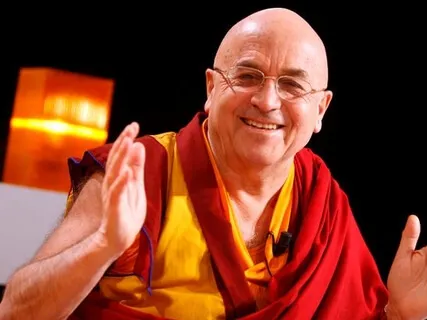
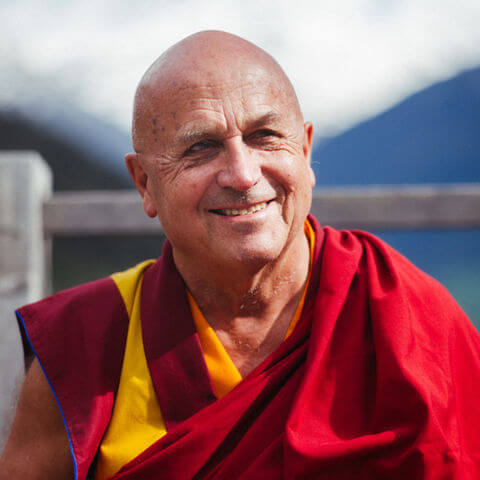
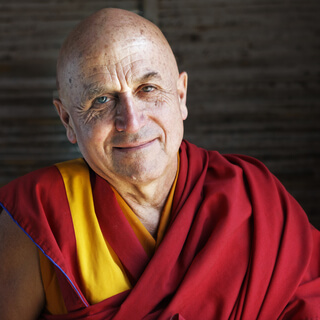
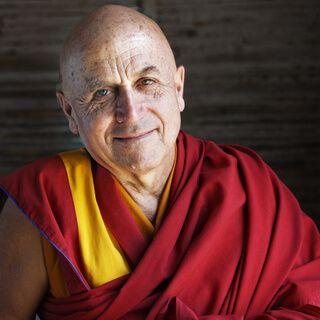
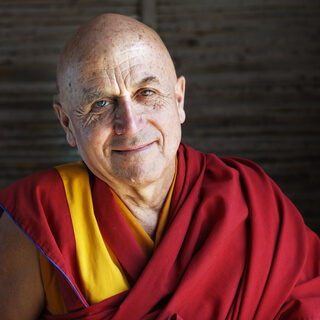
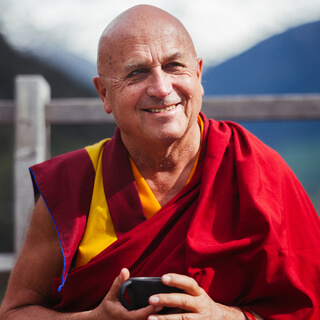
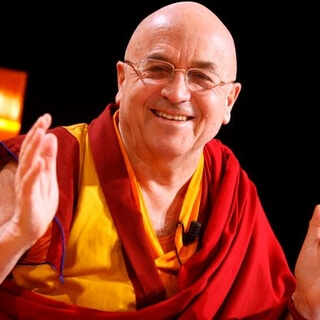
You all know Matthew as the happiest man in the world,
But every time you say that,
Matthew gets embarrassed.
So please don't say that.
Please do not say Matthew Ricard is the happiest man in the world.
I repeat,
Do not say Matthew Ricard is the happiest man in the world.
Don't think of a white bear.
Don't think of the white bear.
Jokes aside,
I'm so happy to have you,
My dear friend.
Matthew is,
In my opinion,
A true gem in this world.
It's getting worse and worse.
By the way,
The email I send them out,
I call you a saint.
Nice time to retire.
He's a gem for many reasons.
I think one of the big reasons is because he is the best person who is bridging east and west,
The best of ancient wisdom,
Eastern wisdom with the best of western science.
Because he has a PhD in micro molecular genetics under a Nobel laureate from Swaz.
Yes,
I got it.
I almost got it.
And after his PhD,
He decided to become a monk.
Not immediately.
Not immediately.
When I grow up,
I want to be a monk.
And then he was under the tutelage of at least two Tibetan masters,
Two great masters,
Kangyur Rinpoche and Dilgo Kensei Rinpoche.
And he has 60,
000 hours of meditation training right now,
Thereabouts,
Give or take 10,
000.
It was 10,
000 hours between friends,
Right?
And when Matthew was,
I think you were the first person ever to be in a first person with 10,
000 hours of meditation ever to be in fMRI machine.
You could be the longest person,
I mean the person who has spent the longest time in fMRI machine.
That's possible.
Yes,
Contributed greatly to science and to because he speaks the language of east and west.
He speaks French,
He speaks English,
He speaks science and he speaks Tibetan and he speaks wisdom.
He speaks everything.
And on top of that,
Matthew is a humanitarian leader,
Tireless,
Working for the world,
Trying to feed hungry people,
Teach the illiterate.
And on top of that,
In person,
If you ever have an unrealistic expectation about what a holy man should be like,
Unrealistic,
Unreasonable,
He meets those expectations.
He's spoiling the market for everybody else.
So it's wonderful to have you in this world and in Google.
And my friends,
Please welcome Matthew Ricard.
Thank you so much to everyone here at Google.
I'm so happy to be here for the first third time.
And since Meg likes to make the same jokes at 10 years interval,
I recall also that last time he said that since Google didn't exist in 1967 when I first went to India,
So besides entering Google,
The next best thing I could do is to spend 45 years in the Himalayas.
So I'm very happy to be back.
Last time was a talk on happiness.
I find happiness pretty boring,
Especially because the risk is that we try to look for selfish happiness,
Which is not only boring but which is a recipe for failure.
And I want to say why.
Because there are people who are smart philosophers who make big statements.
We are sentient beings.
Our main goal is to live the full span of our life,
For those who find taste in life.
It's OK.
Good.
And therefore,
During this life,
We are entitled to look for well-being and flourishing and happiness.
Great.
That sounds OK so far.
Therefore,
We should be selfish.
Big,
Logical,
And experiential mistake.
The idea that,
Well,
If you really want to survive,
Really want to be happy,
Everyone for themselves,
And we have a good chance to achieve that.
Why is that fundamentally flawed?
First of all,
On the purely experiential aspect,
If you think someone who's thinking me,
Me,
Me all day long,
It's a very miserable situation because you feel so vulnerable.
Anything that will be said in terms of praise or blame or gain or loss,
The whole world becomes either a potential threat or some kind of instrument that you hope to use to maximize that selfish happiness.
So then it's a completely unbalanced situation.
The world is not a mail order catalog for your desires,
Your fancies,
Your hopes and fears.
Plus,
On top of that,
Within the bubble of self-centeredness,
It's pretty stuffy to live in that bubble.
And everything takes a huge proportion.
It's like a storm in a glass of water.
And everything that happens unsettles you.
And if you put a handful of salt in this glass,
It's undrinkable.
Put it in a big lake,
No big deal.
Put it in the ocean,
You won't even notice the difference.
So a very narrow mind of me,
Me,
Me is not very pleasant.
And of course,
You will be a pain to almost everyone else around you.
The other reason is why it doesn't work is even,
I would say,
Deeper.
It's basically because it puts you at odds with reality.
Now,
You would assume,
Maybe I don't have an ending against others,
But it's not my job.
So let's try to build my happiness in that little bubble.
It's easier.
It's only about my happiness,
So not about everyone's happiness.
How can I think of that?
So I have nothing against others being happy,
But it's not my job.
So that supposes that we could function as an independent bubble.
And we would be some kind of separate entity from the rest of the world,
Of reality.
But if you look at a white sheet of paper,
The first thing you could write on it is others,
Others,
Others,
Others,
Others,
Others.
I have a friend who teaches Harvard,
Greg Norris.
He studies how many things are implicated in producing a white sheet of paper.
30 nations.
A white sheet of paper in France,
White one.
There's wood come from Finland.
There's stars of potato come from Czechoslovakia.
And then,
Of course,
The guy in Finland had a whole history with his grandparents and everything.
So suddenly,
The whole thing,
Others,
Others,
Others,
Are present in everything.
So our happiness,
Our suffering are so intimately intermingled through this interdependence.
So the idea that we could function as separate entity is bound to misfunction.
Now,
If you look experientially at the state of mind that is full of warm-heartedness,
Benevolence,
Kindness,
Consideration,
Care,
Empathy,
Altruistic love,
Wishing everyone happiness,
Compassion.
That means the wish that they may cease to suffer when they suffer.
So these are kind of the most fulfilling states of mind.
We need to remember,
Particularly filling time in our life is usually a time of unconditional love for a child or for someone.
Even the founders of positive psychology,
Like Barbara Fredrickson,
Called love in the sense of positive resonance with others the supreme emotion.
Because that's,
Among all positive emotions,
The one that broadens more your perspective,
Your way of seeing others.
So at first it feels good.
And of course,
If you are a warm-hearted person,
People usually like it.
Even dogs will like to stay next to you.
But they will sort of sense that you are a nice person to be with.
And then it's also functional.
Why?
Because then it is attuned to the interdependence.
If you realize that when you wake up in the morning,
I don't want to suffer the whole day and,
If possible,
My whole life.
And then it's not very difficult to put yourself in someone's mind and say,
Even that person is confused,
Doing exactly the opposite of what that person should do to find a well-being,
But still basically do not want to suffer.
So then that common humanity,
That common sentience,
I would say,
With other sentient beings like animals,
Create this feeling of interdependence,
Of common sort of wish to escape suffering and find flourishing.
And therefore,
If you value your own wish for happiness,
How can you not value and therefore be concerned,
At least not neglect or disregard or use in instrumental way that wish of others to escape suffering and be happy?
So on the individual level,
I think the pursuit of selfish happiness doesn't work.
The other one is bound to succeed.
But now if we take the little bit global picture to see why this notion of altruism is something more than a kind of noble utopia,
Some kind of luxury that we could afford when everything goes well,
And people say at times of catastrophe,
And actually we could see in Nepal,
In every major catastrophe of any kind,
How the first thing that happened after the initial shock of whatever might be,
A bomb or in that case an earthquake,
How people got calm,
Organized,
Incredible solidarity,
Helping each other,
Bringing people to hospital.
Most of the work is done by local population.
The rescuers,
They come and help with dogs and stuff like that.
But 95% of all that work is not about looting.
It's not about doing terrible things.
It is always and again and again the same pattern that occurs.
So there's a hope that we have that within ourselves and we can enhance that.
So why in the global picture is it so important?
So if you think of the situation of the world,
We are often in our days kind of being on the edge.
And we could be in our own life.
We have to deal with our mind to begin with from morning till evening.
And that mind can be your best friend or your worst enemy.
I mean when people suffer terribly within themselves,
Even when they are sort of living in a little paradise,
It's the working of the mind.
The rumination,
Hope,
And fear that leads to depression,
To despair,
It's the mind made.
And then you can see people who keep the joy of living even in the face of seemingly very adverse circumstances.
So the power of the mind is not that we should neglect our condition.
I'm the last one who would say that because I try to dedicate at least a good part of my life to,
We helped 41,
000 people over the last month in the earthquake area,
Over 160 villages.
So the idea of remaining in poverty,
To whatever we could do to improve our condition,
That's for granted.
But at the same time,
We tend to neglect the inner condition for flourishing.
And I'm fundamentally convinced that altruistic love is one of the main contributors of that cluster of human quality that leads to well-being and flourishing.
But there is challenges.
There are challenges in society.
There are plenty of people who live in poverty in the midst of plenty.
So we have all these challenges in our lives.
But if we look at those challenges,
Basically one of the most serious ones in our times is the difficulty we have to reconcile three times scales.
There is the short term of the economy.
Of course,
Economists say we are making 10 years,
20 years plan,
But nobody will buy bonds that will mature in 100 years.
And basically,
If it's not the next one day to the other coming and going up at the stock market,
It's the end of the month,
The end of the year balance sheet.
That's what matters.
If you tell to economists you should be altruistic,
That's great,
But that's not what the economy is about.
So there is this question of the short term.
And people say if the economy flourishes,
Everything else will go along as a sort of byproduct.
But the fact is you could be in the most powerful and richest nation and still people,
If people feel miserable,
What's the point?
So the idea that happiness will come out of GDP has been already shown to be just a fallacy.
It doesn't work like that.
Then we have the mid-term in terms of time frame.
That is what?
That is your life.
That is a career,
A family,
A generation,
Your lifetime.
So how do you measure that satisfaction or that sense of fulfillment or accomplishment?
First of all is what is the quality of life moment after moment?
How do you experience at the working place,
When you study,
When you engage with others?
What do you see deep within?
The sadness,
Sort of despair,
Or kind of joy to do what you do?
And then if you look at 10 years,
How rewarding was that?
How fulfilling was that?
I remember when I was doing the book on happiness meeting someone in Hong Kong,
We said 20 years ago I wanted to get a million dollars and I've got 10 and I wasted 20 years of my life.
It's not just the pursuit of that per se is wasting your life,
But he found that it had no meaning for him.
So we need to get some kind of satisfaction in our life.
That's obvious.
What's the point going on?
But then there's a new challenge.
And of course you guess what?
It's the long term.
And that new challenge is our impact on future generations.
And that's new why?
10,
000 years ago there was 1 to 5 million people on Earth.
They could not do much damage.
I mean whatever they were doing,
The Earth's resilience would repair that instantly.
And then when came the industrial revolution,
Scientific,
Technological revolution giving us thousand fold more power to influence our environment.
Nobody decided to sort of ransack the planet.
This is not,
Therefore we don't feel individually responsible.
Plus it's a certain time span.
Plus it's not really visible day after day.
It's visible on the longer term.
And we are equipped emotionally by evolution to react to immediate dangers.
If I say there's a rhinoceros coming full speed from this door,
Everybody runs.
If I say there will be a rhinoceros in 30 years,
People say so what?
So in the 60s,
70s when the first data about global warming came out,
Those scientists went to the White House and they told the advisors in 50 years it's going to be a real mess.
So they were told,
Wait,
Come back in 40,
90 years we'll see.
But that's not the way to proceed because 40,
90 years will be much too late.
The tipping points will have occurred.
And then we don't see that happen.
A friend of mine who is a great environmentalist says if the CO2 could be pink and we saw the sky becoming pinker every day we would worry a little bit more.
So it's hard to feel it in one's flesh,
But yet it is absolutely true that no matter how complex scientifically,
Politically,
Economically the question of the environment is,
It is a matter of selfishness versus altruism.
Now I'm a Marxist,
Not the Karl tendency,
The Groucho tendency.
So Groucho said,
Why should I care for future generations,
What did they do for me?
But unfortunately I heard a serious version of it by a US billionaire saying on Fox News,
And maybe you heard of that,
He says about the rising of the oceans,
Which is happening 3 millimeters every year no matter what,
He says I find it absurd to change my behavior now for something that will happen in 100 years.
So after me,
Never mind.
So we won't be there in 100 years,
Maybe some of you if you leave 120 or something.
But of course there will be billions and billions of people who will say you knew and yet you did nothing.
So it's not a trivial matter.
And people say well we'll adapt.
Yes of course,
200 million climate refugees,
Wars because of that,
Terrible devastation,
2,
4,
6 degree increase,
Complete upheaval on the planet,
We might adapt at the cost of how much suffering.
So that's again a question of altruism versus selfishness.
So now you get environmentally speaking with economists.
This is schizophrenic dialogue,
They don't speak the same language because someone is telling 50 years you're going to get all that and they say no I'm interested in the balance sheet at the end of the year.
So what we need a common concept,
At least to have a platform of discussion.
Over the last 10 years I've been going around meeting all kinds of wonderful people,
Psychologists,
Environmentalists,
Social workers,
Spiritual men and women of wisdom and compassion.
I was seven times at the World Economic Forum,
All kinds of weird places for Buddhist monks.
And yet the common thing,
The only concept that emerged through that and which I spent five or six years researching for this book is a simple one.
Having more consideration for others.
It's no rocket science.
If you have more consideration for others,
Which is the definition of altruism,
An intention and motivation to benefit others,
Full stop.
Of course we have other thoughts from time to time,
There's no question about that.
Selfishness does exist but we do have moments where we do things in an altruistic way.
So if you have more consideration for others,
For sure you will have a more caring economics that can be made into two things that homo economicus,
Maximizing self personal preference,
Cannot do,
Poverty in the midst of plenty,
Homo economicus will never resolve that question,
And the common goods.
Quality of the air,
The atmosphere,
Of democracy,
All these things that we can have in common,
But you could easily be a free rider,
Do nothing for that and still benefit,
But you need to step out of maximizing personal interest to take care of the environment.
So we need caring economics.
Then we need to work on gross national happiness,
Provide better conditions at the working place,
In education,
In transport,
Everything that makes a life that can be fulfilled.
And then we need to care for future generations.
So that concept at least allows people to come together and become a platform for a better world.
So to illustrate that,
We have this idea of this limit here.
And of course if you say well let's go on using all the resources we have,
At the current rate of increasing resources,
By 2050 we'll need three planets.
We don't have them,
There's no rocket science,
Still people say let's go on,
Let's go on,
Let's go on.
So let's go on is like this president who about ten years ago,
Spoke about this country,
Said five years ago we are at the edge of the precipice,
Now we made a big step forward.
So you see what happens if this guy makes a big step forward.
So that's called unlimited material quantitative growth.
It cannot work forever.
So what does that line correspond to in terms of science?
So here we go to what some scientists have defined as the planetary boundaries.
So we are now we were in the Holocene,
A period of exceptional climate stability for 12,
000 years.
It more or less ended in the 1950s entering the Anthropocene,
The age of where human beings have the major impact on the planet.
So in 1900 we were well within the limit of safety,
And safety means we could actually continue to prosper for another 50,
000 years,
Most likely without big upheavals,
If we were to keep those factors within the limits of safety.
And you can see them,
That's what the most important,
They are quite related,
You know,
If you increase CO2 you will increase the acidity of the ocean and so forth.
Now 1950 comes so-called the great acceleration.
Some of those factors are looming now to be more looking like dangerous.
Now hold your breath,
Not too long,
But imagine the next slide.
And here we are.
We vastly over gone some of the limits of safety.
To give you one idea,
Very clear sort of picture of the loss of biodiversity,
At the current rate today of losing species forever,
It's not just diminishing or something,
Losing them.
In 2050 we will have lost 30% of all species on Earth.
And it will go on of course over 2050.
That will be the sixth major extinction since the apparition of life on Earth,
The fifth one being that of dinosaurs and many other species.
So that's not a small thing.
And everyone will be deeply affected of course.
So that's something that we cannot ignore.
It's coming very soon.
It will be your children,
Your grandchildren and so forth.
So what can we do about that?
Well we could sit like that as I do in front of the Himalayas waiting for the glaciers to melt.
I've seen them melting over the last 45 years.
People who have never heard of global warming,
Tibetans and Nepalese,
Says that they cannot only go for one month over the ice in the winter with their yaks where they used to go for three months.
So it's again very clear.
Why?
Because of this great acceleration.
Here's the loss of biodiversity,
Of water use.
And the interesting one is methane.
You say why methane?
You know,
Methane now comes mostly from livestock.
The use of livestock to form production has become now the second major factor of greenhouse gas effect.
That may seem strange but that's the case.
According to IPCC and FRO report,
After the habitations and before transportation,
Before the cars,
The planes,
The ships,
It is the whole chain of production for meat production.
That may seem strange but it is the case.
14% or 15% of that.
And that's due mostly to methane emission besides deforestation and other things.
So methane is 20 times more active than CO2 for greenhouse gas effect.
And that shows because of this sort of extreme level of consumption.
You know,
120 kilos of meat in the USA,
80 in Europe,
Only 3 in India per head,
Per habitant,
Per year.
It's about 7 in Africa.
Luxembourg,
As the world recall,
137 kilos.
We don't know exactly why.
That of course comes at a price.
Price,
Ethical price.
There's about 65 billion land animals killed every year.
A thousand billion,
That's a trillion sea animals for our consumption.
Ethical problem.
But not only that,
We do that in all kinds of ways.
And is it because we are so selfish because man is a wolf for man?
Well,
Of course some.
First of all,
Wolves are quite nice sociable animals.
They have a very rich social life and the best friend of man,
Dog,
Comes actually as you know from wolves.
So it's not a very good comparison.
But say,
Of course there are people who manifest terrible cruelty.
But the idea that we all like that,
That's the big mistake.
Is it true?
Look at these nice kids.
It doesn't seem that it's that much of cruelty,
At least potentially.
And then we could also think that we are psychologically wired like that,
Like Freud would think that we are all rascals.
So if that was the case,
That's a good start in life,
Isn't it?
But is it really the case?
I know this guy for quite some time.
He doesn't look too bad,
To me at least.
And then if you look at people,
That is the greatest joy is to cooperate.
Where I live in Bhutan and Nepal,
Like here in this Amish community in the United States,
One time comes to build a house.
Everybody comes.
And not only you build a house,
But it's a recognition of celebrating,
Of making a feast,
Of being together.
And it's well known that hunter-gatherers,
The main factor of social life was an equalitarian,
Cooperative community.
And that's a great joy of doing that.
And not only human beings do that.
And someone said,
Please tell them there's no Photoshop in that.
It's a real thing.
So then also we know,
Of course,
There's a struggle for life,
The survival of the fittest.
But yes,
That is true.
But if you read Darwin,
First of all,
The survival of the fittest is not Darwin's formula.
It's Herbert Spencer,
The Bulldog of Darwin.
And that led rise to social Darwinism,
Like end-run type of competitions.
But Darwin spoke so much more about cooperation.
He even considered the possibility of extending benevolence to others than your kin,
And even to other species.
That's very clearly expressed in Darwin.
And I was really inspired by discovering all that in Darwin's writing.
In addition to that,
The most recent trend in evolution,
Like works of Martin Novak at Harvard,
The book Supercorporators,
Of E.
O.
Wilson,
The Completely Changes,
His views about that,
Is that yes,
There is competition.
Of course,
We know that.
There's no need to write a book in defense of selfishness or hoorah competition.
But to show that,
And that's what they have shown,
That even though competition is not doubtlessly exist,
That cooperation has been much more creative throughout evolution to go from one step of complexity to another,
From monocerular to multicellular to different kinds of symbiosis between animal up to social animals.
So it is quite the case.
And there was a survey from the OCD in the 36 or so developed countries proposing 10 factors that would contribute to well-being and asking people what they thought about it.
Income came around ranked number six.
Of course,
We matter about income.
Number one was quality of human relationship.
That's what people said.
It makes the biggest difference to the quality of their life.
In their family,
At work,
In the social place,
We feel trust,
We feel safe,
And so forth.
So again,
This is not only reserved to human beings,
Because we got that through millions of years of evolution.
If we have some quality,
They didn't come out of the blue.
And if you look at the hotspots for centenaries in the world,
Like there's one in Japan,
They all tell you the reason we feel we live long is because from birth throughout life and up to death,
We're always together.
No one is left abandoned somewhere in a corner.
Now,
I was surprised when doing the research on the book to find out that there are quite more people than I thought who sort of thought,
Well,
Basically,
Whatever you do,
Scratch at the surface an altruist,
And the selfish will bleed.
If you are very smart,
Cynical enough,
And you really look,
You will find a selfish explanation for any seemingly altruistic behavior.
So it's quite true that there are hypercritical behavior,
Or just that you do something calculating what you're going to get in return.
You might make a big smile,
Make a present to someone to cheat them,
Or even it's not that bad,
But you could do just to boot your self-image or whatever,
Or just to relieve your empathic distress.
You see,
Someone's suffering.
You have no way out.
It's not that much that you care about that wounded person,
But since you have no way out,
You help because you can't stand looking at that.
I see with animals,
If you show terrible movies about animals,
People say,
Oh,
I love animals.
I can't see that.
If you love animals,
Look at it and do something.
So the idea of you do something to relieve your distress is not fundamentally altruistic because you think of relieving your sort of tension.
Yes,
This being said,
Everyone who tries to find selfish explanations for every human behavior has failed.
This is Hampshire science.
There's not a scientific,
One single scientific study supporting the universal selfishness hypothesis.
Right or the opposite,
People at Daniel Batson spent 20 years devising skillful experiments in the lab in very nice controlled situations to put people in very specific situations to see the outcome of a choice,
And there's always significant people,
Even if they have an easy escape,
Who choose the altruistic or what you call empathic concern sort of solution.
So his conclusion is after 20 years of research,
We cannot prove 100% the altruistic hypothesis,
But at least there's no support for the universal selfishness explanation.
It's just simply ideology or just imagination.
Now,
Just to tell you some of the arguments,
They hear about someone who did a very beautiful act of generosity,
Making a donation to save 10 children anonymously so nobody is there to praise him,
He's not going to get his name in the newspaper,
And so forth.
But then he confides to a friend,
You know,
I felt so good doing that.
And then you see when people work in humanitarian activities,
They spend one month with us,
And at the end you say,
Oh,
I got more than I gave them.
So those smart psychologists,
Those who defend universal selfishness,
They come and say,
Look,
You did that for the warm glow.
You say you did all that and you feel so good and that's the thing that you take out of it,
So you just did that to feel good.
So is it true all the time?
So let's look at this short movie.
OK.
So you think this guy is saying,
The one who jumped on the rail track,
I'm going to feel so good when that's over.
But that's not finished.
And then you interview those guys and they say,
Of course I had to do that.
I had no choice.
This guy was going to die.
I jumped and took it off.
And then those smart guys come again and say,
Hey,
You had no choice.
Automatic behavior,
Instinctive behavior,
This is neither altruistic nor selfish.
You just did it like that.
What does that mean?
Everyone I talk with is a bit serious about that question,
Like Daniel Batson said,
Of course there's a choice.
But that choice doesn't take long to deliberate.
It's like it comes from what you are.
But it's not that you are behaving like a robot.
Look at this guy.
Is he going to think for half an hour?
Should I stretch my hand or not?
Maybe if I break his little finger,
The insurance company will sue me or something like that.
So there's a choice,
But that choice takes a fraction of a second.
So you may say I had no choice because it was too obvious.
And by the way,
This guy had a choice.
Clear choice.
Sorry,
I don't have the next slide.
I don't know what happened next.
Now,
People had choice.
During the Second World War,
Like in every persecution,
Genocide,
There were people who took immense risks for themselves,
For their families,
For a long time.
They were certainly not looking how to feel good and have the warm glow.
There was terrible danger.
This is the pastor Andre Trocbi and his wife in the village of Chambon-Solynyan in Ottawa near the Swiss border in France.
Over the years,
They saved 3,
500 Jewish persons.
They never closed their doors to anyone who sought help and refuge.
They had them go through Switzerland.
They were of a constant threat of deportation from the Gestapo.
Even the Vichy French government was threatening them.
They never made a concession.
The whole village did that.
And they certainly had the choice and they did it.
So rather than say,
Well,
Those are saints.
This was a whole village.
They were not born as saints.
There's no saint gene or something like that.
They say that is the most natural way to do.
So instead of saying,
Oh,
Those are incredibly exceptional people,
It's better to try to find that potential within ourselves,
Because we do have that potential.
We do have the potential for care as this Chinese person who lost his two legs and all his life has been helping sick people.
And look,
With a kind of joy.
So when you see someone with empathy,
Like this woman with bone TB that we helped in Tibet,
Of course when you see that,
Or even worse,
When you see the extreme form of deprivation,
Of starvation and so forth,
You feel a strong sort of emotional resonance.
Or you try to imagine yourself in the place of that person.
That's called empathy.
But empathy alone is not enough.
Because what happens?
Imagine you are a nurse or a doctor or social worker.
I know someone working with homeless in San Francisco.
If you day after day after day resonate with suffering of others,
Well,
Neuroscience shows that you do suffer.
This is real suffering in the brain.
There's no question.
So it may be too much asking to suffer for 20 years,
Morning,
Afternoon,
And all the time.
So you lead to burnout.
And by the way,
60% of all medical personnel in the United States have or will suffer of burnout throughout their life.
So is there remedy to that?
So we studied that with Tanya Singer.
And of course there is this burnout happening.
With a neuroscientist,
One of the world's specialists of empathy,
And she asked me to come in the MRI,
One of the 120 hours that I spent in the MRI machine.
And she said,
Well,
Just do your meditation and we'll see what happens.
So it was a special MRI called Real Time Ephemera.
You can see immediately what's happened.
You'll have to wait for weeks.
And then after 10 minutes,
She said to the mic,
What are you doing?
This is nothing we see normally for empathy.
I said,
Well,
I'm editing on compassion and loving kindness.
She said,
Basically,
Come out.
We have to talk.
It's not the same areas of the brain.
So we talked.
And she said,
Well,
She was a bit annoyed because it was so different.
And she said,
Could you do just empathy?
So I thought,
OK,
I can try.
Push away your compassion.
So when we explained that to the Dalai Lama,
He says,
How is it possible?
You see all these terrible things that don't have compassion.
I said,
Well,
We just try to focus on suffering and suffering only.
So I've seen a documentary on the BBC the day before on Romanian orphans.
It was so dramatic,
Of those terrible movies.
Like when I was in London recently,
I saw a photo exhibit on the Vietnam War.
If you look at that for half an hour,
You fall quickly in empathetic stress.
So I tried for one hour doing that.
And in the MRI,
You have to alternate to measure properly.
So you do rest,
And then the state,
And then rest like 50 times.
And after one hour,
I was totally burned out.
I mean,
Only resonating with the distress.
I was feeling powerless,
Almost like disgust.
I didn't know how to deal with those terrible suffering.
It's all negative violence.
And then at the end,
It was about 1130 in the morning,
Tanya said to the mic,
Would you like to take a break for lunch,
Or would you like to move to your compassion meditation?
I said,
Please let me do the compassion meditation.
I can't stand it anymore.
So when I did that,
It was like breaking open a dam.
I felt like an outpour of affection,
Embracing,
Like every atom of suffering was filled with an atom of love.
I felt much stronger actually in contrast with this empathic distress.
And it was completely different,
Day and night.
And in the brain,
Of course,
It was so different that we pursued the study with other subjects and eventually published a paper showing that a completely different network of the brain for empathic distress and for loving kindness and compassion is a more positive sort of network of affiliation,
Maternal love,
Sense of wholesomeness and reward,
Positive affect,
Applied to suffering in a constructive way.
And now Tanya has been doing a one year program with 300 volunteers to distinguish those.
She studied mindfulness for three months,
Perspective taking for three months,
META,
Which is loving kindness for three months,
In different orders.
And preliminary results show that mindfulness is great to reduce stress,
But it doesn't increase your poor social behavior.
Hence we need caring mindfulness.
You get two for the price of one,
Because to be caring you need to be mindful,
But you may not be necessarily caring by just being mindful.
Imagine a mindful sniper,
Very mindful,
He's always on the task,
Never distracted,
No emotions,
Always non-judgmental in the present moment.
A mindful psychopath,
Same thing.
But you can't have a caring sniper and a caring psychopath.
So therefore please add those six letters to any mindfulness meditation,
Caring mindfulness,
And that will work out nicely.
So anyway the idea that it is loving kindness meditation that really increases poor social behavior and it is the antidote to burnout,
Because that very positive mental state applied to suffering,
It is basically altruism applied to suffering,
Compassion.
That's a kind of a bone,
A much bigger sort of thing that's just empathy.
Standalone empathy is like an electric pump without water,
It burns.
But if you add this very warm-hearted feeling,
It is actually the antidote to burnout.
So that's why when you see very warm-hearted doctors on this,
Naturally people feel it so good,
And that can be trained,
And that's the whole point of what we do.
That certainly comes from maternal love,
Or paternal love,
But we can use that to enhance it,
To extend it to others.
So now very quickly,
Let's assume that altruism does exist.
If you look at the whole literature,
I think it's pretty strong evidence.
But you say so what?
You look at our world,
The strong narcissistic epidemic,
And individualistic trends,
And the world's not going so so well.
Can we do something using that potential?
So can we change individually,
And can society change?
So first,
Individually,
This is one of the teacher,
I was fortunate to spend 13 years with him,
My friend Vivian who is here,
I also spent many years,
My first teacher,
And he's known as the Dalai Lama,
He's Richard Davidson,
The neuroscientist from Madison,
I think he came here,
Who is very interested in encouraging this collaboration.
So now then you've got those who went to the lab,
Studying with EEG,
And he has Mingyur Rinpoche in the fMRI,
And he characterized fMRI as being four characteristics,
It is narrow,
It is dark,
It is noisy,
And it is cold.
So not a very good place to meditate,
But nevertheless,
You can try.
And then recently I was in a lab,
A coma lab,
In Liege in Belgium,
The world specialist on coma,
He wanted to study different degrees of lucidity,
So then they put me with EEG,
And there was something called transmagnetic cranial stimulation that goes pom pom pom for five hours,
And then you have to meditate,
And then at some point,
On pure awareness,
Free from thoughts,
And then at some point,
Because I could not hear,
Because on top of that they put you a white noise,
And white noise is not just white like snow,
It's like shhhhhh all the time.
And then I can't hear any instructions,
So they came with a board,
Don't blink your eyes.
So I went like this,
And then another board came,
Relax your facial muscles,
Meditate,
And then they said,
Could you self induce a state of torpor?
Okay,
I went really stupid,
And then with all this,
And being,
Being,
Being,
And then they said,
Could you fall asleep?
No.
After five hours I managed to fall asleep,
So anyway.
So here I come out of the MRI after two and a half hours at Richard Davidson's,
And then,
You know,
What the results were,
Was with people with long term meditation there was huge differences.
On the bottom you see novice,
Not untrained people,
With EEG,
Trying to practice compassion meditation,
You know,
The pink line is when they rest,
Nothing much happened.
The blue line is when they meditate,
Nothing much happened either.
On top,
The yellow line is the meditators at rest,
If they rest,
They rest,
But when they engage in compassion meditation you see this huge peak in the gamma rays of brain frequency that is so big that it was never observed before in neuroscience,
And since I was the first guinea pig,
This crazy idea of the happiest person in the world came from a journalist who never thought of a better idea,
But it has nothing to do with happiness,
And there are seven billion beings,
And by the way,
All the twenty others,
Long term meditators did exactly the same,
Even better than me,
So forget about that.
So now if you look at brain imaging,
And you see on the left side the meditators at rest,
And a little bit on the B,
Shows meditators engaging in compassion meditations,
Many areas of the brain are strongly activated,
Those are areas with a sense of affiliation,
Empathy,
What I mentioned before,
Positive effect.
On the right side,
C is the novices at rest,
Nothing happened,
D is novices in meditation,
Nothing happened either,
That's normal,
They didn't train.
You might say,
Well,
Great for you,
Sixty thousand hours of meditation,
What about us?
Hence the ten second meditation of my dear friend Meng.
Now who can say they don't have ten seconds every hour,
So stop everything,
Don't hug people,
You might get a little bit in trouble,
But just think for ten seconds,
May they be happy,
May they flourish in life,
And so if you do that,
It sort of sets up a stream.
Actually if you do not necessarily ten seconds,
But twenty minutes a day for four weeks of mindfulness meditation,
And now I think I'm sure you get even better with caring mindfulness,
You can see a structural change in the brain,
In the hippocampus,
Which is an area of the brain that assimilates novelty,
When you train into something new,
Whether it's playing chess or juggling or mindfulness or altruistic love,
Your brain does change.
It also changes your prosocial behavior,
That's two weeks of compassion meditation,
And you see the prosocial behavior,
The blue sort of stack is much higher than any other psychological intervention,
And at the same time,
Those who are with this increased prosocial behavior,
They also found a decrease in the size,
After two weeks of the amygdala,
Which is an area of the brain related to fear and anger.
So that's quite remarkable,
So don't be discouraged,
Not only ten seconds,
But twenty minutes a day does make a difference very fast.
You could even do that with preschoolers,
Four or five years old,
And you do some kind of mindful breathing,
You see with the little stone,
But there's a ten week program that Rishi Devasan did also in medicine,
Forty minutes three times a week,
Very simple intervention about gratitude,
Emotional intelligence,
Empathy,
Feeling what the other feels,
And all kinds of cooperative learning,
I cannot describe in detail,
There's a nice manual about that,
But the fact is,
That even this simple intervention with four or five years old leads to a significant increase in prosocial behavior,
That's the blue line compared to a control group.
But then comes the ultimate scientific test,
The sticker test,
And that's unforgiving,
So what you do,
You determine before the intervention for each child in the class who is their best friend,
And then,
That's the first photo you see on the left,
And then the child cannot stand.
And then you have two other envelopes with a photo of an image of an unknown child and a sick child,
And before the intervention you give them a bunch of stickers and say please give it to anyone you want,
So what happens,
They give to their best friend almost everything.
Now ten weeks later,
You will say well you know this is four or five years old,
It's kind of a playful intervention,
No big deal,
They get a good time,
But how can it change this in-group,
Out-group sort of discrimination,
Well it changes in a big way,
It levels down,
They give practically as much stickers as their best friend and their least-favored child.
So if you think of the deleterious effect in society of discrimination,
Whether it's racist,
Ethnic,
Religious,
Social class,
If you could sort of level this in a simple way with young children,
What is service to society?
So we do that in India,
We have 25,
000 kids in the school that we build with Karuna Sechin,
So we introduce yoga class,
Meditation class,
And one thing for sure,
It increases their tendency to school.
Now is there other good news,
The possibility of societal ways,
So we always speak about violence everywhere,
In Marseille in the south of France you can buy Kalashnikov for 800 euros almost everywhere,
I mean here of course it's much easier than in France,
But still,
What happens to violence over the centuries?
So if you look at the book of Steven Pinker,
There is a significant decrease in violence,
No matter what violence is still there,
And it was what you see on TV,
In Oxford in 1350,
There was 100 army sites per year,
Per 100,
000 inhabitants,
Now it's 0.
6.
Now in Europe it went down 50 to 100 times,
In Australia as soon as they banned personnel arms it went down 10 times,
In Sicily it's about 12,
We don't know why,
I think there's a good study that should be done there.
In any case,
Basically,
Homicide has been going down steadily over the centuries,
That's what the data said,
If you look at abolition of torture,
And if you look at the average number of casualties per conflict all over the world,
There are two data banks,
One in the United States,
One in Uppsala in Sweden,
If you look at all the conflicts,
Of course there are terrible things happening,
You know ISIS,
South Sudan,
The Iran war,
Million people died,
But if you take all the conflicts worldwide,
Divided by the number of victims,
It went from 50,
000 average to 1,
000.
So there's always something somewhere,
Terribly dramatic,
But globally it had gone down.
Domestic violence is still the main cause of violence in the world,
Because it's one to one,
But abuse and violence against children in the United States goes down by half in 20 years.
So there is hope.
Why is there hope?
And how you could find the articulation point between individual change and societal change.
Another great discovery I made while studying research for the book is the notion of evolution of cultures.
To get an altruistic gene in every human being might take 50,
000 years,
It's too late for the environment.
So evolution of culture is a Darwinian process that is faster than genes,
There's actually a book called that,
Faster Than Genes,
Which is a very good one.
And evolution of culture can happen over a generation.
You know,
Attitudes towards war,
Attitudes towards women,
Homophobia,
Environment,
Name it,
Culture are changing quite fast.
You know the slavery was abolished in England in the 18th century.
First of all there were 10 people who said slavery is an abomination.
Everybody laughed.
The parliament said,
There's no way the British empire will economically collapse without slavery,
We can't afford that.
Ten years later it was abolished.
Today if you say I'm against slavery some people say so what?
And people who would say,
How can you dare to say no it was not too bad,
No economically it makes sense,
Shall we put back slavery on,
Shall we deny voting rights to women?
Of course,
We cannot go back on those cultural changes,
Fortunately.
So we made big progress of civilization.
So that's why,
You know,
This was 10 people who decided to start that campaign.
10 people who decided to promote the Universal Declaration of Human Rights and they succeeded.
So there can be tipping points.
A critical mass of individual new ideas and after a while ethically you can feel comfortable if you still go against women and men having the same sort of gender issue,
Having the same potential and possibilities and so forth.
So that's why I think those two individual changes,
Societal changes,
Being cumulative of our generation,
We don't have to learn again that slavery is terribly bad.
We're born in that sort of ideas and culture.
So to fashion each other like two knives sort of sharpening each other.
So there's a possibility.
So what can we do?
I can go back to my hermitage,
It was a very nice time,
That's what I see in the morning.
But we need to promote also caring economics.
As I mentioned,
That's the only way to remedy poverty in the midst of plenty and take care of common goods,
Especially the environment.
We need to enhance cooperation within the enterprise.
It has been shown again and again that a company,
A community in which there's unconditional cooperation,
Transparency of information,
Of sharing,
Less sort of hierarchy that is waterproof is a company where it's better to work.
I think Google is probably a good example of that.
And therefore some more prosperous issues.
It has been shown again and again that a company where it's nice to work also do better.
And we need more cooperative learning instead of competitive ones.
There's many areas where we could boost our level of cooperation.
We need no more sustainable development or growth,
It's a bit suspicious.
You always think of quantitative growth.
We need qualitative growth.
So instead of speaking of growth,
We're not speaking of harmony.
For now,
Sustainable harmony means reducing inequalities.
There's still 1.
5 billion people under the poverty line.
That's not going to work well if you keep that.
Inequities are growing in all the OECD countries in the last 30 years.
This is very unhealthy,
Less stressed,
It's not harmonious.
And then harmony for the future is to remain in harmony within the planetary boundaries so we can continue to prosper,
Being in harmony with the environment instead of disrupting this equilibrium.
So sustainable harmony is a powerful concept and we should use it.
We need local commitment,
We need to do things ourselves.
And global responsibility,
We have the WHO who takes care of epidemics and so forth.
Nobody,
No country can say there's a plague epidemic,
I'm not part of that.
We have to be part of all things.
Same thing for the environment,
There should be global governance for the environment,
There's no question.
We need to extend our altruism to 1.
3 million species.
No,
We can't say they're just there for our use,
To distract us or to entertain us.
They are co-citizens in this world,
They have a life,
They are subject of a life,
They don't want to suffer,
That needs to be respected,
The natural equilibrium needs to be respected.
We are not the owner of 1.
3 billion other species,
We live with them in a very vast interdependent system.
And we need daring altruism,
We need to dare altruism,
We need to dare that it does exist,
We have a potential for it,
We can teach it at school because there's a potential for that.
Individually we can change,
Society can become more cooperative,
We don't need to be afraid,
It's a kind of lightweight concept.
This is the core,
Most pragmatic answer to times different challenges.
So in terms of animals,
We can say as Bernard showed,
That animals are my friends,
I don't eat my friends,
That is quite good,
Nice way to explain why you don't want to eat fish in a restaurant.
If they say,
Oh you are vegetarian,
So you eat fish,
I say well look,
Everything that swims,
Everything that runs,
Everything that flies,
They are all my friends.
So then you can also do,
Say like Martin Luther King,
Everyone must decide,
Man or woman of course,
Whether he or she will walk in the light of creative altruism or in the darkness of destructive selfishness.
It's up to us,
Someone like the Dalai Lama shows us the path,
We try to implement that,
And even turn activities.
We have now developed 140 projects,
This is one of our clinics,
And we treat about 120,
000 patients a year in Nepal,
India and Tibet.
This is a clinic that we built in Bihar with the help of the Googlers here some years ago,
It was a wonderful initiative.
We built a school with bamboos in Nepal with social entrepreneurs,
2,
000 kids in a school that we can build for 150,
000 dollars,
It's a good return on investment.
All made with bamboo,
So when there's an earthquake it just moves a little bit.
In Tibet we built a number of dispensaries,
Obviously we need a bridge here,
That's our car,
There's a road and there is a river,
Nobody knows why so the driver is resending his mantra very fast.
So we built 18 bridges,
Including one on the Yancei tree on the Mekong,
They all come from Tibet by the way,
We take care of the elderly,
Here is finally the happiest man in the world.
We got him,
And the happiest woman is there as well.
So we built a number of schools there,
Trying to favour especially education of girls,
And we intervened in earthquake areas,
First in Tibet in 2010,
There was 10,
000 people died there so we brought a lot of goods and this year from April we started building an earthquake resistant school at 12,
000 feet in Tibet.
It's a boarding school for children.
In Nepal,
As you know,
The recent tragedy,
So since we are in the place with a clinic 50 people strong and a monastery with 500 disciplined monks,
We could have teams going to the villages and now as I said we help 40,
000 people in 160 villages with food,
With shelter and basic medical necessity and then we are going to move next to when the emergency over to community projects,
Rebuilding schools,
Rebuilding dispensing,
Wherever is needed.
This is our mascot,
The Karuna girl,
I photographed her 12 years ago,
Not the Steve Macury Afghan girl so I thought I should find her again,
And so I found her and I learned her name and she is called Beautiful Ocean of Turquoise.
So this is our website,
It's very easy to see what we do and help us and we are very grateful to Google to host me again and also to help us in the past and I know you continue to help us of course.
So thank you so much and this was a few ideas,
We still have I think 10 minutes or so to have questions answered before we break for the so-called meditation.
Hi,
Thank you for your wonderful talk.
I'm wondering if you can talk a little bit about enlightenment and if that's even a goal worth pursuing or if that's a selfish goal.
Can you tell us a little bit more please?
Well you know that question often put to us,
You know,
Oh you are well in your hermitage,
Practicing compassion or mindfulness or whatever,
Ha ha ha,
You know,
Is it not selfish to be in this nice place facing the Himalayas,
Not to have to think about paying taxes and things like that.
Well you know I thought of it,
As far as my teachers and the tradition which I've been following for 45 years,
One of the main goals is to get rid of selfishness while doing this practice.
So you cannot accuse someone of being selfish,
The goal what he's doing now is to get rid of selfishness.
It's like saying to someone who's building a big hospital,
What are you doing now with all this construction work,
Plumbly electricity,
Doesn't help anyone,
Go and do surgery in the street,
You know,
But of course when the hospital is ready it's so much more powerful.
So I think mindfulness is not the ultimate essence of Buddhism,
It's a tool.
The essence of Buddhism is wisdom and compassion.
Now to achieve that if you're not mindful you're just distracted.
So therefore you need whatever you do,
Whether it's activity in your workplace,
Multitasking has been shown to be very difficult,
A deficient way to do anything.
They don't do anything better in cognitive tasks,
Including the speed of switching tasks,
Which would be the quintessence of multitasking.
You just get a messy mind.
So the idea of being concentrated,
Even if you do many things in the morning,
Each time fully on what you do,
Is kind of the essence of mindfulness.
Now on the personal level it also helps you to have a mind that is a little bit more clear,
A little bit more stable,
A little bit more calm,
And that's also a better tool to then cultivate qualities like altruistic love and others.
And also to deal with your hopes and fears and rumination.
So it's basically a much more optimal and healthy state of mind that they confuse,
Ruminating,
Torn apart,
Divided,
Conflicted mind,
Obviously.
So I think it's a very beautiful and powerful tool,
But again,
It's something that's become more and more popular,
And I mentioned that many times to my good friend John Kabat-Zinn,
Please very explicitly include the caring aspect of it,
Otherwise it could be misused because any tool can be used to harm or do good.
And again,
We don't want caring snipers,
Mindful snipers.
They are mindful,
By the way,
But they are not caring.
So caring,
It just simply dispels all possible deviation.
But otherwise it's a very wonderful and powerful tool.
It's a secular,
So nobody can argue.
That is something that is not for us.
The book is Altruism,
Available where books are sold,
And my friend's Matthew Ricard.