We all long for happiness.
It's the thing we most dream for.
Hail to the altruistic revolution.
Let's go for it.
Now the first exercise is going to get us ready for the big finale.
Good morning.
It's nice to be here again.
And thank you for asking me to come again.
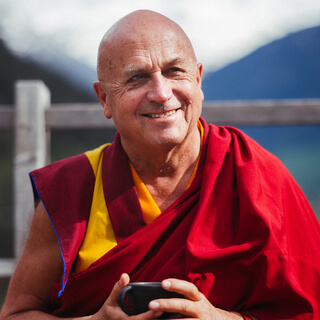
So here we are in eastern Tibet.
A cold morning,
Minus 25 without heating,
At 4,
000 meters of altitude in February.
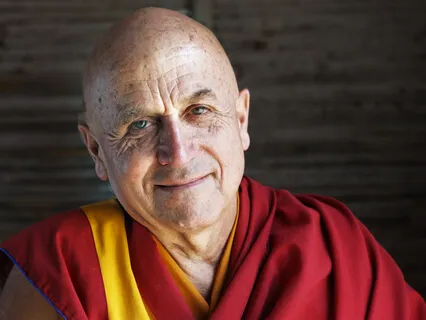
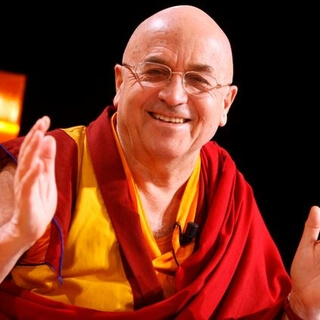
And this man seems to be pretty happy.
So that means that happiness is not only dependent on outer circumstances.
So happiness alone is great,
But it's not as good as happiness for all.
And actually,
We are suspended alone in space.
Happiness,
Love,
All those things will not mean very much.
So now,
How to proceed about that?
Well,
It starts with personal change.
Here's a remarkable woman who was one of my spiritual teachers and was also the spouse of my first master.
And clearly,
Through inner transformation,
That person achieved a remarkable level of inner freedom and compassion.
So it starts with the individual.
Where else could you start?
But from there,
Again,
It's not quite enough.
We should get a critical mass of individuals who have achieved that personal change so as to gain the capacity of bringing more social justice and societal change.
And that's absolutely clear that the pursuit of selfish happiness is bound to fail.
Because first of all,
Me,
Me,
Me all day long makes you miserable and obviously makes miserable everyone around you.
And we are not separate entity.
We are closely interconnected.
So it simply does not work.
And also,
If we achieve a level of happiness,
Well-being,
And care,
You cannot simply ignore the fate of future generations.
Ten thousand years ago,
We were five million people on Earth.
No big deal.
Whatever we could do,
The resilience of the Earth will repair that.
Now,
We've got enormous power,
But not the same magnitude of care.
And therefore,
Without care,
We have the power to bring about the sixth major extinction of species since life appeared on Earth and possibly our own sort of elimination.
So now,
How does it start at the personal level?
So of course,
We have this experience of I,
Moment to moment.
That's fine.
I'm alive.
I'm hungry.
I'm happy.
And then there's a person.
That's the dynamic stream of our experience throughout our life.
That's all fine.
But on top of that,
We cannot help.
But imagining that something like a self,
Like a core that is unitary,
That is autonomous,
That is constant,
That has been traveling with me since I'm this little boy to this old monk.
So the self as a concept poses a problem.
Why?
Because from there,
It becomes self-centeredness.
We split between self and others in a very solid,
Verified way.
What it has done,
Attraction to what is supposed to please the self,
Repulsion to repel what seems to be a threat to the self.
So then,
All the other mental toxins like hatred,
Craving,
Arrogance,
Jealousy,
And all that comes through that.
And out of that,
What is the result?
Suffering,
Of course.
So in a way,
All of that is embedded in selfishness.
The exacerbated feeling of self-importance,
That everything else is an instrument to promote our own interests,
And therefore,
We recklessly exploit those around us.
So it doesn't work,
And it's based on the wrong assumption.
If we look at the self,
We cannot find anything else.
But again,
Just a constantly changing stream of experiences,
Like a river.
But there's no boat along that river saying,
You know,
The Ganges,
I am the Ganges,
The only one,
The real one,
This core entity.
So once we know that,
And then we come to understanding interdependence.
We come to understand that just as deep within,
I do not want to suffer.
I rather flourish in life.
So it's not very difficult.
Even though others and myself are quite confused about where to find happiness and not to turn our back to the cause of happiness,
Nevertheless,
We do want to find some way of happiness.
So that leads for an increased consideration for others in the present moment.
So there are three timescale that we need to reconcile.
The short term of the economy,
The day-to-day life,
The needs that we have,
The midterm of flourishing over 20 years,
30 years,
Social justice,
Inequalities and so forth.
And then the long term,
Which is a new challenge that only came recently to human beings.
We enter the Anthropocene,
The age of human beings,
Where we may have the major impact on the planet.
So for that,
Selfishness will not do.
No Grasso Marx said,
Why should I care for future generations?
What did they do for me?
Well,
Of course,
If you think like that,
And many people do think like that,
Unfortunately,
These days it's not going to work.
So the only concept,
Supposing that we are all in favor of working together towards a better world,
The only concept to achieve that is having more consideration for others.
That is what altruism is.
So altruism and compassion is a win-win situation,
Because it's the supreme emotion,
There's nothing more uplifting than to feel generous,
Warm heart,
Considerate,
Kind to others.
Of course,
Others naturally will feel the same.
It recognizes the basic interdependence of all sentient beings.
So from that,
Again,
We get in the short term,
The caring economics,
In the midterm,
And as in social justice,
In the long term,
Caring for future generations.
But again,
It starts with our mind.
From morning till evening,
We are dealing with our mind,
And that mind can be our best friend,
As those who have brought the mind to a state of freedom,
Of inner peace,
Of boundless compassion,
Or that mind can also be our worst enemy.
So we need to begin to deal with our mind,
To make our mind function in a more optimal way.
So for that,
We also need to address the issues around us,
Poverty in the midst of plenty,
And also the way we abuse other species.
120 million animals are killed every hour for so-called needs.
That's in one week,
More dead animals,
Than the whole number of people who died in all wars in human history,
Every week,
And it goes hardly unnoticed.
So that is a complete incoherence in our ethical system,
And that is obviously the next step after going to abolition of slavery,
Promotion of human rights,
The right of the woman,
Right of the child,
Abolishing torture.
Now we need to have some consideration for the 8 billion species who are our co-citizens on this planet.
Then we started,
As I mentioned,
With 5 million people 10,
000 years ago.
That means a very small world on the last planet.
There was a lot of space for everybody.
Now it's just the opposite.
There's 7 billion people on this earth,
And it seems very small,
Very interconnected by small.
So welcome to the Anthropocene,
Again,
The great acceleration of 1950,
Where everything went very,
Very fast.
So now it is time to work more toward a sustainable harmony.
So we have this incredible sort of expansion of human activities,
And yet there are many people who are left out of that,
Alone in the midst of so many others.
Why is that?
Is that because man is a wolf for man?
Well,
Is that true?
I think we are more unaware,
As His Holiness was saying,
Of the banality of goodness,
That most of the time,
Most of 7 billion human beings behave decently to each other.
And when there is an exception,
When there's some barbarian behavior,
Something alarming and threatening,
Then we all pay attention,
And of course,
The media reports it.
If you know that 20 years old has seen 40,
000 violent deaths on TV,
Movies,
And so forth,
At 20 years old,
What does that have to do with reality?
In fact,
We love cooperation,
We love working together,
And not only human beings.
Of course,
There's a struggle for life,
The survival of the fittest.
But nevertheless,
There's also heroic acts and spontaneous gesture all through our life,
Not only instant acts of heroism,
That happens to animals as well.
You know,
He has a choice,
Obviously.
And then people,
Like in the Second World War,
Who spent years at the risk of their life,
Of their family,
To save,
In the case of this pastor and his wife,
Thousands of Jewish people in a small village of France,
Bringing them to Switzerland,
The whole village conspired to protect them and hide them.
So the chain of heroism can be expressed in so many ways.
Now,
If we work all the time with others and simply have an empathic resonance with their suffering,
If we don't have the warmth and the big sort of balm of compassion and loving-kindness,
Standalone empathy can lead to empathic distress,
Emotional exhaustion,
The burnout.
So we need to compensate that as an antidote with loving-kindness and compassion,
Which is a very constructive emotion.
So no,
Can we cultivate those as a skill?
Well,
That's the purpose of,
For instance,
The collaboration that's going for 30 years now between the Dalai Lama and scientists like Richard Davidson,
Who was here a few years ago,
Through the Mind and Life Institute to see if mind training and can be observed in the brain through neuroplasticity as we train in compassion,
In attention,
How the brain changes,
How you change as a human being.
And so the idea was to bring to the lab,
Of course,
Not those great spiritual masters like Khenstitin Moshe,
One of my teachers,
Who is also one of His Holiness' teachers,
But their students,
Their disciples,
Who are willing to play around with 256 electrodes or spend a number of hours in the fMRI machine.
Here's the first time I spent three and a half hours and just coming out,
So Richard Davidson is pretty relieved that the meditator survived.
But it's a kind of nice,
Small retreat.
You know,
You are there for three hours,
Nobody comes to bother you,
You just meditate.
So I'm not going to go at length on the detail,
But you can see here,
Meditators at rest and engage in compassion meditation,
A lot of areas of the brain are activated.
This is not the case with novices.
Nothing happened at rest and nothing happened in meditation.
But that's normal,
They didn't train.
But now,
It's not only those who did 60,
000 hours,
There are people who did four weeks of meditation practice.
Already,
You can see a structural change in the brain.
Some areas are thicker,
More dense,
And also functionally more active.
So it's encouraging that 20 minutes a day for four weeks already makes a difference.
So now,
Individual change is possible.
Now,
How can we go from there to societal change?
A French philosopher,
A friend of mine said,
It's all nice,
Your meditation is not going to change society,
Not going to change the situation.
Well,
It does,
Because when a critical mass of people who decided to put compassion and altruistic love at the core of their life,
When they attain a rich critical mass in society,
There's something which happens,
Which is evolution of culture.
To get a more altruistic jing in human species would take 50,
000 years,
Much too late for the environment and for social justice.
But evolution of culture can happen within a century,
Within 50 years,
Sometimes within 20 years.
And clearly,
If you want to survive,
The trait that will help us to survive is not reckless competition and violence,
But cooperation and altruism.
It's not a goofy idea,
Idealistic utopian.
It is the most pragmatic concept to face the challenges of our time.
And Victor Hugo said,
There's nothing more powerful than an idea for which the time has come.
So this is the time for altruism.
Sustainable harmony is not sustainable development anymore,
Because we can only increase qualitatively,
No more quantitatively.
We don't have five planets in our hands for using resources.
So we need to continue to flourish while maintaining a balance outside an harmonious balance with the environment.
So the Holocene,
Which is this very stable climate that we have been enjoying for the last 12,
000 years until recently,
Is like our agent.
That's how human civilization could flourish.
Before that,
It was like whole sort of hectic change of climate,
And that's why there were so few human beings.
So we need a caring economics,
Where economies are the service of society and not society at the service of economics.
So we need a balance between the environmental prosperity,
Social prosperity,
And financial prosperity.
Right now,
It's only the reign of the dollar.
There's a big unbalance in that sort of thing.
We need local commitment.
It starts with all of us,
But also a sense of,
As Jonas mentioned,
Global responsibility.
Martin Luther King said,
We came on different small boats,
We're all now on the same ship.
We cannot dissociate our fate from that of others.
We cannot separate fragments of humanity.
We cannot isolate ourselves from the other species on Earth.
So we need to work together for the new 17 global goals for sustainable development that is already so much good.
If you think that the Millennium Goals have brought the people under the poverty line from 1.
5 billion to 700 million in 20 years,
That's a remarkable achievement.
Child mortality,
So many of those things have been reduced.
We must continue with determination.
We must become the stewards of our own planet.
So that's a kind of very interesting book by one of the leading environmentalists,
Johann Rockstrom,
Who defined the planetary boundaries for safe prosperity of humanity.
And we must extend our altruism to other species.
It's not caring for them,
It's not caring less for human beings.
It's caring better for everyone.
Because if we only care for a small portion of those who are sentient beings alive today,
Our love will be of lesser quality,
That if like the sun,
We shine with benevolence of all sentient beings who makes the difference between happiness and suffering.
And that is possible,
There are all reasons for that.
And then,
So the happiness should be achieved not through reckless sort of pursuit of selfishness,
But through compassion and loving-kindness.
His Holiness often says,
My religion is good heart.
What is best in life than having a good heart?
It takes care of everything.
Compassion is the way to resolve conflict,
Caring for each other is the way to resolve social inequalities and so forth.
So there are many things that you could read about that,
Showing your empathy appeared through evolution,
How we are already super cooperators as human beings,
But we need to move to even a further level of cooperation.
That's the only chance to survive.
We need to care again for the animals and not just love dogs,
Eat pigs and wear cows.
That's very strange mental dissociation.
We need to become aware that genuine altruism does exist and we can cultivate it.
So in short,
As Martin Luther King said,
Every man or woman,
Of course,
Must decide whether he or she will walk in the light of creative altruism or in the darkness of destructive selfishness.
No,
We need to put that in action as it always does all the time.
We are trying our best in the Himalayas,
In Tibet,
In Nepal and India,
And through our project,
We actually not just meditate on compassion or amitabha,
But with a pure heart and dirty hands,
We try to help the population there,
Setting clinics,
Palliative care.
We help 200,
000 people in 600 villages during the earthquakes and we continue today in Northern India and Bihar and Jharkhand,
Very poor countries.
We have a program of woman literacy.
Here,
Some of the women are 60 years old and they're absolutely thrilled to learn how to read and write.
And we build a school with bamboos for thousands of kids.
We build dispensaries in the high level of Tibet.
We need bridges,
Of course.
That's our car,
You know.
And so we build a number of bridges in Tibet.
We place for the elderly.
This is the happiest woman in the world.
I'm happy to introduce you to her,
To you.
And schools in normal Syria.
We also intervene in earthquake places.
Here's an anti-seismic school built at near 4,
000 meters of altitude in Tibet.
And that's our little Karuna girl.
I met her,
You know,
10 years ago and last year I found her again.
And she's called Beautiful Ocean of Turquoise.
So hail to the altruistic revolution.
Let's go for it.
Of course,
It's a peaceful,
Nonviolent revolution.
Thank you so much.