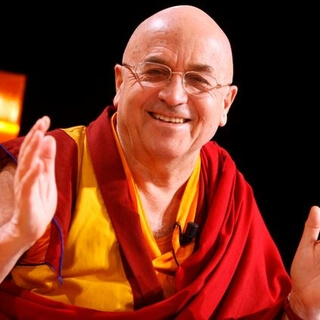
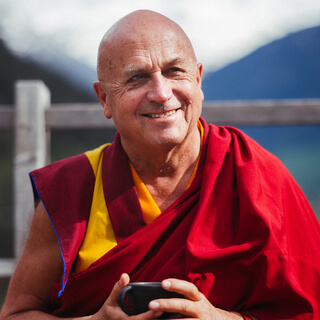
I've been living in Darjeeling in India for seven years,
In Bhutan for ten years,
Now I'm based in Nepal.
Near Kathmandu we have a monastery with 600 monks,
Which is a little bit like a beehive for education.
We have a philosophical college,
A painting school,
There are a lot of young novice monks.
And there we have archives,
We publish old Tibetan books,
Manuscripts.
But then the real secret is that I have my hermitage,
Which is two hours away from Kathmandu,
Facing 200 miles of the Himalayas from the Annapurna almost to the Everest.
And it's about three meters,
Nine feet by nine feet,
With a big window,
And no heating,
No hot water,
Any of those things.
And when I'm there,
For me it's the best place in the world,
I just don't want to come down.
And I spend in that hermitage and in another one in Darjeeling maybe altogether five years in pieces for a solitary retreat.
So you see,
When I'm there,
This is for me a sort of real life.
I mean,
Of course it looks kind of funny to isolate yourself,
And isn't it selfish,
People ask?
But if the goal is to get rid of selfishness and then put yourself better at the service of others,
Then how can you say selfish?
But I feel so good there.
And then the only thing that makes me come down now is to,
I mean,
I started 17 years ago a number of humanitarian projects through Karunasetsen,
An organization that I started.
And now we help 300,
000 people in India,
Nepal,
And Eastern Tibet.
That keeps me a little bit busy.
So you see,
My life is quite different if I'm in the hermitage,
Where I get about four in the morning or 3.
30,
And it's a regular day of practice every day,
Again and again,
Whatever times I can spend there.
Or if I'm in the monastery,
Which is about preserving the culture,
Or if I run like a headless chicken all over the world and find myself in the World Economic Forum of Davos,
So they cannot be more contrasted.
But the heart of my life has been to spend now 50 years near my spiritual teachers and to,
Yes,
Practice their teaching.
And that's the core of my life.
You know,
There's been such an improvement in most countries,
Or there's still much to do in material comfort.
At the same time,
I think it comes from the idea that people sort of believe that they put too much hope and also sometimes fear in the outer conditions.
You know,
If I get all that,
Of course I will be happy.
If I can get those things,
I cannot be happy.
But that's very naive,
Because yes,
We need to improve the outer conditions,
Remedy to poverty,
Try to establish freedom so that people can fulfill their aspirations.
But this being said,
It is quite clear that your state of mind can override either good or bad circumstances.
You can feel totally miserable in what people will call a little paradise,
And you can regain,
Retain your strength of mind,
Your inner freedom,
Your compassion,
Your sense of meaning and direction in life,
Even in terrible situations where people would not want to choose as a way of living.
So again,
We should not neglect to improve the outer conditions,
But certainly,
And that's what many people do and possibly at the root of this crisis,
Is to vastly underestimate the power of the mind.
We deal with our mind for money,
The living,
And that mind can be our best friend's or worst enemy.
So when it becomes our worst enemy,
There's depression,
That's whatever,
You know,
Any of those mental illness that are due to ill-being.
We speak of well-being,
This is ill-being.
So that is a mind that is sort of created by the mind,
And also sometimes because you have something wrong at the level of the brain with neurotransmitters,
It's not your fault.
It should not be a stigma on mental sickness,
Because if I say I have diabetes,
People say,
Oh,
Poor you.
If I say I'm depressed,
They say,
Well,
You should work on it,
You know,
Sort of,
It's your fault.
It's not,
Many things happen in life.
So it's not only a civilisation problem,
It's also a health issue.
And so definitely we should not put a stigma,
We should help.
But yes,
There is an increase of suicide,
For instance,
In the East where,
You know,
Imagination like a very vibrant economy like South Korea,
Hong Kong,
And China,
The teenagers are pushed so hard to perform.
And for them,
If they are not in the first five of the class,
It seems like their life is a big failure and their life is unfulfilled,
But we cannot all be among the first five.
And this vast increase of the rate of suicide in the teenager,
Because of that,
The society and parents put too much demand,
While those people could be very good human beings,
Very creative,
Good elements of society,
But because they're not performing the top on mathematics,
Science or economy or whatever,
Then they feel like a disgrace.
So that's very unfair.
That's a wrong turn of civilisation.
So we should rehabilitate the intrinsic values,
Friendship,
Quality of human relationship,
Being friends with your own mind,
Finding inner freedom,
Finding inner peace,
Inner strength,
And not be too vulnerable and insecure because your mind is,
You know,
You are the slave of your own mind.
It has been shown in many studies by Zinder Segal and many others,
John Teasdale and Mark Williams,
That mindfulness-based cognitive therapy for people who had at least two major depression episodes can reduce the risk of relapse by 40 per cent.
And then not only during the time that you do this mindfulness-based cognitive therapy,
Which might be for six months,
But it has a protective effect for many years after that because you become familiar with the onset of depression,
Starting the rumination and distorting reality and exaggerating a lot of things.
So now you know how to deal with that better.
While medication also prevents from relapsing,
But the moment you stop,
Then it stops,
It sees protecting you.
So I think this is either a combination of both,
Or if mindfulness-based cognitive therapy is enough,
That's all the best,
But I think then having a skillful person to take care of you.
And to come back to this meditation of mindfulness,
I think it's a wonderful contribution to the fate of humanity,
Thanks to John Kabat-Zinn and many others.
But nowadays,
Since it's become used now in not only in hospitals and for people who suffer,
Where compassion is an obvious element of it,
But now it's used in corporations,
In school,
In the workplace.
So there,
I think,
To be sure that we don't sort of deviate from this making us better human beings,
I think for me it's crucial to unambiguously say or speak of caring mindfulness,
That we imbue that with an element of benevolence right from the start and all the way through.
In fact,
You get two for the price of one,
Because to be full of loving-kindness and compassion and care,
You need to be mindful.
You can't be distracted,
Otherwise it doesn't work.
But it adds this very,
Very constructive quality of being benevolent to others.
So I think this is probably the best way to combine those two.
That's my conviction.
I'm not starting to launch a new movement or method,
But I think we should really stress on that.
And it does come when you do the mindfulness-based Trash-Relection program,
But it's expected to come along,
But I think we should give it a more preeminent status from the start.
See,
Meditation,
Of course,
There is a Western meaning for meditation for a long time,
But when we refer to practice of meditation,
These days people think of,
As you said,
Of Oriental practices.
Well,
The meaning of which we translate,
The word we translate by meditation in Western language,
Is in Sanskrit and Tibetan,
It means to cultivate,
To cultivate some qualities.
It could be focused attention or mindfulness.
It could be loving-kindness and compassion.
It could be resilience.
It could be inner freedom,
Sense of openness within your mind.
But it's also the meaning of becoming more familiar,
Familiar with the way your mind works,
How emotions arise and sometimes overpower you,
And familiar with something even deeper,
Beneath the whirlpool of thoughts.
There is this pure awareness that's always there.
So we're not so familiar with that,
So if we can recognize that and rest in that,
It's also part of meditation.
So it's a kind of training of the mind and becoming more familiar with how the mind works and the nature of the mind.
And that's crucial for flourishing.
Try to be free from what we call the worldly preoccupation or concerns like gain and loss,
Running toward pleasure and getting away from unpleasant circumstances,
Fame and anonymity,
Praise and blame.
If you're not too much vulnerable to those things,
It's pretty quiet.
You don't have to stress too much.
You could be extremely concerned by some grave issues,
People being massacred,
Discrimination,
Violence,
Hatred,
Injustice of all kinds,
And then wish to do something about it.
But in terms of yourself,
First of all,
Because you don't have much things that ties you in this world,
Like the pursuit of wealth and power,
You're quite free.
So not much expectation,
Nothing much to lose regarding the worldly achievements.
Of course,
For achieving inner freedom,
You can have unlimited ambition to achieve inner freedom.
It's not an ambition,
But like an aspiration.
So then you should never be satisfied with your spiritual practice.
Always want to continue to progress.
But if you don't care too much whether people praise you or criticize you,
Then you stay at peace and there's no big deal.
So why should we stress?