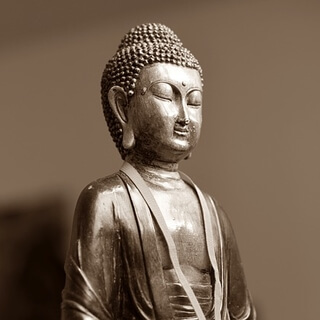
Coming into an alert,
Awake and yet relaxed posture where the spine is straight.
That's the most important thing.
So your energy can flow unimpeded from the base of your spine to the top of your head.
And letting your arms hang down naturally and if you're sitting in a chair your feet are flat on the floor.
And your hands in a comfortable position.
And taking three deep breaths just to arrive.
Continuing with the process of arriving and just coming into this room wherever you are.
Coming into the body,
Noticing the body.
Kind of just sweeping down the whole body,
Noticing anything that's calling out.
And coming into the present moment.
Anything that happened before,
Earlier today or in the past.
Just setting that aside for now.
And just being right here and anything that's going to come up in the future,
Later today.
Also letting that go for now,
There will be plenty of time to experience that later and just being right here,
Right now.
And bringing attention to the breath.
And feeling the air coming in at the place where you've chosen to watch your breath.
And then feeling the air going back out on the exhale.
And pick one place to watch your breath for the whole meditation,
Usually the tip of the nose.
Some people like to watch their breath in the chest and some people like to watch their breath in the belly.
And the traditional way is at the tip of the nose where you can really feel the actual air flowing in your nostrils and across your upper lip and then flowing back out,
Slightly warmer.
Noticing the quality of the breath today.
What's my breath like?
Is it peaceful and calm or is it a little agitated and rushing,
Halting?
Are the breaths long or are they short?
Are they smooth or are they not smooth?
Usually the first 12 or 15 minutes of any meditation are not so settled.
And there's a lot going on and the breath may not be settled yet.
And that's just fine.
There's no need to regulate the breath.
We just let it be the way it is.
Let's use some of the techniques we've learned to strengthen our concentration.
The first one being we can count the in-breaths up to 10.
And then on the next breath start over again at 1 if you get that far and I'll be quiet while we do that.
Okay.
Okay.
Another technique we use to help get concentrated is setting up little touch points along the breath.
So let's jump right to the one where we notice the in-breath,
Notice the space between the breaths,
Notice the out-breath,
Notice the space between before the next breath starts.
And you can note quietly in,
Out if that helps you.
Okay.
So let's add two more touch points to that.
Let's notice the beginning of the in-breath,
The end of the in-breath,
The space before the out-breath,
The beginning of the out-breath,
The end of the out-breath and the space between breaths.
Okay.
And let's add even two more touch points.
So we'll notice the beginning,
The middle and the end of the in-breath,
The space between breaths,
And the beginning,
The middle and the end of the out-breath and the space between breaths.
So you can keep up with that.
It's a lot to do.
Okay.
Okay.
If your mind wanders,
Just gently bring it back to the breath.
Should you experience a bodily sensation such as an itch or pain or any other type of bodily sensation,
Just notice it.
If it stays in the background,
That's great.
You can leave it there.
If it becomes so strong that it moves into the foreground of your attention,
Then you leave the breath and make the sensation the object of your meditation.
Explore it.
Find some words to describe it very softly and just be very intensely with it with your bare attention.
If there's a sensation in your body right now,
You can practice that.
And in the last lesson,
We talked about feelings.
Perhaps you have a feeling right now,
May not be real strong,
But just for practice,
Let's go and be with that feeling a little bit and explore it.
Maybe have some leftover feelings about somebody from an incident before,
Some feelings of anticipation about something that's going to happen,
Maybe a little bored or hesitant in some way about meditation,
Whatever it is.
It doesn't need to be very strong because we're just going to practice with it and just go and experience the feeling.
Maybe you want this to be over with or you want this to last forever.
Whatever it is,
It's okay.
Sometimes feelings make us kind of lean forward or lean back out of the present,
Wishing it would change.
Just to be with that.
Just kind of realizing that we're big enough to hold whatever it is,
This too.
Our container is big enough to hold it,
Accept it,
And eventually coming back to the breath.
By this point in the meditation,
We're usually pretty concentrated and settled,
And the breath may change.
For some people,
The breath gets very small,
Very light,
Almost like it's not there at all,
Like there's no need to breathe,
Like maybe you're breathing through your skin or something.
There's nothing wrong with that.
It's fine and it happens a lot in meditation.
And if it doesn't happen,
That's okay too.
It doesn't happen for everyone.
So just staying with the breath for a little while.
So in meditation,
We notice that we almost always have a stream of thinking going on.
And a lot of times when we're focused and concentrated,
That stream of thinking is in the background.
And that's fine.
It can stay there.
But sometimes our thoughts come forward and grab us and take us on a journey.
And we wake up in Chicago or Moscow or in the garden,
Or suddenly we realize we totally forgot to watch the breath and we're someplace else down a long train of thought.
And when that happens,
It's important just like with bodily sensations and feelings to just notice that we're thinking.
And very gently,
Kindly,
And with appreciation for ourselves for waking up,
Come back to the breath.
Always with kindness for ourselves,
Never with censure.
We may find ourselves planning or reminiscing or worrying or inventing,
Writing computer programs,
Deciding what to have for dinner,
Drawing helicopters.
The mind will do anything.
And as we notice our thoughts,
We can see that thinking is like a sixth sense.
It's a sense door.
And the thoughts come in just like visual images come in through our eyes or hearing sounds come in through our hearing.
And they're not us.
We're not our thoughts.
Our thoughts are totally shameless.
They will think anything and we can't judge them.
They'll think terrible things and there's no reason to get upset by it.
The thoughts will just do that.
It's not me.
And it's just great to realize that we're not our thoughts.
Our culture teaches us,
Western culture teaches us that we think,
Therefore we am.
But it's not true.
Therefore we are.
But it's not true.
And as we meditate,
We learn that.
So just following the breath and then watching as thoughts arise and maybe tempt us like little actors on the stage coming out and tempting us,
How about this?
Or take a look at this?
Or is this tempting?
So we'll try that just in silence for a while.
Try to stay with the breath.
Stay in our awareness and watch as thoughts come up.
So you can very quietly say thinking in your mind.
Notice that you're thinking.
You may even be able to follow some of it.
And then you just come back to the breath.
And just like when we started,
We noticed the quality of the breath.
Notice the quality of your mind right now.
What does the mind feel like?
Is it sharp?
Is it fuzzy?
Is it distracted?
Is it restless?
It's great to realize we actually have some control over this.
So like right now,
If your mind's a little fuzzy,
You can turn up the sharpness like a dial by making a little effort.
All right.
If your mind is restless and having too many thoughts or jumping around,
You can calm your mind and talk your mind down a little bit.
We have a lot of control over the state of our mind if we become aware.
Right?
.
.
.
.
.
.
.
.
.
.
.
.
.
.
.
.
.
.
.
.
.
.
.
.
.
.
.
.
.
.
.
.
.
.
.
.
.
.
.
.
.
.
.
.
.
.
.
.
.
.
.
.