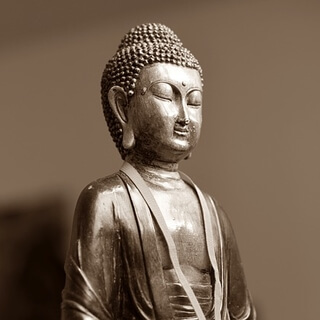
Close your eyes and bring yourself into a meditative posture,
Sitting up straight.
Most important that your spine be straight and that your arms fall down naturally and your feet,
If you're in a chair,
Your feet are flat on the floor and that you feel supported and balanced.
And maybe a string,
Imaginary string coming from the top of your head up to the ceiling and just kind of pulling your head up to a good spot,
To a good position.
And taking three deep breaths of arrival.
And bringing your attention into this room,
Into this space that you're in.
Bringing your attention into your body and noticing your body.
Just being fully present to your body.
Maybe just run your attention starting up at your head and very quickly let your attention flow down over your whole body and see if any parts of your body are talking to you.
And just recognize and accept and make room for whatever your body is experiencing.
And now bringing attention into this present moment.
Letting go of anything that happened earlier today or in the past and letting go of anything that's going to happen later today or in the future.
Just there'll be time to think about all that later and for now just being right here in this very present moment.
And then bringing attention to the breath.
Finding your breath at the spot where you observe it.
Many people observe their breath at the nostrils and feel the air going in and out.
Some people like to observe their breath in the chest rising and falling or even in the belly expanding and contracting.
Choose one of those three places and stay with it for the rest of the meditation.
Just noticing the breath coming in and going out.
And then investigating the breath.
What does the breath feel like today?
Are the breaths long or do they seem short?
Are they shallow or are they deep?
Do you find your breath smooth and even or is it more uneven and irregular?
There's no need to change the quality of the breath.
We're just going to watch it.
Noticing that the breath knows what to do and that we don't have to control anything.
To help us deepen our concentration we can add touch points on the breath.
So instead of just watching the breath or even watching just the in and the out,
Let's watch the in breath,
The space between the in breath and the out breath,
The out breath and the space before the next breath begins.
We have four touch points.
One,
Two,
Three,
Four,
Five,
Six,
Seven,
Eight,
Nine,
10.
So as we work to follow the breath,
The mind may wander off on a train of thought.
And when we notice that happening,
It's a moment of awakening,
And so we are very kind to ourselves without criticism and just say,
Oh,
Thinking,
I was thinking,
And just come back to the breath.
Let's try counting only the in-breath from one to ten,
Quietly in the mind,
Really noticing the breath bear attention.
Okay?
.
So if strong bodily sensations should arise during meditation,
Such as a pain in the knee or an itch,
Feeling like coughing,
We take our attention away from the breath and make the strong bodily sensation the new object of our meditation.
So bringing all of our attention to bear on this sensation and exploring it,
Investigating it with curiosity,
Trying not to judge it or push it away if it's unpleasant.
Similarly,
In meditation,
Feelings can come up.
They may be positive feelings and be just wonderful states,
Or they may be difficult feelings that are very hard to be with.
One of the things to notice first is our general state of mind.
What is your general state of mind right now?
Sometimes we have a certain mood that is affecting everything emotionally,
And we may not be aware of it.
We may be in a good mood.
We might be in a very good mood where we're sort of open to everything,
And it's great to notice that.
We might be in a discouraged mood,
And that will shade everything that comes in.
So there may be a subtle feeling tone going on before the stronger individual emotions emerge,
And this subtle feeling tone will filter everything,
Our thoughts,
Our whole experience.
So it's very good to be aware of it.
We can't always change it,
And we may not even want to,
But it's great to just be aware of it.
Awareness in itself is powerful without our having to take action necessarily all the time.
So just explore for yourself and see if you can name your current state of mind.
For the purpose of training,
Let's try to summon an emotion.
Maybe you can think back over the last week,
Perhaps some situation arose where you had a strong emotion,
And maybe you can resurrect that emotion right now.
Just kind of run over the situation in your mind and see if you can remember and bring back what that emotion felt like.
It might be powerful to work with a difficult emotion,
But not necessary.
If you want to work with a positive emotion,
That's fine.
If you want to work with a difficult emotion,
Perhaps you were annoyed with somebody.
Perhaps somebody did something you didn't like.
Perhaps you were impatient at some point,
Waiting on a line,
Being late.
Whatever it is,
See if you can find something that you want to work with for a few minutes.
So when you have kind of hopefully summoned this emotion a little bit,
Let's recognize it.
We're going to use the RAIN acronym.
The first part of RAIN,
The letter R,
We recognize the emotion.
So we feel it.
What does it feel like to feel this emotion?
Just experience the emotion directly on the feeling plane.
And secondly,
See if you can locate the emotion in the body.
Emotions take place both on the feeling plane and they have a physical component.
So where do you feel this emotion?
In your chest,
In your belly,
In your heart,
The back of your neck?
What does the emotion feel like?
Get familiar with it on a subverbal level.
But be sure you have a name.
Give it a name.
That helps.
And then the second thing is to accept the emotion.
We're not going to try to change it.
Even if it's a difficult emotion,
Our goal is not to fix it.
It's just to be with it,
To make room for it.
Now I have enough space for this too,
This too.
And that may bring up feelings of compassion for yourself.
That's okay.
That's good.
And now the I,
R-A-I,
In RAIN,
I stands for investigation.
So we become curious.
What is this about?
What is it like?
How does it affect me?
We know what it feels like physically and emotionally.
What caused it?
What triggers?
There are some long-term triggers in my life that brought this up.
Does it remind me of something from my childhood?
The last step with an emotion is to realize that it's not me.
That's the N in RAIN,
Not me.
I'm more than this emotion.
This emotion is just a process that has arisen due to causes and conditions,
And it's going to pass away.
And we can begin to let it pass away now.
One way to do that is just to come back to the present moment,
Come back to the breath when you're ready.
Notice the breath,
The quality of the breath again now,
So just noticing the in-breath,
The space between the in-breath and the out-breath,
The out-breath and the space between breaths,
Four touch points.
Okay.
Let's add some touch points and see what that does to the concentration,
If it can deepen it.
Notice the beginning of the in-breath,
The middle of the in-breath,
The end of the in-breath.
Notice the space between breaths.
Notice the beginning of the out-breath,
The middle of the out-breath,
The end of the out-breath and the space before the next breath.
So you have eight touch points.
Try it.
Okay.
So for the last few minutes of this meditation,
I'm going to be quiet.
I can do counting or noting if that will help you to stay with the breath.
Okay.
Okay.
Okay.
Okay.
Okay.
Okay.
Okay.
Okay.
Okay.