BELL So just giving yourself whatever time you need to settle into your posture for this practice.
There is no rush.
Good to spend a little time to settle before you meditate because it can really make a difference to what you experience in the practice.
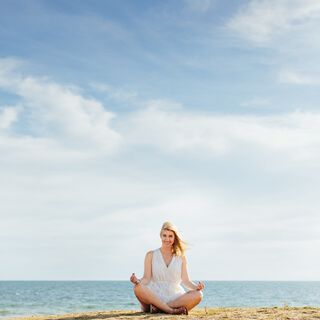
So just finding that dignified and comfortable upright position,
Allowing your eyes to close or lower if you prefer.
Just taking a moment or two to remember your intention.
This is a time just for you.
You're going to use it to meditate,
Not plan or dream or think about a problem.
And of course those things might come up.
Just setting this intention now to bring your attention back to the breath whenever you notice your mind has wandered.
Setting this intention to be kind and gentle towards your wandering mind.
Getting into the awareness of the physical sensations in your body right now.
Maybe focusing your attention on the sensations of touch,
On contact,
On pressure where the body makes contact with the floor or whatever you're sitting on.
Just spending a few moments exploring all these sensations.
Maybe letting a sense of coming into the body,
Of holding your awareness in the body.
What can you notice about the physical sensations of the body as you sit in awareness,
Holding the body in your presence?
When you're ready,
Shifting your focus to the sensations of breathing in the body as the breath moves in and out.
You might have a place in the body where the breath's really familiar,
Allowing your attention to go there.
You might notice the slight stretching of the belly on the in-breath and the gentle sensations of release on the out-breath.
You might find the breath is more obvious to you from the movement of the ribs or from the sensations in the chest,
Throat,
Nose.
When you find yourself attending to the breath,
Seeing what it's like to rest your attention there for the full duration of the in-breath and out-breath.
You're not changing your breath.
You're not trying to breathe in any special way.
You're just simply noticing gently,
Keeping your attention with the breath and seeing what it's like to simply let your experience be.
And as best you can,
Bringing this attitude of allowing the rest of your experience,
Nothing to be fixed,
No particular state to be achieved,
Simply letting your experience be your experience directly.
And sooner or later the mind will wander away from the focus of breathing to thoughts,
Planning,
Daydreaming or whatever it may be.
And this is perfectly all right.
It's just what minds do.
It's not a mistake or a fault.
And when you notice that your attention is no longer with the breath,
In that moment you're aware again.
You're aware of your experience.
And you might briefly acknowledge where your mind has been and make a light mental note.
Ah,
Thinking,
That was thinking.
And then gently guiding your attention back to the sensations of breathing.
When you notice your mind has wandered,
And it will most likely happen over and over again in your meditations,
Briefly acknowledging where the mind has been and then kindly and gently bringing it back to the breath.
Even if you get irritated with the practice or your wandering mind,
Keep coming back with an attitude of kindness to your awareness.
Perhaps even seeing the wandering mind is an opportunity to bring patience,
Gentleness and curiosity to your experience.
Continuing with the practice for another few minutes and reminding yourself again and again that the intention here is to simply be aware of your experience in each new moment,
Using each new breath as an anchor.
Simply reconnecting with the here and now,
Each time you notice your attention wanders.
Noticing the quality of the breath,
The sensations of breathing.
Expanding your attention to the body as a whole,
Aware of the body breathing.
And in your own time,
Bringing a gentle allowing and a patience,
Beginning to wiggle your fingers and toes and gently opening your eyes.
Thank you for your practice.
Thank you.