Hi,
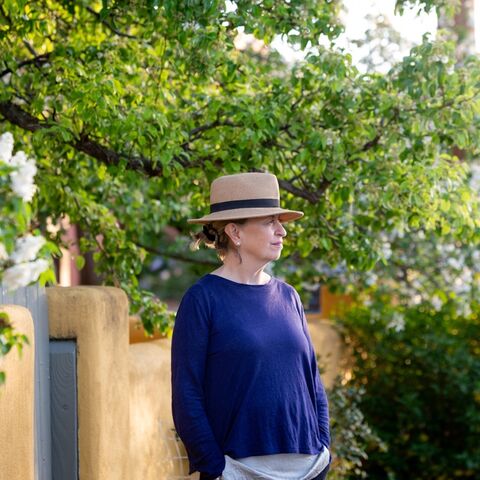
This is Meg Granale of Body Centered Inquiry,
And welcome to this somatic movement audio,
Restful Eyes.
For this session,
You'll be on your back,
On a carpeted or padded surface on the floor,
Or perhaps even on a firm bed if need be.
Either way,
Please use a roll-up yoga blanket or bath towel for head and neck support.
Pillows are too soft for this kind of work.
Have a bolster or roller for beneath your knees to support your spine in a neutral position if you prefer not to have your feet standing.
Many of these sessions are done on the back to take us out of our habitual relationship to gravity,
And expand our possibilities in sensing,
Thinking,
Acting,
Feeling,
And moving.
Wear clothing that allows for ease of movement and warmth.
Have sock or bare feet,
And remove your glasses,
Jewelry,
Or belts.
Gather your props,
And let's begin in standing,
Preferably off your mat.
Take time to sense how you come up over your feet,
Ankles,
And legs,
And how your feet connect to the ground.
Look out into the room and imagine where the horizon line would be,
And find that with your eyes.
Allow your face to look straight out into the room in front of you at that imaginary horizon line.
Notice your breathing,
And how you organize yourself to see.
Have your arms long by your sides,
Find a comfortable way to stand for you right now,
And begin slowly to turn and look around yourself.
Turn to the right slowly,
And come back to center,
And then turn to the left.
Are you turning with your head and neck only?
Or are you turning your chest and hips,
Maybe even a slight rotation in the legs?
And do your eyes follow your head's movement,
Or do they lead the movement?
Do that a few times,
Just noticing what you do.
Breathing,
Being aware of your connection to ground,
And then keep that inner snapshot of how you are in this moment,
And come to lie on your back.
If you can,
Bring your feet to standing hip-width apart,
And have your feet and knees hip-width apart.
If you prefer,
Rest your legs on the bolster or roller,
And allow yourself to settle in.
Imagine that the ground beneath you comes to meet you as you rest into it.
This somatic movement session begins with the eyes,
And expands to include more of ourselves in how we see and how we engage.
Many of us are spending more time online these days for work,
Education,
And pleasure.
With that comes a learning curve.
In the absence of our usual ways of connecting,
How do we engage our somatic imaginations to inhabit ourselves in ways that can ease our fatigue and deepen a more satisfying connection?
And it's worth noting that not everyone is experiencing fatigue from more online engagement.
For me,
The pleasure of connecting overrides the technology,
And others have said the same.
In fact,
They were astonished at the intimacy of it.
So why are some people fatiguing and some of us thriving?
It's curious.
Allow your awareness to come more clearly to your breathing,
And simply notice how are you breathing?
There's no one way to breathe properly.
Simply allow your breath to come and go.
Let your eyes be softly closed for now.
And could you invite more softness into your jaw,
Tongue,
Mouth,
And face?
Fixing our eyes in any one position is a big demand on the muscles of the face,
Eyes,
Neck,
Upper torso,
Hips,
And legs.
In fact,
Those of us who are blessed with sight organize a good deal of our movement around our eyes.
So let's explore this further.
With your head support arranged in a good way for you that gives you good support under your head and neck.
Begin very slowly to roll your head to the left,
Keeping your eyes softly closed.
In an easy way,
Roll your head to the left,
And then gently roll it back to where you started.
And repeat that movement of gently rolling your head to the left and back to center,
And go even more slowly than you are,
And even more slowly.
And notice the relationship between breath and movement.
Rolling your head to the left with your eyes closed and back to center.
If I'm moving too quickly for you through this session,
At any point you can pause the audio and linger longer where it's meaningful to you.
And then pause,
Pause the rolling.
And with your eyes gently closed,
Roll your head ever so slowly to the right in a range that's easy for you.
The two sides are probably not alike,
And you don't need to push into pain or do a large movement.
You could just initiate the movement,
And you will begin to gather information.
In this work,
We're not after particularly large movements.
We're after a quality of movement that is satisfying and sustainable.
Breathing,
Being aware of the ground beneath you that's always there to meet you.
Rolling your head ever so slightly to the right in a movement that is satisfying and sustainable for you,
Rolling back to center.
And pause.
Now open your eyes and roll your head gently to the left again in an easy range of movement.
And as you do that,
What do you notice moves first,
Your eyes or your head?
So it's the same movement as before,
Rolling gently to the left and then back to center with your eyes open,
Being aware of which moves first,
Your eyes or your head.
There's no wrong answer.
It's just becoming aware of what we do.
Go very slowly,
Even more slowly.
Which moves first as you roll your head to the left and then back to center,
Your eyes or your head?
And then let it go and rest and rest with your eyes closed.
Be aware of your breathing.
And now come back to this simple movement with your eyes open and begin to roll your head to the right in an easy,
Sustainable movement.
And which moves first,
Your eyes or your head?
Which parts of you are leading the movement?
Roll your head back to center and then resume ever so slowly,
Rolling your head to the right and then back to center.
Do this a few more times,
Noticing how this side may be similar or different.
Rolling your head to the right with your eyes open and being aware of which parts of you lead the movement.
And then take another rest.
Imagine that the ground is coming to meet you.
So it becomes less about pressing yourself further into the ground as you rest more deeply than it is about being met.
Being met by the support that's always available to you.
And breathe.
Now if it's easy for you,
Bring your right hand to cradle the back of your neck.
So your right baby finger rests at the base of your skull and the palm of your right hand cradles the back of your neck.
Keep your right elbow close to your head.
And then bring a soft,
Listening left palm to your forehead.
Allow your left hand to softly mold itself to the shape of your forehead.
If you have limitations in your shoulders and arms in organizing this way,
Then try modifying the movement by bringing your elbows closer to one another.
If this doesn't work for you at this time,
Then resume doing the movements in the same way you did them earlier,
Without the arms and hands involved.
There's no need for strain or pain in this work.
It just increases the noise in the nervous system.
So if you can arrange your hands in this way,
As I've suggested,
Gently allow the hands to roll your head to the left while your eyes glide to look to the right.
Your eyes are now open.
Gently allow the hands to guide you to roll your head to the left while your eyes glide to look to the right.
And then return to center and breathe.
And then resume gently,
Guiding your head to the left.
It's not pulling on your head.
It's inviting your hands to take over the work of the head and neck.
It's moving with a soft touch.
Then allow your left hand to guide your head back to where you began.
And do this two or three or four more times,
Gently.
Cultivating this listening touch with your hands.
It's actually a way of embodying self-compassion.
Can we extend kind touch to ourselves?
Be aware of the ground beneath you,
Your breathing,
And your quality of mind.
And when you're ready,
Take a rest.
Allow your head,
Arms,
Everything,
All of you to rest.
Gently bring your head back to where you began.
Have your eyes softly closed.
And notice where you look,
Even with your eyes closed.
We all have a habit of where our eyes look,
Even when our lids are closed.
Where do your eyes look when you're resting?
What's your habit?
Does it make you curious about how you usually engage your sight?
And begin to play with this idea.
While lying there on your back,
Consider that the eyeballs actually rest further back into the skull than we realize.
And most of the time,
We're looking with what we would call the surface of the eyes.
It can be quite restful to play with looking from deeper,
Deeper within the skull,
Deeper within the eyeballs,
Deeper within the eye sockets.
Imagining,
Following the depth of the eyeballs back into their sockets,
And looking again with a soft gaze from a deeper place.
Breathing.
It's a subtle idea,
But an important one.
And let go of that little experiment and continue to rest.
Holding our eyes still for long periods of time,
Looking at particularly a computer screen,
Is tiring.
And that holding recruits from muscles throughout the body,
Including muscles of the face,
Neck,
Chest,
And upper back.
Our eyes are actually never still.
We have the sensation of them being steady thanks to all the other muscles,
Including the eye muscles,
That help to create that steadiness.
It's good to understand the complexities of seeing so that we can learn to distribute that work throughout our systems and not rely on such a small part of ourselves to engage.
Now if it's easy for you,
Bring your left hand to cradle the back of your neck so your left baby finger rests at the base of your skull.
And the palm of your right hand shapes itself gently to your forehead.
Allow the elbows to be close to your head if it's easy for you.
Now simply roll your head to the right with your hands taking over some of the work of your head and neck.
And as your head rolls to the right,
Allow your eyes to glide to the left.
What happens in the rest of your face,
Your jaw,
Your tongue,
Your mouth,
And your breathing as you explore these movements?
Return to center and resume doing this movement slowly and gently four or five more times.
The head goes to the right supported by the hands and the eyes glide to the left.
Which movement happens first?
The movement of the eyes or the movement of the head?
There's no right or wrong here as you explore this gentle rolling and support with the hands.
Here's the opportunity to discover what you do and how to uncouple the habits of head and neck and upper torso from the movement of your eyes.
These gentle disruptions to the nervous system actually refreshes our capacity.
Are you breathing?
And then once again let it all go and rest.
Notice your connection to the ground,
Your breathing,
Your quality of mind.
This time have your arms resting by your sides or on your body and resume the movement again of rolling your head to the right and as you do allow your eyes to glide to the left.
And then return to where you started,
Pause,
Breathe,
And roll your head to the left and allow your eyes to glide to the right.
Is there one side that's easier?
How would you describe that ease to yourself as you continue now to go from one side to the other with the head rolling in one direction and the eyes gliding in the other direction.
Then coming back to center,
Breathing and resuming.
Play with this for as long as it's interesting to you.
Take your time.
And then pause.
Now in a simple way,
Roll to one side and in your own good time come up to sitting and then slowly up to standing.
Pause the audio as you need to.
Take your time.
And once you come to standing,
Recall how you inhabited yourself at the beginning of the session.
What's present for you now?
Allow whatever is present to reveal itself in its own good time.
Our nervous systems reorganize and reveal change to us in its own time.
Breathing,
Feeling your feet connected to the ground,
Your arms long by your sides.
Take a look out at your horizon line.
And then slowly turn again and look around yourself.
How is that for you now?
Can you describe what's different or the same to you?
Look around yourself to both sides.
Take your time.
As you turn,
Allow your eyes to glide along that horizon line.
So you're not looking high or low,
But continuing to glide along that line.
And then return to center,
Breathe and then turn and look around yourself the other way.
And when you're ready,
Take a few steps around,
Again taking your time.
This is your time,
Your learning.
And the next time you're at a computer screen,
Call upon one or two of these ideas that you've explored here.
How could you find a more restful place from which to engage your online sessions?
Our seeing is a whole body experience.
And the more we can learn to distribute our efforts throughout our whole system,
We become more present and less fatigued.
Thank you.
That's the end of this session.