Hi there,
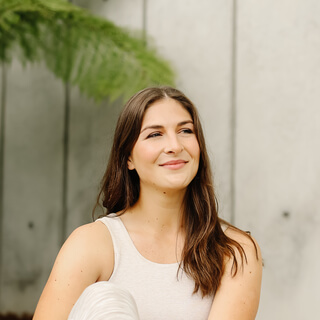
My name is Makenna and it's my honor to practice with you.
We'll begin our meditation in a comfortable position,
Either sitting on the ground,
On a cushion,
On a chair,
Or lying on a bed or wherever you feel comfortable.
It's important that no matter what position you're in,
You have both a level of relaxation and a level of alertness.
Once you've arrived in a comfortable position,
Let out any last movements.
If it feels okay,
You can go ahead and close your eyes.
If you prefer to keep your eyes open,
Just turn your gaze within.
First,
We'll just begin to ground ourselves in this present moment.
Notice all the places that your body makes contact with the surface beneath you.
Beginning at the heels of your feet,
Up through the body to the crown of your head.
Just acknowledging all of the spaces that the weight of your body sinks down into the surface below you.
And acknowledging that this physical space we take up can ground us,
Can help us to mentally shift from thinking about whatever came before,
Whatever is to come after this meditation.
So that we can fully grasp that we are here now,
And we can become fully present.
Notice the way your breath moves through your body.
It's very possible that up until this moment,
You hadn't even realized that you were breathing.
It's a process that we often take for granted.
Notice the quality of your breath.
Is it fast or slow?
Is it deep?
Is it shallow?
Notice the texture.
Notice the temperature.
And while there is no need in our meditation practice today to change the way that you're breathing,
You can take this opportunity to note whether there's a different way of breathing that may serve you better here.
And for a few rounds of breath now,
We'll just follow the inhales and the exhales at whatever pace you decide feels right for you.
Whether it's in and out through the nose or through the mouth.
Just take three rounds of breath with your attention glued to the in-breath,
The pause between the out-breath and so on.
It's natural for the mind to wander.
It seems like the harder we try to concentrate at times,
The harder it is to concentrate.
Oftentimes,
There's this pressure with meditation or really with mindfulness in general to have the mind totally adhered to one stimulus,
One activity,
One thing.
But really,
The discipline of mindfulness,
Sure,
It does include this,
This endurance.
The hardest part to learn is the always coming back.
It's inevitable that the mind will wander.
It's really what our mind's job is.
And that's what allows it to keep us safe by acknowledging what's going on around us and within us.
So that we can adopt the appropriate response.
It's natural that this would happen during meditation too.
The practice is the ability to bring it back,
To bring it back to your breath,
The sensations in your body,
Or whatever your anchor may be.
Notice if the quality of your breath has changed.
Notice if the quality of your breath has changed since we began our meditation not long ago.
And if the quality of the breath has changed,
How has the quality of the mind changed as well?
These two things are inextricably intertwined.
Though they may not sync automatically,
Perhaps within a few minutes,
Perhaps within several minutes,
We can start to notice that the rhythm,
The cadence,
The pace,
And the quality of our breath oftentimes evokes that same rhythm,
Cadence,
Quality in the mind.
Meditation is where we practice the effects that we can exert on this relationship,
The relationship between the breath and the mind.
But it can be helpful to think of this practice as just that,
Practice or training for the challenges that we encounter outside of meditation.
How comfortable can we become using our breath as a tool?
In certain times of stress,
Of anger,
Anxiety,
Heartbreak,
We can use this tool as well.
Let's take the next several moments to track the breath as it moves through the body,
To hone our focus,
And to practice bringing the mind back over and over again.
Yas,
These two The more attention we pay to the breath,
The more we notice its subtleties.
The way that it moves our abdomen forward and back.
It expands side to side.
And there are subtle movements throughout other parts of the body as well.
Like the shoulders,
Which may be moving up and down with the breath.
You may begin to notice that the breath is in the belly,
The chest,
And even the back.
The more attention we give to the breath,
The more there is to notice.
And not only is the breath a tool,
It's also information.
Information about the state of our mind,
The state of our emotions,
Our state of being.
When we notice that the breath is accelerated or shallow,
Jagged,
It may be important information for us to collect so that we know when it's time to check in.
To check in with ourselves and to take care of ourselves when we need it.
We'll take just a few more rounds of breath here together.
And whenever you're ready,
If your eyes are closed,
You can begin to blink them open.
And begin to orient yourself with your surroundings once again.
Shifting the gaze from inward to outward.
Thank you so much for joining me for this practice.
As always,
It is my honor to practice with you.
I look forward to practicing with you again soon.
Namaste.