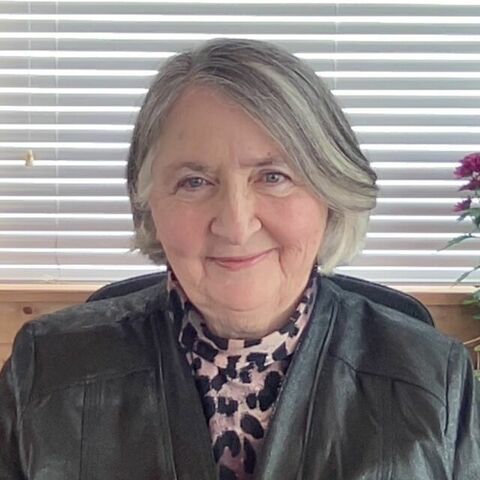
Dr.
Gabor Maté talks about the effect of trauma is that we disconnect from ourselves,
The present moment,
And our sense of value.
What I know from my work is that we have to be able to stay aware of the safety of the present moment in order to go back and heal trauma.
One of the ways that we disconnect from the present moment is through thought.
In particular,
This relates to the flight response.
Sometimes we remove ourselves from a situation physically,
And when we can't,
We often disconnect.
We disconnect from our feelings.
We won't let ourselves go there.
We disconnect from other people.
We go into a freeze response,
Perhaps.
Dissociation is a little bit more serious.
It's when we really aren't aware of what's in the present moment.
We're not aware of our body.
We might have a pattern of eating in a way that we're not really noticing how the food looks or tastes or how full we are.
We might have a pattern of daydreaming.
We go off into space somewhere.
Sometimes it's that we're rewriting our current circumstances in a way that feels better to us.
Maybe we have more excitement in our daydreams than we do in our real life.
Maybe we are loved and protected.
We have some security that we don't have in our real life.
This pattern of disconnecting from reality can be helpful in some ways,
And it's always helpful to know how to bring ourselves back into this moment so that we can be present with what's actually going on.
One of the biggest reasons for that is our neuroception,
Our perception of,
Am I safe in this moment or am I in danger?
So let's start with that.
Look around the space that you're in and notice what you see.
What do you bring in through your eyes?
Our eyes are always scanning for potential danger.
When we combine that with the nervous system's negativity bias,
Our nervous system always goes with,
Better safe than sorry.
And when we actually look to see,
Is there anything in my immediate environment that's dangerous to me,
Most often we see that there isn't.
Instead of thinking about it,
We need to let our senses experience that.
One of the ways that we do that is we look around the environment,
We look behind us,
We really look around our environment and see,
Right now in this moment,
There's no danger to me.
It's okay for me to relax,
Take some breaths,
And come back into the present moment.
When we've had overwhelming experiences and weren't able to process them at the time,
They are stored in our body as sensations and energy with associated memories,
Thoughts,
And words.
One of the reasons we disconnect from our body is that it's uncomfortable and it's kind of scary.
If we really feel what's in the body,
We take the lid off,
Then what's going to happen?
Are we going to be dragged back into traumatic memory?
This is why it's so important to get grounded and to have some practices that we use and to get skilled at them,
To bring ourselves back into awareness of the safety of the present moment.
We might use our sense of touch.
You could hold your own hands,
Feel the warmth and support.
You could give yourself a hug.
You could pat your arms and legs.
Just notice,
Here I am in my body.
We could move our body,
Stretch,
Wiggle your toes,
Become aware of the sensation of the soles of your feet,
Your seat,
How it is that you're supported.
We can develop the capacity to witness our body and our breath.
Most people hold tension in their body,
Forehead and eyebrows,
Mouth and jaw.
We might clench our teeth,
Back of the neck,
Shoulders,
Upper back,
Our stomach area are very common places.
Somatic awareness helps us to notice what's going on in our body.
What I've found is that my shoulders are rarely up around my ears anymore,
And when I have even a little bit of tension in my neck and shoulders,
Upper back,
I notice it.
Then I can relax my shoulders.
I can let myself settle.
Tension in our body,
Bracing ourselves through the neck and shoulders,
Clenching our teeth,
Those are signals that there's something wrong.
There's some kind of threat here.
When we experience threat,
We go into a response.
One of the responses we go into is this disconnection.
What we've done so far is we've used our eyes to ascertain how safe we are in this moment.
We've used touch,
Holding our own hands,
Feeling our seat,
Our feet,
Moving our body or stretching.
Let's go into a breathing practice just for a moment.
Cyclic sighing is when we do a deep double inhale through the nose,
And then we purse our lips and breathe out as though we're breathing out through a thin straw.
Inhale again,
And then breathe out through your mouth like you're breathing out through a thin straw.
As you breathe out,
Let your forehead relax,
Mouth and jaw,
Neck and shoulders,
Your whole body softens.
In and then again,
Breathing out.
Let your exhalation continue as long as you can let your belly soften on the exhale.
So we don't squeeze the stomach in,
We just let it soften as we breathe out.
Inhaling,
Deep double inhale through the nose.
Long,
Slow exhale like you're breathing out through a straw.
And then let go of that practice.
Let your breath come back to whatever it wants to do.
Ideally,
We have a smooth,
Continuous,
Even breath.
We're breathing diaphragmatically.
And notice if there's anything too uncomfortable or overwhelming about your situation right now.
Do you need to disappear?
Do you need to disconnect from your body?
It's interesting that we hear many people say,
I'm really only in my head.
I live from my neck up.
In actuality,
A lot of the sensations and energy in our body is what drives the thoughts in our mind.
A lot of the compulsive thinking in particular,
The ruminating,
The catastrophic thinking are driven by nervous system alarm,
Hypervigilance,
Survival responses that appear when we feel threatened.
This ongoing practice of right now,
I'm looking around,
I'm seeing that I'm safe.
I'm feeling that in my body.
I'm taking a few breaths.
I'm letting myself be supported in the chair.
I'm stretching,
I'm moving.
It's safe enough for me to breathe and to be present in my body.
And over time,
That transforms our whole life.
We live in our body.
And if we want to daydream a little,
That's not such a bad thing once in a while.
And in our everyday life,
We're present.
We notice what's going on.
We're here for ourselves.