So let's do a practice now,
This shorter practice that we do,
Just of orienting and noticing safety.
And so one of the things that can be helpful,
Especially if you woke up today feeling anxious or triggered somehow,
Activated,
Pete Walker talks a lot about emotional flashbacks,
And it might not even be that you woke up with a certain thought in your mind,
It might be more of an emotional flashback back to a sense,
A felt sense of what it was like maybe when you were younger.
So there's anxiety,
There's fear,
The anchor practice is to come into this moment and notice right now in this moment are you safe.
Let's do a few practices to let our nervous system know that.
So we start with this beautiful practice of using our eyes,
Looking around the room,
And as you're doing that look to see if there's anything concerning or dangerous in your eyesight.
So look in all the directions,
The front,
If you're sitting especially do a twist so that you can really look behind you and look up and down and really check it out.
Notice doors,
Windows,
Is there anybody hiding behind you,
Is there anything unsafe in the room,
And then just notice the cues of safety as well.
We're in a location where our body is safe,
Otherwise we wouldn't be doing the practice,
So that's one of the things that we could notice,
My body is safe right now.
And then still using our eyes,
Let's do the 5 4 3 2 1 practice with the senses.
So if you can say it out loud if it's not embarrassing where you are,
Say it out loud five things that you can see.
I see a picture my granddaughter drew,
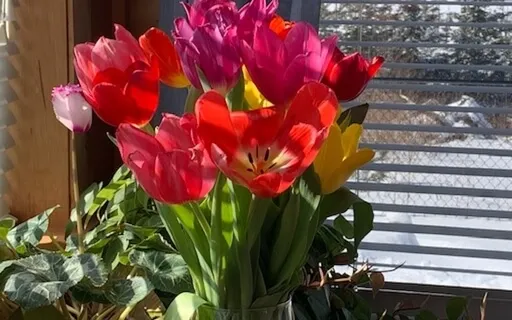
I see the trees through the window,
I see five things you can see.
And then four things you can touch or four textures.
So I feel the sensation of my butt on the seat,
My feet on the floor,
I can feel the warmth of my hands and the texture of my shirt.
Four things that you can feel.
I feel the breath in my nose.
And then three things that you can hear.
The sound of your voice as you're saying it maybe is one.
And two things that you could smell or two favorite smells.
And really kind of bring that to mind vividly.
The smell of the rain on the earth,
The spring.
And one favorite taste or one thing that you can taste.
And again say it out loud.
I'm drinking a cup of coffee.
And I can smell and taste the forest.
And then notice again as you're looking around,
Notice what's here.
And again notice what is your neuroception,
Your perception of safety right now.
Does it feel like you're in a place where you're not feeling well?
What is your neuroception,
Your perception of safety right now?
Does it feel like your physical body is very likely to be safe for the next little while?
And that's one of the things that helps us to recognize that right now in this moment is a different actual experience than throughout our history.
Many times throughout our lifetimes we have not been safe and we carry that memory in our nervous system.
And our nervous system and primitive brain very helpfully try to remind us that we might not be safe.
And actually right now my body is safe and you could see just how that sits with you.
So it might not feel very safe in your body if you have a lot of fear in your body because we associate fear with not being safe.
What we're looking at is a pattern that's historically true and it's not true right now.
Let's do a little bit of work with the breath.
So Andrew Huberman is a neuroscientist at Stanford University in California who has the Huberman Lab podcast website.
So if you're looking for science-based information,
He's a good one.
So one of the practices he suggests for breathing is his double inhale and a long exhale.
So you breathe in quite deeply and then breathe in some more and then a long slow exhale.
If you want you can purse your lips,
Get a long exhale and then deep inhales.
And then deep inhales.
We'll do this several times at your own pace.
Deep inhales,
Two inhales.
And let your breath come back to normal.
And notice again your sight,
Your hearing.
Our body is really set up to notice if anything dangerous has come up.
So you would hear it if there was a noise that wasn't usual for your environment.
You would hear that and your mind would go,
Oh what's that?
So because we know we can rely on that part of the brain to do that,
We can notice if it's giving us false alarms.
But also we don't have to be so vigilant.
We could remind ourselves through our eyes or touch that we're here now and that our body is safe.
And let's do some long exhales with the syllable voo or you could hum.
So deep through the nose,
Deep inhale.
And as you're listening to your exhale to the sound,
Notice the smoothness of it.
A lot of that is driven by the diaphragm muscle,
The same as the muscle that works with our breath.
Deep inhales.
Let's do this several times.
As you're exhaling,
Relax your throat,
Your chest,
Relax all the muscles around the diaphragm and really tune into the smoothness of your breath.
See if you can make it a little bit smoother each time.
Deep inhales.
And then let your breath come back to normal.
Relax your belly as you're breathing out.
And then let's use some touch.
We could start by bringing our hands together and really feeling the warmth and the support of our hands,
The strength.
I was surprised when I started doing this how much it feels like I'm holding somebody else's hand.
It's a very similar sensation.
Just to notice that with a snug grip or a light grip.
You could experiment with it the other direction.
We usually have one side that we do.
Really notice what that feels like.
Texture,
The warmth,
The strength.
And then if you want,
You can bring your hands to your heart.
Kind of rub a little bit around your chest,
Your neck,
Your shoulders,
Over the heart center.
Really feel into that.
I can comfort myself and nourish myself through my own touch.
We can bring our hands up to our face and do the same.
We might not have somebody who's gonna check for a temperature on our forehead or brush our hair back.
We could do something similar.
The sides of the neck,
The back of the neck.
The back of the neck.
And also there's a practice where we could put one hand on the forehead and the other hand on the back of the head where the brain stem,
The neck,
Reaches into the skull area.
And relax your shoulders and just kind of notice that for a moment.
Let yourself be grounded in that.
And then let's do a little bit on the whole body.
So touching on your legs or patting yourself down,
Remembering that we're here.
Touching your arms.
And then let's do a few breaths if it feels okay with the arms.
So as you're inhaling,
Breathing up really deeply and exhale.
Let your arms come back to the floor,
To the,
Towards the floor.
And as deep an inhale as you can comfortably.
And smooth.
One more.
And then just kind of move your body around.
Wiggle a bit.
Let yourself kind of feel into the effect of that.
And then using your eyes again,
Check for cues of safety.
And in addition to whatever is in your room or your location,
There's all of us here.
So we can have that experience as well,
That we're actually not alone.
We have this energy connection through zoom and technology.
And we can rely on that as well.
Our bodies are really made for connection.
Our nervous systems love connection because it's safer.
Not all connection is safer,
But there's that built-in need for safe connection.