Who's driving?
This is a way to really connect with who it is that's making the decisions.
Who in the sense of what part?
A lot of people are very familiar with internal family systems and inner child work.
This concept and this experience we have of connecting with parts of us or our younger self that feels worried and scared,
You know,
When we're three years old or 15 years old,
We don't have the brain development,
We don't have the life experience to really make the kind of decisions we would make now.
To make the kind of decisions that we would make now is great.
Our adult self can be here.
As we get older,
We tend to maybe have a little bit more self-confidence,
A little bit less power to other people's opinions of us.
We're working on freedom,
On becoming free from some of the pressures that our culture puts on us,
But also free to be present and kind and compassionate with ourselves.
So notice what that brought up.
Who's driving?
Is that a six-year-old right now?
Is that a 10-year-old or a 23-year-old,
Whatever that age might be?
Or is it our more mature,
More regulated,
Wiser adult self?
I know from my own experience that it can be any one of those at any given moment.
The real key to being present for ourselves in our life is to be aware that that happens and to be able to really invite in and welcome those younger parts of ourselves.
When we're young,
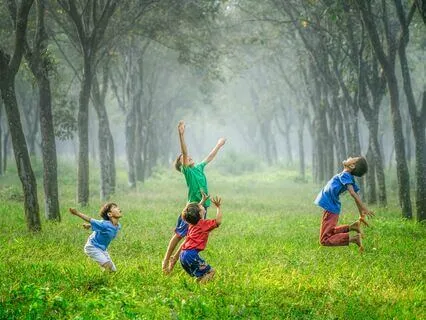
We like to play.
So it's not just,
I'm feeling overwhelmed.
I feel like I need to protect myself.
I feel like nobody cares about me.
All of the things that happen,
They're so difficult.
And then quite often,
Children can just go right into play.
And as adults,
We've often forgotten that lovely capacity of children to be creative,
Be creative,
To make art and go,
Look what I made.
And as we're older,
We're like,
Well,
I made this thing,
But you don't have to look.
We just have so many ways that we limit ourselves that we can explore during our own inquiry and practice and connection.
Notice your body.
Notice your breath.
Take a few deep breaths if that feels good in your body.
You might move around a little.
And if you were to allow your adult self to be here,
What would change?
What would be different?
What does that mean?
I'm here.
My adult self is here.
What does that mean for you?
So much of the work that we do around healing trauma has to do with being regulated in our nervous system.
So it's not that play only happens when we're a child.
It's that as an adult,
We're often shut down or disconnected from certain parts of ourselves.
And we might do something that's enjoyable,
Like getting a massage or going for a walk in the woods or something.
Spontaneous play,
We often don't have room for that in our life.
So when you think about my adult self,
How are you defining that?
Is that pretty serious?
Is there room for a range of ideas,
Experiences,
Explorations?
And as we're doing any somatic inquiry,
We're not thinking about it as much as we're allowing it to arise in our body,
In our mind.
Often when we tune into our body,
We're drawn to whatever hurts or what's tight.
So that would be a good time to do a little stretching or open your chest or bring your arms up,
Whatever that might be.
Move your lower jaw around a little bit.
Loosen up the tension in your body.
And also to come into your body in a very grounded way.
Notice the parts of your body that are connecting with the support that you have.
Feet,
Our seat.
Where are you connecting with earth,
The furniture?
And also,
We have all the space around us as well.
And what's in that space is also supporting our body.
So it could be the air that we're breathing.
It could be that we're looking at plants,
Pictures of someone we love,
Animal creatures,
Plants,
Animals,
Animal companion.
As you look around,
What's there to support you?
And notice if there's a restlessness in your body,
In your arms and legs in particular.
We could allow our body to be supported and not have to be on duty.
We could give our body a break.
Notice the whole of your back,
Back of your head and neck,
The top of the shoulders and the neck,
The back of your neck and shoulders,
The upper back.
Notice those large muscles of your upper back.
And for a few breaths,
You could allow your awareness to sweep down over the sides of your neck,
Your shoulders,
Down through your arms and hands,
Fingers and fingertips.
Let your arms and hands be in your awareness and allow them to rest.
And from the back of your neck and shoulders,
Upper back and behind the heart center,
Let that soften.
And through your mid and lower back,
Your buttocks,
Don't hit the legs,
The front and back of the legs,
Those large muscles where we move about in the world,
We defend ourselves.
See if you could allow your body to know that you don't need to do that for the next little bit.
Notice the front of your body as well,
Forehead,
Eyebrows and eyes.
Notice sensations of air as you breathe,
The front of your throat and neck,
The sides of your neck again,
Relax your shoulders,
Coming down into the chest area,
To the belly as well.
And then be aware of the whole of your front from head to toes.
Now let's come back to the question,
Who's driving?
If you were to focus all of your awareness in your heart center,
What does your heart know right now in this moment?
One part we're checking in to see if we're feeling kind of regulated and steady.
We're also noticing there might be emotions.
You're thinking about play as a child,
There might be a lightness or a sense of having fun.
And we can bring that in,
Allow ourselves to focus on that,
Let that ripen a bit.
It might not have been the overall theme song of your childhood,
And yet children have this capacity to find joy and pleasure and fun.
Let that be in your heart area for a moment.
And there might be specific things.
We all have minds that work in a very similar way,
And we all have our individual content.
One thing that came to mind for me was playing Double Dutch Skipping,
And that exhilaration of our body is really working so hard,
And yet it's so much fun,
And we're singing and skipping.
What are some things that come up for you when you think about having fun?
It could be from a child,
Or it could be now as an adult.
And if you're having trouble finding some memories of fun,
Not to worry about that either.
Stuff might come up in a day or two,
Or later today,
Think,
Oh yeah,
There was that time when.
.
.
Sometimes those memories aren't as firmly installed as the more difficult memories,
Because our nervous system has that negativity bias.
It really only wants to be sure to remember things that could be dangerous.
Inhaling,
Exhaling,
Be aware of your body and focus on your heart.
And what else comes into your heart,
To your felt sense of being a child?
Maybe something that was a little more difficult.
When this inquiry around who's driving,
We're really looking at what's happening in my present day life that's highly affected by something that's unresolved from my younger self.
And maybe it's that I have to get this job done perfectly.
It's a survival level intensity often when we're a child.
I can't go into that social setting,
I'm not going to know what to say,
And then I'm going to feel like nobody cares about me.
We might have memories of that.
So if there's something that's a little bit more challenging coming up,
See if you could get specific again.
It doesn't have to be the worst thing,
Just something that's coming to mind.
And there's a through line from our experience as a child.
Time doesn't exist in our mind in the way that it does in the material world.
So something that happened when we were much younger can feel just as present moment as what's going on right now.
Let yourself stay with that,
Let yourself settle in.
And if something's come to mind,
An age or an experience,
Notice the sensation of that in the body as well.
It might be in the heart area,
It might be in the gut,
Somewhere else in your body.
And if you're in a situation where you're not sure what to do,
In the heart area,
It might be in the gut,
Somewhere else in your body.
Maybe you've got that restlessness in your arms and legs again.
Notice your whole body,
Notice any sensations that are here.
We also can remain aware that we're here right now in this moment.
You could always open your eyes and look around.
And we're exploring,
We're inviting forward some part of ourself from when we were younger that's relevant to something that's going on now.
Sometimes we'll do a welcoming practice.
I'm really happy that you've shown up,
That I can connect with you.
I want to let you know that I'm an adult now,
And you don't have to do this yourself anymore.
You don't have to figure this all out on your own.
You might visualize holding them,
Or sitting next to them,
Or somehow having them in your heart,
Your younger self.
It's not all on your shoulders anymore.
Let yourself have some ease with that.
And sometimes that younger self,
And sometimes that younger self,
There's a real sense of relief.
I'm so glad I don't have to be paying attention to that all the time.
In fact,
I'm not on my own anymore.
And if your younger self was freed from that task or that burden of trying to figure it out all the time,
Let's move back into play.
You could vividly imagine your face,
Your body language.
If you were to feel free of fear and free of having to protect yourself from harm,
If that burden has now been taken on by your adult,
What might flow through?
What might you be interested in?
Or how might you express that freedom?
Stay with this for a few minutes.
Feeling into that,
Our adult self is reassuring our younger self.
You don't have to do this on your own.
You could go off and have some fun.
You could play,
You could relax,
You could sleep at night.
Let yourself feel that and see that.
What would that be?
See the little things that are happening in your life.
See that.
What would that be?
See the look on your face.
See whatever it is you're going to do.
Let yourself feel that.
And notice that maybe your shoulders are more relaxed.
There's a little bit more movement in your body now.
Notice the sensation and energy in your body.
What has shifted from the beginning when we were kind of opening into play and then coming into something is a bit more difficult,
Coming into connection with our younger self.
And coming back into what would my experience in this moment be as I imagine that the freedom and the safety of my younger self,
How they might express that.
And before we finish the inquiry,
Notice if there's a way that you could bring that into your adult self and into your adult life.
Inviting some friends over for a dance party,
Or what would it be if you felt free to have fun and if you had no contraction around that?
How might you bring that freedom into your life right now?
Might be that there's something that I could do more of or invite in more.
It's always so interesting when we look at an inquiry,
Where it goes,
Because it always goes somewhere different.
To really allow ourselves to follow,
What does my heart know about this?
Instead of that old,
Well,
You know,
I know I should do this more.
What does your heart feel like?
What does your body tell you?
If I was to be more free,
How would I express that?
If I was to be more free,
How would I express that?