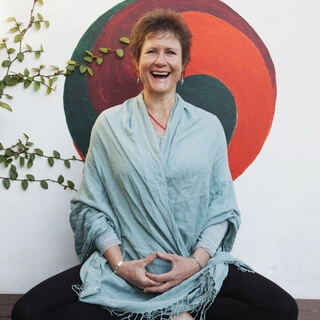
So this is a mindfulness session using breath as a support.
And the first stage is to settle the mind.
And focusing in a very relaxed way on the breath.
Breathing in a little more deeply than normal.
And balancing the in-breath with the out-breath.
And we can do this by counting the length of the breath.
Maybe counting one,
Two,
Three or four on the inhale.
And then one,
Two,
Three or four on the exhale.
Thoughts will arise.
That's normal,
That's okay.
We just allow them to go free.
And we maintain our attention on the experience of the breathing.
And the gentle counting in the back of the mind.
When thoughts do arise,
Remember you don't need to push them away or suppress them.
Equally we don't get involved with them.
We simply escort our mind back to the present.
And the experience of breathing and counting.
And after a few minutes of settling,
And settling the mind,
We let go of the counting.
Tuning in a little more to the out-breath.
Just following it as it releases from the body.
And noticing any effects the out-breath has on the body.
Seeing if we can feel a little heavier on the earth,
A little softer on the surface beneath us.
And we allow our breath to find its own rhythm,
Sometimes long and smooth,
Sometimes short.
So we're grounding our awareness into the body.
So maybe scanning down systematically from the crown of the head.
Noticing any sensations in the forehead or the face or the jaw.
And if we find a place that's holding tension,
Then as we exhale,
Getting a sense that the exhale is also releasing that tension held in the body.
So the body is learning from the breath.
And we find too that the mind can learn from the body.
Continuing your scan down over your shoulders,
Letting them soften into the torso.
Down the spine,
Over the front body,
Softening the belly.
Noting is there any subtle holding in the buttocks.
And we release and sit a little more connected with the earth beneath.
Feeling sensations in the hips.
And if there's tightness or achiness in any part of the body,
We can imagine inviting the breath there,
Creating a sense of space on the inhale.
And then softening,
Opening around the tightness on the out-breath.
We're not trying to push sensations away.
We're just giving them permission to ease,
To release in their own time.
And now opening our awareness a little to take in the space around the body.
Feeling how we're connected to the earth beneath with a sense of openness,
Spaciousness all around.
And now we move to the resting phase.
So we can let go of any specific technique,
Any sense of effort or striving.
We're not trying to achieve or do anything.
We simply drop into the present moment and just sit in a relaxed and casual manner without any purpose or goal.
We allow the mind to be open,
Alert and at rest.
Awake and relaxed.
Right.
At some point we'll notice that the mind has wandered off into the realm of thinking.
So this is where we can introduce the mindfulness support.
And we can use breath.
So we shift our awareness to the breath and the sensations of the body breathing a sense that we're moving in really close to the breath following the rising and the falling of the abdomen,
The chest,
The rib cage,
Feeling the entry and exit point of the breath at the tip of the nostrils.
We can rest our attention at a point in the body where the breath is felt most vividly.
Or we can follow an entire breath cycle riding the waves of the breath noting its flow,
Its changing qualities maybe shallow or deep,
Long or short,
Smooth,
Jagged,
Maybe soothing,
Tangible,
Or disappearing.
We can watch for any tendency to want to control or change the breath simply allowing the breathing to happen in its own way a sense maybe of surrendering to the body breathing for us.
A sense maybe of surrendering letting ourselves be breathed.
Each time the mind wanders and we recognize this fact we gently and kindly escort ourselves back to the present moment.
This is the care,
The gentleness that we show in a meditation practice.
So we're learning to settle the mind and also cultivating qualities of patience,
Perseverance and concentration with a kindly acceptance towards ourselves and our experience.
Again and again we'll notice that our mind has drifted into thinking and has left the sensations of the breath.
We'll begin to notice all the many places that the mind likes to go and how we have particular habitual habits and how we have particular habitual places that we frequently return to.
Maybe the past or the future,
Worries or planning,
Judging or evaluating,
Maybe a constant commentary or a sense of fantasizing.
We realize that the mind just pops up this vast array of random thoughts.
And as soon as we notice that the mind is no longer with the breath we congratulate ourselves for waking up,
For being aware.
This is the moment of mindfulness.
There's no need to judge ourselves for moving off into thinking.
It's the nature of the mind to wander.
And we're learning more and more about how the mind is addicted to distraction.
So we simply acknowledge the fact that we've been thinking and gently return again and again to the breath.
Thank you.
Thank you.