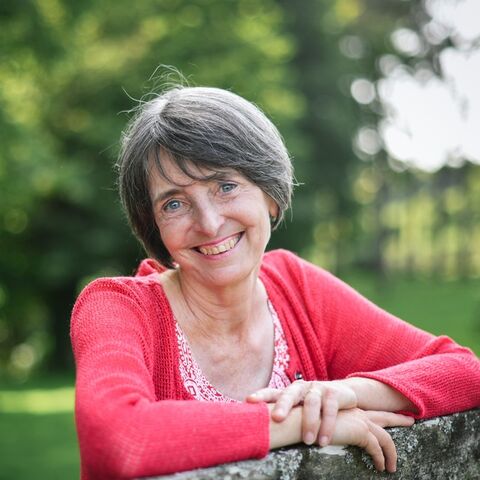
Hello and welcome to Five Minutes in Nature with me Liz Scott.
Oh it's gorgeous here up on Dartmoor.
Blue sky,
A very cold easterly,
Northeasterly wind I would say which I'm going to turn my back to and it means that I'm facing the sun,
Got my back to the wind,
Looking up a hill just enjoying the blue sky with white clouds and feeling that this is a very seasonal kind of time of year.
So beautiful to be outside.
Today I am reflecting on what you lose by speeding things up.
I've got two examples really.
One is from the digital age which is using artificial intelligence and the other is from just speaking to a neighbour who's just acquired a piece of land and it just got me reflecting which is when you speed things up,
When you speed processes up,
What are you missing out on?
So let me start with the digital stuff,
Artificial intelligence.
I use it often to help me create letters or to create bits of writing to make sure the grammar is correct and what I found is that I've become a bit lazy.
I write things sloppily and then ask artificial intelligence to tidy them up and make them sound better and what I've realised is that whilst that speeds me up it means that I can do more admin,
It means that I'm able to write more letters and to make them sound better.
What I'm missing out on is the creation,
The creative process of writing my own stuff,
Writing it all,
Learning from the mistakes,
Thinking more carefully about how I construct a sentence about what I want to say.
What I do is I just write it really quickly,
Ask artificial intelligence to rewrite it for me and hey presto there is something done for me without me having to think too much about it.
So it's quicker but I'm missing out,
I'm missing out on that relationship,
That slow relationship of considering how I write and construct things.
And as I was walking today I met a neighbour who's just acquired a piece of land and he was showing me the hedge which was very scruffy and lots of gaps in it and he was explaining to me that he wanted to what's called lay the hedge and it's a traditional way of dealing with hedgerows which is brilliant because it's a way that's traditional,
It's been used for hundreds of years and what you do effectively is if there are saplings and small trees growing out of the hedge you cut them up pretty much 80% through the trunk and then you bend them over and lay them horizontally and you sort of weave them in and out of each other along the hedgerow.
Now those saplings are still alive and what happens is that the trunks which are now horizontal when they start growing in the springtime all the new branches start growing upwards vertically.
So what happens is you you start to get a hedgerow that's creating its own bushiness.
It's brilliant,
It's it's a great thing for wildlife,
It's great to keep livestock and it means that the hedge is nice and thick and it stays like that for years you have to just keep an eye on it.
But the downside of it is as my neighbour was telling me is that it takes a lot of time,
It takes a lot of skill,
Takes a bit of planning and it doesn't provide quick results.
What usually happens these days when it comes to cutting back hedgerows is a tractor will come with a cutting machine in the late autumn and just pretty much strip the hedges and cut them and it looks really like they've been massacred.
They're sort of shattered branches and twigs and debris all over the place.
It looks quite heartbreaking to see them and they do grow back but as my neighbour was saying what happens is that because of the way that they've been cut rather than being bushy and thick at the bottom of the hedge they end up being bushy and thick at the top of the hedge and if you're trying to keep in livestock that's that's the wrong way to create a hedge.
So today is just a real reflection on I guess what we give up when we speed things up what we lose and I for me there's something about we lose relationship.
It might be a relationship with language when I'm writing or it might be a relationship with nature when we talk about the hedgerows.
It might be the skill we lose.
It's almost this sort of sense of handing over responsibilities to something else rather than taking responsibility ourselves.
So by speeding things up I guess the question is what do we lose?
What do we lose and what do we gain?
And that's what I'm reflecting on today.