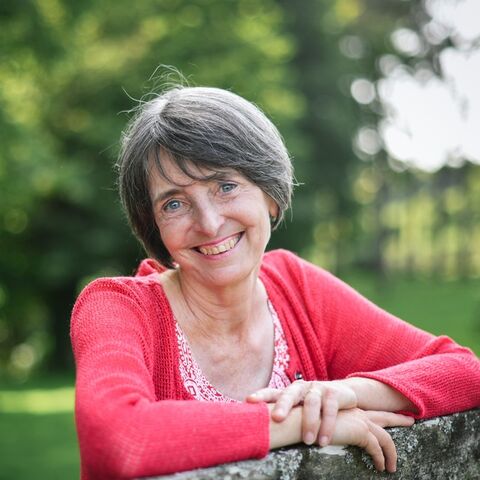
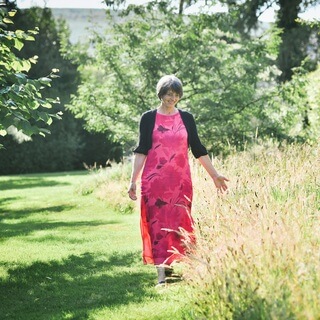
Hello and welcome to five minutes in nature with me Liz Scott.
It's so squelchy underfoot.
This morning has been an absolute downpour of rain with a storm.
Yesterday was a downpour of rain and I'm up on the moorland now.
It's just paused with the rain.
There's a mist covering the top of the hillside and everywhere is rushing with water.
The moorland is traditionally known as a sponge.
It soaks up the water but we've had so much rain recently that there is nowhere for this water to get soaked up.
So it's creating little rivers and streams where there are normally no rivers and streams which are rushing off the moor down the roads and down down down towards the rivers.
And I'm just sheltering.
It's still very blowy.
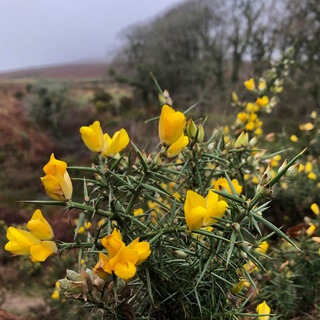
I'm sheltering in my little thicket of gorse bushes.
I come here sometimes because I'm just out of the strength of the southwesterly wind.
I'm just hoping I might be able to get away with a brief walk without it being a downpour in the midst of it.
And today is a real reflection on the busyness of a mind and the sense of what happens when we understand that we have a busy mind.
You see what can happen when you realise you've got a busy mind is that you literally fall out of your thinking.
You fall out of that busyness and you land in a space of calm.
It's not something I've found I can do on demand.
So when I feel busy,
Let's say for example I wake up in the middle of the night and my mind is chuntering on about something or other,
I find that I can't switch it off.
I wish I had a switch that I could just flick off the switch of my mind thinking and fall out of it.
In those instances what I do is I push the thinking to one side and I don't give it any more energy.
I just allow it to burn itself out.
And one of the things that I love when I met a friend recently is she was telling me a bit about her artistic process.
And what I love about this is she doesn't claim that she's an artist.
She doesn't make money from art.
What she loves though is she loves the creative energy of painting.
And for some time she has thought very long,
Hard and deeply about the three principles and the inside-out nature of life.
So much so that I think she's found it hard when I explain things to her because I feel things at a different level,
An intuitive level.
And I find it hard often to put those things into word or to articulate or to find a way of describing what I'm experiencing and and how I sort of sense that life works.
And so for her she's really curious about the three principles and she's just for a long time been trying to work it out,
Trying to think it out,
Trying to intellectually find a logical process around these three principles.
And by the way there's a course on the three principles,
An introduction to the three principles if you're interested to learn more.
But what I've found is that you can't think your way into the three principles.
I mean intellectually you can get them on a particular level but ultimately it's about understanding the nature of thought,
Understanding the nature of consciousness and being curious about this deeper energy behind life.
So when this friend who has been trying to grasp the principles for so long shared her artistic process and she said that she gets these huge big canvases and then when she's got the canvas she just applies colour.
She loves the abstract art and applies colour here and there and she just allows the flow of her creativity to come through onto the canvas.
And then she'll pause and she'll look at it and maybe turn the canvas around or upside down or just change it slightly and add different colours.
And at the end of it she looks at the piece of work that she's created and then she gets a white paint and paints it all over and starts again the next day on a fresh white canvas,
A canvas of white paint.
So she just covers it all over and starts again.
And I just love this on so many levels.
I loved it that she had the experience in the process of art of falling out of her thinking.
She wasn't trying to do it,
It wasn't an intellectual process,
She fell out of her thinking.
And I just also love this symbolism and this idea that so what you can do is you you have these crazy thoughts,
You put them down on the canvas and then the next day the canvas is clean.
You've got a fresh canvas,
It's it's been cleaned and you can start again.
You don't have to add to thoughts,
You don't have to add to thinking.
You can start again day in,
Day out,
Moment to moment when you notice you're thinking.
It's the equivalent of painting white all over the canvas and starting again.
And I just love that as an image,
A metaphor.