Breath-based meditation to dissolve anger and frustration.
This is a breath-based meditation to help us dissolve feelings of anger and frustration.
It can be used at any time whether our feelings are elevated or we are looking to avoid elevated feelings.
For this meditation,
We will explore three breath practices.
The first is single nostril breathing,
Where we breathe in and out from our left nostril only.
Left nostril breathing is connected to our right brain and is also correlated to our parasympathetic nervous system and feelings of ease and relaxation.
The second breath practice we will employ is often referred to as breath of fire and it involves a pumping action with the diaphragm.
Our focus here is entirely on a forced exhale through our nose similar to a bellow that we would use on a fireplace.
We focus on the exhale while letting the inhale happen automatically.
To assist in this,
We contract our abdominal with force by squeezing our belly in towards our spine and releasing,
Squeezing in and releasing.
It sounds like this.
Th,
Th,
Th,
Th,
Th,
Th.
The benefit of this breath is actually to turn on our sympathetic nervous system but in a safe,
Regulated way.
At the same time,
We are releasing stagnant air from our lungs,
Improving breath capacity and releasing pent-up energy.
And then our third breath takes us into a full,
Three-part yoga-based breath where we focus on breath expansion,
Breathing in and out from our nose and coming back to our parasympathetic state by activating our vagus nerve.
To practice this meditation,
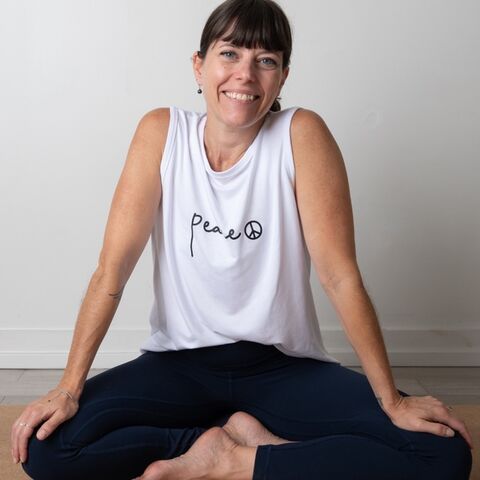
It will be best performed in a seated position with a tall spine.
If you're sitting in a chair,
Please sit a little further forward on your chair so your spine is tall and both feet are placed firmly on the ground.
Or you may choose to sit on the floor with your legs crossed in a comfortable position.
So let's first begin by simply creating awareness around our breath in this moment.
Without trying to change anything,
Let's notice if our breath feels shallow or if it feels deep and full.
Let's notice if we're breathing through our nose or mouth or a combination of the two.
Let's notice if we feel our breath more in the top part of our chest or if we feel it a little more in our lower belly.
Now let's just start to lengthen the breath,
Breathing in and out through the nose,
Slowing down.
We will begin to count our breath in and out,
Breathing in for a count of five,
Four,
Three,
Two,
One,
Slowly exhaling for five,
Four,
Three,
Two,
One.
Doing this a few more times,
Breathing in for five,
Four,
Three,
Two,
One,
Exhaling.
Five,
Four,
Three,
Two,
One,
Breathing in.
Five,
Four,
Three,
Two,
One,
Exhaling.
Five,
Four,
Three,
Two,
One,
Exhaling.
Five,
Four,
Three,
Two,
One,
Inhaling.
Five,
Four,
Three,
Two,
One,
Exhaling.
Five,
Four,
Three,
Two,
One,
Exhaling.
Five,
Four,
Three,
Two,
One,
Exhaling.
We will continue with the same count of breath,
However now taking our thumb and closing off our right nostril,
Breathing in only through our left nostril without our physical ability to like bodyato.
Now under our pretense test results,
Take a NR affecting our victim's brain,
Landing a M 1,
Exhaling 5,
4,
3,
2,
1.
Last time inhale 5,
4,
3,
2,
1.
Exhale 5,
4,
3,
2,
1.
Breathing again in and out from both nostrils.
Notice now if the breath has begun to slow down a bit.
Notice if there are any other sensations you are beginning to experience.
As we move into our next breath,
Breath of Fire,
Let's place a hand on our belly between our navel and sternum to give us a tactile reference point.
Once again,
The focus here is to create a pumping action with our diaphragm by contracting our abdominals,
Which then forces our exhale out.
Let the inhale come in naturally.
We will practice this breath today in three rounds of 21 pumps each.
We start with a big inhale through our nose,
Then exhale halfway before beginning to pump.
At the end,
Breathe the rest of your air out.
Inhale and exhale halfway again.
Let's begin.
Inhale.
Exhale halfway.
Begin to pump.
Breathe out.
Breathe in.
Halfway out.
Again.
Breathe out.
Breathe in.
Halfway.
Last time.
Breathe out.
Take a big inhale and hold.
Continue to hold,
Feeling the oxygen absorbing into our capillaries,
Refreshing our energy,
And slowly let go.
Slowly breathe out.
Breathe in and let our breath return to its natural flow,
Noticing any shifts in our awareness,
How we're feeling physically and or emotionally.
Notice the fullness of your breath as we continue to expand now into our three-part breath.
The beauty of this breath is that it can be used anytime,
Anywhere to help calm us and bring us into the present moment.
Let's keep one hand on our belly and now place our opposite hand on our chest.
As we breathe in through our nose,
We are feeling our breath expand into our chest,
Continuing to breathe in,
Now feeling the breath laterally in our rib cage,
Continuing to breathe in still.
Now our diaphragm presses into our belly,
Our belly gently pressing out,
And then slowly exhale.
The belly contracts,
The rib cage draws in,
The chest lowers.
Inhale again.
Breathe into your chest,
Feel your breath expand into your ribs,
Breathe right down into your belly,
And exhale slowly.
Three more times.
Big breath in,
Chest,
Rib cage,
Belly,
Exhaling belly,
Rib cage,
Chest.
Inhale,
Chest,
Rib cage,
Belly,
Exhale belly,
Rib cage,
Chest.
Last time,
Big breath in,
And slow breath out.
And then once again,
Returning to our natural rhythm of breath and pause,
Checking in with how we're feeling.
If you have the time today,
I invite you to sit here quietly for just a few more minutes to continue to feel the effects of this practice.
The more often we practice this meditation,
The more we will begin to experience the energetic shifts that our breath-based meditation provides.
Perhaps you may even want to practice this meditation daily.
When the time is right,
Please open your eyes and come back into your day.
Thank you for practicing this breath-based meditation with me.