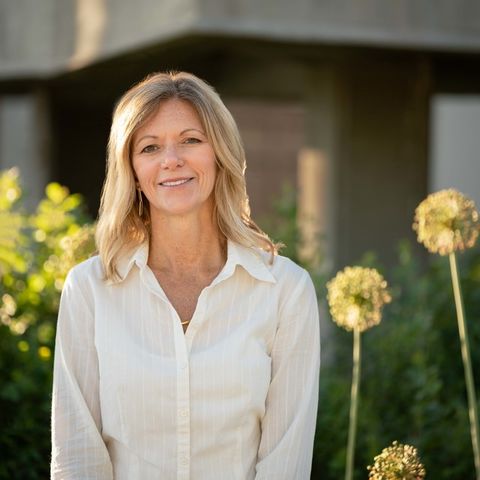
Welcome back to the Inner Compass Class,
Session 3.
I'm Michelle Walter with Life from the Summit,
And I'm so glad that you're here for Day 3.
Yesterday,
We explored Part 2 of the three-part framework for finding your inner compass,
Which was seeing the fork,
Where hopefully you got some clarity around the non-core values that have been getting in the way of honoring what is deeply important to you.
Now,
If you haven't listened to Parts 1 and 2 yet,
Please go back and do so before proceeding with today's lesson.
So today we're exploring the third and final part of this framework,
Take One Step.
Once again,
I invite you to find a comfortable,
Quiet place and grab some paper and something to write with.
So just to refresh,
We've done Part 1,
Which was find your direction,
Where you determined your core values,
What they mean,
And picked one core value to work with.
And in Part 2,
Hopefully you became aware of some non-core values that have gotten in the way of honoring your core values.
And you've also picked one of those non-core values to work with.
Today,
In Part 3,
Take One Step,
We're going to lean into honoring that core value more and lean away from honoring the non-core value more.
Any path between where you are now and where you want to go involves a lot of small individual steps.
Nothing,
Nothing happens overnight,
And nothing truly worth doing is ever easy or hackable.
When you set out to climb a mountain,
Either literally or figuratively,
You have to know where you're starting from and where you want to go.
But sometimes seeing that whole path in front of you can feel really overwhelming.
For example,
Any time I set out to climb a really tall mountain and I'm standing there at the base of it,
Looking up at the summit,
If I can even see the summit,
And I see the long,
Winding path that starts to get really small toward the top,
I often get so overwhelmed that I can't even imagine taking all the steps to get there.
And sometimes it makes me just want to turn back and go to the car.
That overwhelm can keep us from ever taking a small step down the path or down the fork that we talked about in session two.
We want to be able to release this overwhelm so that it doesn't stop us in our tracks before we even get started.
And to do that,
We want to focus on the next step right in front of us.
That step will start us down our path,
Down that fork guided by your core values.
When we focus on the next step and just that next step,
Not all the 500 million steps ahead of us,
It does two things for us.
First of all,
It allows us to have some humility for the journey itself.
Humility for where you are,
Where you want to go,
For each step,
And for the journey.
Without humility,
It can be easy to just fantasize about getting to the end of the path or to the summit.
And we can expect that we should be able to reach that end or that summit really easily or really quickly.
Without having some humility,
We live in the fantasy of the result,
The future,
As opposed to living in the present.
And I want to make a really important distinction here.
There is power in visualizing and feeling into your future vision.
For example,
There's a meditation I'll share with you as a bonus session here where we learn to get in touch with what it feels like to be aligned with your core values.
This is an embodiment practice that invites us to get in touch with how our body tells us if we're aligned or misaligned with our core values.
That is really important work to do.
And at the same time,
We want to invite in humility for the journey,
For the steps it'll take to make that aligned life happen.
So it's really a balancing act.
Embracing the vision and the feeling of the experience of what it's like to live in alignment with your core values on one hand,
Balanced on the other hand with the humility for the work and effort we want to do to create that experience.
We can't just sit back and fantasize or vision it into reality.
We have to have humility for the work and the journey along the way.
Having humility for every step and for that journey is how we learn to appreciate life,
How we keep focused on the next step and the next step.
The second thing that focusing on that next step allows us to do is to gradually step into an identity that you want to embrace without totally overwhelming yourself.
James Clear,
The author of the book Atomic Habits,
Explains that once you decide your identity and the who you want to be,
You can learn to step into this identity to basically prove it to yourself with small wins,
Small steps.
And this identity that we'll work with is informed by your core values.
As I said in session one,
Your core values are your why,
Your W-H-Y.
Your identity is your who.
And your who is informed by what's most important to you.
For example,
I have a value,
As I said,
Of compassion.
So I am someone who is constantly learning how to be more compassionate.
That's part of my identity,
The who I want to be.
So we're going to develop that identity for you,
The who you want to be,
And bring in humility for the journey of embracing that identity one small step at a time.
So I want you to go back to the one core value that you picked to work with from session one.
For that core value,
I want you to come up with your identity around that value,
An identity that you can step into gradually that will allow you to honor the journey of learning to align with that core value.
And let me walk you through how we do this.
We do this by developing a flexible identity,
Not a rigid identity.
We want to have an identity that will allow us to be someone who is learning how to honor that identity and our core value.
So for example,
Let's take my other value of growth,
And specifically physical growth.
That's kind of part of that larger value of growth.
If I want to embrace an identity of someone who honors that core value of physical growth,
My identity is not I'm a marathoner.
That's too rigid of an identity.
My identity also is not I'm someone who's going to lose 10 pounds.
That's also too rigid.
And the reason that those kinds of identities are too rigid is that they don't leave room for missteps.
There's no room for me to be human.
There's really no humility for my humanity and for the journey.
Those kind of rigid identities set me up for failure because then if I don't become a marathoner,
If I don't lose 10 pounds,
Then I feel defeated.
I feel like I've failed.
I beat myself up.
And all of that will create a greater tendency for me to just give up because I'll be too overwhelmed.
I'll feel too deflated.
I'll see too much ground to cover,
Especially if I take two steps forward and one step back in order to become a marathoner or to lose 10 pounds.
So I'll probably give up.
And I won't just give up on those goals.
I'll give up on what's really important to me,
Which is growth.
What's important here is not the tangible goal of doing a marathon or losing 10 pounds.
That feels important and it's not really where we want to put the focus.
What's really important is the intangible goal or the core value of growth.
So we want to create a flexible identity that allows us to take missteps,
That allows for days off,
That allows for two steps forward,
One step back,
That allows for some grace and compassion and humility on our journey.
So in my example,
A flexible identity could be I'm a runner.
Or even better,
I am someone who is learning to be a runner.
When we embrace the learning,
That really gives us a flexible identity.
That kind of flexible identity allows for learning and growth and expansion.
It allows for spaciousness.
It allows for small steps.
So maybe one day just putting on my running shoes is enough because it still means that I was able to embrace the identity of being someone who is learning to be a runner.
It still allows me to feel like I honored that core value of growth,
Physical growth,
By just putting on my running shoes,
By taking one small step.
And then maybe tomorrow I put on my running shoes and go outside or just stand on the treadmill.
I am then still someone who is learning to be a runner,
Even if I haven't run a step yet.
That flexible identity allows me the freedom and humility to take tiny steps.
It sets me up for better success because then all I have to do is take one step.
So now it's your turn.
There are four things that I want you to do.
So get your pen and paper ready.
First,
I want you to take that one core value that you chose from session one and write a flexible identity statement for it along these lines.
I am someone who is learning to blank.
I am someone who is learning to blank.
Pause the audio again if you need to to reflect on this.
And the second thing I want you to do is write down one small step you want to take today or tomorrow that will allow you to step into that identity statement.
Make it small and reasonable.
Something that is within your capacity to do right away.
Third,
Write down someone that you could share that step with and report to so that you're accountable.
This is your accountability buddy.
And let me give you some statistics on why this accountability buddy is so important.
There are some studies from the Association for Talent Development that says if you have an idea or a goal,
You're 10% likely to complete the goal.
If you consciously decide that you're going to achieve that goal,
You have a 25% chance of success.
Planning how you're going to do it,
Actually making a plan,
Gives you a 50% chance of success.
Committing to somebody that you will do it gives you a 65% chance.
And having a specific accountability appointment with that someone that you're committed to gives you a 95% chance.
95% if you have an accountability buddy and you have a specific accountability time appointment set up with them to check in.
I want you to have the highest possibility of success for your,
So I encourage you to find that accountability buddy.
And if you need someone,
Put me down.
Send me a message.
I'll be your accountability buddy.
And the fourth step here,
And please,
Please don't skip this step,
Is write down how you want to celebrate or acknowledge yourself for taking that step.
I know,
I know,
That sounds cheesy,
But it's so important from a neuroscience perspective.
We have something called a negativity bias,
Which means that we're wired to scan for and attach to bad or negative things.
But as neuroscientist Dr.
Rick Hansen talks about,
We can actually rewire that negativity bias a bit so that we can be happier.
We can learn to rewire our brains for more positivity by installing or sitting with the good feelings and the good emotions.
So let's bring this concept in here to honoring your core values.
We want to keep encouraging you to take these small steps toward honoring your core value.
So it's important to install the good feelings that come with having taken a small step.
That way you can remind yourself of what you did.
You can sit with those feelings.
You can rewire your brain to think,
I want more of that.
I want to take more steps to honor that core value.
So please write down some celebration,
I don't care how small,
That'll allow you to install the good feelings of having taken that first step.
Maybe it's calling someone to celebrate,
Like your accountability partner.
Maybe it's having a special treat or watching a funny show,
Taking a bath.
Once you've done those four steps,
Then we can rinse and repeat with your other core values when you're ready.
No need to push it.
And we're going to also rinse and repeat that same process for the non-core value that you picked.
Again,
You don't have to do the core value and the non-core value at the same time.
Maybe you want to do this four step process for all of your core values first and then come to your non-core values.
However you want to do it,
Just take your time.
No need to push it.
Okay.
Dealer's choice,
How you want to go about this.
When you're ready to move on to the non-core value,
Start first with the flexible identity you want to lean into.
So what's the flexible identity that you can create that encourages you to devote less time and energy to that non-core value?
So let's take my non-core value of perfectionism,
For example.
Instead of saying,
I'm someone who tries not to be perfect.
That's kind of rigid,
Right?
Instead,
I could say,
I am someone who is learning to let go of perfectionism.
See how we bring in that concept of learning again?
So now it's your turn.
Write your identity statement for your non-core value.
I am someone who is learning to blank.
Maybe it's learning to let go of,
Release,
Become aware of something.
And the second step here is to write down one small step that you can take to move away from giving so much time and energy to that non-core value.
Something that allows you to step into that flexible identity.
So for my non-core value of perfectionism,
Mine could be that the next email I sent to my email list,
I'm going to let there be typos in it.
The third step is write down an accountability buddy and check in with them.
It could be the same person for your core value or it could be a different person.
And the fourth step again is to write down how you want to be a better person.
Now I know that all of this might sound a little tedious at first,
But as you go along,
Trust me,
This process will start to feel more natural.
But in the beginning,
Until you've gotten some new habits and some consistency down,
I really encourage you to be accountable to what you're doing.
And I hope that you're doing it right.
I want to just pause here and say that if you seem to have trouble taking that small next step,
There might be a few tweaks you can make,
A few things to ask yourself.
So write these questions down.
Is this step small enough?
Maybe you need to back up the step to something even smaller.
Is it too big?
Is it too small?
Is it too big?
Is it too small?
Is it too big?
Is it too small?
Is it too big?
Is it too small?
Is it too big?
Is it too small?
Is it too big?
Is it too small?
Is it too big?
Is it too small?
Is it too big?
Is it too small?
Is it too big?
Is it too small?
Is it too big?
Is it too small?
Is it too big?
Is it too small?
Is it too big?
Is it too small?
Is it too big?
Is it too small?
Is it too big?
Is it too small?
Is it too big?
Is it too small?
Is it too big?
Is it too small?
Is it too big?
Is it too small?
Is it too big?
Is it too small?
Is it too big?
Is it too small?
Is it too big?
Is it too small?
Is it too big?
Is it too small?
Is it too big?
Is it too small?
Is it too big?
Is it too small?
Is it too big?
Is it too small?
Is it too big?
Is it too small?
Is it too big?
Is it too small?
Is it too big?
Is it too small?
Is it too big?
Is it too small?
Is it too big?
Is it too small?
Is it too big?
Is it too small?
Is it too big?
Is it too small?
Is it too big?
Is it too small?
Is it too big?
Is it too small?
Is it too big?
Is it too small?
Is it too big?
Is it too small?
Is it too big?
Is it too small?
Is it too big?
Is it too small?
Is it too big?
Is it too small?
Is it too big?
Is it too small?
Is it too big?
And let me leave you with this.
Remember to celebrate how far you've come,
No matter what that distance is.
The fact that you showed up for this Masterclass is three steps ahead of where you were before you started.
So honor yourself for that.
And know that I honor and I celebrate you.
Please reach out to me with any questions or reflections,
And especially if you have any celebrations that you have.
I love to hear people's celebrations.
And don't forget to subscribe to my channel.
I love to hear your thoughts.
And I'll see you next time.
Bye.
Don't forget to listen and bookmark the meditations in parts four and five.
I've been so honored to go on this journey with you.
And remember that this work of honoring what's deeply important to you isn't just for you.
The world is a better place when you are living in alignment with your core values.
Thank you so much for taking part in this Masterclass.
May you stay safe and well.