Hi there.
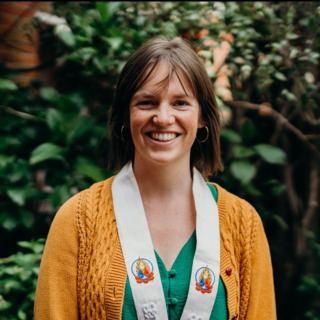
This is Dana Yatah at the London Buddhist Center and today we're going to be doing a guided mindfulness of breathing practice.
So to start off with,
See if you can sit somewhere where you'll be comfortable.
If you have meditation cushions and a meditation posture,
You might want to get into that.
Otherwise,
You might want to use a chair,
An upright chair,
That you can sit comfortably in for the next 20 minutes or so.
So I'll just give you a few moments to settle into your posture.
You might want to make sure that you feel upright and stable and that you've placed your hands in a position,
Perhaps on your lap,
Or support it with a cushion so that your shoulders can rest down and back.
You might want to support your hands with a cushion so that your shoulders can rest down and back.
Once you're in position,
Perhaps closing your eyes,
We'll spend a few moments cultivating awareness of the body before we turn more specifically to the breath.
So see if you can feel into your face and just encourage your face to relax,
Particularly around the eyes,
Around the mouth.
Can you feel the muscles in your jaw and your tongue?
Drawing your attention down the sides of your neck and into your shoulders.
It's encouraging your shoulders to rest down,
To rest back.
Feel down your arms into your hands,
Into your fingers,
And just encourage your fingers to be very still at rest.
See if you can feel into your belly,
Into the seat of your posture,
Your sit bones,
Your legs,
Perhaps your feet on the ground.
And as you stretch your attention through the body,
Just encouraging the body to be calm and to be still and steady.
If we want our minds to be calm and still and steady,
We need to support that with a body that's calm and still and steady.
Now let's start to cultivate more specific awareness of the breath.
As you turn your attention to the breath,
Be aware that you're not trying to breathe in any special way.
This isn't a breathing technique.
Rather,
We're trying to cultivate our awareness and we're simply using the breath as an object.
So in the first stage of the mindfulness of breathing,
We place a number from 1 to 10 at the end of the out-breath.
So we allow the breath to come naturally in,
Naturally out,
And at the end of the out-breath,
1.
Breath comes in,
Breath goes out,
2,
And so on up to 10.
When you reach 10,
Just start again at 1.
Just watch out for telling yourself to breathe and see if you can just breathe in the natural way.
Wait for the next breath.
So when you've marked 10 breaths,
Just start again at 1.
If you've gotten lost,
You've lost count or found yourself at 15 breaths,
That's okay.
Just start again at 1,
Marking the end of the out-breath.
You might spend a few moments noticing how it is that you're dropping in the numbers or marking the breaths.
You don't need to shout the numbers out to yourselves.
It can just be a quiet marking,
A bit like dropping a pebble into a still pond.
Trying to encourage the mind to calm down,
To start to gather the focus of our attention.
So the energy that we expand to do that,
Quality of energy is very important.
Now in the second stage of the mindfulness of breathing practice,
We mark the start of the in-breath again with a number from 1 to 10.
Just before the start of the in-breath,
1 breath comes in and breath goes out.
2 breath comes in,
Breath goes out and so on up to 10.
When you reach 10,
Starting again at 1.
Again,
Be aware if you're trying to force the breath into a particular breathing pattern.
It's allowing the breath to calm and just before the in-breath,
Placing a number.
One,
Two,
Three.
You're ready to take the breathing pathway.
Notice if you're dragging the number out along the in-breath.
If that's happening for you,
See if you can make the numbers quite crisp,
Precise,
Accurate.
Remember,
It's not the mindfulness of counting.
It's the mindfulness of the breath.
Primarily an exercise of mindfulness.
Now,
Let's take a deep breath.
Now,
Let's turn to the third stage of the practice.
In the third stage of the mindfulness of breathing,
We drop the numbers.
We're aware of the whole of the breath.
The dynamic flow of the breath as it comes in through our nose or through our mouth.
The process of expansion and contraction in the ribcage and the belly.
The rise and fall of the diaphragm.
You might notice the breath in the front of the body as well as the back of the body.
The back of your ribcage moves as well.
You might notice that some breaths come quickly in succession.
And at other times,
There's a long,
Spacious gap between the end of one out-breath and the start of the next in-breath.
And that slip doesn't move and you can give classical ‒ classic classical breath stress Again and again,
Bringing your mind back to the breath and the body.
And seeing if you can sustain your attention from one breath to the next.
And see if you can sustain your attention from one breath to the next.
Now as you move into the last stage of the mindfulness of breathing practice,
Very skillfully,
Slowly,
Carefully move your attention to the very edge of your nostrils or your lips,
Where the breath first comes in to the body and last exits the body.
We're trying to look for quite subtle sensation.
So don't worry if you don't feel very much or sense very much.
We're trying to encourage our attention to be one-pointed,
Subtle.
So the object of our awareness is one-pointed and subtle.
Keeping your attention at the edge of your nostrils or the edge of your lips,
And noticing the breath there.
It might just be a little bit of cool air coming in,
A little bit of slightly warmer air leaving,
And then gaps in between where nothing much happens.
So keep your attention at the edge of your nostrils.
Subtle awareness can be quite content with simple experience.
Keep holding your attention at one point.
Following the breath at one point.
Now as we begin to draw the meditation to a close,
See if you can relax your effort to focus your attention on the breath.
Just relax.
Feeling into the benefits of the practice.
And then when you're ready,
Just opening your eyes again.
Taking the world in.
So that's the end of the mindfulness of breathing practice.
I hope you have enjoyed practicing,
And hopefully see you at the London Buddhist Centre.