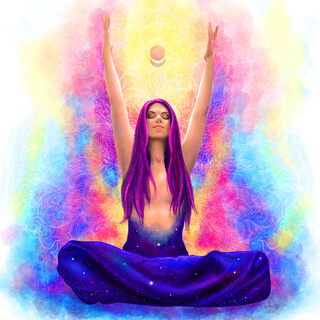
Meditation with a Yantra.
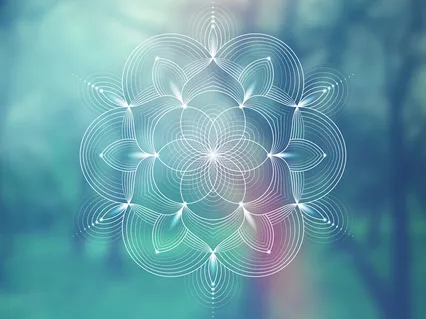
You will need your Yantra positioned at eye level around about an arms width from your body.
You will need to be sat in a comfortable seated posture,
Whether that is upon a meditation cushion or a chair.
So your upper body is upright and relaxed.
If there's a great effort required to hold your body upright,
You need to adapt your posture with more support.
So once you've sat,
Make sure you're comfortable.
Drop into your breath and close your eyes.
And as you close your eyes,
You can just connect to your body so you can feel yourself sitting here in your comfortable position.
You can feel your contact with your seat.
You can feel the lightly lifted posture that your body is held in.
And you can feel the flow of your breath moving from the outside to the inside of your body.
Softening your forehead and softening the space behind your eyes and between your eyebrows.
And then when you are ready,
Opening your eyes to allow your gaze to rest lightly on your Yantra.
We can allow the whole of the image of the Yantra in.
So you're not looking at a specific part of the Yantra,
But your gaze is just resting steadily on the whole image.
As we rest our gaze steadily on the whole image.
We try not to blink our eyes,
But of course,
If you need to blink,
You may blink.
But if we can relax the eyes enough so it's not a fixed hard stare.
But it's a soft welcoming in of that image.
Then there will be less urge to blink the eyes.
So we're just going to keep our gaze resting here.
Staying attentive to our breath,
Staying attentive to our posture.
And staying attentive to that image that we are taking in to our being.
We're now going to allow our eyes to close.
And as the eyes close,
We're going to allow that image to be visualized,
To be reflected in our mind's eye.
Perhaps you can visualize that image to be located between the eyebrows.
Or in your heart center.
Or it might simply just be present within your mind's eye.
The image may fade and it may come back so it may fade out of your mind's eye and then come back.
As you visualize this image,
We allow the breath to flow.
Slowly opening your eyes again to rest your gaze on that image once more.
As we rest our gaze on that image,
We can allow our relationship with that image to be a relationship of drawing that image into our being.
Perhaps with our breath we may feel that we can inhale that image in.
And as we exhale,
That exhalation is planted onto the image that we see before us.
Your eyes are soft,
Your forehead is soft.
So it's an effortless gaze,
It's an effortless trishti.
There is no barrier between us and the image that we see before us.
Closing your eyes once more,
Continue to see the yantra in your mind's eye.
Maybe that we can place that yantra between the eyebrows or our heart center.
Or it's just a simple visualization that we see.
Keep your attention drawn into that image within your mind's eye.
If your mind wanders,
If your attention wavers,
Bring it back,
Visualize the image.
Feel the breath,
Feel your body in your easeful position.
We're now slowly taking a slower,
Deeper breath.
And as you take that slower,
Deeper breath you may start to slowly open your eyes.
So again you can look towards your image.
And this time we're going to take a nice deep,
Full breath as we look at the image we're going to allow our eyes to open fully.
We're going to feel our seat.
We're going to feel our body and we may even place our hands somewhere specifically on our body.
To pat the hands onto the thighs,
To touch the head perhaps or our feet and to touch the floor.
To bring a sense of groundedness to close our practice.
And then again taking another deep breath before we fully close our practice.