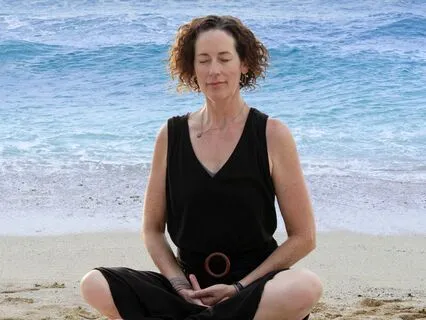
Finding a comfortable seat as comfortable as you can be in this moment.
Sitting on a chair,
A cushion,
Keeping your spine straight,
Sensing the possibility of relaxing your shoulders and any other areas of tension in your body.
If you're in a chair you can place your feet flat on the floor.
If you're on a cushion you can sit cross-legged with your knees touching the floor.
Whatever is most comfortable right now.
Rest your hands on your lap or on your knees with your palms facing up in a cup position or down.
Tilt your chin slightly down to align your head and neck.
You may keep your gaze soft looking down a bit in front of you or close your eyes,
Whichever is most comfortable.
We'll focus on our breath,
Directing your attention to wherever you feel your breath most.
That may be at the tip of your nostrils,
On your upper lip,
The back of your throat,
Your whole chest rising and falling,
Your whole belly rising and falling.
Perhaps noticing the inhale and the exhale.
If your mind wanders,
As it will,
Gently bring it back to your breath,
Letting go of any judgment that arises.
We just come back to the breath over and over.
You can also use other forms of an anchor instead of the breath.
Other kinds of sensations of awareness can be sound,
Can be touch,
Feeling your feet on the ground or your hands touch points.
These two can serve as the anchors that you return to as you notice your mind wandering.
When we do notice the mind,
We simply name what we're experiencing.
It might be thinking,
It might be remembering,
Planning.
We simply name it and return to the anchor.
Another level of awareness is physical sensations in our body.
We may notice an itch or pain,
Discomfort.
Simply bringing awareness to that area of the body without judgment.
Just really asking,
Can I be here with this?
Returning back to your chosen anchor.
If anything is too uncomfortable or too painful,
It's perfectly okay to make small adjustments.
Just do so mindfully.
You can start this practice with just a few minutes or extend out to five minutes,
10 minutes,
15,
20.
Some people find comfort in a guided meditation and others prefer silence as you wish.
Remember we're not trying to achieve anything.
Any practice is a perfect practice no matter how much your mind wanders.
You can use any timer to set a bell at the end.
Sometimes the bell will ring and you will have felt as if no time has passed and other times you will have sworn it's gone way over.
This is all part of the practice.