A direct registry of what's happening in us and to us at successive moments of our experience.
That's mindfulness.
Without going into reaction for or against what we notice.
So the practice of mindfulness is about not just observing stimulus,
But observing our reactivity to that stimulus.
And I spoke this morning and a bit yesterday about how the nirvana access is through agency.
Our human agency to choose how we respond.
And that takes effort.
To pay attention takes effort.
To watch ourselves takes effort and to lean into and notice patterns of our reactivity,
The short circuitry of our triggers.
Neuropsychologists have studied the responsiveness of the nervous system to triggers.
And they've seen in conducting kind of electric experimentation with brains wired that it takes three milliseconds for the system to respond.
That's about half of a second.
And so neuroscientists are calling this the three millisecond miracle that it takes such a short time for us to process and then decide what we're going to do about a certain event.
That's the definition of survival.
And as complex as we like to think we've evolved in the past several thousands of years,
We're still wired neolithically.
Our nervous system is still that of a caveman.
So we're wired for survival when a saber-toothed tiger walks into the cave.
It's the kind of glorified but simple technology of fight or flight.
It doesn't take long for our system to recognize threat and act on it.
Whether it's saber-toothed tiger or being stuck in traffic or an email from your boss or you know a text from an ex-lover.
When the amygdala and the insula start to sound the alarm,
Right,
That's the intellect center,
The intelligence center,
Then the body can recruit whatever is needed in the kind of inner resources to fight it off or to flee or to freeze which is another wing of survival responsiveness.
So it doesn't take long to set us off.
And when there are severe threats to our existence,
We'll be grateful for that rapid fire responsiveness.
But it's not often that our survival is threatened to the degree that our inner states are heightened and triggered.
So we really can't discern from a saber-toothed tiger to an overloaded Gmail.
It's scary all the same.
And we feel,
If even for a moment,
Unsafe.
So what we do in a mindfulness practice is try to lengthen the time between the first wave of experience,
Which is the onset of an event,
And the second wave of experience,
Which also informs our reality,
How we respond.
And that was a radical insight of the Buddha.
It's not the stimulus itself that informs if we're suffering.
It's our reactivity to it.
Does it trigger us?
Are we quick to fight?
We want to create space to see what's happening to us and choose skillfully how to move through it.
So mindfulness is the study of what's going on right now.
Because what's happening to us is of utmost importance.
We'll need to get very clear about what exactly that is so we can choose how to skillfully respond to it.
Is that thing he said as big of a deal as I'm really making it out to be?
And if it is,
How do I want to engage with this material?
So Thit Nhat Hanh says the ocean of suffering is immense.
Because that first wave of experience can be a tidal wave and we can drown in it and feel completely oppressed by whatever is happening.
And then he also goes on to say if you turn around,
You can see the land.
You can see the impermanence of that first wave.
This is intense.
It has a climax,
Which means it will peak and it will dissolve.
And then I can swim to shore,
Catch my breath,
Feel the earth,
Bake in the sun for a moment,
Remember my Buddha nature,
Which is the belly wisdom,
The horror perspective that no matter what I'm swimming through,
I can find stability and stillness.
So the mindfulness practice really becomes that laboratory for experiencing all of the different waves and researching the vividness of life in all of its qualities and that's the 10,
000 joys and the 10,
000 sorrows.
So that we can get a little bit more clear in an uncluttered way about how we're feeling and how we want to respond to what we're feeling.
So I'll just give a personal example of that.
Let's see if I can call upon one that has a storyline that will be supportive.
So we use mindfulness as a practice grounds to breathe that type of space that I'm speaking about,
The space between the first wave and the second wave of experience.
If we can sit for a moment,
Particularly in the morning before the waves start crashing and experience stillness of mind,
Luminosity of heart,
Stable Buddha nature of the belly,
And just know that that's true for us,
Then that will be really helpful because we don't know what's in store after that.
So there was a morning practice probably about a year ago now where I knew I had a really busy day.
I had a friend and colleague coming over to the house.
We were going to do kind of a work retreat together.
We had a lot to plan.
So I knew that was happening.
I knew that I had just a wealth of emails to get to and that at a certain time in the day I'd have to carve out time for physical activity because there are parts of me that really need that stimulation.
Knowing that I also had to get breakfast on the table and probably had a load of laundry and all of these things,
There was a moment where I just watched myself balance between just starting to get things done for the day.
Like,
Should I just start a whole list of things to do?
If I miss my meditation practice this morning,
That would shave off 20,
30 minutes.
I might feel a little bit more spacious.
And I can see myself now just like perched at the top of the stairs.
Like,
Do I turn right into the practice space or do I go downstairs and make a smoothie?
I could just hover for a moment.
How important is this now?
Checking in,
Like I feel okay.
I had a nice practice yesterday.
I could probably get by and nobody would know.
But I took a seat.
And you don't remember the particular practice and what occurred and it was probably pretty bland.
Bell rang.
I sat.
I let time flow and then the bell rang again and I got up.
And then my friend came and the day started and she had just been nursing an injury.
She had broken her leg a few months before and was just starting to walk again and had been a traumatic break for her and not the first time that she's been laid out in a cast for months on end and relearning and rebuilding.
So there's a lot of sensitivity there.
We're up in the workspace upstairs and she gets up to go get a cup of tea.
It was probably coffee for her.
And she goes down the stairs and I have had at that time a big wooden staircase,
An old house in Boulder.
And I just hear her slide and tumble and thump,
An immediate three milliseconds,
Right,
Till her nervous system says,
Oh shit,
I've just gotten back on my feet again.
So there's a big emotional alarm that she's exuding and it's scary and I rush over,
Of course,
And run down the stairs and find her crumpled at the bottom of the staircase.
And by the time I get there,
She's in hyperactivity and in the sympathetic state where fight or flight lives.
So there's chest breathing.
It's short,
It's erratic,
It's staggered,
It's sharp.
And she's crying and she's in panic.
And at this point,
Almost a full-blown panic attack.
And that was when I was so grateful I had had my practice that morning.
Because even if there was a moment in that seated meditation where I remembered what stillness felt like,
I could pull it to the foreground more effortlessly.
And had just a lucid moment of recognition that whatever just happened has already happened.
So I'm not going to freak out.
I'm just going to respond.
And took a few breaths with her.
And just because of limbic resonance,
Because our brains are all wired together to pick up on other people's emotions,
If I'm calm,
The brains in the room will want to gravitate towards a slower tone and resonate with that frequency with me.
So I start breathing slower and I come into the belly.
And I just observe her for a moment to see how severe the situation actually is and untangle it from what really happened and how she's responding.
Has the bone that's just been set been re-broken?
Is there some other acute danger?
And if that is the case,
I'm gathered enough to make the phone call that I need to make and do what I need to do.
But as I'm breathing and watching and just asking her,
What are you feeling?
Like we're both able to come to the table and recognize that it's more of an emotional response,
Thank God,
In this situation than a physical one.
And she says,
I think I'm just really scared.
And I'm noticing like the chest is starting to slow a little bit more.
And I ask her if there's any acute pain.
And she says,
No.
It's more of like a broad buzzing of fear in the pain body.
So okay,
Can you move enough to just get you to lie down?
Yes,
That seems okay.
So we put her on the floor and put a blanket kind of rolled up under the base of her skull and just lay her down for a moment so we can reset and just see what's going on and bring her back into coherence.
And that was all it took.
And that whole thing probably happened in a span of a minute and a half.
And you know,
In this particular moment,
There wasn't an acute trauma to address.
But if there had been,
I probably would have been more skillful at it because I wasn't in reactivity response.
There was just a stable place in me for that moment,
Because I had just practiced that I could draw upon.
And then the fear of falling and the trauma of re-injury is softened in her the next time she slips,
Which will happen again.
Knowing that there was a kind of safe shore to swim to and just assess what has just happened and what needs to be done.
So we don't know what will be asked of us.
And I've had other occurrences where it does become an acute trauma and someone has an epileptic fit and goes into seizure and then,
You know,
We need to act stringently.
But the waves that are crashing around us,
We don't have a choice about,
Matcha.
And we will drown in them if we don't practice how to stay afloat.
So these Buddhist constructs,
The teachings of the Dharma,
Which I love the Dalai Lama says it's not a religion,
It's a science of the mind.
The suggestion is don't take them as dogma.
Don't take whatever I offer this weekend as truths.
Bring them to the laboratory.
Experiment.
Is this helpful?
Am I successful in navigating when difficulty emerges and when the universe does what I don't want it to do?
Can I hang?
So train in them,
Train in the practice and see if there's an impact.
Because there are certain visualizations,
There are certain mantras,
There are particular practices at lengths of time that are suggested in these teachings to cultivate these attitudes.
But fundamentally what it's really about is just connecting back in to the places in you that know how to respond and not react.
The inherent baseline we have of ease and tranquility and stability,
Buddha nature.
All of these practices and these poses are about remembering who we really are.
So the Tibetan book of the dead has a line that's repeated again and again.
Oh you who are the sons and the daughters of the awakened ones,
Remember who you really are.
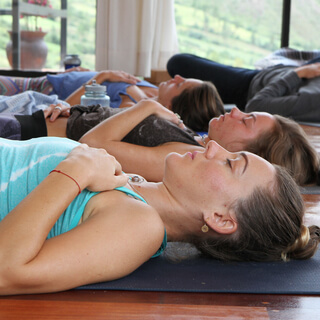
So let's lie down and remember.