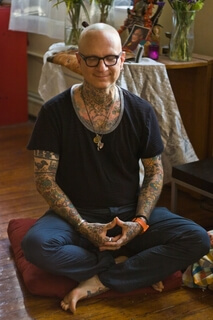
And tonight's talk is coming out of the lockdowns and the social distancing,
Returning to the world of interpersonal interactions.
So social anxiety that has developed over the course of the pandemic.
I was actually reading that the census bureau does a pulse survey where they actually take the temperature of our nation's mental health.
And boy,
Is it grim reading these days.
In 2019,
Before they did the study in 2020,
Obviously about 10% of the people who filled out the survey,
Registered symptoms associated with generalized anxiety disorder or GAD,
When that poll was taken in 2020,
It went up 300% to 30% of all adults showed symptoms of generalized anxiety disorder.
And what was even more concerning was that fully one out of every two individuals who lived alone showed and displayed the symptoms associated with anxiety disorders.
So I thought,
Given the themes I've been hearing in the counseling and reading this fact that,
Um,
It's,
There's certainly a preponderance of individuals who have been experiencing some degree of discomfort at the thought of returning to the interpersonal sphere of,
Um,
Social interactions.
So we'll be discussing what causes,
Uh,
One of the,
Not all of the causes,
But some of the causes of social anxiety,
Especially why it's been exacerbated by during the pandemic and what to do about it.
So general anxieties are triggered by unconscious memories stored in very often the right temporal lobe organized by the right amygdala.
These are all right.
Amingla is a very fast and dirty preconscious region of the brain.
And your amygdala gets a very early,
Uh,
Impression of everything that's going on around you well before consciousness becomes aware of the becomes aware of what's going on,
What's happening.
Your amygdala gets a kind of early,
Uh,
View of all the incoming sensory impressions.
And what it does is it's constantly in the background,
Looking on the lookout for anything in the present that resembles in any way,
Something that was scary in the past.
So for example,
If in childhood,
When you were four,
If you got bit by a German shepherd,
You might have entirely forgotten about that German shepherd.
You might've forgotten about being bitten,
But unconsciously your right temporal lobe holds that memory.
And your amygdala is scanning through the present,
Looking for anything that's associated with danger.
And if even as an adult in your forties or fifties,
If you see a German shepherd,
You might actually fear experience your heart racing,
Your gut muscles contracting,
You might suddenly find yourself freezing or whatever.
Um,
So as an ongoing basis,
Our amygdala is,
Which is a preconscious part of the,
Uh,
Midbrain is scanning through all the incoming sensory impressions of the world and just looking for anything that reminds us of something that was scary in our past.
This amygdala gets a very early view of incoming sensory impressions.
And it's a very fast and dirty,
Uh,
Uh,
Information that's coming in.
So we can very easily,
For example,
Mistakes sticks on the ground for a snake and instantly react with action potential or HPA accesses in our brain,
The hypothalamus pituitary,
The adrenal glands,
All jump into action,
Release cortisol,
Fight flight impulses,
And all of this can happen in a 10th of a second.
So we have these fear memories.
They're very durable,
Which means they don't,
They're not extinguished easily.
They last for years and years,
And it's very difficult as anybody knows,
Who's had panic or anxiety disorder,
It's very difficult to override anxiety.
Once it's instilled,
If you have an anxiety or fear of heights,
You can try to be logical with yourself all you want,
But it's a preconscious,
Deeply ingrained circuits that are,
Uh,
The right hemisphere,
Uh,
Circuits are very over-determined lots of different connections.
So they're difficult to extinguish.
They're automatic.
We don't have any,
Generally any ability to override and they're context free.
So anything that reminds us of a past unpleasant event,
No matter what the context is,
Can still activate anxiety.
Now you'd think then the only things that cause anxiety for us are unpleasant events from the past.
And so if something,
If something in the present,
Uh,
Is not resembling something in the past that was scary or unpleasant,
Maybe it wouldn't trigger anxiety,
Uh,
Unfortunately there's a part of the amygdala,
The basal nucleus of the amygdala,
In fact,
For those keeping score at home that links avoidance with fear.
So it's not just things in the past that were terrifying that trigger us.
Anything in our life that we're avoiding over time becomes scary,
Becomes perceived as a threat,
Even if it's actually not particularly threatening.
So for example,
If you get on a bike,
You have a,
You have a accident that's not particularly dangerous.
You fall over the side,
Scrape a knee,
And then you get up and you decide,
I'm not going to ride my bike back.
That was a little scary.
I'm just going to walk my bike back home.
And then for the next few weeks,
You decide,
Yeah,
I think I'll skip riding my bike and then weeks turn into a month or two,
Then when you get back on your bike,
Because you've avoiding it,
Avoided it,
It will become scary.
You might very well start to have your,
Uh,
Heart rate increase above 120 beats per minute.
You might start to feel the blood rushing up into your extremities.
You might start to have the looping thoughts of associated with,
Uh,
Concern about what might happen and so forth.
So another example would be,
Um,
Suppose you go through a lot of people would be,
Um,
Suppose you go through a breakup with someone.
And after that breakup,
You decide I'm never going to,
For a long while,
I'm not going to walk around their neighborhood.
I just don't want to run into them for any reason.
So I'm just not going to take a walk in Greenpoint for a while.
And then months turn into a year.
And now you go,
Somebody invites you to go out to dinner in Greenpoint.
And then you walk into Greenpoint and you start feeling actually nervous and anxious because you've been avoiding it.
So any,
It's not just things that are associated with past wounding events that become scary.
It's also anything that we avoid long enough.
The basal nucleus can link what we're avoiding with threat,
A sense that,
Uh,
This is something that could hurt me.
And it uses the exact same over-determined fast circuits as fear memories.
So guess what a year of social distancing,
Where we've been avoiding,
Uh,
Unnecessary social contact with people in and of itself could associate social interactions with fear,
With anxiety,
Because we haven't been connecting with people.
Now it's not just the fact that we've been avoiding social contact or me,
At least a lot of us who've been following the,
Uh,
Suggestions.
Um,
There's a region in the brain,
The dorsal anterior cingulate cortex,
Which is,
Um,
And I think the parietal lobe,
I'm not sure.
Uh,
But the dorsal anterior cingulate cortex has been shown to be the social monitor in the brain and it's constantly monitoring how well connected we are with other people.
And when the social monitor,
The dose dorsal anterior cingulate cortex notices that there's a decrease in our social connections,
It changes the neuro violence of neurotransmitters.
It actually lowers,
Uh,
Serotonin and it actually can lower endorphins.
Uh,
It actually lights up when it feels that we're not as well connected.
Why does it do this?
Why is there a region of the brain that cares so much about how well connected we are with others?
Well,
Of course,
Over the course of human evolution,
Being connected with other human beings is what allowed our species to survive.
We're not a species that ran fast,
Could fly.
We don't swim particularly,
Uh,
Like fish.
Uh,
We don't have shells like turtles or other species that have shells to protect us.
We don't have claws so that we can fight very well.
We're not even particularly fast when,
When we move.
So when we have exposed,
Uh,
Organs that are not that well protected.
So in terms of simply fighting for our lives,
We're actually not that well equipped as a species,
But what we are well equipped to do is to bond into affiliations and mutually protective bonds with others so that,
You know,
If we are in a threatening position,
Whereas other species normally run or fight or fly away.
What we do is the species connect with others,
Build alliances.
And if three people are bonded,
They can overcome a predator much more efficiently than one person by themselves.
So over the course of evolution,
People,
Individuals who bonded well,
Were the ones who passed down their genes.
And over the course of human evolution,
Due to the fact that those who survived were those who bonded and maintained affiliations.
Uh,
Now we have this region and when our affiliations drop,
Then what happens is to notify us that we're in increasing what,
At least what would have been danger in our past,
The brain will sec,
We'll lower the secretion of,
Um,
Endorphins and serotonin.
So normally as well for a third reason,
Why the pandemic can activate,
Uh,
Our social distancing can activate social anxiety.
Normally we have ongoing concerns about how well other people view us,
How,
Whether we are,
Uh,
Thought about positively or negatively,
We have ongoing social concerns that have been wired into us by evolution,
Of course.
And we have worries about,
As I've said,
Social rejection.
If you have ongoing regular interactions with people,
You get used to awkward social,
Social situations.
You get used to awkward pauses in conversation.
You get used to seeing people whose,
Uh,
Whose,
Um,
Whose eyes or facial expressions you can't make out.
Uh,
What happens when we have ongoing social interactions is our fears of social rejection or,
Uh,
Being viewed as incompetent or worthless by others is overridden by actual experience.
Our actual experiences day in and day out,
We have reaffirming positive interpersonal interactions that show us that we're still well solid,
Solidly connected with others.
And that allows us to,
Allows us to lessen our worries and it allows us to alleviate our concerns about any form of disconnection or rejection.
Which is so important to our species.
But of course,
Get over the last year,
We haven't had those robust interpersonal interactions that can disprove our fears.
So there's far less regulating those fears.
And even if you did have a lot of interactions,
Many times the interactions happen when there was a mask over your face.
So you couldn't actually see the nonverbal cues that were being sent to you by others and much of the nonverbal cues that people send to each other by facial expressions are what alleviates our concerns about being criticized by others.
You might've noticed in your life that if you text a lot,
A lot of misunderstandings happen over text,
Because you don't have nonverbal cues.
To help you interpret what the texts are saying.
But if you can't see people's facial expressions,
Again,
You're deprived of a way to understand and make sense of any verbal statements that have been made.
So once again,
Yet another reason why over the course of the pandemic and social distancing,
Social anxiety has tripled in the last year.
It's tripled in just one year from 10% to 30% of the population and 50% of those who live alone,
The anxious brain acts as if a threat is always present.
It's the threat for the anxious,
The socially anxious brain.
The threat is not a predator.
It's not starvation.
It's not,
Uh,
The threat of being attacked.
The threat for those of us who have any social anxiety is the sense that others will judge us,
Will view us as somehow flawed or incompetent or useless or unworthy,
And this ongoing concern leads to a host of stressful states internally.
The first is of course,
We become hypervigilant and start monitoring other people's facial expressions,
Looking for even the slightest hint that they are negatively evaluating us.
So,
Uh,
What happens is it creates an ongoing task and a task that's actually quite stressful for working memory.
We have to,
While we're trying to think of what we're saying and doing,
We also at the same time,
Feel the need to constantly monitor other people's,
Uh,
Eye contact and expressions and body language for any sense of,
Uh,
Disapproval.
On top of the ongoing monitoring,
It also has,
Is notorious social anxieties,
Notorious for activating self-conscious ruminating thoughts along the lines of after we say something,
Thinking,
Holy shit,
Was that a stupid thing to say?
It makes us awkward.
We become stiff.
We become,
We struggle to relax.
Our bodies become tight.
Our heart rate rises and we start to become aware sometimes if it's really acute of ourselves sweating or a heart pounding or a sense of overwhelm.
If this happens enough,
It can turn into full social anxiety disorder,
Which is essentially a chronic ongoing worry,
Worry of embarrassing ourselves or being a judged as less than by others.
It's a hypervigilance that never switches off,
Especially when we're around others.
And so over time,
Any form of social anxiety or general anxiety,
Generalized anxiety disorder leads to avoidance coping.
We start avoiding situations and people that could trigger the anxiety.
So the anxiety grows.
And of course,
The more we avoid social interactions due to the basolateral major,
The scarier social interactions become and the more anxiety it triggers.
So social anxiety activates avoidance coping that makes social interactions even more scary.
So it's a feedback loop.
And on top of that,
Finally over time,
Social anxiety can exacerbate core shame.
What is core shame?
Core shame is an underlying feeling that there's something wrong with me,
Something unlovable about me.
And so it's a,
It becomes then a chronic sense that there's something that we have to hide from others.
There's something that others will see in us.
That's unlovable.
Now those facing social or any form of anxiety for,
Without any prior experience will struggle more,
Not less.
We like to think maybe that people who've struggled with it,
Um,
Maybe are the ones who would just be crestfallen or by it or triggered by,
But actually,
Uh,
Those who haven't experienced anxiety disorders up until now will struggle far more because they've never had to manage the symptoms and the underlying roots of anxiety disorder.
So it can be very disconcerting if people haven't had up until this point,
An underlying discomfort around groups of people,
Interpersonal events,
Interacting with colleagues,
Going back to an office or whatever.
And of course,
Due to the complex associative nature of the circuits in the right hemisphere that govern anxiety and withdrawal emotions and impulses,
Social anxiety is extremely resistant to willpower and inhibition.
It's far too fast and early,
Preconscious in its activation.
So it's notoriously difficult to alleviate.
And yet that is my job as a Buddhist pastor to share some of the tools and techniques that actually allow us to become more,
Uh,
Adept and comfortable when we interact with others without becoming experiencing.
Or experiencing as much of the distress of the mind,
The stress associated with social anxiety.
So what are the ways we address it?
Well,
Every cognitive behavioral therapist,
Of course,
Will espouse a very useful tool,
Which is known as incremental exposure.
We rather than jumping back into our life after,
Or as the pandemic begins to wane out,
Or at least as numbers go down,
Rather than rushing back in to the world and going to,
Uh,
Bars or restaurants that are crowded or,
Uh,
Situations where we're surrounded by others or events where we have to perform or,
Uh,
Anything of the sort,
We start by connecting with those who are in our inner circle,
People who,
Um,
In the past we've associated with security,
Uh,
Support,
Somebody we find it easily easy and comforting to be around.
And we just start with small,
Small interpersonal gatherings,
One or two people,
Three or four.
And then we reach out to individuals that we're slowly warming up to and expand our social circle to include eventually some situations that trigger some nervousness or discomfort,
But not throwing ourselves in too quickly.
The goal of most cognitive exposure therapy type projects or,
Uh,
Approaches,
I should say to anxiety is to take our time to socialize at our comfort level and push ourselves each time to open the circle wider,
Or to include situations that are a little bit more challenging for us.
And frankly,
Since there's not going to be anybody holding a gun to our head,
I hope to make us rush back into the world too quickly.
This is right now,
April,
2021,
The perfect time to start incrementally interacting with individuals.
The second is,
And this for me is even more important to tool than incremental exposure.
I find this to be one of the most invaluable approaches to working with anxiety.
Disclosure.
Disclosure is revealing to others,
Whatever internal situation or,
Uh,
Or symptom we're struggling with to reveal our nervousness,
To reveal the fact that we're anxious to not try to conceal it.
Now,
Why is this so important?
Well,
When we fail to disclose our internal experience to others,
It actually sets up a notorious feedback loop that makes anxiety worse,
Which is the following.
We have to try to seem natural and comfortable.
Yet at the same time,
We have to monitor if other people notice that in fact,
We're not comfortable and relaxed.
So we have to excessively pay our attention to the subtleties of their facial expression,
Looking for even the slightest cues that they have spotted something in our demeanor.
That is a giveaway of our internal lack of comfort or anxiety.
And then at the same time,
We have to maintain an awareness of whatever it is we're talking about or whatever's going on.
So that's a classic menu or ingredients,
I should say,
For cognitive overload.
It's very,
Very difficult to be relaxed,
Present,
Interactive if our brain is not only monitoring our internal state for anxiety,
But monitoring other people to see if they spot the anxiety while at the same time,
We're trying to be relaxed and funny and witty or whatever it is.
So numerous studies have shown that one of the most efficient ways to alleviate anxiety is to disclose it.
Locke and Culligan,
I think in the 1980s,
Did a classic studies that showed the less that people disclose and express their internal experience,
The worse their anxiety becomes.
And another study by,
I can't remember,
Feldman and Johnson or something,
And 2008,
Self-disclosure released people from the concerns about what other people are thinking about them and allows them to focus more on their anything else,
But essentially all the worries about monitoring other people and what they're thinking about us as well as the ongoing inner narrative of,
Oh my God,
I don't feel relaxed.
I hope this stops and whatever.
From a personal angle,
I can say that there's many social settings where I don't feel particularly comfortable.
As I've noted quite a number of times over the years,
If there is a least favorite thing for me to do,
It's going to people's weddings.
I don't like camping and I don't like weddings.
I don't really like camping because I'm a Jew and I think my people spend 40 years in the desert,
So we never have to go camping again.
Camping always seems like an evolutionary,
Like we're slipping and sliding backwards.
I always thought that we camp so that we could eventually live in buildings.
I think that's a good thing.
But anyway,
Nobody cares about what I think about camping.
Most people actually like it quite a bit,
But weddings.
Oh my God,
Those are not to be accepted.
There's no excuse for throwing a big wedding.
I find them to be just a horrific experience because what happens?
Well,
You get set at a table and you're just sitting there and you're like,
What happens?
Well,
You get set at a table with seven complete strangers that you don't know.
And generally in my case,
Because I'm a Buddhist pastor and I'm tattooed,
People will put me at a table with the strangest oddballs in their entire family because they go,
Well,
Josh is kind of a Buddhist.
I am a Buddhist,
In fact,
But he's like weird.
He can accept and deal with pretty much anyone.
Anyone will put our uncle Mort who once went to India at the table with him because they'll have something to talk about.
So anyway,
I never know what to say at weddings.
I'm just not gifted at wedding small talk.
And the only way I can ever find and make any bonds with people at weddings at the dinner table,
Especially is when I say,
Boy,
I find sitting at dinner tables at weddings really awkward.
And then believe it or not,
Over the years,
I've made quite a number of friends at weddings because they go,
Yeah,
I really hate sitting at tables with strangers too.
And then we have all kinds of fun conversations.
And plus either way,
I don't have to sit there hiding the fact that I don't enjoy or I find the experience rather difficult.
So disclosure,
The best way.
One study showed that when people disclose the fact that they have anxiety speaking in front of people,
It was the most efficient way to down,
Regulate their heart rate and their skin valence simply by saying,
Yeah,
I'm not that comfortable speaking in front of others was the most efficient tool to alleviate anxiety.
Now the third tool is shifting the spotlight.
Attention is like a spotlight.
What we focus attention on grows bigger and more prevalent in our life.
Here's the problem with attention.
If you don't actively focus your attention using your volitional will,
Your right singulant will take hold of your attention and just move it around and what will it move it around to?
It will move it around to any sensation or sensory impression that it thinks might be a threat.
That's the job of your right hemisphere to monitor the background for ongoing possibilities of threats or where are the unknowns of any given situation.
So if we don't take hold of our attention and focus it and learn to guide it very often our right singulant will take our attention and pin it to the most distressing sensation or internal experience in any setting.
And guess what?
Very often that will it will focus our attention first on our anxiety and then it will focus our attention on the automatic thoughts associated with our anxiety.
So the key is to focus your attention on something that's not stressful.
To orient as we say in psychology to safety cues in the environment.
This regard requires practice.
For most people they only guide their attention a little while in any given day and most of the time they just allow the unconscious mechanisms of the right hemisphere and midbrain to guide attention.
And so we're prone to stressful default automatic thinking.
To alleviate anxiety we have to learn to guide our attention to the safe easeful sensations and experiences in any room.
So for example if you don't focus your attention and you're giving a talk your right singulant will find the person is giving you the least friendly expression and pin your attention to that one person.
You would think your brain would not want to focus your attention on the one person who's frowning or giving you a negative expression but no the right brain which controls the tension when we're not actively guiding our attention will look for the single threat and it will find that person who's scowling or frowning or has got their arms crossed or who looks unfriendly and will pin us to that person.
So it's very much a key the heart of reducing anxiety is focusing away from our internal rumination,
Focusing away from the sensations of our heart fluttering or stomach becoming tight or any gastric distress and to find something in the environment that's soothing.
It could be a nice painting in a room it could be a look out of a window it could be someone who's actually looking at us and smiling it could be anything but resting our attention on something that is pleasant.
Shifting our attention away from how others perceive us focusing on sensations that are soothing.
The neuropsychologist Sarah Lazar of Harvard Medical School showed that 20 minutes a day of concentration meditation actually diminishes the size of the amygdala making us less reactive less anxious and less triggered by external or internal triggers.
So again practice focusing your attention at all times develop that muscle the ability to pull your attention away from things that worry or distressing towards things that create a sense of safety.
Last final two notes before we jump into the meditation it's very important to rather than view anxiety as something to be ashamed about or pushed away to allow ourselves to be scared.
As we say in the dharma world what we resist persists.
Instead of reacting to anxiety the dharma focuses on learning to be with fear rather than trying to hide it or conceal it.
One of the oldest Buddhist teachings the five daily recollections goes I'm of the nature to grow old become sick to die separate be separated from the loved and all that I own are the quality of my actions.
But we could add to that list I am of the nature to be anxious at times.
Rather than view it as a mistake or something to be ashamed of or hidden we move to the idea that this is just another part of being a human being.
One way I've also put it in my own practice is we're trying to move from but to and but thinking is I would like to travel but I get anxious when I'm on a plane so I can't travel.
We move to and thinking which is I like to travel and I get anxious so I still do it even though I know I will experience anxiety.
Knowing we're going to experience anxiety in certain settings for a while we welcome it we don't try to push it away and in so doing we actually mitigate the feelings of anxiety we focus less on it we're more likely to focus on other sensations.
Remember even if it seems that other people are relaxed and eager to get back to life in the world one we can't see their internal experience we are generally comparing our insides with their outsides that's never going to work no one's been through a pandemic before so there's no right way to do it there's no right way to go back into the world either.
Lastly a couple of notes it's very worthwhile to practice good self-care if we exercise regularly that secretes endorphins and why does that matter listen endorphins not only make us feel better less tired in our bodies less pain makes us feel a sense of bliss but endorphins bind to receptors in the autonomic nervous system and when they do dopamine is is secreted as well so when dopamine when endorphins are released eventually dope when endorphins are released dopamine is eventually released dopamine makes us feel smarter more capable and thus it also is a wonderful way to alleviate anxiety.
Lastly visualizing situations that are scary and softening the embodied response or visualizing situations that are scary in practice while you do that visualizing someone that you trust being there creating what we call a resource resourcing having a sense of what a friend would tell you or what a friend would say while we're in a scary situation allows us to diminish the sensations associated with social anxiety so that said we're going to actually practice a lot of these tools in our meditation so my strong suggestion is to find a position that's really comfortable where you can relax and meditate and for this practice let's really focus on finding a really comfortable position while you do that i'll just gently remind that everything i do is supported entirely by donations that's how i as a buddhist pastor live so if you'd like to support my work the venmo is dharma punks with an x nyc so that's my pitch and now let's find that position and i'm going to take off my glasses and i'm going to close my eyes and i'm just going to start to reel back my attention from the world around me all the for a moment all the the sights and sounds and i'm going to reel my attention away from any thoughts that are popping up automatically in my mind and i'm just going to find a really pleasant sensation in my body any find the most pleasant sensation in your body it could be the very often my palms feel very relaxed or if your belly is relaxed it could be just that expansion without any contraction in the abdominal muscles or it could be the breath as it expresses itself and the air flow coming in the diaphragm expanding and then releasing it could be if you don't want to work with internal sensations find the most pleasant sound that's in your environment it could be the soft background murmur of distant traffic or cars or it could be sounds of nature it could be sounds of people talking outside or it could sometimes i've used in my practice just the closed eye visuals when we close our eyes sometimes patterns of light firing or retinal firing creates strange almost vaguely psychedelic impressions behind closed eyelids those can be very pleasant so just resting our attention on any sensation internally or externally that is soothing practice keeping our attention on a soothing ongoing sensory impression something that is present that we don't have to put any effort into now if the sensation is internal the palms of your hands a feeling of warmth in your heart center sometimes people will put a hand on their heart center and just feel the warmth of the hand resting there and over time we can slowly begin to expand this the pleasurable sensations some expand the sensations with the in-breath or the out-breath or just let the warmth and ease spread naturally slowly glacially even it's very helpful if we're struggling to sit with a pleasant sensation keep bringing our attention back again and again to relax the micro muscles around the eyes when we're lost in stressful thought the full default mode operation of the brain is very stressful when we're thinking about what's going to happen to ourselves in the future or what other people think about us we involuntarily tighten the micro muscles around the eyes so relaxing those micro muscles allowing the eyes to settle behind the eyelids actually becomes a very wonderful easily available tool to settle the repetitious ongoing thoughts that are generated by default mode operation so just allow your muscles around the eyes to settle the eyes to soften and keep time and again bringing your awareness back to that anchor the anchor being any sensation in your present environment internally in your body or externally a sense of sounds or aromas that is soothing just this simple practice resting on what is soothing time and again when we get pulled away by thoughts just bring back your attention to your anchor no judgment in fact reward yourself with a smile every time you catch yourself wandering off every time you come back home to what's really happening right now away from the virtual reality of thoughts concerns worries anxiety every time you come back to the present it's like coming home that's something to be happy about there's nothing wrong with doing that a thousand times in your meditation wandering off and coming back home to the present you you you you you you you you you you you so hopefully we've been practicing guiding our attention back to soothing present time sensations which will of course come in exceedingly useful in allowing us to relax in uncomfortable settings and for a second tool one of the capabilities of the mind is we can visualize or imagine situations that might be challenging for us situations where we feel that the we're being monitored by others situations where we don't know people around us and we feel constrained by expectations situations that are very formal where there's a very narrow limited range of behaviors that are acceptable or whatever situations that are challenging perhaps upcoming or likely to occur just visualize that if you can't visualize if it's difficult for you to generate internal images just think of the name of some event or some situation that might be challenging if you can really put yourself in a setting that we might normally shut down or avoid or not feel relaxed and just visualize that and while you visualize it just soften the belly breathe easily hold a smile on your face just gentle gentle it's okay if this makes me anxious it's okay if i'm uncomfortable in this situation so we're every time we bring up an image and we re-associate it with pleasant sensations reducing the likelihood slightly that in that actual setting that will be triggered so just with a very relaxed slow full inhalations and exhalations a soft belly an unforced smile just hold in mind any interactions that are generally challenging interpersonal places workplaces something that we might even dread just visualize it but keep your body relaxed breathing comfortably smiling re-associating these this image with pleasant internal states and then visualize a friend someone who's soothing someone who is a resource visualize them being there with us a buffer so just the thought of this person makes us slightly more relaxed and comfortable so if it helps again putting a hand on the heart center or sighing and just allowing ourself to conjure anything that's normally difficult or challenging but re-associating it with support care inner comfort soothing sensations you you you you you you