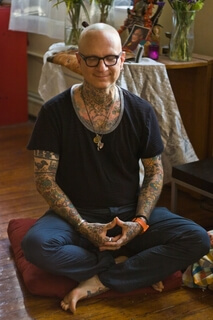
So the meditation I'll be guiding will be in a style similar to what is practiced by the Kamatahana school of Thai forest Buddhism.
Some notable teachers in the Kamatahana school were Ajahn's Lee,
Fuang,
And Suat.
So start by balancing your head above your hips.
Sometimes it's helpful to tip the back of your head slightly back so that it's almost like you're looking at an object slightly above the horizon.
Close your eyes and bring your awareness into the body.
Take a survey to note for any sensations that are uncomfortable.
For example,
Do your clothes feel tight?
Are your legs in a sustainable position?
Make any adjustments that feel necessary.
And throughout the course of the meditation,
If anything starts to feel uncomfortable,
Ask yourself,
How can I change my position in a way that doesn't create too much agitation or noise?
So let's start out with three long in-and-out breaths.
In the first long inhalation,
Lift up your shoulders like you're trying to touch your ears,
And then hold the breath before breathing out through the mouth and releasing the shoulders down.
In the second breath,
Tighten the belly as you breathe in through the nose,
And then holding the breath for an extra beat,
And then breathing out through the mouth,
Softening the belly.
The third breath,
Contract the muscles in the face,
Arms,
Buttocks,
Legs,
Squinching the toes,
Even making fists.
Hold them tight,
Tight,
And then breathe out and release.
So let's allow the breath to return to a normal rhythm.
And see if you can be with it without being too fussy in controlling when you breathe in and when you breathe out.
So let's start with the long inhalation.
In the first long inhalation,
Lift up your shoulders like you're trying to touch your ears,
And then hold the breath for an extra beat,
And then release the shoulders down.
In the second inhalation,
Contract the muscles in the face,
Arms,
Buttocks,
Legs,
Squinching the toes,
Even making fists.
And then release the shoulders down.
In the third inhalation,
Contract the muscles in the face,
Arms,
Buttocks,
Legs,
Squinching the toes,
Even making fists.
In the fourth inhalation,
Contract the muscles in the face,
Arms,
Buttocks,
Legs,
Squinching the toes,
Even making fists.
Observe if your breathing feels comfortable or uncomfortable.
If either the inhalations or exhalations feel cut off,
See if you can adjust the muscle groups in the areas where the breath feels restricted.
For example,
If the chest feels tight,
If it's limiting your inhalations,
Gently pull back your shoulders to open up more room for the breath.
If you feel uncomfortable,
You can relax by relaxing your shoulders.
If you feel uncomfortable,
You can relax by relaxing your shoulders.
If you feel uncomfortable,
You can relax by relaxing your shoulders.
If you feel uncomfortable,
You can relax by relaxing your shoulders.
If you feel uncomfortable,
You can relax by relaxing your shoulders.
If you feel uncomfortable,
You can relax by relaxing your shoulders.
If you feel uncomfortable,
You can relax by relaxing your shoulders.
When you breathe in,
You can feel the flow of air at the tip of the nose or at your mouth,
While at the same time relaxing the micro muscles around your eyes.
See if you can work in relaxing those muscles until your eyes feel like they're floating in two pools of warm water.
During the exhalations,
Follow the sensations from the crown of the head down the spine to the sit bones,
Feeling the energy release into the cushion or the chair beneath you.
Breathing in,
Either through the nose or mouth,
Or even feeling the sensations in the eyes,
And then down the spine out through the sit bones.
A second route that the exhalations could take is to follow them down the back of your head,
Over both shoulders,
Past the elbows,
Down past the wrists to the tips of your fingers,
Softening the palms of the hands,
And then out into the air.
The third route of the breath,
Especially the exhalation,
Is to follow the sensations from the jaw down the front of the throat,
Down the vagus nerve,
Which runs at the front of the body,
Past the lungs,
Down to the abdomen,
And then using the full exhalation to soften the belly.
The exhalation is to follow the sensations from the jaw down the back of the body,
Past the lungs,
Down to the abdomen,
And then using the full exhalation to soften the belly.
The exhalation is to follow the sensations from the jaw down the back of the body,
Past the lungs,
Down to the abdomen,
And then using the full exhalation to soften the belly.
The exhalation is to follow the sensations from the jaw down the back of the body,
Past the lungs,
Down to the abdomen,
And then using the full exhalation to soften the belly.
The exhalation is to follow the sensations from the jaw down the back of the body,
Past the lungs,
Down to the abdomen,
And then using the full exhalation to soften the belly.
The exhalation is to follow the sensations from the jaw down the back of the body,
Past the lungs,
Down to the abdomen,
And then using the full exhalation to soften the belly.
See if you can connect all the breath sensations so they flow throughout your body,
In through the nose or mouth or eyes,
And then down like a stream of warm water down the back,
The spine,
The arms,
The front of the body,
Spreading awareness.
See if you can connect all the breath sensations so they flow throughout your body,
In through the nose or mouth or eyes,
And then down like a stream of warm water down the back,
The spine,
The arms,
The spine,
Spreading awareness.
See if you can connect all the breath sensations so they flow throughout your body,
In through the nose or mouth or eyes,
And then down like a stream of warm water down the back,
The spine,
The arms,
The spine,
Spreading awareness.
See if you can connect all the breath sensations so they flow throughout your body,
In through the nose or mouth or eyes,
And then down like a stream of warm water down the back,
The spine,
The arms,
The spine,
Spreading awareness.
See if you can connect all the breath sensations so they flow throughout your body,
In through the nose or mouth or eyes,
And then down like a stream of warm water down the back,
The spine,
The arms,
The spine,
Spreading awareness.
See if you can connect all the breath sensations so they flow throughout your body,
In through the nose or mouth or eyes,
And then down like a stream of warm water down the back,
The spine,
Spreading awareness.
The goal of this practice is to use the breath as an anchor,
Which is essentially a series of naturally occurring sensations we keep in mind,
So that we can stay connected to present time sensations.
So long as you know whether you're breathing in or breathing out,
That's enough.
There's no need to push away any thoughts,
Memories,
Plans or distractions.
They can be in awareness as well,
So long as you can feel the sensations of breathing in and breathing out.
On the other hand,
If a thought sneaks up on you and pulls you away from the breath,
And you wake up far away,
Don't add any frustration to that experience.
Everyone loses track of the breath.
It's important to be patient and to be grateful for the mindfulness you're developing.
Our practice will only flourish if we associate it with appreciation and kindness.
Self-criticism will only sabotage our peace of mind,
And it will make it less likely that we'll want to continue day in and day out with our practice.
When you do find yourself kidnapped by a thought,
Note the basic theme of the thought.
Perhaps it's a resentment,
Or planning the days ahead,
A fantasy,
Or even an obsessive worry.
We can learn a great deal from labeling the thoughts that don't want us to experience inner peace and pull us away from the breath.
These represent the areas of life we're trying to figure out and solve,
The topics where we haven't learned yet to let go.
Remember,
It's only when we can put down our worries,
Our concerns,
Our plans,
That other regions of the brain that are non-verbal can set to work,
Providing us with new perspectives and solutions.
I believe it was Einstein who said,
We can't solve problems by using the same kind of thinking we use to create them.
So we need to allow the other regions of the brain to observe,
To work on,
To be with life.
How we respond when we lose awareness of the breath is just as important to practice as how well we can stay with the breath.
Remember,
We're cultivating patience,
Kindness,
Appreciation in every moment of the practice.
Remember,
We're cultivating patience,
Kindness,
Appreciation in every moment of the practice.
Remember,
We're cultivating patience,
Kindness,
Appreciation in every moment of the practice.
Many practitioners will think boo on the in-breath,
Do on the out.
Boo-do means to awaken,
And to awaken can only happen in the present moment.
So the phrase boo on the in and do is a way to remind ourselves to stay awake and to stay present.
So the phrase boo on the in and do is a way to remind ourselves to stay awake and to stay present.
Once the mind begins to settle,
You may start to feel a sense of physical and mental ease,
Which the Buddha called in Pali,
Piti and sukhā.
Allow these feelings to arise and pass,
But continue to focus on what's creating any feelings and experiences of ease,
Namely that we're focusing our awareness on the sensations of the breath.
If you keep the objects of concentration in your awareness,
The peace and tranquility are sure to follow eventually.
Thank you.
Thank you.
Thank you.
Thank you.
So we're going to begin the transition from the meditation.
And as always,
I first like to spend a moment in appreciation of our practice.
Remember that we're cultivating ease and peace within.
We're not competing with others or using up the world's resources.
We're developing an unconditionally available source of tranquility.
And when we have some peace of mind in our life,
We act with greater kindness with others.
We're less reactive.
And so our practice is not just for our benefit,
But for the benefit of all beings that we encounter.
And so our practice is blameless and virtuous.
How many other endeavors in our life can we say that about?
So it's worth taking a moment to appreciate any effort we put in to our meditation.
Finally,
When you hear the tone of the bell,
Try not to just quickly open your eyes and look around.
If you do,
The sights of the room will rush into the mind and will push away any awareness of the body and breath that you've cultivated.
To maintain mindfulness,
What we should do is slowly open the eyes and integrate sight back into awareness.
Mindfulness is a balanced awareness where we don't lose track of the body,
The breath,
Our inner experience.