In this practice,
We'll observe everything we experience consciously.
Every thought,
Every emotion,
Every sound,
And every sensation that comes and goes within the space of each breath.
Rather than trying to stop the mind or force silence,
We'll gently shift our attention to what is here now,
In this very breath,
And this one,
And the next one.
But more than just focus,
We're cultivating a kind of open awareness,
The capacity to notice what arises without getting caught in it.
This activates what scientists call meta-awareness,
The ability to observe thoughts and sensations without being pulled into them.
So let's begin.
We'll begin by assuming a comfortable but alert posture,
Finding a posture that you can hold comfortably for the duration of this practice.
Gently close the eyes or soften the gaze.
We'll systematically relax the body from head to toe,
Releasing tension you may not even realize you're holding.
There's no rush with this practice.
Take your time with each area.
So we'll begin by relaxing the muscles of the face.
Bring your attention to your forehead,
Eyebrows,
And the area around your eyes.
These are the muscles that create expressions and often hold our emotional tension.
Even during this practice,
When we're concentrating deeply or when our mind wanders,
These muscles may tighten without us realizing it.
The forehead wrinkles,
The eyebrows scrunched together,
We might squint.
These are your frontalis muscles of the forehead and the corygator muscles between the eyebrows working over time.
Relax these muscles,
Consciously releasing all tension in these muscles.
Let your forehead become smooth and wide.
Allow your eyebrows to settle naturally,
Relaxing the tiny muscles of the eyelids.
Let the muscles around the eyes soften completely.
With your next exhale,
Release any remaining tension here,
Forehead,
Eyebrows,
Space between the eyebrows and eyes.
Within the space of the next few breaths,
Shifting attention down to the jaw,
The muscles of the mouth.
The jaw muscles called the masseter and temporalis are some of the strongest in the body.
These muscles often tense up when we're stressed,
Angry,
Or concentrating.
The tongue also holds tension,
Often pressing against the teeth or the roof of the mouth when we're anxious.
Even our lips purse or tense up,
Pressing together tightly when we're frustrated,
Which can often happen in a meditation practice.
This happens when we put pressure on ourselves to meet some expectation or to achieve some state.
So as you're letting go of these muscles,
Also let go of all those expectations.
Let the jaw drop slightly,
Allowing space between your upper and lower teeth.
Let the tongue rest softly at the bottom of the mouth.
Allow the lips to soften.
As you breathe out,
Release all the tension from these powerful muscles.
Within the space of the next few breaths,
Relax all the muscles of the face,
Forehead,
Eyebrows,
Eyes,
Muscles around the eyes,
The jaw,
The lips,
The tongue.
With the next breaths,
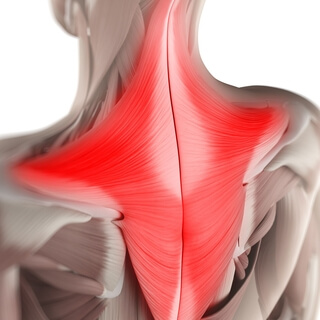
Move awareness down to the trapezius muscle.
These are the large muscles that form the upper back and shoulders.
Think of them as the muscles that create the slope from your neck down to your shoulders.
To locate these muscles,
Imagine you're carrying heavy grocery bags.
The trapezius are the muscles that would be working hard and might feel tight or sore afterward.
They're the same muscles that tense up when we're stressed.
These muscles start at the base of your skull,
Spread across the tops of your shoulders like shoulder pads,
And extend down your upper back in a diamond or kite shape.
Many of us hold tension here even during meditation.
Continue relaxing this muscle.
These muscles work in layers,
From small,
Subtle contractions to larger ones.
To fully relax them,
We need to release even the smallest,
Deepest tensions that might be hiding underneath.
Do the same for the muscles of the face.
Allow these muscles to soften and melt completely.
Take the next few breaths to ensure there's no contraction,
However subtle,
Remaining in the trapezius muscles and the muscles of the face.
Within the space of the next few breaths,
Focus on the trunk muscles,
The deep muscles of the core,
Chest,
And back that control breathing and posture.
When these muscles are tense,
Breathing becomes shallow and happens high up in the chest.
But when they're relaxed,
Your diaphragm,
Which is this large dome-shaped muscle that sits under the lungs,
Kind of like an umbrella,
When you relax,
They can work freely.
When you hear me say,
Breathe into your belly,
What's actually happening is that your diaphragm contracts and moves downward,
Gently pulling your abdomen out.
This creates more space for your lungs to expand fully,
Allowing you to breathe more completely and efficiently.
This kind of breathing called diaphragmatic breathing is the signature pattern of relaxation.
Stress makes us chest breathe,
Shoulders rise,
Breathing feels tight and quick,
But when we're truly relaxed,
Our belly gently rises and falls with each breath,
And our chest and shoulders barely move.
So allow this natural,
Relaxed breathing pattern to emerge as you soften all the muscles of your trunk.
And within the space of the next few breaths,
Relaxing all the facial muscles,
The trapezius muscles,
All the muscles of your trunk.
Now in the space of the next few breaths,
Relax the limbs,
Everything from your shoulders down to your fingertips,
And from your hips down to your toes.
That includes the deltoids or shoulders,
The bicep and tricep muscles of the upper arms,
Your forearms,
And all the tiny muscles in your hands and fingers.
Think about how your hands might clench into fists when you're angry,
Or how your shoulders creep up toward your ears when you're tense,
But now in this relaxed state,
They just hang loosely.
The leg muscles are the largest and strongest in the body.
The quadriceps and hamstring muscles of the thighs,
The calves,
The feet,
Relaxed.
These muscles often tense up when we're anxious,
Preparing for fight or flight.
Even during meditation,
You might notice your legs feeling restless when stressed,
Or the feet pressing firmly into the ground.
Sometimes,
We hold unnecessary tension in our limbs,
Keeping our leg or arm muscles slightly contracted.
In this practice,
Let go of all of this.
Allow your arms to feel heavy and loose,
Like they could just melt into the chair,
Cushion,
Or mat.
Let your legs feel completely supported without any effort.
Release your hands and fingers completely.
Soften your feet and toes.
In the space of the next few breaths,
Scan your entire body from head to toe.
Notice the feeling of complete relaxation flowing through you.
Facial muscles relaxed.
Trapezius muscle relaxed.
Muscles of the trunk relaxed.
Limbs relaxed.
Study this.
This is your body's natural state of rest and restoration.
Your breath is flowing naturally and easily.
Breathing is diaphragmatic.
You're completely supported and at ease.
And you're in control.
Scanning.
Relaxing any tension.
Observing.
All within the space of a breath.
And the breath comes.
Scanning.
Observing.
Relaxing.
Letting go.
Keep settling into the body.
Feeling the weight of gravity.
Weight of the body supported by the ground.
The cushion.
The mat.
The chair.
Now notice any movement of the breath without changing it.
Feeling the breath leave.
Now the breath comes and goes.
And begin to soften around the edges of control.
Nothing to fix.
Nothing to perfect.
Just breathing.
Staying relaxed.
Relaxing into the space.
And in this breath.
One breath at a time.
And the breath comes and touches you.
A breath you have never taken before and will never take again.
Along comes another.
As fresh as the day.
And the breath comes.
A new moment comes.
A new opportunity to settle in.
To observe.
To connect to life.
The life energy.
All things come courtesy of this breath.
The emotions.
The thoughts.
The sensations.
The experiences.
This moment.
And another breath comes and touches you.
Do you know what is touching you?
What is here now in the space of this breath?
Sense it as a living question.
Not a problem to solve.
Not as a list to make.
But an invitation to notice.
To remain aware.
What is here now in the space of this breath?
Another new breath comes.
Continue practicing like this for the next three minutes.
It will be three minutes of silence.
During those three minutes you will be taking many breaths.
Each one is an opportunity for you to stay connected.
To observe.
To notice what arises within the space of the breath.
If mind-wandering comes,
Then it's mind-wandering within this space.
Whatever it is,
Just notice.
What is here now in the space of this breath?
Feel the breath coming in.
The inspiratory pause.
The breath going out.
And the expiratory pause.
The inspiratory phase.
The breath comes in.
The inspiratory pause.
Then the expiratory phase,
Or the out-breath.
Then there's the expiratory pause.
A perfect rhythmic cycle as true as the rising and falling of the tides or the coming and going of the waves along the surf.
Continuous.
Rhythmic.
Perfect.
In the space of the next few breaths,
Notice the expansion and contraction of the ribs.
Ribs moving laterally.
Expansion,
Contraction.
Notice the subtle play of temperature at the nostrils within the space of the breath.
You may even notice the subtlest touch of the breath in the back of the throat as the air moves up and down the windpipe.
As if you were being breathed into.
We're often not conscious of the breath.
We don't consciously think about breathing.
We're breathed.
You can imagine the windpipe as God's wind instrument and feel the breath of life coming and going,
Creating the soft melody that is this moment,
This note.
A breath comes,
And within that breath,
Emotions,
Thoughts,
Sensations.
Again ask,
And now,
What is here in the space of this breath?
Maybe something new comes,
Something new goes.
Maybe there's a thought pattern that continues on or an emotional tone that continues on into the next breath or the next one.
Just observe.
Noticing,
Not naming.
But if naming comes,
No resistance.
We notice we're labeling.
Continue like this for the next several breaths.
There will be another three minutes of silence.
A new breath comes.
Again ask,
And now,
What is here in the space of this breath?
And this one.
Feeling,
Not analyzing.
But if analyzing comes,
We don't resist.
We simply notice we are analyzing in the space of this breath.
Now widen your field of attention.
Instead of focusing on breath as an object of attention,
Sense breath within a field.
This field includes sound,
Sensation,
Movement.
The life energy dancing within you,
Pulsing within you.
The life energy animating you.
All as part of the same moment.
Breath,
Sound,
Sensations,
Movement,
Life.
Ask quietly,
Can I allow all of this to be just as it is?
Answer with feeling.
No grasping,
No pushing,
No imagination,
No rejecting.
Can I allow all of this to be just as it is?
Letting awareness rest as the space in which experience arises.
Experience arising in the pure field of awareness,
The way clouds arise and move and change shape within the field of the open sky.
Be like the open sky,
An open mind sky.
If something pulls attention,
A thought,
Sound,
Sensation,
Simply notice it and stay in the openness.
Be the open sky,
Not the cloud.
Be the open sky,
Not the cloud layer.
Whether storm clouds arise or the sky remains cloudless,
Keep the mind open,
Vast,
Spacious,
Welcoming it all,
Allowing.
The patterns come and go of their own accord,
Like the winds or the clouds.
Let the winds of thought be.
Let it all be.
Allow it to be as it is.
Be the open sky.
Just as the open sky holds the currents and the winds and the clouds and the storms,
Keep the mind sky open,
Allowing it all to be just as it is.
Occasionally,
Whisper inwardly,
Was there a drift just now?
Not to judge,
But to notice.
If awareness collapses into content,
Gently return to openness,
To vastness,
Spaciousness.
And if awareness is stable,
Simply rest in it.
Continue like this for the next few moments.
For the final few breaths,
Gently return to the breath,
Bookmarking the beginning and end of each new moment,
With each new breath coming in and going out.
A new breath comes,
A new moment.
Feel this one breath completely.
And the next one.
And the next one.
The beginning,
Middle,
And end of the in-breath.
The pause.
The beginning,
Middle,
And end of the out-breath.
The pause.
And another one comes.
Rising,
Passing away.
Notice the arising,
The passing away.
The comings and goings.
The rising and falling.
Allow gratitude to arise.
Feel it in the heart center.
Let it expand out.
Gratitude radiating from the heart.
For the breath.
For the body.
For these moments of aliveness that come,
Courtesy of this breath.
And this one.
Maintain this awareness until the next moment,
And the next moment,
And the next moment.
Even as this practice comes to a close.