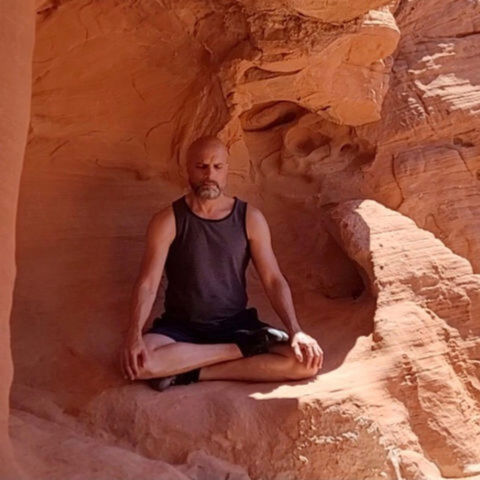
The most common rationalization I hear from beginners struggling to establish and maintain any meditation practice is the one I used.
I don't have time.
I get it.
I worked 50-70 hours weekly.
I had three small children at home,
A failing marriage,
And two jobs.
Stress had been my default state.
I carved out time for exercise to mitigate the symptoms of stress but had time for little else.
So it's paused to define stress.
Stress is the body's reaction to a perceived challenge or demand,
Psychological or physical in nature,
That threatens or that is perceived to threaten the self.
The stress is anything that triggers a physiological response,
Increased heart rate,
Rapid breathing,
Muscle tension,
And so on.
Vigorous exercise is stress,
But I don't mean this.
Exercise is eustress.
The prefix eu in eustress is Greek for good.
There are stressors like exercise or breath work that are beneficial.
Stressors can be real,
Like a category 5 hurricane heading through your neighborhood,
Or imagined.
Think misreading the body language of a colleague during a presentation.
The intensity of our reaction to a stressor is highly individual and situationally dependent.
One person may be terrified of a garden snake,
For example.
Herpetologists who study reptiles may be fascinated by the same snake.
Storylines,
Implicit or explicit neurocognitive appraisals,
Coping strategies,
Social supports,
And past experiences are variables that affect the physiological stress response in any given situation.
When we speak of the harmful effects of stress,
We usually mean chronic stress,
The persistence and unrelenting strain on our physical,
Psychological,
And emotional well-being,
Not episodic stress like project deadlines,
Presentations,
Some performance,
A pregnancy,
A move.
Episodic stress has a limited duration.
Chronic stress is persistent.
There are costs,
We assume,
When chronic stress is left unchecked.
These are hidden costs that are withdrawn from your health account and from your balance of mind.
Let's itemize some of these costs.
In this way,
You can do a cost-benefit analysis that's more informed and that accounts for true costs.
As for actual costs,
US healthcare spending reached $4.
1 trillion in 2020,
Which averages to over $12,
500 per person.
A Harvard study claimed that 62.
1% of all bankruptcies were caused by medical bills.
We're willing to spend trillions,
Mortgage our homes,
And sell our belongings to recover the health we spent accumulating homes and belongings.
When asked what confounded him most about people,
The Dalai Lama said,
We sacrifice our health in order to make money,
Then we sacrifice money to recover our health.
We're so anxious about the future that we can't enjoy the present.
We live as if we're going to die and then die having never really lived.
I'm going to itemize some of the costs we pay for neglecting our well-being.
First one is back pain,
Neck pain,
Muscle tension,
And stiffness.
Before meditation exercise was my primary way of mitigating stress.
It was somewhat effective.
However,
As intense as my workouts were,
I was even a fitness instructor,
I still experienced the kind of muscle tension common to those under stress.
Under stress,
The brain releases norepinephrine.
Norepinephrine helps the brain focus on perceived threats,
Literally.
The pupils dilate and the visual field narrows.
Brain cells that process visual data have a specific receptive field,
Meaning they activate in response to stimuli that appear in a particular zone of a person's visual field.
I focus on the perceived threat to the exclusion of all else,
And this data gets encoded into memory.
What's interesting about modern day stress is that we are seeing things that aren't physically present in the receptive field.
College debt,
Geopolitical conflicts thousands of miles away,
Threats to identity,
Worries about upcoming elections,
And so on.
When the body perceives a threat,
The muscles contract.
They're recruited in a fixed order.
Small,
Low threshold motor units are recruited at low levels when mildly stressed before larger ones,
And are kept activated until the muscle is completely relaxed.
I didn't know how to achieve a state of completely relaxation,
So the muscles remained contracted all day.
Long lasting activation of these units,
I learned,
Could cause degenerative diseases.
The low levels of activation I experienced were contributing to chronic pain in my back and neck.
Unless I could fully relax,
The same muscle fibers would remain active during breaks at work and after work.
Another cost,
Sleep deprivation,
Compromised cognitive functioning,
And poor mood.
The brain's method of waste of removal,
The glymphatic system,
Is highly active during sleep,
Clearing away toxins responsible for Alzheimer's disease and other neurological disorders.
The brain's cells reduce in size during sleep,
Allowing waste to be removed more effectively.
The restorative nature of sleep appears to be the result of the active clearance of the byproducts that accumulate during wakefulness,
According to one researcher at the University of Rochester Medical Center.
Stress affects sleep,
And sleep exerts major modulatory effects on endocrine function.
For some hormones and neurotransmitters,
50% to 75% of the total secretion is dependent on sleep and is eliminated by total sleep deprivation.
75% of the human growth hormone,
For example,
Which plays a key role in growth,
Cellular repair,
Metabolism,
And body composition,
Is restored after sleep.
Human growth hormone promotes muscle growth,
Strength,
And recovery.
The hormone is mostly secreted in pulses during sleep.
Poor sleep reduces the amount of HGH production.
Sleep deprivation also affects endocrine function the following day.
Lack of sleep impairs cognitive and immune functioning.
So I wasn't getting enough sleep most nights.
Stress plus sleep apnea compromised sleep.
I was fatigued on most days.
This was my default state.
It exacted a toll on my relationships and well-being,
And I just didn't have the energy.
Now,
I uploaded a talk specifically on sleep,
Which you can access on Insight Timer.
Another cause is metabolic syndrome.
Metabolic syndrome is defined as a cluster of cardiovascular risk factors that include abdominal obesity,
Elevated triglyceride levels,
Reduced HDL cholesterol,
High blood pressure,
Increased fasting glucose.
How the body responds to a stressor occurs largely outside conscious awareness.
In response to a stressor,
The brain coordinates a response.
The sympathetic branch of the autonomic nervous system is activated.
The autonomic nervous system is divided into the sympathetic and parasympathetic branches.
Although the relationship between the sympathetic and parasympathetic branches is complex and shouldn't be thought of as binary,
Like a binary either-or system,
It's generally accepted that during a stress response,
The sympathetic or fight-flight-freeze response is activated,
And the parasympathetic system,
Responsible for calming and stabilizing the body,
Is dialed down.
The degree of a sympathetic nervous system response is thought to be determined by one's perception of how threatening the stimulus is,
Even if the perception is not within conscious awareness.
Further,
The physiological responses during stress can be enhanced or diminished by psychological factors such as perceived control over the situation.
When stressed,
The fight-flight-freeze response is triggered.
The body secretes cortisol.
Calcutta promotes the synthesis of glucose from proteins in order to make more glucose available as fuel in response to stressful situations.
So if I need to fight or flee,
I'll need some fuel to do that.
This reduces lean muscle mass and increases blood sugar levels.
Sugar is the fuel the body uses to fight or flee.
When stress is chronic,
The pancreas hypersecrets insulin to try to get sugar out of the bloodstream.
Cells get tired of insulin and begin to ignore the signals.
Cells become inefficient at producing energy,
Which leads to further increases in hunger and blood sugar levels.
Research has shown that cortisol increases the deposition of abdominal fat and increases cravings for foods,
Especially carbohydrates and sugars.
This helps to set up the vicious cycle of stress and overeating,
Especially of unhealthy,
Processed and sugary foods,
Which creates more stress and more overeating,
Et cetera.
Although I exercised daily and my routines were intense,
My blood sugar levels were high,
Pretty close to pre-diabetic levels.
My father died of diabetes.
It's a merciless disease that pecks away at its victims.
Aware of the threat,
I exercised vigorously and ate a plant-based vegetarian diet.
Diet and exercise helped mitigate the worst effects of stress,
But this wasn't enough.
I was lean and muscular,
But my sugar levels remained elevated.
Learning to relax and meditate helped me to mitigate stress at the level of thought.
In meditation,
I learned to cut mental elaborations and challenge those perceptions,
Which triggered stress.
At the physiological level,
That meant increased insulin sensitivity and lower blood sugar levels.
Another cause is compromised immune function.
Chronic stress suppresses immune functioning.
Sexual killer cell activity declines significantly when we're under stress.
These cells are one of the battalion of bodily defenses,
Many of which are compromised when stress is chronic.
Long-term stress suppresses or dysregulates innate and adaptive immune responses by altering the cytokine balance,
Inducing low-grade chronic inflammation and suppressing the numbers,
The trafficking,
And the function of immunoprotective cells.
While I was relatively healthy,
I would fall ill once or twice a year.
These incidents fell to once every few years.
Meditation techniques enhance immunoprotection,
As well as proper diets and exercise and good sleep.
Another cause was inflammation.
I was diagnosed with spinal degeneration in my 30s.
Spinal degeneration is a form of arthritis.
When stressed,
I'd feel stiffness in my joints,
Especially my neck,
My hands,
And along the vertebral column.
I felt my genes were cursed.
Pain in my back plus insomnia plus apnea made it hard to sleep.
I was wearing myself down.
Spinal degeneration,
My doctor informed me,
Was caused by wear and tear.
While it could not be reversed,
It could be slowed and the symptoms mitigated.
Exercise,
Diet,
And meditation made the difference,
As well as sleep.
Mindfulness meditation training compared to relaxation training reduces interleukin-6,
An inflammatory health biomarker.
The benefits were not just in my head,
But measurable.
Another cause is accelerated aging.
My hair began graying in my 30s.
Jon Kabat-Zinn,
A professor of medicine and credited with bringing mindfulness to the attention of Western researchers,
Wrote,
Thoughts and emotions,
Especially highly stressful thoughts that involve worrying about the future or ruminating obsessively about the past,
Seem to influence the rate at which we age,
Right down to the level of our cells and our telomeres,
The specialized DNA repeat sequences at the tips of our chromosomes that are essential for cell division and that shorten over time as we age.
These telomeres are often described as plastic tips you might find at the end of shoelaces.
Once they're damaged and they start to degrade,
Then the chromosomes begin to start fraying,
Which leads to errors as they replicate,
As cells replicate.
Cell changes alone can't reverse aging,
But they can slow it.
Another cause is anxiety.
Anxiety is a common neurobehavioral correlate of stress,
And both acute and chronic stress exposure could trigger anxiety.
Anxiety has a biochemical substrate.
Neurochineurinin are neurochemicals linked to stress and anxiety.
Neurochineurinin antagonize the central effects of precursors of serotonin,
Which are tryptophan and 5-HTP.
Serotonin is sometimes called the calming molecule.
Some neurochineurinins downregulate serotonin such that you feel less calm.
Many are excitatory.
So not only are you feeling less calm,
You're also more excitable,
Alert,
And vigilant.
It's established that the neurotransmitters acetylcholine and epinephrine are secreted when under stress.
Acetylcholine is a neurotransmitter that amplifies activity of brain circuits associated with focus and attention.
Norepinephrine is a neurotransmitter that amplifies activity of brain circuits associated with alertness.
Now,
There's an upside to this,
But it's subtle.
Dopamine is another neurotransmitter,
And it amplifies activity of brain circuits associated with pursuing goals,
Motivation,
And reward.
Now,
If all three neuromodulators are present,
Norepinephrine,
Acetylcholine,
And dopamine,
Accelerated learning can occur.
Alertness,
Focused attention,
And improved cognitive performance are some benefits of adaptive sympathetic nervous system arousal,
Or what we call good stress.
During adaptive sympathetic nervous system arousal,
Sensory perception,
Including visual,
Auditory,
And olfactory senses are enhanced.
This improved sensory interoceptive awareness increases our ability to successfully address any stressor.
But we don't often perceive anxiety as good stress,
And it isn't felt as good because dopamine levels are low.
In meditation,
We learn to leverage our dopamine schedules.
We tend to conditions like sleep,
Diet,
Social connections,
And exercise.
I was exercising a lot,
And this took the edge off of the anxieties I felt sometimes.
I would take the adrenaline coursing through the body and use that as fuel for runs,
Long bicycle rides,
Swims,
Or other high-intensity exercises.
In this way,
I was able to adapt to stress by intentionally putting myself under stress.
In addition to exercise,
I added fasting and cold exposure.
In this way,
I was able to adjust my baselines to stress.
As my understanding deepened,
I began to integrate stress into my meditation practices.
I would intentionally induce this adaptive sympathetic nervous system arousal prior to meditation with breathwork,
Like the Wim Hof Method,
Bastrika,
Pranayama,
Breath Holes,
Kapalbhati,
And other breathing techniques.
By introducing mild stressors,
We prime the mind and condition our response to stress.
We learn to dial the stress response up or down.
I also learned many top-down strategies for mitigating stress,
Which again is largely perceptual.
In meditation,
We learn to examine and deconstruct these perceptions,
And many of them are misperceptions.
The ventromedial prefrontal cortex and its functional architecture can help mediate anxiety.
Recognizing cognitive distortions as cognitive distortions,
For example,
Or pointing out inconsistencies and logical fallacies in thought when these thoughts did arise can be somewhat beneficial if one is resourced enough to talk oneself down.
Self-compassion,
Self-love,
Self-responsibility,
And patience hold anxiety in a tender embrace.
Taken together,
These modalities,
Exercise,
Diet,
Sleep,
Breathwork,
Top-down cognitive techniques,
Meditation,
Give us a measure of control,
And this sense of empowerment is called self-efficacy.
One of the traits of anxiety is the absence of self-efficacy and control,
But these techniques can be learned.
And although anxiety is often vilified,
If we surrender to it and drag ourselves to the therapist's office,
The gym,
A meditation center,
Or house of prayer and desperation,
The part we've exiled could be the part that points us to our own liberation.
Everybody may be a friend to you on your path to peace.
Depression is another cost.
When we're under chronic stress,
The body hypersecrets cortisol.
Hypocampal shrinkage and memory loss is directly proportional to elevations in cortisol,
According to Dr.
John Rady.
When depressed,
We are often caught in rumination.
The same negative thoughts repeat in a loop.
In meditation,
We develop cognitive flexibility and strategies to detach from depressive thoughts.
At the structural level,
We strengthen neural networks that allow for detection,
Detachment,
And the reorientation of attention.
We also learn how to inhibit some distractions and redirect,
Reorient attention to more positive mental states.
At the experiential level,
We no longer feel stuck.
We cultivate self-efficacy,
A greater trust in our ability to manage strong emotions.
We approach our emotions,
Moreover,
With a degree of compassion and curiosity.
This leads to greater integration,
Acceptance,
And wholeness.
However,
Meditation is contraindicated for people with severe depression.
While studies show meditation is an effective complement to therapy and drugs,
Sessions will be more effective when guided by a professional.
And I don't just mean someone with an abbreviation after their name,
But someone who understands the science of meditation and walks the path.
There are five intervals in the attention cycle.
The first is sustained attention.
Attention is single-pointedly focused on an object.
The executive network is active.
This network includes the right parietal cortex,
The right frontal cortex,
And the thalamus.
When we're focused on the touch sensation of the breath,
For example,
The parietal lobes are active.
The right frontal lobe is responsible for impulse control,
Among other functions,
Which helps regulate and modulate attention.
The thalamus also regulates alertness.
The second stage in the cycle is mind wandering.
At some point,
The mind will wander.
The posterior cingulate cortex,
Posterior lateral parietal and temporal cortices,
The cingulate cortex,
And parahippocampal gyrus are active.
This network is called the default mode network,
Is associated with mind wandering,
Disruption of attention,
Autobiographical memories,
Judgment,
Self-referential thoughts,
Guilt,
And emotional processing.
If you understand this,
It'll explain why meditation is so difficult for beginners and potentially ineffective for those stuck in depression.
When the mind wanders,
And it will,
And beginners realize the mind has wandered,
Rather than cut and reorient attention,
They often criticize their performance,
Which is judgment.
They make self-referential evaluations and say things like,
This is not for me,
I'm not good at this.
And all they're doing is reinforcing the default mode network.
Tibetan Buddhists call this stage Nyonyi,
The nuisance mind or neurotic mind.
In Sanskrit,
The stage is called vijñana,
Or the divided mind.
In adept meditators,
The default mode network becomes less active or quiescent.
The next stage is awareness of mind wandering,
And the salience network is implicated here.
This is the moment the practitioner realizes attention has wandered.
Sometimes we call this the aha moment.
The skilled meditator celebrates and reorients attention,
But the unskilled meditator returns to the default state.
Ah,
This is frustrating.
I can't do this.
I've been sitting here for 10 minutes.
I only caught my mind wandering once.
All these thoughts start to occur.
They're stuck in the default mode network.
The active nodes of the salience network include the cingulate cortex and the anterior insula.
The cingulate cortex is involved in emotion formation,
Processing,
Learning,
And memory.
So when you're in this stage,
You can leverage learning and memory.
The salience network and its functional architecture is involved in cognitive control,
Perceptual decision,
And error processing.
So how we process the error of mind wandering,
Whether skillfully or unskillfully,
Will affect perceptions,
Learning outcomes,
And performance.
It's really important.
When we recognize mind wandering and celebrate that aha moment,
Neurons activate in the brain's ventral tegmental area,
A place in the midbrain that secretes dopamine.
Dopamine is the signal that creates that rush of joy or bliss,
And it travels from the ventral tegmental area to the nucleus accumbens,
Which spreads that signal to other structures throughout the brain.
The increased dopamine levels deliver a sense of pleasure,
Improved attention,
And interest.
We're then motivated to repeat our behavior to reach that pleasure again if you practice properly.
The mind wanders,
Ah,
I recognize it's wandered.
I return my attention to the object of focus.
Again the mind wanders.
At some point I recognize the mind is wandered.
Yes.
This is the attitude of the skilled meditator.
The skillful approach is simply to acknowledge,
Celebrate,
And move on to the fourth interval.
The fourth interval is letting go.
It's another executive function.
This is a critical choice point.
The experienced practitioner lets go of the distraction.
The active nodes are the basal ganglia,
The lateral ventral cortex,
And the anterior cingulate cortex.
These nodes are involved in control and decision making.
The anterior cingulate cortex,
Interestingly,
Lies in a unique position in the brain with connections to both the emotional or limbic system and the cognitive or prefrontal cortex.
The anterior cingulate cortex likely plays an important role in affect regulation,
Serving as a mediator between emotions and reason.
That's a little voice that says,
Oh,
No big deal.
Let's cut and go back to our focus.
And that's the fifth level,
Reorienting,
Another executive function.
The practitioner redirects attention to the object of focus.
The active nodes here are the superior colliculus and frontal eye fields,
Temporal parietal junction,
And superior parietal cortex.
So when the mind wanders and you realize it's wandered,
You celebrate,
You cut,
You reorient attention.
In this way,
You're strengthening those neural networks.
You develop greater cognitive control.
You maintain your motivation,
And you can sustain your meditation practice.
And we do this with a growth mindset.
No one's born with enhanced attentional control.
We have to train mindfully,
Intelligently,
And with patience.
Now,
This list of costs is not exhaustive.
There are many more.
Electric imprinting,
Damaged memory cells,
Diminished productivity,
Cognitive inflexibility,
And distorted perceptions of hopelessness,
Helplessness,
And reduced agency.
Nor does stress end with us.
In the female brain,
Dr.
Luanne Brisondine writes,
The nervous system environment a girl absorbs during her first two years becomes a view of reality that will affect her for the rest of her life.
Studies in mammals show that this early stress versus calm incorporation can be passed down through several generations.
Stressed mothers naturally become less nurturing,
And their baby girls incorporate stressed nervous systems that change the girl's perception of reality.
This isn't about what's learned cognitively.
It's about what's absorbed by the cellular microcircuitry at the neurological level.
So I don't have time.
Now,
When I realized I was compromising my health and peace of mind,
I decided to make the time to investigate these practices.
While I had been meditating on and off for years,
I decided to really commit.
After my first week-long meditation retreat,
The contrast between the quiet and a quantum state I experienced and the busyness that had been my default state was so pronounced,
I committed to observing a daily practice.
And the body doesn't lie.
My biomarkers improved.
My health and mood improved.
It wasn't in my head.
That's anecdotal.
But it's also in my physical charts year after year.
A marked improvement in all measures.
This is true in replicated studies.
I don't have time.
That's what I told myself.
But really,
I had to choose how I would spend my time.
My father made time to sit in a chair four hours a day,
Three times a week for hemodialysis treatment.
And I would rather take 30 minutes to exercise.
We make time to drive to the pharmacist to pick up our prescriptions.
We schedule time for doctor's visits,
Therapy,
Surgeries,
Procedures,
Chemotherapy,
Physical therapy when stress begins to exact its toll.
I would rather spend an hour meditating,
Working out,
Or nurturing my social connections.
We can make time for self-care.
One of my teachers said that if we practice for an hour a day in the morning and an hour in the evening,
We would be more productive.
This seemed counterintuitive.
But I trusted him and practiced for an hour the first year.
My mind was clear.
I was more detached from outcomes.
I made better choices.
I was more rested.
My moods and mindset improved.
I added a second hour in the evenings and accelerated the benefits.
Then I added 20 to 30 minutes of formal practice midday as a mental reset.
This optimized cognition.
And I did this not to become a more efficient cog,
But to be more fully human.
And surprisingly,
Some things haven't changed much at all.
I'm still working 50 to 70 hours weekly,
But most of it is what I want to do,
Like this.
I have three jobs.
My children are still young.
My marriage failed.
One of my jobs was cut.
But stress is no longer my default state.
My sleep is optimal.
I eat well.
I'm physically fit.
And the mind is balanced.
When stress does come,
And it does come,
I recognize it and have learned many techniques for bringing body and mind quickly back to homeostasis to approach circumstances with calm,
Focus,
Reason,
And clarity.
Beginning with the end in mind is one of the seven habits of highly effective people.
This was the title of a business book classic,
Researched and written by Stephen Covey.
These habits apply to the business of living.
Bronnie Ware,
A hospice nurse who worked in palliative care,
Recorded the epiphanies of the dying.
I wish I had the courage to live a life true to myself,
And I wish I hadn't worked so hard with the top two regrets of the dying.
On my ignorance,
I was working myself to illness,
And quite possibly to an early grave.
Beginning with the end in mind,
I decided to change course.
Putting first things first is another of the seven habits.
There's a quote by Jim Rohn that I like,
Which speaks to this.
Work harder on yourself than you do on your job.
This is sound advice.
The harder I worked at improving my mindset,
Attention,
Sleep,
Nutrition,
Exercise regimen,
Communication skills,
The more grounded I felt.
There's the old adage that an ounce of prevention is worth more than a pound of cure.
Meditation,
Exercise,
Sleep,
And friendship are free.
There's a cost to diet,
And there could be a cost to attending a retreat,
Taking time off at work,
And planning around that,
But there's also a price to pay for stress and illness.
Peace,
Good health,
Joy,
Love,
These are priceless.