Sit or lie comfortably.
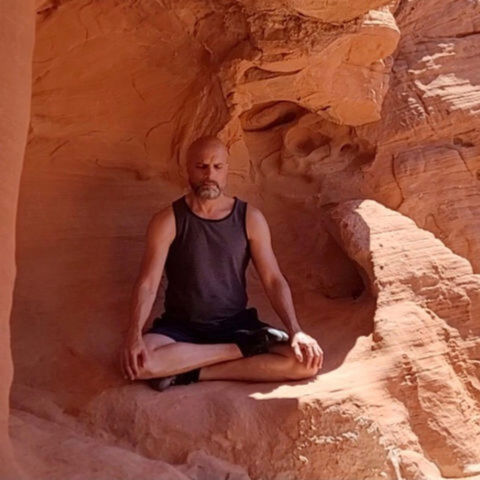
The traditional posture for sitting meditation is with legs comfortably crossed with a straight back,
The eyes half closed or closed completely and the hands resting on the lap.
You may also meditate sitting on a chair if you support your back and keep it straight.
Or you may choose to lie down.
In either case it's important not to change the position frequently,
If at all,
Since every movement may interrupt concentration.
Mindfulness does not mean the cessation of thinking.
To hold on to this intention is to disturb the mind.
The correct technique for a meditator is to note whatever mental or physical process arises the instant it occurs.
In this practice try to note every mental or physical event.
When no object is distinct,
We'll return to noting the primary object.
In this meditation the primary focus is on the rising and falling of the abdomen.
With every act of breathing the abdomen rises and falls.
This movement is always evident.
Note this movement.
You'll find the abdomen rising when you breathe in and falling when you breathe out.
We note the rising mentally is rising and the falling is falling.
Do not change the manner of your breathing.
Either slow it down or make it faster.
Breathe steadily,
Naturally,
And note the rising and falling of the abdomen.
Note it mentally.
Rising,
Falling.
Rising,
Falling.
While noting the rising of the abdomen,
Do so from the very beginning of the movement to the end,
Just as if you were seeing it with your eyes.
Do the same with the falling movement.
Note the rising movement in such a way that your awareness of it is concurrent with the movement itself.
The movement and the mental awareness of it should coincide.
So keep your attention on the abdomen and the tactile process of bodily motion,
Which is perceived as a continuous rising and falling of the abdomen.
Noting these sensations as rising,
Falling.
While engaged in just noticing the rising and falling of the abdomen,
There may appear thoughts and feelings.
When these arise,
Notice these activities of mind and body.
If they are thoughts,
You can label them as such.
Thinking,
Thinking,
Thinking.
After noticing and labeling,
Turn again to the rising and falling of the abdomen.
Simply note these sensations as rising,
Falling.
When you realize the mind has wandered,
Return to the rising and falling of the abdomen.
Be very matter of fact about this.
Wandering thoughts will continue to hinder the mind while it is occupied in developing the practice of noticing.
Remain patient,
Compassionate,
And not judgmental.
These are beautiful qualities we'll want to cultivate.
Your mind may wander elsewhere while you are noting the movement.
This can be noted mentally saying wandering,
Wandering.
When this has been noted once or twice,
The mind stops wandering,
In which case,
You return to noting the rising and falling of the abdomen.
The mind is not aware of the rising and falling of the abdomen.
The mind is not aware of the rising and falling of the abdomen.
The mind is not aware of the rising and falling of the abdomen.
The mind is not aware of the rising and falling of the abdomen.
The mind is not aware of the rising and falling of the abdomen.
The mind is not aware of the rising and falling of the abdomen.
The mind is not aware of the rising and falling of the abdomen.
The mind is not aware of the rising and falling of the abdomen.
Approach the emotions in the same way.
If you feel happy,
Note happy,
Then return to the rising and falling of the abdomen.
If you feel calm and at peace,
Note calm,
Peace,
Calm,
Peace,
Then return to the rising and falling of the abdomen.
The mind is not aware of the rising and falling of the abdomen.
The mind is not aware of the rising and falling of the abdomen.
The mind is not aware of the rising and falling of the abdomen.
The mind is not aware of the rising and falling of the abdomen.
The mind is not aware of the rising and falling of the abdomen.
The mind is not aware of the rising and falling of the abdomen.
The mind is not aware of the rising and falling of the abdomen.
The mind is not aware of the rising and falling of the abdomen.
The mind is not aware of the rising and falling of the abdomen.
It is usually a mistake to try to measure progress in meditation.
When the mind is very calm and peaceful,
We are inclined to think that we are making progress.
Conversely,
When the mind is restless,
We might think that the meditation is not so good.
However,
One of the main purposes of meditation is insight and not just to get peaceful.
So do not judge your performance.
If you do,
Simply note it as judging and return to the breath.
If you find yourself becoming restless and frustrated with your inability to keep the mind concentrated on the primary object of the rising and falling movements,
However hard you try,
Simply acknowledge it and note it as restless,
Restless,
Or frustrated,
Frustrated,
And return to the rising and falling of the abdomen.
If you become bored or sleepy,
You may think that you are too tired to meditate or may wish to stop.
This too should be noted as dull,
Dull,
Or sleepy,
Sleepy,
And return to the rising and falling of the abdomen.
If you have doubts about the value of practicing this technique of meditation or about your ability to do so,
Note these thoughts as doubting,
Doubting,
Then return to the rising and falling of the abdomen.
This noting of mental states and hindrances,
Like sleepiness,
Dullness,
Or doubt,
Is an important aspect of mindfulness meditation.
This is a practice of meditation that is not only about the mind,
But also about the mind.
This is a practice of meditation that is not only about the mind,
But also about the mind.
If,
After long and patient practice,
The mind becomes extremely peaceful,
Or if waves of joy and bliss start to infuse the mind,
These positive mental states should be noted in the same way.
Peace,
Peace,
Joy,
Joy,
Bliss,
Bliss,
And return to the rising and falling of the abdomen.
This is a practice of meditation that is not only about the mind,
But also about the mind.
Peace,
Peace,
Joy,
Joy,
Bliss,
And return to the rising and falling of the abdomen.
This is a practice of meditation that is not only about the mind,
But also about the mind.
Peace,
Peace,
Joy,
Joy,
Bliss,
And return to the rising and falling of the abdomen.
This is a practice of meditation that is not only about the mind,
But also about the mind.
Peace,
Peace,
Joy,
Joy,
Bliss,
And return to the rising and falling of the abdomen.
When you have sat meditating for a long time,
Sensations of stiffness or discomfort will arise in the body.
These are to be noted carefully too.
Similarly with sensations of pain and fatigue.
Failure or omission to note these sensations makes you think,
I'm stiff,
I'm feeling hot,
I'm in pain.
There's really only a succession of one new sensation after another.
These sensations should be carefully and intently noted.
Whether they are sensations of stiffness,
Of heat,
Throbbing sensations,
Tingling sensations,
Numbness.
In the beginning of one's meditation practice,
These sensations may tend to increase and lead to a desire to change one's posture.
This desire should be noted,
After which the meditator should return to noticing the sensations of stiffness,
Of heat,
Of pain,
Etc.
After noting it two or three times,
Return to noting the primary object,
The rising and falling of the abdomen.
For more information,
Go to www.
Mooji.
Org Thank you.
.
.
You may want to change your posture if the sensations of unpleasantness do not disappear,
Even after noting them for a long time,
Or if they become unbearable.
One should then begin by noting wanting to change,
Wanting to change.
If one raises the arm,
Note as raising,
Raising.
If one moves,
Note as moving,
Moving.
This change should be made gently and noted as raising,
Raising,
Moving,
Moving,
And touching,
Touching.
If the body sways,
Note swaying,
Swaying.
If you raise a foot,
Note raising,
Raising.
If you move it,
Note moving,
Moving.
Let your awareness be continuous and unremitting,
Without any interval between acts of noting,
Whatever phenomena arise.
For instance,
If a sensation of itchiness intervenes and you desire to scratch because it s hard to bear,
Both the sensation and the desire to get rid of it should be noted,
Without immediately getting rid of the sensation by scratching.
Sit with the discomfort for a while.
If you persevere,
The itchiness will generally disappear,
In which case you revert to noting the rising and falling of the abdomen.
If the itchiness does not disappear,
You may eliminate it by scratching,
But first the desire to do so should be noted.
All the movements involved in the process of eliminating the itch should be noted.
Raising the arm,
Raising the arm,
Touching,
Touching,
Pulling,
Pushing,
Pulling,
Pushing.
And the scratching movements.
Lowering the arm,
Lowering the arm.
And eventually return to the rising and falling of the abdomen.
.
.
.
With patience,
Practice and persistence,
We rewire the brain.
Each time we note and label,
We re doing something different than what we habitually do,
Which is to engage in the thought and get swept away in rumination.
In this practice,
We note our experience as it arises,
Without reacting to it,
But simply observing without judging.
Noting,
Disengaging,
Reorienting attention back to the primary object of focus,
The rising and falling of the abdomen.
The aim here is to examine our habitual patterns of thought,
Taking a step back,
Getting some perspective.
In this way,
We can break the cycle of rumination.
With practice and overtime,
Persistent anger,
Sadness and pain become less intense.
.
.
.
As the meditation comes to a close,
Acknowledge your effort.
As this meditation comes to a close,
We can acknowledge our effort and list the benefits we've cultivated during this session.
We made the intention to meditate and we followed through.
We're strengthening self-discipline.
We're developing awareness and metacognition,
Using the faculties of mind to observe the mind.
By observing,
Noting,
Disengaging and redirecting attention,
We're developing cognitive flexibility.
By accepting what arises without judgment or reactivity,
We're cultivating emotional balance.
Now,
Even as you intend to open the eyes,
Even as you intend to move,
Note those intentions.
Intending to open the eyes,
Intending to open the eyes,
Or intending to move,
Intending to move.
Whenever you change your posture,
Begin by noting your intention or desire to change and note every movement closely,
Such as rising from the sitting posture,
Raising the arm,
Moving and stretching it.
You should note the movements at the same time as you're making them.
As your body sways forward,
Note it.
As you rise,
The body becomes more light and rises.
Note it.
Focus your mind on this.
And in this way,
We can continue practicing mindfulness meditation informally,
Off the cushion.
.