There are over 20 references to meditation in the Bible.
The first mention is in Genesis chapter 24 verse 62.
Quote,
Now Isaac had come from Bir Lahai Roy,
For he was living in the Negev.
He went out to the field one evening to meditate.
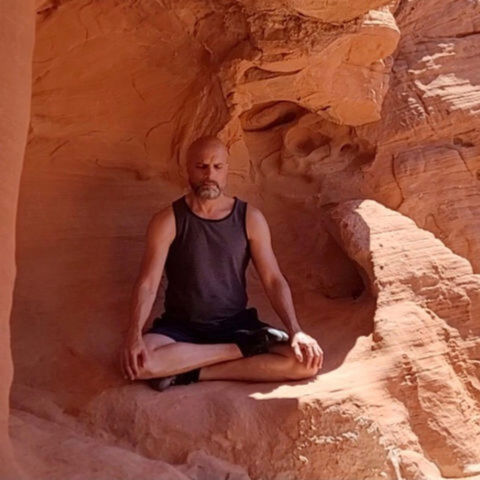
It's doubtful that Isaac was sitting in full lotus with his hands in a mudra.
There's no mention of technique.
Rather,
He was probably in a contemplative and prayerful state.
In the book of Psalms,
King David references meditation 19 times.
But there's no record of deep breathing,
Anapana,
Posture,
Body scanning,
Chakras or mantras.
The book of Psalms chapter 19 verse 14.
May the meditation of my heart be pleasing in your sight,
Lord.
Chapter 48 verse 98.
We meditate on your unfailing love.
Chapter 104 verse 34.
May my meditation be pleasing to him.
Chapter 119 verse 15.
I meditate on your precepts and consider your ways.
And 97.
Oh how I love your law.
I meditate on it all day long.
Chapter 143 verse 5.
I meditate on all your works and consider what your hands have done.
Meditation,
As David described it,
Is more contemplative and generative.
By generative,
I mean the cultivation of an affect or quagmire.
An affect or quality of mind.
Like gratitude,
Humility,
Compassion or joy.
In the epistles,
The Apostle Paul writes,
Finally brethren,
Whatever things are true,
Whatever things are noble,
Whatever things are just,
Whatever things are pure,
Whatever things are lovely,
Whatever things are of good report,
If there is any virtue and if there is anything praiseworthy,
Meditate on these things.
Philippians chapter 4 verses 7 and 8.
He repeats this instruction in a letter to Timothy.
Meditate upon these things that thy profiting may appear to all.
1 Timothy chapter 4 verse 15.
By focusing the mind on virtuous qualities like compassion or loving kindness,
We cultivate the feeling which then expresses outwardly in thought,
Word and deed,
Such that the evidence of discipline,
Quote,
May appear to all,
End quote.
This is very similar to what Buddhists do when they do the loving kindness or metta practice.
Within the Judeo-Christian tradition,
Meditation is a spiritual discipline which includes prayer,
Worship,
Service,
Fasting,
Charity,
Gratitude,
Asceticism and chastity among others.
The practice of Christianity is not identical across denominations however,
Nor is there uniformity in rites,
Rituals or beliefs among the many sects.
But it's important to note that Christians have been meditating for millennia.
It's not a new trend.
Hezekasm was one of the earliest techniques and originated in the early church sometime in the 4th century,
Long before the schism in 1054 that split the Catholic and Eastern Orthodox churches.
Hezekasm is Greek for quiet or to rest.
The practice was based on Christ's injunction in the Gospel of Matthew to,
Quote,
Go into your room and shut the door and pray to your Father who is in secret.
And your Father who sees in secret will reward you,
End quote.
They took this verse literally and sequestered themselves in cells to practice concentrative prayer.
The technique begins with catharsis,
Which is purification.
In this technique,
Emphasis is on focus and attention.
The hezekast,
Or the practitioner,
Develops single pointed concentration on his or her inner experience and repeats the Jesus prayer,
Breathing in,
O Lord Jesus Christ,
Breathing out,
Have mercy on me.
This is similar to the gathas that a Buddhist might practice,
Where breathing in,
They might note breathing in,
Breathing out,
They might label it breathing out.
With practice,
The hezekast then goes on to cultivate nepsis,
Or vigilance.
Christ speaks of this in a parable.
Matthew chapter 24 verse 42,
Watch therefore,
For ye know not what hour your Lord doth come.
If the good men of the house had known what watch the thief would come,
He would have watched and would not have suffered his house to be broken up.
This can be interpreted in many ways.
One interpretation is to guard one's peace of mind.
Peace,
Joy,
Equanimity,
Faith,
Compassion,
And love are treasures.
The thief is whatever robs you of God's peace.
It could be fear,
Anger,
Stubbornness,
Hopelessness,
Ill will,
Animosity,
Doubt,
Hatred,
Willfulness,
Or other affliction.
In the parable Jesus holds the watchman accountable.
If he had watched,
He would not have suffered his house to be broken up.
If we attend to our own minds and remain vigilant,
We guard against affliction.
Watch therefore,
Remain vigilant.
This is nepsis.
The hesychast attaches eros or yearning to overcome esidia or sloth,
Which leads in time to theoria or illumination.
Here the mind approaches purity and stillness.
Then finally ego dissolves kenosis and the hesychast achieves theosis or union.
This path is similar to what meditators in other traditions also experience.
They also speak of overcoming sloth,
Distraction,
And other hindrances.
They speak of mind approaching purity and stillness.
They speak of no self,
Of ego dissolution.
Meditation is well suited for certain temperaments.
The early desert fathers and mothers were hermits and ascetics.
Wandering sadhus of the third century who were tired to the desert and in solitude practiced meditation among other spiritual disciplines.
The monks and nuns were the progenitors of monasticism in the west.
In the sayings of the desert fathers,
One hermit was a Take care to be silent and be quiet.
The same is true for the The early desert fathers and mothers were hermits and ascetics.
Wandering sadhus of the third century who were tired to the desert and in solitude practiced meditation among other spiritual disciplines.
The monks and nuns were the progenitors of monasticism in the west.
In the sayings of the desert fathers,
One hermit wrote,
Apophatic meditation is another centuries old technique that began sometime in the fifth century.
Apophatic means approaching God by negation,
Without concepts,
Images or words.
To experience the peace of God which surpasses all understanding.
It is a concentrative practice similar to the Vedantic technique of neti neti,
Which means not this,
Not this.
It's a rejection of whatever mind conceives as God.
God cannot be grasped by the puny intellect from which it derives its source and light.
God is the ground of being.
We approach without concepts,
Receptive,
Expecting nothing,
With an open heart,
Thirsting for instruction and experiential insight.
Not more words or theories or ideas or theology,
But direct experience.
In the Catholic Church,
Lech Dio Divina is a traditional monastic practice of scriptural reading,
Meditation and prayer,
Intended to promote communion with God and embodiment of the word.
The technique consists in first reading or oratio,
Two contemplation,
Contemplatio,
Third is meditation,
Meditatio,
Fourth is prayer,
Oratio.
The rosary or prayer beads are often used to train,
Discipline and center the mind and faith.
Just as beads are used in other traditions for centering.
Visualization techniques are common in Christianity,
Just as there are in other contemplative traditions.
For example,
In the Mahayana or tantric schools of Buddhism.
But here we visualize Christ or a saint and contemplate their qualities.
We try to generate these qualities within ourselves,
The compassion of Christ,
The altruism of a saint,
The faith of an apostle.
Centering prayer is another popular technique among Christian meditators.
Father M.
Basil Pennington suggests these steps.
First,
Sit comfortably with your eyes closed,
Relax and quiet yourself.
Be in love and faith to God.
Choose a sacred word that best supports your sincere intention to be in the Lord's presence and open to his divine action within you.
Let that word be gently present as your symbol of your sincere intention to be in the Lord's presence and open to his divine action within you.
Whenever you become aware of anything,
Intrusive thoughts,
Feelings,
Perceptions,
Associations,
Simply return to your sacred word,
Your anchor.
This is very similar to transcendental meditation where you're given a sound to repeat over and over again.
For the Keating ads,
The method consists in letting go of every kind of thought during prayer,
Even the most devout thoughts.
Many Christians practice secular meditation techniques which can be integrated within the faith.
When focusing attention on the breath,
For example,
I might begin with scripture.
All the while,
The breath is in me and the Spirit of God is in my nostrils.
When I assume a meditation posture,
I might think,
Ye are the temple of God,
And the Spirit of God dwelleth in you,
For the temple of God is holy,
Which temple ye are.
When scanning the body,
I might think,
I am fearfully and wonderfully made,
Marvelous are thy works,
And that my soul knoweth right well.
When discouragement arises,
I might think,
I can do all things through Christ which strengtheneth me.
If fear arises,
I might think,
God hath not given us the spirit of fear,
But of power,
And of love,
And of a sound mind.
Christianity informs my practice in a much deeper sense.
The end is kenosis,
Or self-abnegation,
Or no-self.
Like the Apostle Paul,
I wish to die daily to self,
To ego.
Ego is like a golden calf,
A false idol.
Christianity provides me a solid moral foundation upon which to build a life.
What Buddhists call sila,
Or morality,
Is similar to Christian precepts.
In Buddhism,
The precepts require abstention from taking life,
Which is similar to the commandment not to kill.
Abstention from taking what is not given,
Similar to the commandment not to steal.
Abstention from committing sexual misconduct,
Similar to the commandment not to covet,
Where Jesus is warning against lust.
Abstention from engaging in false speech,
Similar to the commandment on bearing false witness,
Or the many injunctions on being honest.
Abstention from using intoxicants,
Similar to the many injunctions against alcohol in the book of Proverbs.
It's not for kings to drink wine,
Nor for princes strong drink.
Proverbs 31,
Verse 4.
Wine is a mocker,
Strong drink is raging,
And whosoever is deceived thereby is not wise.
Proverbs 20,
Verse 1.
At the last it biteth like a serpent,
And stingeth like an adder.
There are precepts requiring abstention from participating in worldly amusements,
Similar to the verse in Romans,
Chapter 12,
Verse 2.
Be not conformed to this world.
Christianity is a form of bhakti.
In Hinduism,
Bhakti emphasizes devotion,
The intense emotional love of a devotee toward God.
And I share these similarities because many Christians are uninformed about the contemplative practices within their own faith,
And begin looking elsewhere.
While others reject anything that is unfamiliar.
In the Declaration on the Relation of the Church to Non-Christian Religions,
Nostra Aetate in Latin,
Theologians at the Second Vatican Council in 1965 asserted unequivocally that humanity was one,
Had a common purpose in God.
People turn to different religions in search of answers to fundamental questions such as,
Who am I?
What's the purpose of life?
Why do we suffer?
What is its meaning?
What leads to happiness?
What lies beyond death?
Quote,
The Catholic Church rejects nothing of what is true and holy in other religions.
We should acknowledge,
Preserve,
And encourage the spiritual and moral truths found among non-Christians.
End quote.
They go on to list some of the commonalities found in other religions.
Hindus seek the divine mystery in myth and philosophy,
And practice asceticism,
Meditation,
And faith in God's love,
Which they call bhakti.
Buddhists testify to the inadequacies of the material world and that wisdom must be sought through liberation.
Muslims worship one God,
See in Abraham a spiritual father,
And regard Jesus as a prophet and Mary as a source of intercession.
Muslims adhere to familiar practices of prayer,
Fasting,
And almsgiving.
Our spiritual heritage with the Jewish community is so intimate.
Pope John Paul II called Judaism the elder brother of Christianity.
But as we often say in meditation circles,
Go deeper and look within.
You don't have to abandon your traditions or faith.
There's beauty in it.
In the hymn,
Be still and let the spirit speak.
Antonio Haskell writes,
Be still,
Let the spirit speak.
Forgo the worldly strain.
Your closet enters,
Shut the door.
Let silence in you reign.
The center of your being find,
From it turn not away.
Wait on the Lord,
Give ear to him and all he has to say.
The great I am in you will speak and you will wisdom find.
With seers who in ages past the hearing ear inclined.
The spirit unto you will give the knowledge that you need.
Nearly will you grow in grace if you,
The spirit,
Heed.