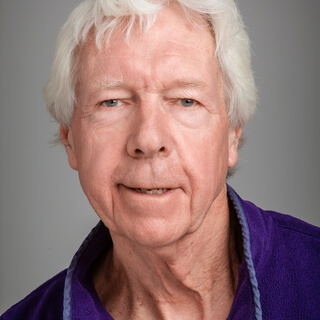
This is Jacob Watson and this is a recording of the introduction to my book,
Gifts of Grief.
This will present the natural and distorted emotion.
The point I want to make here is that every emotion is natural and every emotion has its own time and place.
By that I mean every emotion can be trusted.
It was a great relief to me after my wife died to understand that my grief,
Natural as it was,
Was always available to me.
It had its own timetable,
Not my timetable as a human being at all,
But its own timetable.
And that,
As I said,
Came as a great relief to me.
I could trust it.
I could trust my grief.
The natural and distorted emotions I learned from Elizabeth Kubler-Ross,
Starting with grief and sadness.
Again,
It's a natural emotion.
The distorted emotion comes up when grief and sadness is dictated by the culture and we try to find somebody to blame or we are ashamed of feeling this natural emotion.
Not so much.
The purpose of grief is to live with our sadnesses,
Our small sadnesses,
Sometimes small,
Sometimes large,
Every day,
Like getting out of a warm cozy bed in the morning and putting your feet on the cold floor.
That's a small grief.
A large grief is losing a spouse,
As happened to me,
Suddenly from a heart attack.
One minute she was there,
The next minute she was not there.
So I experienced extraordinary grief.
Over time,
Particularly as I expressed my grief on the pages of a journal,
I came to understand that the grief could be trusted.
It wasn't so much that I was dictating what was happening.
In fact,
I was not in control at all.
The grief came when it wanted to and I could trust that.
And in that,
I found great relief.
Another natural emotion is anger.
A foreigner to me.
Anger?
Are you kidding?
I was not taught that it was okay to express anger as I was growing up.
But the purpose of anger is that it holds lots of energy.
The purpose of anger is to express this energy,
To find safe ways,
Underline the word safe,
Safe ways to express anger.
Hitting a pillow,
Hitting a couch,
Using a tennis racket on the bed,
Whatever it is that's safe for you and the environment to express the anger,
The natural anger.
Here's a story that was a first teaching for me about anger.
When I was a boy,
About,
Say,
I remember eight years old,
I think,
I was racing with my favorite uncle Bill in a small sailboat and a line had jammed on a cleat and I was the crew member and I was responsible for undoing that line.
I couldn't do it.
My uncle looked at me and said,
Get angry at it.
That worked.
I got angry at the line caught in the cleat and I was able to untie it.
That was the first lesson in realizing that each emotion,
Even anger,
Has a purpose.
The distortions of anger are rage and hatred and you can see already that there's a longer time because it takes time for unexpressed anger to build up into rage and hatred.
As always,
The task here is to move these feelings into a purposeful vein so that we can express them and keep our feelings moving.
That's the key,
To keep our feelings moving.
Another natural emotion is fear and yet it's always about the future.
I'm afraid that something will happen,
Even in the present moment,
When I feel fine.
The purpose of fear is to be cautious,
To take it easy.
The distortion of fear is when we are anxious about the future.
It helps a great deal when we can move from being worried about the future to being content in the present moment.
Another natural feeling is envy.
When we envy another person for,
Say,
Their skill,
If we can recognize that we put that person up on a pedestal only because we ourselves have some of that same quality in us,
We can lead that meeting.
We learn not to project our experience on someone else but to take advantage of it ourselves,
To be the leader.
The final natural emotion that I want to bring to you here is love.
I'm talking here about unconditional love,
Not the conditional love that we were taught as youngsters.
In order to survive in our family,
We learned what was expected of us,
What we needed to do in order to be loved.
This is conditional love,
And while it might have worked really well to grow up in a family and learn the rules of the family and therefore be loved,
It does not serve us in adulthood.
These are the natural emotions,
And my point here is that we can trust them.
We can learn what is natural and what is distorted,
And most of all,
We can trust our feelings to come up when they need to,
When they need to.
We don't have to be in charge.
That's the point.
Now that you've learned the natural and distorted emotions,
Here we'll be focusing on the feeling of grief,
The natural feeling of grief,
And it could be true that any other feeling can come up,
But let's focus for now on grief.
So I'll give you about three minutes to meditate and allow whatever feeling it is to come up.
Remember,
Feelings are asking for only two things.
One,
Acknowledgement,
And two,
Expression.
Simply acknowledging the feeling is a lot.
If it feels right to you to express it,
To give it some words or a sound,
Fine.
Go ahead and do that.
As we enter the meditation,
I encourage you to be kind and gentle to yourself.
If a feeling comes up,
Excellent.
Find a way to express it.
If not,
Be kind and gentle to yourself again.
Allow yourself to experience whatever it is that you are experiencing.
As our meditation time comes to a close,
Honor and respect whatever it is that came up for you.
Remember,
Natural emotions only want two things,
Acknowledgement and expression.
The point of this introduction is to allow yourself to respect,
Appreciate whatever it is that comes up during this quiet time.
And the goal here is to respect and find relief in whatever it is that has come up to your awareness,
Your consciousness.
Particularly when it is a difficult feeling as described by the culture and our friends.
Grief itself,
Of course,
Is a quote difficult feeling,
Meaning that we have a lot of other feelings when grief comes up.
So here's a story.
Several years ago,
I was a student at the University of Creation Spirituality,
Matthew Fox's school in California.
And I was attending a class taught by Brian Swim,
The author of The Story of the Universe.
And he was telling the story of the universe.
He started,
Of course,
With the Big Bang and proceeded.
And then he came to the moment in time when humans entered the picture.
And he stopped.
He was in shock.
He couldn't say anything.
And an awkward three or four minutes occurred.
And he still didn't say anything.
The translator of a sweet little book of Rilke's poems and,
Of course,
The environmentalist and Buddhist scholar from which she brought an amazing perception.
She named the feeling of grief.
She said it out loud.
She used the word grief.
Who was a guest and happened to be sitting on my right,
Reached out to me and took my hand.
And soon we were all,
About 50 of us in that class,
Joined by the hands.
And we grieved.
The feelings poured out of us.
We wailed.
We screamed.
We yelled.
We cried.
Maybe five minutes,
10 minutes.
And then the grief had been expressed.
The grief had come up just as the humans entered Brian Swim's story.
And we let it out.
We expressed it.
The grief poured out of us.
And then and only then could Brian Swim continue his lecture.
It was then and only then that I understood at a much deeper level how grief came up on its own.
We didn't call for grief.
Grief called for itself to be acknowledged and expressed.
Thus,
I understood anew how grief will speak for itself.
And it came as a relief to me.
I didn't have to worry about grief.
It worried about itself and expressed itself when and if it needed to and it needed to.
So,
I encourage you to take that into your heart.
To find the relief that grief will express itself when it needs to.
That's the point I want to make in this introduction.
That grief,
Left alone,
Will find a time and a place and a way to express itself.
My grief at losing Christine was profound.
And for a long time,
I worried about I have to grieve in the right way or the right time.
But no,
Eventually I learned the lesson that the natural feeling of grief takes care of itself.
That's the central lesson that I want to impart in this introduction.
May you too experience the relief that I felt just knowing that the natural emotion of grief will indeed take care of itself.
This,
Of course,
Was a primary lesson for me and one of the major gifts of grief.
Simply to know that grief takes care of itself was an enormous relief to me.