Any amount of meditation will be beneficial,
But the best way to get the benefits from a meditation practice is to practice daily.
Daily practice does a few things for us.
Number one,
It establishes the importance of meditation in our lives.
It sets a precedent.
It tells us that we're doing something important,
That we're geared towards self-improvement,
That we're looking towards an awakening.
By practicing daily,
We compound the benefits.
We're saying to the universe,
Saying to ourselves,
That this is something we're working on,
Something we're going to keep growing with,
And something that we're going to dedicate time every day towards.
And when you put it in that context,
It highlights just how central to our lives that practice will become.
It's easy to become a spiritual or meditation connoisseur,
But a rare practitioner.
If we practice daily,
We will see the benefits.
But if we only talk about it daily,
And not actually practice it,
The benefits will just be theoretical.
There's an analogy here to exercise.
We don't exercise once and expect to see massive changes in strength or shape or fitness.
We exercise daily.
And through daily exercises,
Eventually,
We start noticing gains.
We start noticing the benefits to our health.
We feel stronger.
But that initial or the single exercise session doesn't do much.
Now,
True,
A single session of exercise is infinitely better than no sessions of exercise.
But in terms of real,
Long-term,
Permanent and deep changes to our musculature,
It doesn't do that much.
The same is true for meditation.
Any session of any length is,
Of course,
Beneficial.
And if you can't establish your daily practice,
Doing what you can,
When you can,
Is better than nothing.
However,
The real benefits of the practice compound.
They compound with increased use.
It's like your brain,
Your mind,
Your psyche,
Your spirit,
Your body,
Everything gets on board.
And it starts to learn the best way to sit and to function.
It's like,
This is what we're doing.
And the benefits compound.
And the exercise analogy here holds in the sense that if you practice exercising daily,
If you practice going through those motions,
Going through those movements,
You will soon start to see that your form improves.
You get better at doing the exercise.
So therefore,
You're more competent and therefore,
You can exercise better and therefore,
The gains will grow.
And the same is true for meditation.
When we first started meditation practice,
We don't really know what we're doing.
We're distracted.
We're confused.
We're unsure of which pathway to take.
But with time,
We know that when we sit down,
This is what we're doing.
We've set our intentions.
We've got our rituals.
We've got an idea of our goals.
So it's always good to establish that practice daily.
The question now is,
How to do it?
How do we establish a daily practice?
Because it's one thing to say it,
But life has other ideas.
Prior to starting a daily meditation practice,
The time that I now meditate in was filled with other things.
I meditate in the morning is the first thing I do.
But prior to starting meditation,
That time was spent exercising.
That time was spent with my family.
So we've got to sort of carve out a time for the practice.
I started with one minute a day.
Just one minute.
I guarantee you,
No matter how busy you feel that you are,
You will have just one minute.
Now,
Very quickly I was able to find two minutes in a row,
And then three,
And then four,
And so on.
But what I would suggest is,
If you are looking to start a daily practice and don't think you have time,
Do it.
Do your random meditations here and there.
Do the ten minute sessions when you have the capacity and the time and the motivation to do it.
But in addition to that,
Do a one minute session at the same time every day.
I would suggest as the first thing you do in the morning,
Or the last thing you do at night.
But your life circumstances will dictate when you do that.
Some people find time in their lunch break,
Or after they've dropped their kids off at school.
You choose the best time for you.
And start with just one minute,
And slowly build up from there.
And,
You know,
As with every practice,
Like I said,
There's a risk or an issue with life blocking you off.
Because,
You know,
Our time can be spent on any number of things.
And when you put something into your day,
Like a meditation practice,
You're blocking off other things.
It's the opportunity cost.
But those other things don't just go away.
At least not on their own accord.
You'll have to make some choices.
So some instant things that you could sort of give up without much cost will be some television time.
Some general just,
Relaxed time.
I'm not saying to give it all up.
But just,
You can cut back and you won't notice too much of a difference.
In fact,
You'll find that the meditation practice itself provides some of that.
Some of the stuff that you're getting from your relaxation activity.
Rather than watching three hours of TV,
If you chose to watch two and a half,
You're still getting what you're getting from the two and a half hours.
Now,
You can always cut down,
At least in my mind,
On television and TV shows in place of spiritual practice.
I've gotten to the stage where I don't watch any.
And I've replaced that time with meditation and exercise.
And I find that my mental state has dramatically improved because of it.
But,
I couldn't have made that change instantly.
This has been literally a ten year journey,
Starting with one minute a day,
Going to daily meditations of half an hour or longer.
And,
You know,
Still fitting in time for work and family and all of that sort of stuff.
But speaking of family,
Speaking of friends,
It's a wise idea to talk to them and tell them and say,
Hey,
This is what I'm spending my time on.
This is what I need from you during that time.
And this is why I'm doing it.
I'm doing a meditation practice to be a better partner,
To be a better friend,
To be a better parent,
To calm my mental state.
So if you give me this time,
In peace,
I will come out and I'll be a better person for you.
So it's a win-win situation.
It's also important to realize that you won't see,
Necessarily see,
Results straight away.
There's a lag between actions and results.
So once again,
If we go to the exercise analogy.
If you start exercising now,
You may not notice any changes to your body for a month or more.
That doesn't mean that things aren't happening.
It just means that you don't notice the things that are happening right now.
So we need to apply that same concept to the meditation practice.
If you start meditating right now,
You may not notice a difference for months.
You might not notice a difference in your clarity,
Your focus,
Your calmness,
Or any other of the purported benefits that I and other meditation instructors will tell you.
That's okay.
It's to be expected.
This is where I feel faith comes into play.
I'm not talking faith in a god per se,
Or any sort of spiritual entity.
I'm talking about faith in the process.
You can have faith that if you take these certain actions,
You will get certain results.
If you exercise,
You'll get fit.
If you read books,
You'll get smart.
If you meditate,
You'll get the benefits of meditation.
It just takes time.
So what I suggest you do from today,
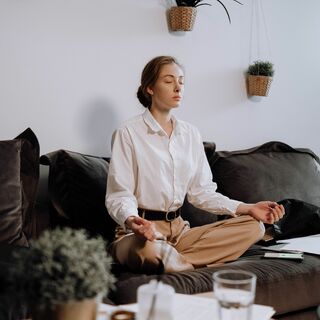
Sit for one minute in silence and focus on the sensation of the breath entering and leaving your nose.
If your mind wanders,
If your mind gets focused on anything other than the breath,
This could be thoughts,
Moods,
Emotions,
Memories,
Physical sensations,
Whatever.
You acknowledge it as the distraction that it is,
And gently return your focus back to the breath,
Entering and leaving the nose.
Just one minute.
You can do that after this session.
And then you're done.
That's your meditation practice for the day.
And then tomorrow,
Do it again.
One more minute.
And when you've been consistently able to do one minute,
Consider upping it.
Now you could go up by one minute a day,
You could go up by five minutes a day.
Just don't go too hard too soon,
Because you'll find that you'll be able to do it for a little while.
But like the New Year's resolution of a new diet,
Or,
You know,
Big change,
Life doesn't always agree with you.
So a better approach would be to take it slow and work up those incremental breaths.
And over time,
Eventually,
You'll have established a deep and true meditation practice,
And you will find the benefits to be compounding.
So I invite you to take a seat and practice one minute of mindfulness now,
And then tomorrow,
And then onwards.
Enjoy.