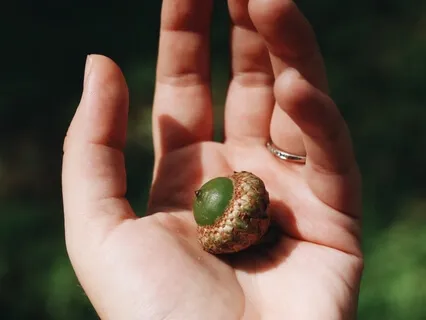
Dr Rick Hansen has said that the brain is like Velcro for bad experiences and like Teflon for positive experiences.
We tend to notice the bad way more than we notice the good,
And we tend to hold on to the bad way more than we hold on to the good.
And this is true even in the way we treat ourselves.
Now each of us probably makes somewhere in the vicinity of half a dozen mistakes in a day and they tend to stick with us a lot more than everything else in between,
Which is essentially everything that wasn't a mistake.
But how much do we tend to celebrate all of those moments?
How much do we even tend to notice those moments?
If we're going to be truly mindful,
We'll be present for every single moment,
And most of those moments are going to be moments that have some cause for celebration,
For rejoicing,
For gladness.
These moments are filled with small triumphs.
So in this practice we're going to see if we can experience small triumphs and celebrate them as we go.
So I invite you to find a nice awake posture,
Upright if possible.
Take a couple of deep breaths to settle in.
Just allow your shoulders to drop or to loosen.
Perhaps you want to give your shoulders a bit of a shrug,
Just let them drop,
See where they land.
If that feels right,
Allow them to stay there.
Check in with the muscles in your face,
Around your forehead,
Around your jaw in particular.
And just as you notice them,
Maybe give your face a little bit of a scrunch as well,
And then let that loose and just see where that lands.
Now just do a quick scan of your body and see if anything else is calling your attention,
Any other part of your body.
And if it is,
The invitation is to just go there and be present with it,
To give it your attention.
And through that act of attention,
See if anything changes.
If it does,
Good.
If it doesn't,
Good.
If your attention shifts within your body,
That's fine.
If somewhere else is calling your attention,
Go there.
Rest your attention there as well.
And as you are able,
Allow your attention now to gravitate towards your heart space and rest in your heart space,
Dropping any attention that we had in our head towards our heart space.
We spend most of our days in our head and it's good to get out of there every now and then.
Now allow your attention to rest in your breathing.
It may be in your heart space.
It may be in your belly.
It may be around your nose.
It could be in your throat.
It could be anywhere.
Wherever your breathing is most obvious to you,
Wherever your attention wants to rest with your breathing,
That's the place.
It may even be more than one place.
For instance,
You may feel your breathing in your nose and in your belly over the course of one breath.
It's where it travels,
Right,
From your nose at least into your lungs and then that impacts your belly.
So there's a process.
So however you want to follow your breathing,
However you want to rest your attention in your breathing,
That's the right way.
So the invitation is to see if you can follow an entire in-breath from beginning to end.
And if you can do that,
See if you can follow the subsequent out-breath from beginning to end.
And as with your attention resting in your breathing,
In your breath,
Just keep doing that and seeing if you can follow an entire in-breath,
Seeing if you can follow an entire out-breath.
And with each one that you do follow,
Consider that a small triumph.
How much time do you spend following your breath?
Outside of meditation practice,
Probably not a whole lot.
And inside meditation practice,
If you're like most of us,
Probably not a whole lot.
You spend a lot of time attempting to follow your breath perhaps.
But actually following your breath is a pretty significant small triumph.
Beautiful.
U where?
One in-breath,
And one out-breath at a time.
Just this.
One in-breath,
And one out-breath at a time.
One in-breath,
And one out-breath at a time.
If your attention has wandered from your breath,
Gently,
Kindly return it to your breath,
And consider that return another small triumph.
.
.
.
.
.
.
.
.
.
Where is your attention now?
If your attention is not on your breath,
Or not even fully on your breath,
See if you can return it there and celebrate another small triumph.
So many opportunities to celebrate.
.
.
.
.
Notice that happening.
Again,
Just see if you can let those thoughts drift by,
Drift on,
Move along,
And sit alone with your breath,
With this in-breath,
With this out-breath.
.
This in-breath is the only one ever that will be this one.
This out-breath too is the only one ever that will be this one.
Can you be here for it?
Can you celebrate it as another small triumph?
Even the act of breathing,
Isn't that a small triumph?
With or without your attention.
.
.
.
.
.
.
.
.
.
.
.
.
.
.
.
.
.
.
.
.
.
.
In a few moments,
Or perhaps a couple of minutes,
We'll finish this practice.
In the meantime,
See if you can maintain your attention on your breath.
And celebrate each in-breath and out-breath as another small triumph.
Not just the in-breath or the out-breath,
Just the ability to pay attention to it.
And if you do,
Perhaps reflect on how many other small triumphs fill your day.
And perhaps,
Just perhaps,
Allow yourself today to let your attention rest in the small triumphs.
And to celebrate all the things that didn't go wrong.
Because if they didn't go wrong,
They went right.
.
.
.
.
.
.
.
.
.
.
.
.
.
.
.
.
.
.
.
.
.
.
.
.
.
.
.
.
.
.
.
.
.
.
.
.
.
.
.
.
.
.
.
.
.
.
.
.
.
.
Thank you for your practice.