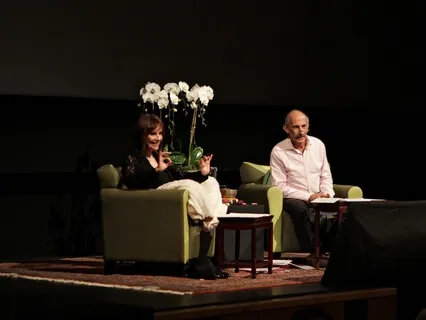
So I've just come a day or so,
No,
Wednesday,
Sunday,
Friday,
From being at a big conference in San Francisco,
The largest tech conference in the world put on by Salesforce.
150,
000 people came to it,
A lot of people online,
And they had a day of mindfulness,
So we did some teaching there.
Part of the reflection that I had in others who presented was that while mindfulness is very good for reducing stress and harmonizing the body and mind for our physical well-being,
Making our life more manageable because we're actually able to be there in a more balanced way,
It also is an invitation to something deeper and bigger than simply regulating our days as we go through the checklist of our lives and so forth.
And it really opens the gate or the doorway to the mystery of life.
Who are we?
How did we get in this wild human incarnation?
What matters?
What do we do with it?
And in Bali,
Where Trudy and I spent some time a couple of years ago,
Where I've lived on and off over a lot of years,
They say that the people who are closest to the gods are either newborn infants who just come from somewhere else or old people ready to go back,
And those who are furthest from the gods aren't middle-aged people with mortgages.
So it's possible that we forget in some way what I'm talking about.
And one of the things that happened in the green room and in talking with other presenters at the conference was that people began to say,
Well,
How did you get on this spiritual path?
What started you?
What is your motivation?
They're kind of the origin stories.
And as T.
S.
Eliot says in the Quo Quartets,
In my beginning is my end,
And in my end is my beginning,
And everything is the end of something,
The beginning of something new as something else ends.
And there's something so beautiful about that,
Because what called you,
It could be called the sacred question or the moment that turns your life from getting through school or getting through your job or surviving in some way to looking around at mystery,
Is a really important moment.
And this kind of sacred journey in the archetypal way,
Joseph Campbell talks about it in the Heroes Journey and so forth,
Is written about in so many forms.
The Buddhist archetype is the Buddha as the young folks who had everything,
The palace for the winter and the palace for the summer and the palace for the rainy season and the best music and best food and the dancing girls and all the usual things that young men want anyway,
Or young women too,
Depending on your precarity.
And then he went out with his charioteer,
He kind of escaped the palace,
The pleasure palace,
And everyone knows this story,
And he encountered for the first time,
First an old person,
They sort of protected him from that,
And he said,
Well who does this happen to?
The person was very old and sort of tottering and the charioteer said,
Well sire everybody.
And then he encountered a very very sick person.
What does this happen to?
Well everyone.
And then finally,
You can perhaps remember the first time you saw a dead body.
It's a shock.
Wait a second,
Me?
Who's this going to happen to?
What is this about?
It feels so solid and real,
Who I am,
And then it ends this way.
And the thing it was to be was,
Okay,
Things aren't quite how it was presented in my childhood,
I better take a closer look at this.
Went off to begin his practice.
And we all have the things that call us.
One of the women who was part of the presentation there,
Parma Shree,
Was the chief technology officer for Cisco Systems,
So she has 30,
000 engineers that she supervises.
A very kind of one of the major figures in Silicon Valley,
And she has been for many years.
But she was then presenting on mindfulness and yoga,
And I said,
Well what happened to her?
She said,
Well when my son was born,
Was the same year,
Actually a few months,
And the same period that my mother died,
And I was really close to my mother.
And there I was torn open,
I had this tremendous joy of having this new child and this new baby,
And this tremendous grief and loss at the same time,
And I didn't know what to do about it.
And so I sought out a teacher,
Yoga and meditation,
To somehow give me a place to rest in the middle of this mystery.
You know,
And then,
So sometimes it comes through suffering,
Through the encounter of death,
Or sometimes it comes through birth,
Or sometimes it will come,
In my case,
I was in college studying pre-medicine.
And I went from my organic chemistry class to a class in Asian philosophy,
Taught by this wonderful old Chinese professor,
Dr.
Wing Sih Chan,
Who sometimes would sit cross-legged on the desk and lecture on Lao Tzu and the Buddha.
And so,
Yes,
There are the truths of the Buddha that they're suffering,
And I knew that because my family had,
My father was a brilliant scientist and a pretty disturbed person who was violent and abusive in pretty serious ways.
And then he said,
Wing Sih Chan went on and said,
There's suffering and there's an end to suffering.
I thought,
Oh wow,
I don't know about this,
But you're organic chemistry,
How do you learn this?
And so I was told,
Did go a little detour through the summer of love and hate ashberry and some of those substances like LSD that sort of enhanced the questioning,
If you will.
But I knew I had to find something and nothing in my education had taught me how I deal with my own anger or aggression or conflict or how do I find my own values,
What matters,
Or how do I love,
How do I make a relationship that actually does work,
Right?
Sometimes it's innocence.
You know,
People would tell their childhood stories,
And they're on that table where we were talking,
There was another major Silicon Valley CEO who said,
Yeah,
I actually am a corrupt Catholic.
And he said,
A lot of the church didn't work for me.
I had mean nuns who taught me,
Sort of that archetype,
Unfortunately,
But for him it was true.
He said,
But I would go to Catholic school early and go and sit in the chapel because there was something magic in there that was completely independent of how the nuns taught me or this person narrowed up in a torture position or something.
But I knew there was something else.
And Alice Walker writes about it.
She says,
One day I was sitting there like a motherless child,
Which I was,
And it came to me,
That feeling of being a part of everything.
And I knew if I cut a tree,
My arm would bleed,
And I laughed and I cried and I run all around the house.
In fact,
When it happens,
You can't miss it.
And I remember as a kid lying out under the stars,
As we all do in the grass,
And especially on the East Coast,
Those kind of summer nights,
And looking at the stars and imagining,
Because it's true,
That I was at the bottom of the world,
Being held onto the globe by the magnet of gravity and looking down into the sea of stars,
Because it really isn't the top or bottom.
And there would be this kind of both fear and rush of,
Wow,
I could fall down into that dazzling sea of stars.
I said,
Well,
What is this?
How did we get here?
And then I think of another colleague,
And it was the death of his child.
He was a farm service officer in the State Department,
Doing all kinds of creative things.
And then he said,
I stood at the grave of this one and a half year old who died in kind of a sudden,
Crude death,
Whatever it was called in those days.
And he said,
I knew my life would never be the same.
And just something cracked open,
And I said,
What is this about?
So I'm interested in what draws us,
Because using that T.
S.
Eliot thread in My Beginning is My End,
There is some thread in you that touched you or brought you here,
Or the invitation of meditation.
You know it's helpful in regulating and balancing and living a saner and kinder life and maybe treating your own body better or treating the people that you're with in a wiser and more compassionate way.
But you also remember,
Perhaps,
That things aren't permanent and that you are not permanent.
I'm not permanent.
Sometimes I don't like that very much.
I mean,
It feels very comfortable to be myself,
You know.
But then we're faced with something bigger.
I think the phrase from Carlos Castaneda where he talks about death is stalking you,
That because death is stalking you,
Everything becomes more mysterious.
You know,
If it was always going to be like this,
First of all,
It would be pretty boring.
But secondly,
Because death is stalking you and life is tentative and can change at any moment,
How then will you live?
What do you do with this human life?
What matters to you with this perspective?
How do you guide yourself?
And I think in the origin,
That question for me,
How do I live with the suffering of my family and confusion?
Can I find a place,
You know,
Where the woman whose child was born and whose mother died in the same month?
How do I live in the mystery of birth and death?
And mindfulness,
The beginner's mind or the don't know mind of our teacher,
Satsang,
The Korean teacher,
Really allows us to inquire who am I,
What is this?
So I think I'll pass this on to Trudy,
If she has something to add.
You have your mic.
You got your own?
How is this going to be defined?
Yeah.
When he turned 16,
He was called Dae Satsang,
Which is honorific.
But satsang used to,
We were 20-somethings and we would get caught up in things all the time.
I'm not looking at it now,
But it's harder.
And he would just look at us and he would say,
Soon dead.
And then he'd laugh.
He'd laugh.
But he kept saying it.
Soon dead.
Different intonations according to the situation.
You know,
When you're 20-something,
You laugh.
But death is inevitable.
This body will be a corpse.
And he wanted us to remember this.
Again,
Not to be morbid or gloomy or make us really anxious so we couldn't sleep at night.
But just what Jack was saying for that appreciation of the preciousness of his life.
And our whole meditation instruction in those days at the beginning was to sit,
You know,
Zen meditation,
He was a Zen master,
To sit in the cross-legged posture and take a few deep breaths and regulate your breath a little bit.
And then just ask this question.
And the way that he demonstrated how he would ask the question is he would sit in a closed side and say,
What am I?
Don't know.
And that was our meditation instruction.
And then later he elaborated a little bit.
He said,
Think of it this way when you're asking this question,
What am I?
Think of it the way you would be looking for your wallet if you misplaced your wallet.
You wouldn't be going around the house and,
Where's my wallet?
Where's my wallet?
Where's my wallet?
Where's my wallet?
You would just look for your wallet.
So it's not that you sit there like a mantra,
What am I?
What am I?
What am I?
But you ask,
You inquire,
What is this?
What is this being?
What is this life?
This organism that needs water and carry out its activities and fuel.
And the question not,
Who am I?
Because then you could say I'm a mother,
I'm a teacher,
I'm a sister,
I'm a daughter,
I mean all the things that we might be.
But he didn't ask who,
It was what.
Now sometimes there is a practice very similar to this where you do ask who.
Who is thinking?
Who is listening?
Who is talking?
Who isn't?
They saw these thoughts,
Who's sad,
Who's angry?
Who's deep and peaceful?
Who's overjoyed to be here?
Who's,
You know,
Just who,
Who,
Who?
But he taught us what,
Which worked better for me because it kind of pointed into that,
How do we be mindful of this bigger picture that's going on all the time?
But we get so encapsulated in this body,
This mind,
And this perspective on,
Well whatever it is,
How is it going to help me,
Enhance me?
How is it going to threaten me,
Scare me?
How is it going to maybe mean nothing to me,
What are the others?
So I'll just space out and ignore it.
Mindfulness is the opposite of these three strategies of disconnecting really from our experience.
Mindfulness is really about having that open questioning,
What is this,
You know,
Just try it when you ask,
Just try for a moment and just look at not anyone or anything particularly,
But just asking yourself,
What is this?
What is this reality we're in?
And there's something about genuinely asking and wondering that stops that dispersive thinking that sort of fills in all the gaps so that we don't get to have a moment to just look,
What is this?
What am I?
What are we all in here?
And if you catch a moment of that freshness of inquiry that Jack was talking about at the beginning,
That beginner's mind,
It's that flash of perception,
Just clear,
Bright,
That moment.
That's really a moment of mindfulness.
And it's very easy in our attempt to be mindful,
You know,
To return to the breath,
To return to this moment of experience,
To return to what's most important in any given moment.
But sometimes mindfulness can be off into,
I call it a self-surveillance system,
You know,
Where you can start to be watching yourself,
And you can start to think that there's this edge of judgment or criticism or how am I doing?
How am I measuring up?
Is this the way I'm supposed to do this?
Is this all right?
And that's really,
Mindfulness helps us be aware of that,
Of that habit of the mind to judge and wonder and be anxious about who and what and where we are at any given time.
And I think it's very helpful that I had that first teacher,
And I think it can give all of us a sense of how asking,
Inquiring,
Really wondering.
I was saying,
Sometimes it's terrible events that shake us up or health crisis or loss of a loved one.
I'm going to ask Carol to speak about what she's done with that situation,
Her loved one is still with her,
But not who he was before.
So,
All these kinds of things that happen in life,
They just give us a chance to see how we're going to meet these experiences.
Are they going to diminish us?
They don't have to.
They can actually open our hearts.
They can actually draw us more deeply into our practice.
The 12th step is called the gift of desperation.
When we're suffering,
We're motivated to do this.
Which reminds me,
Because I'm going to forget to say it later,
I just want to insert here that a week from Wednesday,
Suzanne and I are teaching a day of mindfulness and being with death and dying for people who are working at the bedside of either critically ill and dying children or adults.
So if any of you are caring for a loved one who's dying,
It's really for professional caregivers,
But I'm just telling you because we have been having trouble getting the word out and if you can let people know who might be interested,
I would appreciate it.
I'm also very aware that even though I was not raised in an observant Jewish family,
And I mean at all really,
I remember going to the first weekend to explore,
This was I don't know,
20 years ago at the Barry Center for Buddhist Studies in Massachusetts,
To explore some of the interface between Judaism and Buddhism.
It was called the Dharma and the Torah.
The Jewish practices meant nothing to me and it was so sad because everybody was sort of weeping to have their chants and songs from Judaism in their Buddhist place of practice.
But I didn't have that upbringing.
But I am aware that we are right in the middle of the high holy days.
So if you are Jewish and you are practicing,
This is a hugely important time of year.
I was telling Jack last night,
Because he also wasn't raised in an observant Jewish family,
That I really love Yom Kippur and he was like why?
It's the Day of Atonement,
It's a very solemn day.
And you say Shana Tala is like good.
It's good,
But it's kind of sober too because you're really asking for another year of life and you're cleaning up whatever relationships have been,
Well,
Might need some cleaning up from the previous year,
You're given,
And especially in these 10 days,
You do that.
But in Yom Kippur,
That day,
Which starts Tuesday night and then it's Wednesday,
You fast,
Which you don't drink water,
You don't eat food,
You don't have sex,
You don't.
And I was always wondering,
Why?
Why to be spiritual would you have to not do those things?
And not be very drawn to fasting,
Especially.
I have a friend,
We were invited to a break fast and he said,
I'm going to fast all the way from my office to the break fast.
After work.
So,
You know,
That's kind of how I was brought up too.
The reason is that because in a sense you die,
And then people can't do any of those things.
Corpses can't eat and drink and have sex and,
You know,
Do all the living things that,
I don't really do more things than that,
But I'm just talking about basic bodily things that they can't do.
And so it's as though you die and then you spend that day reflecting on your life as if you had already died.
Now that is very cool.
I think that is a very interesting practice.
And I do it sometimes,
I mean,
Not on Yom Kippur necessarily,
But just to like,
How would I feel about this after I'm dead?
And it's amazing how much equanimity it brings.
Something that really bothered me I can laugh at.
It seems so small from the perspective of no longer being alive.
So I'm just bringing up these HaYi Holy Days because there are some of the practices that I think dovetail very beautifully with how we study here.
And,
You know,
Try,
As Jack was saying,
To have relationships that work to make amends for the times that we've perhaps caused them not to work,
Or to work less well.
To return to Shiva,
To return to what's most important to us in our lives.
To offer our blessings and well wishes for each other.
To just live the best way we can.
So that's what we wanted to share with you this morning.
So I'll just sit for a moment.
So as we close this period of practice and exploration together,
We remind ourselves that while this is for us,
It's also for all those whose lives we touch,
And we offer the goodness of our practice and the privilege of coming together in this way to all beings everywhere,
Without exception.
May we and all beings grow in love and understanding.
Thank you.