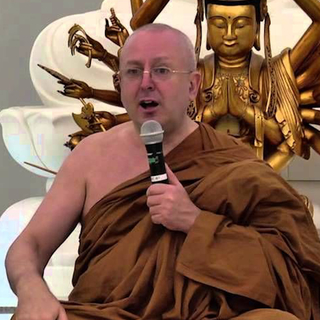
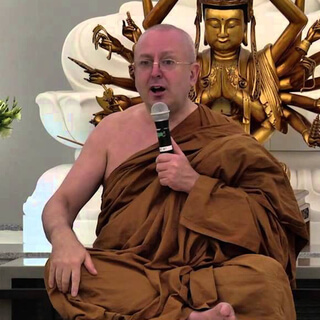
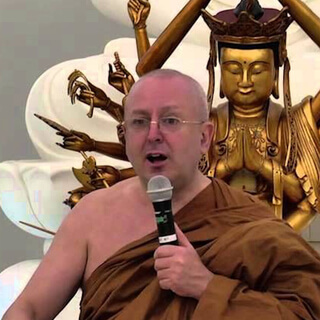
Anyway,
All these lectures here,
They are all recorded of course,
And they're all streamed outside there to the world.
As you'll find out later,
If you don't know,
After the talk is complete,
Then we have some questions and they usually begin with the questions from overseas.
They come from so many different places.
It's very joyful that what we do here can benefit so many people in some of the furthest lands,
In places where they don't have any access at all,
Even in healthy times,
To a center where they can hear some talks on Buddhism.
And the talks we give here,
As many of you will recognize,
Are not intellectual.
Sometimes it's one thing to say what the other books say,
Or compare this teacher to that teacher,
But here you're always here,
Just what we call the experience,
The feeling of all this thing which is lumped together as Buddhism and meditation and kindness.
It's one of those sayings,
There's a few sayings which I invented.
I remember where this one actually came from.
When I was visiting,
I used to go all around the world,
I was visiting UK once,
I was visiting,
Surprising to me,
It was some Buddhists,
Both male and female,
Who were members of the British Army.
I thought,
What's a Buddhist doing in the army?
And I wasn't doing anything critical,
I wanted to find out why.
And I thought,
Well maybe these are just people who do support.
We did have one monk many years ago,
But in the Anna Monastery.
Yeah.
Okay.
This one monk,
He was a Gurkha,
And a Gurkha was some of the most dangerous military figures you could possibly imagine.
And he was a real Gurkha,
And he used to tell us that the Gurkhas saying,
They always carry these big,
Very sharp knives,
And said,
You always know when the Gurkha had visited you,
In the middle of the night,
When you wake up and you shake your head and it falls off.
That's the sign the Gurkhas have been.
And I was a bit scared,
He was actually already a monk,
He'd been ordained in another place.
But I was surprised he was a monk,
And he was a Gurkha,
And said,
Didn't your Buddhist values and your being a Gurkha military man give you any conflict?
He said,
No,
Not at all,
Because he worked in the accounts department.
He never needed to use his knife except to cut costs.
But anyway,
He's a very,
Very wonderful man,
But these were British soldiers.
I thought they must be similar,
Like working in dentistry or.
.
.
But these were,
I was surprised,
They were frontline soldiers,
Who were fighting in Iraq.
So wow!
That's one of the reasons why I wanted to talk to them.
Because instead of judging and saying,
Oh that's wrong,
You shouldn't do that,
Whatever,
I wanted to learn,
And to learn just how they felt,
Why they did this,
What they were doing,
Without judging,
And how they could have a very strong sense of ethics,
Buddhist ethics even,
Believe it or not.
But in the end,
You know,
When they knew that what they were doing,
What they felt they were doing was correct.
But they said that sometimes when they heard from other monks already in the books,
Sometimes that's where the conflict came from,
What they knew,
And what they were told,
Sometimes conflicted.
And of course that happens to us in our life as well.
And sometimes that,
You know,
You look in the books,
You look at what you're supposed to be doing,
And look at what's really meant to be happening,
But the real life doesn't fit the books.
And from that,
When I came up with this little one-liner,
Which now sometimes people receive written in people's books on t-shirts,
It's never allowed your training,
Or never allow the theory to stand in a way of truth.
Because the truth is something which you experience yourself.
It's not what other people tell you.
It's not what you read in the books.
It's not what even just wise people say.
All that wise people can ever do,
And all the books which are supposed to do,
Is be able to help you find that truth for yourself.
To encourage you to put aside all those other fears,
What other people think of you,
Fears of what might happen,
Or that,
Am I doing the right thing?
And go deeper than that to find out inside yourself what the truth really is,
And to trust in that.
And so,
Much of what we teach here is,
It's not against at all in any which way,
What the Buddha taught,
Because the Buddha found that teaching that truth in the same place.
So interesting.
So the deep wisdom which comes from what I said this afternoon,
In another talk I gave on Zoom,
On calming down what we call the five hindrances.
Calming them down until they become so weak,
That the thing which bends the truth,
The things which distorts your whole processes of knowing,
Are discarded.
Why do we think in this way?
Why do we believe in another way?
Why do we perceive in this way or that way?
And much of our life,
Especially when it comes to the normal life,
A lot of it is sometimes just perceptual distortion.
Just a couple of days ago,
There was two regular supporters of our monastery,
And they were having an argument in monastery,
And I thought,
Why are you doing this?
And when you talk to them separately,
The causes of arguments and falling out and not trusting one another,
Is because one of them had said something which the other person really objected to.
They said something which wasn't nice.
But then the solution came and said,
Was that all they ever say to you?
Why is it you want to destroy good friendship,
Because one or two unpleasant things which you said to one another?
Why don't we take into account all the wonderful things we share together?
It's the old story,
For those of you who know the two bad bricks in the wall,
I'm not going to go into that in depth because that's such a famous story,
But it's a key story.
Why did I want to destroy my first brick wall,
Which I laid with my own hands,
At Bodhinyana monastery because of two crooked bricks?
That's all I could see,
The mistakes.
All I could see was my faults and I was embarrassed about that.
I was a perfectionist.
And I wanted to blow the wall up until somebody came,
Three months of suffering.
There was suffering as well,
I'd had nightmares about that.
I'd wake up in the middle of the night thinking,
Oh my goodness,
What have I done?
It was a small thing,
Small error,
But it got exaggerated out of all proportions.
Just like those little bad comments which somebody made to the other person in Bodhinyana monastery,
Was exaggerated out of all proportions.
How can you say that?
How can you do that?
And of course,
The brick wall which I laid is still there because someone pointed out the 998 beautiful,
Perfect,
Good bricks.
Just like I was pointing out,
You may have one person let you down once,
Twice,
Three times.
Is that worth breaking a good friendship?
Over two bad bricks in a wall?
They're human,
They make mistakes,
Like I make mistakes.
And when that happens,
You have to let it go.
Because the mistakes which I always make is telling the same joke again.
Which is a good introduction to this joke this evening.
I tried it out just before I had on a few people.
And I have to tell this joke now because as many of you know,
Tomorrow night is a full moon night,
But it's also Halloween.
It's a night for ghosts.
And it was one of my friends,
He was in London and he was getting his first house.
He got this townhouse really cheap because even a real estate agent who sold it to him waited,
He was haunted.
No one else wanted to buy it,
But he said,
Wait,
He didn't believe in ghosts,
It's cheap,
So let's go buy it.
So he bought it and the first night in that house,
He was sleeping on the ground floor.
In the middle of the night,
Around midnight,
He heard a sound.
Rap rap,
Rap rap,
And he thought,
Just imagining.
There were no ghosts and everything was closed and shut,
There was no wind,
Just imagining.
So he just turned over and tried to get a sip again.
As soon as he turned over,
Rap rap,
Rap rap,
Even louder.
So he got up,
Tried to find out.
Was there a window open or a mouse or something which was making that noise?
He searched all the ground floor,
Couldn't find any source of that noise.
So he decided to go back to bed.
Then he heard it again,
Upstairs.
He didn't believe in ghosts,
But he was shaking as he walked up the stairs,
Turned on the lights,
Looked all around,
Could see nothing,
No scientific reason to cause that sound.
So he turned off the lights,
Was going downstairs again,
But then he heard it once more.
Rap rap,
Rap rap,
He was coming from the top story.
Now his legs were really shaking.
It's amazing,
People say they don't believe in ghosts.
When you hear something supernatural,
You think twice.
So he went upstairs,
Turned on the lights,
Looked all over,
He couldn't find anything.
There was no cause,
No evidence to have anything create such a sound.
So he thought,
Just imagination plays tricks on you,
It does sometimes,
Especially if it is on Halloween night.
So he was about to go downstairs and go to bed,
Have a good night's sleep.
And he heard it again,
Rap rap,
Rap rap,
And he was coming from the attic.
Attics are very scary places.
They're places where people put all sorts of rubbish and who knows what's attached to that rubbish and what lives up in that closed area of your house if you have an attic.
So he got a ladder and a flashlight and he pushed his head through the manhole and looked around,
He saw so much rubbish in that attic,
So much discarded stuff,
But he couldn't see any ghosts there at all.
He was shining around with his flashlight and then of course he heard it right behind him,
Rap rap,
Rap rap,
Rap rap.
He turned around,
He shone the flashlight,
He saw it.
It was an old piece of wrapping paper.
Oh come on,
It's Halloween tomorrow.
He's made of a few more groans instead of just those.
Okie dokie.
Anyway,
I do try.
You know that sometimes those silly old jokes which I say people just groan and say they're really bad jokes,
But you share them with your friends when you go home or the people you go to work with.
Anyway,
So when we can just let go of some of those old ideas in order to be able to see things in a different way,
That is where wisdom comes from and hopefully that's why people come to a place like this,
To see things in a different way.
And one of those things we can see in a different way,
I already mentioned to you about the way we meditate here.
And it's starting off just relaxing your body first of all.
Should be the most easiest thing in the world to do,
To relax.
But one of the things which comes up when you relax your body is the feeling of delight,
Pleasure,
Just in your body.
And I'm getting old now,
69 years of age.
Most of those years have been in service to the Buddhist Society of Western Australia the last 37 years.
37 years I've been serving here.
I got pictures of me when I first came here.
Now I was thin and handsome.
But anyway,
It's a lovely service.
But there are some of the things which you learn here is how to get a body which has got no aches and pains when you're this age.
Just be able to relax so deeply that the body becomes pleasurable.
When I was just looking at my body before,
During the talk,
Just being aware of it,
Feeling that and relaxing everything,
The body felt like perfect.
It's very difficult for me to make comparisons.
But I remember just because I don't have a body massage,
Sometimes the monks give me a foot massage.
But there was one time some years ago when I went to Bhutan and went climbing up the tiger's nest.
And then it's not that far up but it's like very low oxygen in the air.
So you're always panting just getting up there.
That's what really makes it very arduous physically.
But getting up there and coming back down again,
Where they were letting me stay the night was in a hotel which had a bath,
Had a hot bath.
Now usually as a monk that's too much indulgence to soak in a hot bath but I had a good excuse for once.
Having climbed up to tiger's nest and back down again I thought,
Yeah,
Okay,
Let's have a hot bath.
And so I soaked in a hot bath and it's wonderful.
You probably do it every day,
It's like a jacuzzi or something.
You know I don't know what a jacuzzi is,
Honestly.
It's something like hot bath.
Spas?
What's a spa?
Excuse me,
What's a spa?
A water jet.
A water jet.
Ah okay.
That's what a jacuzzi is.
You learn something every day in the Buddhist Society in West Australia.
Because I'm a monk you don't have those things.
But anyway,
Just without any jets of water,
Just hot water which is so relaxing and all those tightness,
Baking bones all just disappeared.
It was lovely.
You wanted to stay there as long as possible and the water kept getting colder and colder and colder.
It would be wonderful.
In a real jacuzzi does the water stay at a constant temperature?
Wow,
I've been missing out on life.
Not really because to get that same degree of relaxation just sitting here.
Just,
You know,
Body sort of cross legged on a cushion or on a chair and feelings are so comfortable to the point that you can feel just the joy,
The happiness coming in your body gets very relaxed.
Now I know because sometimes you do have like a bruise or a wound or something,
Just living in a,
Especially in a forest.
But I know that when you do have a wound or a cut or something and you give it this beautiful energy of softness and kindness,
Awareness of the kindfulness,
It just relaxes it so much that a lot of the time the aches and the pains go away.
And that has been my,
Please excuse me,
My major means of medication over the last 46 years of a month.
It's just being able just to look at a wound or an ache or a bruise or a pain or something and being able to relax it all away,
Which is weird.
And I usually say this on retreats because there's always somebody who gets sick on a retreat,
They get a cold or a bruise or something.
And just because this afternoon I also did a Zoom talk to a monastery over in Canberra,
I remember the first time I visited Canberra for a few days.
And I never realised,
I didn't do research,
That Canberra is one of the coldest cities in Australia.
It's not like Perth.
So I didn't have any cold weather clothes and after just the first day there I got a cold.
And it got worse because people after lunch,
After giving me lunch,
They took me around touring around Canberra and the forests outside there,
There was a monastery not far away and I spent so much time there,
They wouldn't let me go.
And so I was supposed to give a talk that evening in a Vietnamese temple.
It'd been advertised and people were waiting to see me.
And when I got there I had five minutes after arriving,
Getting out of the car,
Just didn't have time for a shower,
Just to try and get a,
I asked if you got a cup of tea,
Something to give me a lift.
And it was Chinese tea.
I said,
Look I'm a Theravadan,
I like Sri Lankan tea.
They gave me Chinese tea,
What I call Mahayana tea.
But anyway,
It didn't really just have any effect on me at all.
So imagine what it's like when so many people have turned up to listen to you and you feel terrible.
And it's not just a feeling terrible,
But every time you're giving a talk and then sneeze,
Coughing and stuff dripping down from your nose.
It's disgusting.
I'm glad it wasn't actually videoed.
And also the other thing which I've learned giving talks is always to scan the audience,
Have a look at you,
See if you're actually listening or if you're looking at your clock or you're falling asleep or.
.
.
But there,
People were just,
Their head was down,
They were looking at their clock.
Because it was really one of the worst talks I'd ever given.
Not my fault,
I had a cold.
You couldn't put a sentence together without coughing or sneezing.
And so after 10 minutes,
The talk was not going anywhere.
So I was supposed to do a meditation sometime that evening,
So I said,
Let's do the meditation now.
And everybody was very happy to do that,
Especially me.
So instead of talking,
We just meditated,
Not a guided meditation,
A silent meditation.
And that was one of the most wonderful things for me personally.
Because only half an hour,
Instead of talking,
I could focus on just the feeling in my nostrils and my throat and really give it lots of kindfulness.
Kindfulness which means just to relax it.
So the inflammation or rather what you might call just the over expression of the immune system in that part of my body,
I know there's a few doctors here,
Probably I'm saying it wrong,
But anyway,
That I could relax it so much that the nasal liquid,
I always call it what I learned at school,
Snot,
Stopped coming out and I stopped sneezing and the wyes weren't watering.
And after half an hour,
It's all gone.
No medication at all.
Just like learning how to be kind and aware of your body and how to relax everything.
And I've used that very often ever since.
The power of kindfulness to relax the body and the body to feel really wonderful,
Joyful,
Happy,
No pain,
No ache,
No inflammation,
Nothing.
The joy of that is something which you try and teach other people because it does create a very healthy body.
You're becoming aware of how your body works.
You're not told this,
It may not be in the medical journals,
But you feel it for yourself.
Once you feel it for yourself,
It gives you great power.
You know one of the problems with,
If you do get sick,
Sometimes you feel that you can't do anything about it,
It's just taking away all your responsibility,
You're just following the words of advice of a doctor or a nurse,
No matter how compassionate they are,
They can't really understand how you're feeling.
Only you know that.
And they never know exactly what works for you.
But you can find that out.
So little by little you can sometimes trust your own kindfulness and just how it's worked on so many other parts of your bodily ailments and just to feel that everything's starting to disappear and what was once painful is now sort of quite pleasant and other parts of the body just so delightful you can stay there.
And it also taught me one important thing of meditation.
Your mind will always wander off,
Will always just slow thinking or doing something if you're not enjoying where you already are.
Is when you're enjoying where you are,
You find peace in your heart and in your mind.
And how on earth do you find joy where you already are?
Just being here for a little bit longer,
Just being kind to all these parts of your body and joy is there.
The body feels like you had a massage or been in a jacuzzi and it means that the aches and pains in the body just basically got not much chance to keep on going and they vanish.
Just like they did in the cold.
Of course I've had much worse ailments than that and it seems to work for me,
Maybe because I know how to really do it.
It's not something which I was read in books.
I didn't follow what I'd learnt.
I followed what I felt,
The truth inside,
Not the theory but actually the reality.
And so that's something which everybody here can learn.
And I was just talking about this the other day because somebody's friend had bad,
Well they had a child who had arthritis which I was told is an inflammation of your joints or whatever and a child of 10 years of age or something and they said,
10 years of age has arthritis,
I thought that was an old person's problem,
Shows you how much I know about medicine but there was also this email we received here about 2 or 3 years ago and I'll never remember this,
Apparently that was when Dimmi was,
What do you call him,
Admin officer and she showed it to me.
It must be in the computer there somewhere but Dimmi is now at Dhammasara monastery training to be a bhikkhuni,
It's wonderful for her.
But I always wanted to find a copy of that because when she read it out to me it just brought tears to my eyes.
Because there was an old lady in Poland I think it was and this lady,
I think in the 70s or 80s,
I may have got that wrong,
Please apologise,
But she had this chronic arthritis and it was so painful and the only way she dealt with it was these medications which were very,
Very bad side effects.
You know what it's like in life?
People get themselves in these situations and the usual treatment,
Yeah it sort of works but it's not really that good.
But then out of desperation she was searching around,
Something to help her overcome this arthritis,
She had to take those medications she wrote to get through the day,
Just to get through a day.
That was just how painful this was for her.
But then she heard about these meditations we do here,
She tried it,
The kindfulness,
Relaxing her body and she managed to do it.
The end of the letter,
It still makes me emotional because of the joy of seeing this work for other people,
She said that now I don't need the medication anymore because there's no more arthritis.
I thought wow,
How wonderful that is because I've seen people,
They're just crippled and distorted with arthritis and for this to actually to vanish like that,
That was more than I'd ever imagined could be possible.
Wow,
Well done.
So the joy and the health which you get from your body just doing this,
Imagine what happens next when you do this to your mind,
Your inner world.
Wow,
It's really crazy,
Beautiful,
Especially just bringing the joy to the mind.
The joy to the mind is something which when we lack that joy,
We just,
We get grumpy and we get irritable very easily.
Without that joy,
The sign of no joy is the sign you're stressed out and tired and we take it out on each other which is a terrible thing to do but we can't resist that.
It's one of the reasons why a long time ago I told people if you're married and if you go home and your wife says something rude to you or nasty to you,
It's not your wife talking,
It's her tiredness which is doing the talking.
Your husband is just,
He's stressed out,
He's just telling you this,
It's rude words or nasty words to you,
Not because he doesn't like you,
Doesn't love you,
It's almost as if he thinks that he's venting,
Letting out this tightness and tension to someone he thinks understands.
Someone who thinks understands,
Whoops,
Who understands.
Someone who understands how he feels,
Can let it go.
Doesn't hate his wife,
He's just tight and tense.
So why do people have to get to that tight and tense state anyway?
Can't we just bring some happiness to our mind?
Joy,
And this is what happens if you learn how to relax the body,
It feels joyful.
If you learn how to relax the mind,
That starts feeling joyful too.
That starts making you more bubbly and more happy.
Why?
It's the beauty of this mind,
The beauty of just this moment starts to shine forth.
It's one of the reasons why people come to learn meditation or they come to this Buddhist society not just to be wise and knowledgeable or healthy,
It's to be happy,
Joyful.
I saw that from the very beginning when I started becoming a Buddhist.
Remember I wasn't born a Buddhist,
No one in my family could even spell Buddhism,
Let alone know what temple to go to.
I didn't know there was temples,
I just read Buddhism in books.
But nevertheless,
Just I had this understanding that if a Buddhist was a practicing Buddhist,
If they were really meditating,
You should be able to see that,
Not with the wise words which they can say,
But just in their happiness and their joy and just how pleasant they were to be around.
Now it was so important to me that when I was looking for a type of Buddhism to follow,
There were many Buddhist temples in London,
At least it was in London,
A big city so you could find different temples.
But it was only the Thai temple,
It was a Thai temple more than any other temple at that time where the monks smiled the most.
You know you may think that was superficial but that was really important to me,
To see people who'd been practicing meditation,
Who knew something about these teachings and you could see it on their face.
And sometimes you can make up all sorts of wise words.
What I really didn't like in temples was when somebody would say,
Oh it's really high-faluting stuff,
And we'd go out afterwards with my friends and they would say,
Wow that was really profound.
He said,
I didn't understand a word of it.
Yeah because it was profound,
It was very deep.
And to me there was so much,
Please excuse me,
Bullshit.
These days I call it Gomayang,
Gomayang is a Pali word which means the same thing.
And so now if it's something which is really truthful,
Surely you should be able to explain it.
And surely it shouldn't be just theory,
It should be something which you can feel and inspires you,
Makes you happy,
Joyful.
And of course it was a great relief eventually to find great teachers like an Ajahn Chah who was incredibly happy.
Sometimes even in sort of unexpected situations,
You know,
When he was sick or hurting or something or someone told him off,
He could always make these wonderful little jokes.
I don't think I've told this one for a while.
This is not so much a joke but a very,
Very deep explanation of what meditation is.
Because this was,
Oh,
Maybe about 40 years ago now,
Where meditation was becoming known in the West but not well known yet.
And Swedish governments wanted to find out what was meditation.
So they got a professor from one of the big universities in Sweden and they paid this professor to go around South Asia,
That's India and Sri Lanka and Nepal and South East Asia to try and find as many meditation teachers as they could and ask them the same four questions.
And eventually this Swedish professor came to see Ajahn Chah.
And I was there at the time.
So this was a representative of the Swedish government,
So he had a diplomatic visa.
So he's a really important person.
So Ajahn Chah received him with a lot of respect,
As he should,
Representative of a foreign government and just asked him what he was doing here and he said,
I needed to get an answer to four questions.
He'd been asking so many different meditation teachers and gurus,
Professors in Asia,
What's the same four questions?
Now he came to Ajahn Chah.
So Ajahn Chah said,
Well what are the four questions?
Through interpreter.
And the four questions were,
What is meditation?
Number two,
How do you meditate?
Three,
Why do you meditate?
And four,
What do you get out of meditation?
Those four questions.
Because you know,
If you're doing a survey,
You've got to ask the same questions,
Compare the answers,
Collate everything so you can write out a report to a government.
That's how things are probably done in universities,
Maybe,
But it's not the way things are done in monasteries.
So Ajahn Chah,
I remember this,
He said,
Oh,
Important questions.
So he asked for a piece of paper and a pencil.
That's the first time he's ever done that.
And Ajahn Chah did something like that,
He knew he was up to some trickery.
He's going to do something weird.
It made you very excited because it wasn't just answering the questions,
It's just the way he was answering it.
He made a drama out of it.
And so,
And then,
What's the first question again?
Sort of,
What is meditation?
And so he scratched his head,
It's the first time I've ever seen him do that.
He scratched his head and then he licked his pencil and he wrote something down.
He did that for all the four questions,
He couldn't wait,
He got the answers to those questions.
See how a great teacher would answer,
You know,
What is meditation?
Why do you meditate?
How do you meditate?
What do you get out of meditation?
And then the monk who's translating this into English,
He had to stop laughing before he could actually translate properly.
So what is meditation?
My venerable Master Ajahn Chah's answer is,
What is eating?
Second question,
How do you meditate?
His answer is,
How do you eat?
Third question,
Why do you meditate?
His question is,
Why do you eat?
Fourth answer,
What do you get out of meditation?
What do you get out of eating is his answer.
Or that professor was very upset.
He said,
I can't take those answers back to my government.
And Ajahn Chah,
That's all you're getting.
But I can't do that,
They're silly answers.
And of course Ajahn Chah didn't budge,
He gave those answers to the professor and of course we always thought afterwards what brilliant answers they were.
Meditation is something very simple and easy,
We make it complicated.
What is eating?
Did anybody ever teach you how to eat?
They maybe taught you manners,
Terrible manners,
And to try and eat this and try not try and eat that,
But how many people told you what to eat?
They do that to me every day and I refuse to follow their instructions.
You know yourself,
You know what you need to make your body healthy,
What you can digest and how much,
And if you have that mindfulness you will know better than anybody else.
Still recall that there's articles which,
Weird articles which you collect every now and again.
There was a young kid,
I think it was in UK,
And he had a craving for salt.
He couldn't speak yet.
So he would actually crawl on the floor and he would eat any salt which had fallen on the floor,
When he could climb up to the table he would take in a little salt container and just put it in his mouth and eat so much salt.
But he became such a good climber that his mother had to hide all the salt in cupboards,
Sometimes locked or really high so he couldn't reach them.
And over the weeks she was doing this he got more and more sick and he died.
And when he died they had to do an autopsy on him and they found out he had a very,
Very rare condition which needed to consume salt.
He was trying to survive but he couldn't speak.
But you know he knew that that's what he needed.
He couldn't say.
Sometimes I remember when I read that I thought,
Wow,
Sometimes we know better,
But do we?
When you have mindfulness and kindness you know exactly what you need,
You can feel it.
And trust in that.
And that's one of the reasons why Ajahn Chah said,
What is eating?
What is meditating?
Sometimes he would always say as well,
The meditation,
Or just being around good people,
Even like reading some inspiring books,
Is called food for the heart.
Food for the inside,
Not just your body but for your mind.
I know that because sometimes we don't meditate enough because you're busy travelling or talking or doing all sorts of stuff.
Sometimes your mind feels like weak,
Even sick.
And how do you know it's sick?
Because you can get angry and grumpy.
Far too easy for nothing.
That's the sign of a sick mind.
But if you're healthy,
Well you might do some meditation,
It's almost impossible to get upset and angry.
You're just too happy.
Oh,
Jambhava,
You're really fat and stupid.
Yeah,
Yeah,
That's good.
Honestly you can feel that's so true.
So when you eat the right food,
What is eating?
What is meditating?
Why do you meditate?
Why do you eat?
What is meditation?
What is eating?
What do you get out of it?
You get health out of eating good food.
You get mental health out of eating meditation.
So that's one of the reasons why I wanted to see healthy individuals who are fit through meditation.
When you saw those things,
You realize,
Ah,
This meditation does actually make you happy.
Make you joyful inside.
It's very wonderful to be around joyful people.
I don't like being around people who are miserable.
I don't want to spend time with people who are,
Why is the government like this?
What's going to happen if Mr Trump wins?
What's going to happen if this happens?
You try your very best to be compassionate and kind and spend time with people.
It's really hard sometimes,
Isn't it?
It'd be much nicer to be around people who are smarting and happy and joyful.
So it's wonderful being around sometimes some people who had this smile on their face.
They lifted you up.
If you want to go and be miserable,
Just go to parliament house,
Listen to a debate or something.
I don't know,
But it's pretty miserable for people in the world.
But actually to have happiness and increase that happiness and find out what the meaning of happiness is.
That is powerful.
So what is the meaning of happiness?
It's the opposite of suffering.
It's the end of suffering.
And that was something which was so obvious when I was a lay person.
If,
If this path is to end suffering,
You know what the Buddha kept on saying,
The Four Noble Truths,
To end suffering,
I want to see some examples of people who have ended suffering.
I want to actually see this,
My own eyes.
Is this real or not?
If you're in one of these religions which they promise you happiness afterwards when you get to heaven,
That's a pretty tough one to believe or to trust in.
You haven't died yet,
You don't know if they're telling the truth or not.
But to see if this actually ends suffering now in this life,
You see examples of people who just really have hardly any suffering at all.
Now that is impressive to see.
So that's what you can do.
That's what it means we chant this to be seen in this very life for yourself.
You don't have to wait till afterwards,
After you die.
But to be able to see it for yourself.
And it was very inspiring to see happy people and then to see just happiness in your body and happiness in your mind.
Just by learning how to be in this moment and being still.
See this happiness grows so much.
And I've said this many times before,
So it's no real secret to people.
That was one of the reasons I became a monk.
The happiness in meditation was greater than any happiness which I'd have known.
Even as a monk,
As a lay person,
Sorry.
It's actually to experience that.
When I was a very successful young man,
Passing all my exams,
As I mentioned earlier to you,
I was very young and handsome and good looking.
So I had my girlfriends at that time.
Just only one at a time.
I was too poor to have many.
I really was.
But you know sometimes,
Ajahn Brahm,
Please don't say this,
I don't know why I can't say this,
You know you would have some sex with your girlfriends,
As a young man.
And in the end,
I was very glad I did that.
I don't know why people criticize me,
I'm just being honest.
I was a monk,
I wasn't a monk at the time.
So I almost got into trouble then.
See,
I made you laugh,
Isn't that wonderful?
I was a lay person,
A young student.
But what it did was,
At least I knew what I was going to give up when I became a monk.
And I gave it up because the meditation was better.
It's a crazy thing to say.
But you know with all honesty,
The happiness,
The pleasure of meditation was more intense,
Was more delightful and was actually longer lasting,
You know than good sex.
There we go.
And that really just,
That threw me as a young man.
You're looking for meaning,
Experimenting in life,
Trying to find out what to do with your life,
And to have that come up to you,
Wow.
And then eventually obviously becoming a monk and really get into the meditation world,
Finding out why that's happy.
And the beautiful happinesses of life and things which many people miss.
The happiness of being a good person.
If you want to look at this,
This isn't a Samanya Palasuta.
I found this out before I read that.
If you keep things like precepts,
You're a good person,
Trustworthy,
Moral,
You don't break rules just for the sake of breaking rules,
You don't take drink or drugs,
You're a happier,
A happier individual.
My happiness level just was rising.
I couldn't understand why that was,
But it was because you were clearer,
More peaceful.
Only later on,
Could you put it in words which made sense to myself and sense to others.
All those other things which I would stop doing when I was keeping precepts and being moral,
Were things which were called my desires,
My gross desires.
And I realized later on that those desires control me.
I wasn't free at all.
You saw a nice girl,
You just followed her,
A young,
A young man,
Saw something you wanted to eat,
You just ate it.
Someone said,
Oh this drug is really good,
Or this alcohol is really nice.
You just did it.
I was not in control of my desires and cravings.
They controlled me.
But when,
When you start to keep precepts,
You realize that you're free from desires.
There's two different freedoms and this is not taught enough in our world,
The freedom of desires or the freedom from desires.
And of those two freedoms,
What meditation gave you was the freedom from desires.
Meditation only took off when you really let go.
You didn't want anything in the whole world.
Just being in this moment,
Not thinking,
Just watching a breath come in and go out,
It just ends up in the deep meditations.
You didn't want it,
It just happens.
The freedom from desires,
Not the freedom of desires.
And so as I was lessening the freedom of desires by keeping precepts,
The desires,
They weren't free to just play their games anymore.
And I was experiencing freedom from desires,
Wonderful contentment,
Peace.
Who wants anything?
And that was just so powerful,
Such a powerful happiness and bliss.
And of course that leads all the way to enlightenment.
I'll finish off with one of my favorite stories.
I know many of you heard this many times,
But it fits in on this talk.
That was the story of the five children playing the wishing game.
I often mention this story because when I was a young man again,
I just was interested,
I was very open to all sorts of teachings and religions.
And I would go and ask people just,
When you talk about enlightenment,
What is it?
God,
What is it?
The ultimate reality,
What is it?
I didn't want to find out and I could never get a good answer from anybody.
Especially I remember going to ask the chaplain at the school I was in.
I was coming from a poor home,
I went to a good school,
Scholarships all the way.
And anyway at the school I asked the chaplain,
What is God?
I remember him asking something like,
It's beyond words.
It's beginning and end of all things,
The Alpha and Omega of life,
The end of all being and he went on all this stuff which didn't make any sense to me.
He said,
Can't you actually,
If this is the one you've devoted your life to,
Can't you actually give me a real description of what God is?
And he couldn't.
So that was one of the reasons I didn't have any confidence in that path.
But then I remember going to see the monks in the temples in London and asking them the same question,
What is enlightenment?
You know what they said?
Enlightenment is beyond words.
It's the ground of all being.
I've heard that before somewhere.
But then you get to real people who practice this stuff,
Real sort of good monks in places like Thailand and you ask them that question and you get these amazing answers which you can understand and make sense.
And the one which made sense was the five children playing the wishing game,
Which I've obviously changed over those many,
Many years.
So five children playing the wishing game and it goes like this,
The rules are that every child has a wish.
Whoever comes up with the best wish,
Wins a wishing game.
So first child has said,
If I had a wish,
I'd wish for a new PlayStation.
Is that right,
PlayStation computer games?
Whatever.
I'm 46 years old as a monk,
69 as a human being.
So I didn't have computer games when I was a kid.
Used to play knots and crosses on pieces of paper.
So anyway,
I wish for a new computer game.
Second kid,
I wish for a computer game shop.
Have a shop,
I can have the latest computer game whenever I want it.
Third kid said,
The problem is,
And any kids will know this,
That if you like to play in computer games,
Your mummy and daddy keeps telling you,
Do your homework first.
And homework is just a drag to do homework.
I shouldn't say that with these kids here.
But mummy and daddy says,
Oh,
I must do the homework first of all and get good grades at school and then I can mess around with my computer games.
So the third kid said,
If I had a wish,
I wish for 10 billion dollars US.
With 10 billion dollars US,
I'll buy my own computer game shop and secondly,
I'll buy my own school.
If you own the school,
You can sack the headmaster or the teachers if they give you bad grades for not going to school.
And then once you graduate from your own primary school,
Then you can buy your own private high school and then your own private university like Mr.
Trump.
He's got a university,
Hasn't he?
Trump University?
I don't know.
Anyway,
But anyway,
You can do that,
Which means you don't have to worry about passing exams,
You just award yourself an honorary degree and you can spend all your time playing video games.
That's a much better wish.
And the fourth kid,
The fourth kid did much better than that.
The fourth kid said,
If I had a wish,
I would wish for three wishes.
Which is a wish?
For my first wish,
I'll have the computer game shop.
The second wish,
I'll have 10 billion dollars US.
The third wish,
I'll have three more wishes.
That way I can go on forever.
That's the infinity of wishes,
Granted.
It's pretty good.
And the last child did much better than that.
The last child would win the wishing game.
When asked what wish would you want,
The last child said,
I wish I was so content I never needed any wishes ever again.
And there we have the best description of what enlightenment is.
So content you don't need any more wishes.
The fourth kid,
As many wishes as you have,
Granted.
That's like a person in power,
Like a president or prime minister,
Who whatever they want they can get just like that.
The third kid with 10 billion dollars US,
That's just the millionaires,
The billionaires,
Thinking that will give you happiness.
It's not having infinite money,
Not having infinite power like the fourth child.
It's having the wisdom that you can be so content,
You never needed any wishes ever again.
Freedom from desire,
Not the freedom of desire.
So there we go.
That's the talk this evening.
So I hope you enjoyed it,
Because that's all you're getting.
Sadhu,
Very good.
Okay,
Nice joke here.
Okay.
Oh thank you,
Yeah.
Any questions from the floor,
Please?
There's a microphone there,
Please come up to ask it.
Okay,
Hi Ajahn Brahm.
What happens after a non-returner dies but is not yet fully enlightened?
Where do they go after death?
Non-returners don't die.
If they're a non-returner in this life,
Then they go to what's called the pure abodes,
The Sudha Wasa,
And they hang out there until they pass away.
And when they pass,
They don't actually die,
They just fade away and disappear,
And no trace is left of them.
In the heavenly realms,
Especially the realm of the non-returners,
There's no funeral palace,
There's no cemeteries where they bury old bodies,
There's no crematoriums.
The human body is mind-made there.
So but if they pass away from the non-returner realm,
Sudha Wasa realm,
Then they just,
They vanish.
Poof,
And they're gone.
From Jenny,
Ajahn,
Thank you for the talks,
Very useful during my chemotherapy care instead of cure,
Oh,
Chemotherapy care instead of cure has been my guiding me through,
Guiding me through.
Please advise how to maintain good thoughts when the body is weak and tired.
Remember whatever thoughts which you have when your body is weak and tired because of going through chemotherapy,
Because of the cancer,
Please remember that sometimes you cannot control your thoughts.
All you can do,
You can control the reaction to the thoughts and give them some,
Again,
The kindness.
But don't ever think you had some really crazy,
Weird thoughts and there's something wrong with you,
It's just the chemotherapy working.
And anyway,
The care rather than cure,
As many of you know,
Is one of the doctors who would come here,
And I expanded that story to the monks the other day because I remembered,
If I'm not mistaken,
He was the very first waysack which we did at our North Perth meditation place in Magnolia Street.
And I was there,
I'd just come,
I think,
From Thailand to be there for the first waysack.
And their parents told them,
Only little kids,
Five,
Six,
Seven,
Eight or whatever,
Told them to keep eight precepts,
They weren't allowed to eat anything after noon or in the evening or night time.
And these are little kids.
And I remember just finding a group of them,
About four or five,
Hiding under a bush about three or four o'clock in the afternoon,
Munching on some biscuits.
And they felt so busted.
Raaah,
Please don't tell our parents,
Raaah.
I said,
Oh,
Come on,
I'm not going to tell your parents,
It's just four or five years,
Six years of age,
Of course you can have those biscuits,
But make sure you save,
They look very nice,
Make sure you save some of them for me tomorrow.
And one of them was just,
This person who became just a doctor and he was the one who lost one of his patients and he wanted to resign and I told him,
Look,
If you think that curing is what being a doctor is all about,
You've missed the point.
He goes,
You're always going to fail if you think curing,
You won't be able to cure people all the time.
Caring for people is what you can always do,
You can always care for people.
And so make caring your priority,
Not curing.
And then he got it straight away and so he went back to work again,
He never resigned,
Which is great.
And he sometimes helps our monks,
You know,
Needs specialists for free of course.
I cared for him and he's always very happy to care for us.
Anyway,
So caring is far more powerful than curing,
So care for your thoughts as well,
Don't try and cure your bad thoughts,
Care for them and say,
Oh,
It's a really bad thought.
It's my personal best,
The worst thought I've ever had.
Great,
See if you can do better tomorrow.
In other words,
Just don't judge.
In UK,
Dear Ajahn Brahm,
I suffer from anxiety and find it hard to make decisions.
I meditate every day and I feel within me a lot of resistance,
Please advise.
Making decisions in life,
You know,
Just,
I've mentioned this before,
It doesn't really matter which way you decide to go,
To go left or to go right.
Because when you go left or you go right,
If you go outside this hall here,
When you go out,
You turn left or you turn right,
It all actually goes around in a circle around the park.
So it doesn't really matter which way you go,
Left or right,
You all end up in the same place.
And that's much of life as well,
You turn left and you turn right,
It doesn't really matter which choice you make.
But what really is important,
You don't waste all your energy worrying about which decision I should make.
Instead,
Preserve that energy for after you've made the decision.
So you turn left,
Make the left turn work.
If you turn right,
Save the energy,
So you make the right turn work.
You'll be far more successful in life.
It's not which decision you should make,
You should be worrying about,
It's make the decision reasonably quickly and then make it work afterwards.
I have to make decisions,
It's amazing sometimes I don't worry about them,
People say,
What decision?
Oh,
You do it this way.
Other than that,
The other way of decision making is,
I don't know when I last told this story,
This was in Oslo University,
When somebody asked,
I got a really important decision to make in life,
This young woman and how can I make that decision?
And I told her,
Let's make this a bit more real.
I don't like theories,
I like grounding them in some reality which makes it much easier to understand.
Suppose that decision is,
Should I marry the young guy sitting next to me?
And oh,
I should not have said that,
I really picked it up because she held her hands in her face,
That was the decision she was trying to make,
Whether she should marry a boyfriend or not.
And she got red in the face and people started laughing.
I shouldn't have done that,
But I always tell people I did it.
And anyway,
So I said,
Well,
It's an important decision in life,
Who are you going to marry?
And so if you want to make that decision,
Get out a coin,
Toss it,
Heads I marry him,
Tails I don't.
And that's what I said.
And sometimes I thought,
This is a crazy monk from Australia,
So they got no sort of wisdom at all.
But then of course I told her,
No,
Take out the coin,
Heads I marry him,
Tails I don't.
So it turns out heads,
Heads I marry him.
How do you react?
Do you say,
Yes?
Or do you say,
Two out of three?
And that will tell you whether to marry him or not.
If it's two out of three,
Then don't marry him.
If it's yes,
Then go for it.
So sometimes the tossing of the coin is not to make the decision,
But to reveal what decision you want to make.
Lastly,
Ajahn Brahm.
I can't,
This is from Poetry Jones.
Ajahn Brahm,
Please tell your joke about the giant coffin that chased the man next time,
Next Halloween.
I said that over in,
Where was it,
Over in the retreat which I just was given last week,
The coffin joke.
I'll say it very quickly,
Just to finish off.
No more questions,
Because it is Halloween tomorrow.
Okay,
So I'll do it very quickly.
So there was a guy and he listened to a talk in the temple just like this and he was walking home,
There was two ways to go home.
One was a long way round,
One was a shortcut through the cemetery.
And he made the choice to go through the cemetery.
And the cemetery is fine,
You know,
There's nothing really to be afraid of there,
But maybe on Halloween's night,
Ooh,
That may be a different story,
And it was for him.
He got halfway through the cemetery,
Everything was going fine,
A little bit further and he heard a sound.
You know sometimes you feel that something's following you?
That's what he felt.
So even though he wasn't afraid at all,
His pace went a bit faster,
He started walking faster.
And as he was walking faster,
His awareness became stronger.
What else was behind him that was also keeping up with him,
Was also coming faster.
With mindfulness he focused on the sound and it was like a bump,
Bump,
Bump behind him.
He didn't have any idea what it was,
But he started walking as fast as he possibly could,
Bump,
Bump,
Bump.
It was not just keeping up with him,
It was actually catching up with him,
Whatever it was.
When he got to the cemetery gate,
He made a big mistake.
He looked around and what he saw almost made his heart stop.
What he saw behind him,
Bump,
Bump,
Bump,
Was a coffin.
A coffin,
A vertical coffin.
It obviously just ripped out of the ground,
So it still had the dirt on it and spider's web.
Bump,
Bump,
Bump,
Chasing him.
Whoa,
That was really scary.
And so he started running.
Bump,
Bump,
Bump,
Run and he could hear it behind him,
Bump,
Bump,
Bump,
Bump,
Bump,
Bump,
Coming after him.
And he got to his house,
He didn't open the garden gate,
He jumped over it.
Fortunately,
He was fit enough to do that.
Bump,
Bump,
Bump,
He looked around,
The coffin was at the gate too.
And he was at the door of his house,
He picked out his keys to open the door,
He dropped the keys on the floor.
Bump,
Bump,
Bump,
As the coffin broke down the garden gate.
Bump,
Bump,
Bump,
It was coming after him,
Just along the garden path.
And he picked out the first key which came into his fingers,
Put it in the lock,
It was the right key,
Turned it,
Opened the door,
Jumped inside and banged the door shut and locked every lock which was on there.
He could see the coffin now was at the door of his house.
You know they have little glass panes on your house,
So you can see what's on the other side.
You can see the shape of the coffin,
You notice,
You just flap the top and then a little bit of an angle and then coming down the ground.
But he was inside,
He was safe.
So he thought,
Bump,
Bump,
Bump,
As the coffin started to break down the front door of his house.
He saw some of the hinges start to give way.
He saw some of the wood start to splinter.
What can he do now?
He ran up the stairway of his house to the top floor.
As he got to the top of the stairway,
Bump,
As the coffin broke down the front door.
And he saw the coffin,
He just came into his house and the coffin looked this way,
Looked that way,
Looked up,
Saw him.
Oh,
Bump,
Bump,
Bump,
Bump,
As the coffin started to climb the stairs.
Oh,
This was really scary now.
He had no place to run,
He just went into the only room which had a lock,
Which was the bathroom.
He went in the bathroom and locked the door.
The coffin had already seen him.
Bump,
Bump,
Bump,
Bump,
Bump,
Against the bathroom door.
Bump!
As he realised there was no place to go and that coffin had broken down the garden gate and even the front door gate.
He knew there was no escape.
It was only a matter of seconds.
He was true.
Another couple of seconds,
Bump!
And the bathroom door gave way.
It was just him and the coffin with no one,
Nowhere else to run.
As he started coming towards him,
Almost out of instinct,
He reached out for a bottle of medicine on the shelf and threw it at the coffin.
Didn't know what he was throwing,
Didn't know what he was doing,
He was so scared.
And the bottle of medicine,
Glass bottle broke and this brown smelly liquid came out.
And the coffin stopped right there.
Just as the pharmacist said,
That medicine stops the coffin.
So,
So true.
See,
People liked it.
Let the audience just decide.
Very good.
I can go,
Thank you so much.
Please,
If you like that,
Please you can tell your friends when you go home.
Okay,
Let's go now then.
Thanks again for listening.
O ye,
O ye thanGBF Sean Seagal-Tides-erence- Morris Lee,
S gigYUR Chan Hello Kim Met I think I should apologize to everyone for those jokes today.
I think I should apologize to everyone for those jokes today.