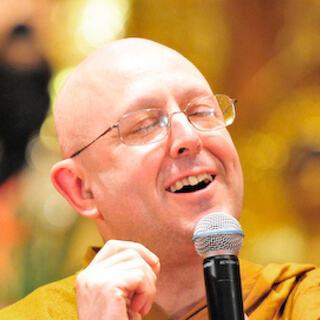
So you know,
For this evening's talk,
It was something one of the monks said today.
He said,
How can you have a positive attitude towards everybody?
He said,
It's easy,
This is what we do.
He said,
It may be easy for you Ajahn Brahm,
But can you please explain?
How can you do that to other people in your life?
And at the same time there was a lot of wonderful people today,
A few people,
The last few days celebrating anniversaries,
Being married for such a long time.
And I asked them,
I said,
Your partner,
Just,
Can't you see,
How can you be married to them for such a long time?
Can't you see all their faults and defects?
And the guy first of all said,
No,
No,
She's perfect.
And I looked at him,
Come on,
You're supposed to be honest in front of me.
And he said,
Oh yeah,
Yeah,
She's got a few imperfections.
And then she gave him a bad look.
And I said,
What about him,
Has he got lots of imperfections?
He said,
Yes.
That's when I told him,
If your partner is imperfect,
You're imperfect,
Then you're a match.
In other words,
It's not just a little joke,
It's a big insight,
That you can't find a perfect partner in this world.
You're not perfect in this world.
And you know,
If you come to this place to try and improve yourself,
You might as well leave right now.
You're not going to improve yourself.
You're going to be able to accept yourself more,
Be more at peace with yourself.
In other words,
To love yourself instead of always trying to improve yourself.
It's one of those,
I'll come back to the same old stories,
But this was a huge story of my life.
Oh,
What was it?
The couple of people today,
They came,
It was their anniversary.
And they came up to me and said,
Can you please give us some advice?
I think 15th wedding anniversary.
I said,
Okay,
Turn to one another.
And they said,
They wanted to sort of repeat their vows.
And I said,
Well,
You can repeat some vows,
But not the ones you took when you got married.
Let's improve those vows.
And so I got them to look at one another and say to one another,
You probably guessed this,
To tell one another,
Just my partner,
Whatever you do in your life,
Wherever you go,
However things work out,
Please always remember this one thing,
The door of my heart would always be open to you,
No matter who you are,
No matter what you do.
The door of my heart is open to you.
It's a very beautiful little saying.
And what it meant was that you're taking this connection much deeper,
And it's called sort of unconditional love,
But it also means that someone can come into your life and they don't have to be perfect.
No matter who you are,
No matter what you do,
You can come in and you're welcome.
What's it like when you're welcome into somebody else's life?
You may have like a parent,
Sometimes even parents are not as welcoming as they should be.
In other words,
They're trying to train you to make you better,
To do better at school,
To do better in life,
To do better in this and do better in that.
You know there's no end of improvement in life.
All these courses you can go to for self-improvement,
All these other classes you can go to to learn more,
Maybe it's because I'm getting old,
I'm sorry,
Maybe because I'm old now.
For those of you who don't know this,
I keep on saying I'm getting old,
But my monks,
They're very kind monks,
This is one of my monks,
A very wonderful monk from Switzerland,
And you know when he knows his story,
That I told the monks I'm getting old.
And they said,
No Ajahn Brahm,
You're not getting old.
That's really touching,
Just the way they said it with the sincerity,
Because monks don't lie.
They said,
No you're not getting old,
Ahh,
You're already old.
Raaahh!
Which is true,
I'm almost 70 now.
But in all those years,
I mean all that stuff,
That hard work tried to improve,
Have I really improved?
Have a look at some of the talks which I gave years ago,
Pretty much the same.
But one of the things,
You're at peace with yourself,
And that's a wonderful thing to actually be able to witness,
To see.
You're not trying to impress anybody,
You're not trying to improve anybody,
But you're being kind and caring,
Connecting with somebody.
This is actually where that understanding,
You can allow other people into your heart.
But how many?
Monks don't get married.
So what does Ajahn Brahm know about love?
Well,
A lot of people come and ask me questions about it,
And they keep coming back and asking more.
So there must be something which you've got,
Which other people don't get.
And of course,
It's not just loving one person,
It's loving a huge amount.
And it's strange,
But honestly that's how I feel.
When I see many of you,
I've seen you many times before,
Even though I haven't seen you before,
And you're just a new person,
It's so easy to get that compassion going.
I say,
Yeah,
Come inside my heart,
There's still plenty of place for each one of you.
And in other words,
How can you do that?
Part of that allowing other people to come into your heart is learning about respect.
I don't mean respect in the usual way,
I usually respect your elders,
Respect politicians,
Respect this.
That's not what I'm talking about.
I'm talking about respecting,
It's actually seeing in another person,
Something which you can really be inspired by,
Impressed by.
Thinking,
Wow,
What a wonderful quality you have there.
It doesn't mean that they're full of wonderful qualities,
Because many people got some terrible qualities inside of them.
No,
As I mentioned earlier,
We have an election tomorrow for politicians.
What do you feel about politicians?
Why did you laugh?
You know,
In my life,
I live an interesting life,
I thought being a monk,
You'd just be in a monastery,
In a cave,
Meditating all day and being away from the world.
But the weird thing is,
Being a monk,
You actually get all these invitations to places which you guys can never get to.
You know,
Just how many of you have seen the Queen Elizabeth?
How many of you have seen,
Say,
The Cambodian president,
Khun Sen?
How many of you have seen Thaksin,
The old Thai prime minister?
Interesting story about Thaksin,
By the way.
You know,
This,
He told me this,
He's a prime minister of Thailand years ago,
That there was this big American industrialist called John Ford,
He was the head of Ford Motor Company for a while,
And so he went to see the Thai prime minister,
He was the prime minister at the time,
Because they were going to get a contract to build this big factory or whatever it was,
To actually manufacture Ford vehicles in Thailand and to spread them around,
That made that the hub to spread those to Southeast Asia.
And so that was a really big development,
So don't go through the small purple and the government,
And went straight to the prime minister.
So the two of them met,
John Ford and the prime minister of Thailand.
You know what they talked about?
John Ford said to the prime minister,
Do you know anything about this monk Ajahn Chah?
And the prime minister said,
Yeah,
I've got quite a few of his books in my library.
And so apparently they spent two hours talking about Dhamma and Ajahn Chah,
Nothing about factories being bought in Thailand.
Maybe,
I don't know why,
Maybe that's why Thaksin got the sack eventually,
I'm not sure.
But anyway,
It was interesting just to see what people are really interested in.
And of course these are human beings,
Whether you're a prime minister,
Or whether you are a queen or a king,
Or whether you are just a person who just cleans the toilets at Dhammaloka of an evening.
There's so much you can see in all of these people,
Which you can respect,
You don't respect everything about that.
I must admit,
I don't mind saying these things now,
Because you can't travel.
The scariest prime minister I've ever seen was Nghi Khun Sen,
Prime Minister of Cambodia,
I don't know,
I just got bad vibes from him.
Seeing sort of the ex-Prime Minister John Howard,
Seeing him,
I thought,
I was with Ajahn Sujato at the time,
We were thinking,
Oh my goodness,
Sort of he thinks he owns Australia.
That's another image which I got of him.
But ordinary people as well,
As well as having access to all these really high-flying people,
You also have access to the lowest.
You might say these are people actually in prisons.
And it's wonderful when you go into prisons in this world to see what the politicians and the royalty and the cleaners of the toilets of Dhammaloka Centre here,
What the president and the account secretary,
And everyone else,
What we all share in common.
Those little titles,
Those little positions of power and authority,
And no power and authority,
You can look at some of those really notorious prisoners.
The most notorious prisoner I've ever seen was in England,
Is one of the Kray brothers,
Ronnie Kray.
They make films about these people.
And he was a person,
He was a bit psychotic,
This person is a dangerous person.
And he goes in there,
You shake his hand,
How are you going?
And he was a person who said,
If I ever get any money,
A few quid,
I'll send a few quid to your monastery.
Such a nice thing to say.
And so a lot of my life I've been surprised that when you are kind to other people,
They are kind to you.
And they show you parts of them which you can respect.
And so much of what I've seen,
In all types of people,
A wide range of people,
You can really respect them.
And so when you start to see something which you can admire,
Respect,
In people you never thought you would ever be able to do,
That just shows you just how you can open the door of your heart to all types of people,
No matter who they are.
And it's sometimes disarming that when you meet somebody,
And they may be totally different than you,
They may be a terrorist from a different religion,
About to kill you or whatever.
What happens if you don't exhibit that fear?
What happens if instead of feeling that you're in a dangerous position,
You look at them and try and have respect for their position in life?
I don't know why you're doing that.
But you're much more than that act of terrorism or violence which you're about to commit,
You're far more than that.
And of course I had lots of training in that,
Training in dealing with terrorists or violence,
By going into these prisons.
And in these prisons,
In Australia and other places,
Yeah,
They're supposed to be safe places to visit,
But are they?
Oh,
That time when I went into the jail in Canning Vale,
And it was the Canning Vale jail at the time,
It was really interesting because it was open,
I forget the Prime Minister of Honour,
The Premier of Australia,
Which opened that jail,
But had his plaque on the entranceway,
Opened by Premier or whatever.
But then actually when I was visiting,
He was actually in the jail at the time,
As an inmate.
But first of all,
I thought that was really fascinating.
It doesn't matter what position in society you are in Australia,
If you're in the Premier,
You build the jail,
You open the jail,
It doesn't mean you can never actually go and get a taste of the thing which you built because you broke the rules.
So that was actually quite reassuring.
But some of the people in there,
Oh,
They've done some very terrible crimes,
Really bad ones.
And sometimes you meet with them,
And you never ever believe that they've done anything like that at all.
They had done it.
What was that?
Oh yeah,
It's a long time ago now.
You know that once we,
In our retreat centre,
Down at Jhana Grove,
At that retreat centre,
That sometimes it's hard to get cooks for the retreats.
We usually get Bianca,
But she's,
You know,
Was getting older.
But this one time we didn't have a cook for a nine-day retreat.
So what did you do?
I always liked thinking outside the box,
And really thinking outside the box this time.
Maybe Ajahn Brahm goes too far.
But I did this and it worked out beautifully.
Because there was a prisoner at Carnet Prison Farm,
Just down the road,
Who would actually do some work at monastery,
And then we'd go back to the prison in the evening.
So I asked him,
Hey,
You're a good cook.
Would you like to cook for our retreat for nine days?
And he jumped at the chance,
But of course,
I had to get the permission from the prison guards and stuff.
And they looked at us,
Because they'd known the monks for a long time,
And they looked at this guy and they said,
Okay,
Yeah,
If you're willing to take a chance,
We are willing to.
So he came and cooked for nine days.
A brilliant cook,
All by himself,
With 60 people on this retreat.
I'll never forget him.
Because one of the things,
He would make these incredibly delicious pizzas.
And one of the reasons they were delicious,
He would make everything himself.
And he'd just start with the flour,
And just do this all in the morning,
And cook up the pizzas,
And lots of other stuff as well.
The amount of food which he managed to do alone was incredible.
He's such a wonderful man.
And of course,
They always sort of think,
Well,
Where do you get that cook from?
Can I have him come and do some cooking for me or something?
I say,
It's not really available.
I didn't tell anybody until the end of the retreat.
He's in jail for a violent rape.
And I only told him at the end of the retreat.
And afterwards,
Just saying that,
Just totally just,
What Ajahn Brahm,
You've allowed this wonderful guy to do some good karma,
And to cook for us for nine days.
Yeah,
I did.
And he did a wonderful job.
What it did,
Was I saw something in him I could respect,
His pizzas,
And I opened the door of my mouth to them.
But more than that,
He was just a wonderful kind guy,
Who had done some terrible,
Really bad,
And hurt a lot of people with what he had done.
But give him a chance to do something good.
And he rose to the occasion,
Wonderful.
But what it really did do,
Is just to show you can open the door of your heart,
In the right place,
With the right safety,
To almost anybody.
And people couldn't believe,
When I told them that this is what he'd done.
And they thought,
Wow,
It changed a lot of the judgments they make in life,
Where some people will reject.
And there's too many people in relationships,
I'm going to get a bit of trouble here again.
In your relationships,
It all falls apart.
Why?
You spend a lot of time choosing your partner in life.
And if I had a reasonably good one,
Maybe I'd do one or two bad things,
Stupid things,
Selfish things.
Is that really necessary,
To throw that relationship away?
It starts,
The relationship starts to fall apart,
When you can't see anything to respect in your partner.
Don't call it love yet,
Or no love at all,
But respect.
And I'm talking about that deep idea of respect,
Seeing something in the person you live with,
Which you can really,
Really admire.
Yeah,
They go through some,
We all go through some really difficult times.
We sometimes go through some bad choices.
But we're all growing and learning together.
We're trying to do our best.
You know,
I do have a great faith in human beings,
Because I trusted them.
And I've always lived up to that trust.
You trusted them,
To actually make the best decision.
And at least I know they're trying to do their best.
Maybe it's because of meditation,
You can see something inside of them,
That they've all got a good heart.
I'm saying that seriously.
Human beings are born into this realm,
Because they've got good hearts.
And sometimes in their life,
Something happens,
Some difficulty occurs,
And they just,
They lose sight of this beautiful value inside of themselves.
We can't see that.
And sometimes they react to other people,
With violence,
With fear,
With.
.
.
So here's a story for you to wake everybody up.
This is one of my favourite stories in one of my books.
This was of the husband who had the afternoon off work.
And half the afternoon off work,
And his wife said,
Darling look,
This was not in Australia,
This was in Asia somewhere.
So darling,
Look,
I haven't got enough eggs to make the dinner this evening.
Could you go to the market and just get me some eggs please?
You've got a free afternoon.
I said,
Yeah sure,
No worry at all,
I'll get you some eggs.
But he'd never been to the market before.
So his wife had to give him a little mud map.
Give him the basket,
Here's the basket,
This is where you put the eggs,
And here's the money.
Because sometimes you need to do that with husbands.
So off he went,
Happily helping his darling wife to get some eggs from the market for dinner that evening.
And as soon as he got into the marketplace,
Just minding his own business,
This young boy came right up to him,
Almost nose to nose,
With a very aggressive manner,
And said,
I'd never seen you before,
But you are the ugliest,
This is the young man saying to the nice husband,
You are the ugliest person I've ever seen in my life.
You're so ugly,
You make even the back end of a camel look more beautiful than you are.
And I don't know what sort of aftershave you've been using,
But it smells like dog poo.
Now actually,
That's all of the nasty words which I know,
Because I'm a very good monk.
I'm sure you can make up more nasty words,
But anyway,
All those nasty words.
At this time in the story,
You should tell about the nastiest curse which I've ever heard.
Actually,
The second,
Okay,
Two nastiest curses.
And it all comes from the Middle East.
I was just chatting with a Muslim fellow once in an airport.
When you're in an airport,
You've got to do something,
So you get some really good stories for your next talk.
So he told me,
He said,
The worst curse in the Middle East,
If you really want to upset somebody,
Actually the two worst curses,
This is the second worst curse.
And the second worst curse is to tell somebody,
May the fleas from a thousand camels infest your armpits.
The fleas,
No fleas from a thousand camels infest your armpits.
Well,
It's got some style,
I suppose.
I personally love it.
Please don't do that to your wife,
Your husband,
Or please don't do that to your boss when you go to work on Monday.
But the worst one was even more profound.
And the worst,
You know the worst curse,
I think it must have come from the Sufi tradition in the Middle East.
The worst curse you can give to somebody is,
May you get everything you want as soon as you want it.
And I thought,
After hearing that first curse and that second worst,
And that worst curse,
Why that really blew me away.
May you get everything you want as soon as you want it.
Is that heaven?
It's not at all.
Because a lot of time,
Your life is about working hard,
Striving to make things better.
If you got everything straight away,
Which was wonderful,
The meaning of your life will be gone.
You can think about that when you go home.
But anyway,
Because it doesn't happen.
So it's only an idea.
But anyway,
Going back to this young boy,
So really swearing,
Really letting this husband just really,
Just be so criticized,
So badly defamed,
Cursed or whatever,
So the husband couldn't take it.
He said,
I don't even know you.
Why are you picking on me?
And the husband just turned around and went straight back home.
When he went home,
Banged the door,
His wife said,
You're home early dear.
Ahh,
We're going to that stupid market ever again.
Those people in the market are just so bad man,
And so ill-tempered,
I don't know,
Blah,
Blah,
Blah.
He was really angry.
But of course,
Like many wives,
You know how to deal with angry husbands.
You just,
One of the ways to deal with anger is to speak slowly.
And after a while,
Of course,
He calms down.
But anyway,
When he did calm down,
She asked him,
What happened to you?
He said,
I went to that stupid market and this young man came along,
He started again.
And she,
Once he finished,
He said,
Oh him.
Now he does that to everybody.
That poor young boy,
When he was very young,
He fell over and hit his head.
He was brain damaged.
Poor young boy can never go to school.
Poor young man can never get a job.
He can't find another person to share his life with.
So we just allow him to come to the market and he curses me much worse than that.
Sometimes he curses everybody from time to time.
He's only,
He's got brain damage.
That's all.
And as soon as he realized the reason he was being cursed,
Nothing wrong with the husband,
It was just a sickness in the boy.
And so he calmed down.
And as soon as his wife saw that he calmed down,
His wife said,
I still need those eggs.
So he turned around and went back into the market.
And when he went back into the market,
This young boy criticized him again,
Cursed him,
Swear at him.
But this time it didn't matter,
The poor boy,
He got brain damage.
And so he went to buy the eggs and the lady selling the eggs,
Said,
Don't worry about him,
He's bad,
Yeah,
I know,
What a shame.
And he managed to get cursed for half an hour in the market and it didn't hurt him at all.
Why?
Because he's been criticized by someone with brain damage.
What's the meaning of that story?
If your wife comes home from work and she starts criticizing you and cursing you,
It's nothing to do with you.
Just assume that somebody's hit her on the head that day and she's got brain damage,
Temporarily.
Because in Buddhism,
All anger is temporary brain damage,
Temporary insanity.
Why did anyone get angry at somebody else?
And it's only temporary,
So your wife,
Your husband will calm down after a while.
So instead of getting upset at one another,
We look at something else to respect that person.
What we respect in that person who had the brain damage hit on her head was that you can see there was some goodness inside that young man,
But the sadness that couldn't actually have a wonderful life like everybody else.
And you can always see some goodness in everybody.
And that's been a part of what I've taught others,
What I do myself.
You go in jails and you don't see the crime for which they've been put in jail.
You see,
They're much bigger than that.
They're much bigger than just the terrible thing they did.
And that became the case that I could never see a criminal inside jail.
I said this many times before.
I've never seen,
In all the jails I've been to in my life,
I've never seen a murderer.
I've never seen a terrorist.
I've never seen a thief.
I've never seen a fraudulent person,
An arsonist,
A rapist.
I've never seen any of those people in jail.
What I've ever seen is a person who committed a murder.
A person who'd raped,
But not a rapist.
I've seen a person who'd stolen,
But never a thief.
You've seen a husband who spoke angrily to you.
They're not an angry husband.
You see a wife who threw things at you,
But she's a bad shot.
You survived.
In other words,
See more than that part of the character or actions of somebody else,
Which too many people feel that is them,
That's the real them.
They're much more than that,
Which means you can respect something in anybody.
Different religion,
Different race,
Different culture.
We have so much problems in our world.
You know,
With different cultures,
We have our indigenous culture here in Australia.
It's not just a single indigenous culture.
Huge number of different indigenous cultures.
Different religions in our world.
It's not just main religions,
Every religion has different types of religion.
Even just Buddhism,
There's so many different types of Buddhism.
Then we've got Theravada Buddhism,
This Buddhism,
There's so many different types of Theravada Buddhism.
Then we've got the forest traditions,
So many different types of forests with different traditions in it.
Even in Bodhinyana monastery,
There's so many different types of monks.
What is your tradition?
We might say what your tradition is,
Is respect,
Peace,
Kindness,
Wisdom.
Little things like that mean so much more.
And what that does do,
It allows you to find something you can see in all other beings.
And I mention that very clearly,
Beings,
Not just human beings,
Other beings in this planet.
Because sometimes you see that in animals.
See that just today on the way,
Just from my cave to the car to come here this afternoon,
You pass one of the kangaroos and all the kangaroos have got markings on in Bodhinyana monastery.
Many of you have seen them,
They've got white markings,
They're very rare.
I've never seen that in any book or any other type of kangaroo anywhere.
I'm sure there must be somewhere.
They've got white kangaroos,
Like the indigenous markings you see on the heads,
On the faces of humans.
But because they've got these indigenous markings,
You know them,
You can recognize who's who.
And just how peaceful they are.
You just walk right past them,
They just have a look at you and then they carry on eating.
They don't move at all.
And sometimes it's me who has to get off the path and walk around them.
Fair enough.
But you respect them.
And they respect you.
And that way of respecting each other is how we can live in peace and harmony together.
They are not our pets.
These are wild.
And every now and again,
Not as many as we had off in Thailand,
We have the snakes.
Didn't see many this year because it's been cool.
Those poor snakes must be very hungry this year.
But anyway,
You see those snakes around and you respect them.
Simple thing,
You're not afraid of them.
Because look,
Snakes don't eat human beings.
The only reason they'll attack is if they're afraid and they feel that you're trying to harm them.
So,
So often with snakes,
Not so much here but over in Thailand,
You meet them all the time.
So I told this story to someone the other day.
I was doing some chanting in front of all the other monks.
As I was doing the chanting,
Sometimes I wish we did have cameras or mobile phones in those days.
Because some of these photos would have just been classics.
I was doing the chanting and another monk right in front of me,
This little head poked up above his left ear,
Little head.
And he looked round.
I stopped the chanting because I realized it was a snake.
And he looked round and the snake looked round.
It was this French monk,
Very good monk.
And anyway,
He was looking at the snake and the snake was looking at him,
Eye boarding one another.
But not with anger or fear or aggression.
It was just this snake,
What do I do next?
Because it wasn't threatened at all.
And the monk was very wise,
This is why we just very gently loosened it.
So the snake could fall off very gently and then the snake just wandered away.
Didn't run away,
Wasn't afraid at all.
And I got lots of nice snake stories that time,
Meditating all night once.
And in the morning time,
When you're meditating,
You just really want to sit still.
Then afterwards,
Have to go into the forest to urinate,
Have a pee.
I used to do it in the forest,
Because it was a natural forest and could take a little bit of human,
Take all the animal urine.
So what about mine?
No trouble.
So you squatted down,
Like the Asian style,
When you squat down.
Remember this was,
I'd been meditating all night,
So in the morning you're a bit tired.
And it was the first light of the day,
So the light wasn't strong,
Enough to see,
But wasn't strong.
So I squatted down to urinate,
And there was urinating on a stick.
And the snake started to move.
And I realised,
Oh my goodness,
That's not a stick at all.
It was a very dangerous,
Venomous snake in Thailand.
And I was urinating on it.
Is that dangerous?
No,
Not at all.
Because that snake,
He was being blessed with holy water.
From a monk.
They just stood there,
And they just stayed there.
It's very rare to get a nice warm bath that early in the morning.
So when you have respect,
There's no fear.
You sort of know that those animals won't harm you,
Even though they're really dangerous.
They're supposed to be dangerous if you upset them,
They're very venomous I should say.
And it's so often,
You know,
Other people,
They won't harm you if you are not afraid and respect.
Did I tell that story last week about just walking through this group of young men?
Is that last week here?
Oh yeah,
I did my kung fu pose.
Yeah.
And they let me walk right the way through,
That's really cool.
But if you're not afraid,
Then you can have respect.
You're a boss at work.
Are you afraid of them?
If you are,
You're not respecting them,
And they're not respecting you.
So you respect and see something beautiful and good in them.
They're human beings doing a hard job,
They're probably far more stressed out than you are.
One of the reasons why,
Look,
If ever you go to work and someone offers you a promotion,
Don't take it,
That's total ridiculous,
Stupid.
You've already got enough work,
Because it is.
And you want to do some more work?
Haven't you got enough?
Then you think,
Oh no,
No,
No,
I need the money.
I've seen many people get promoted.
Yeah,
They get more money in their pay packet,
But they've got more hospital bills from the stress they get afterwards.
Is it really worth it?
Honestly.
But sometimes,
Just if you're happy with your job,
Keep that.
Anyway,
So when I get promoted,
I don't get any extra money,
Do I?
Mr President,
Dennis at the back there.
I get the same amount of money,
Which is absolutely nothing.
Anyway,
I enjoy my life.
So anyway,
I don't get paid in money,
I get paid in just happiness and fun of helping others.
But anyway,
When you respect somebody,
You connect with them.
One of the ways of connecting with them is,
Again,
Where you can't open the door of your heart to somebody,
Is often the way I meditate,
Based on the wonderful Empress Re-Questions story.
Again,
One of these stories I keep on repeating,
But it meant so much to me when I first read it as a student.
It was the year after I left Cambridge,
I was studying to be a school teacher.
And I read this,
I remember reading this,
And wow,
It really hit me.
Oh no,
It was actually when I was at Cambridge,
It really hit me.
I went walking around,
Sort of just like in the days.
And that was the Empress Re-Questions by Leo Tolstoy.
So no religion can own it.
So you don't have to be afraid of this is religious stuff,
Dogma.
But it's so meaningful,
So helpful for my life,
And at all levels.
And that was Emperor's Re-Questions got fed up with religion.
Now religion's always arguing who's got the best,
Who's got the worst.
Don't argue about who got the worst.
Other people got the worst,
I got the best.
That's what we always think.
But he got fed up with always arguing and not respecting one another.
So he decided to make up his own religion,
This emperor,
In Russia,
Pre-Soviet Union.
And wanted to make up his own religion,
So he decided really to keep it simple,
But keep it effective.
The only thing you really need to know in life is the answer to three questions.
It became the Emperor's Three Questions.
This is a long time ago,
Way before Eckhart Tolle and all his other people.
When is the most important time?
Answer?
Yeah,
Simple one.
Now is the most important time.
The second question,
Who is the most important person?
Now if you know this answer be quiet.
If you haven't heard it before,
What do you reckon?
Who's the most important person?
And there's sometimes if you might be a Christian say oh Jesus or if you're a Buddhist say the Buddha.
If you're a comidist you say Chairman Mao or I don't know.
Who's the most important person?
Some people say me,
Oneself.
All wrong answers.
The answer which was given was,
Wow,
So smart.
And I just,
That was the question,
The answer which really threw me and just changed a lot of my life.
The most important person in the world is the one who is right in front of you right now,
Whoever that happens to be.
That's your partner in life when you go home.
And say,
Good evening darling,
They're right in front of you.
Do you really give them that importance,
That respect?
If you do,
You can have a wonderful relationship.
Have you ever felt,
These are people you live with,
Your family,
They're just too tired,
They're trying to get rid of you,
They take you for granted.
Your little kid comes up,
Daddy,
Daddy,
Daddy,
I'll lay to son.
Now if they're right in front of you,
They are the most important person in the whole world.
That's called respect.
And if anyone's ever done that to you,
You ask them a question,
They come right in front of them and ask a question and then you know they're listening.
Because you are given that importance.
I sometimes fail at that but I really try to remember that.
Doesn't matter who you are,
Doesn't matter how tired I am,
Doesn't matter all the stuff I've got to do afterwards,
That's not important.
You right in front,
Right now,
That's the most important person in the whole world.
And of course,
Maybe I spend more time by myself than most being a monk.
But each one of you spend a lot of time by yourself,
In your car,
At home,
In bed at night.
You may have a partner sleeping next to you but when you close your eyes,
You're the last person you see before you go to sleep.
You're with you.
So who's the most important person in the world then?
You are.
Because you're right in front of you,
Right now.
And the most important thing to do in life,
Again another beautiful answer,
But number two is the best answer,
I never expected that.
The most,
Only thing to do,
Most important thing to do in life is to care.
Not to cure,
Like I said to that doctor whose parents were here earlier,
Still here?
I think they're around somewhere,
Yeah.
Because he was the one who was about to,
Oh yeah,
They're in the back there.
Yeah,
There they are.
You know when your son was about to resign?
I don't know if he told you the full story.
He came to see me here and he was in one of the hospitals,
One of his patients died and he wanted to resign.
The reason was because it was a surprise and he had to tell the patient,
It was a woman,
If I remember it correctly,
Young woman,
You can imagine what it must feel like,
To tell the husband,
They'd only been married a few years,
To tell the husband that the woman he'd chosen to live with in his life,
They still loved each other really,
Really much apparently,
To tell him his wife had died unexpectedly.
He was a doctor looking after them in hospital and said like adding salt to the wound was he had to tell the two little kids,
You've got no mummy anymore,
She's dead.
He said that hurt him so deeply and he said I can't do that ever again,
I can't face that,
I've got to resign.
You can imagine the pain of a doctor having to give that news and so that's why I wanted to go and I managed to talk him out of it and how I talked him out of it was with these M3 questions.
The most important thing to do is not to cure your patients.
If you think you have to cure your patients,
You'll fail many times.
Not everyone can be cured but just change one letter,
The U to an A.
Your main job as a doctor,
I told him,
Was to care and if you care for your patients and the relations of those patients,
You never need to fail.
You can't always cure,
My goodness,
You can always care.
It was very intelligent,
You got it straight away,
Went back to work and cared.
I became a wonderful doctor,
I mean,
I always ask him afterwards,
How's your career?
He said more people get cured when I don't make that so important as caring.
I think you can understand that.
So the M3 questions,
Now is the most important time,
It's the only time you have,
The most important person in the whole world is the person right in front of you,
No matter who that happens to be,
It might be a terrorist,
It might be a snake about to,
You know,
Wanting to bite you,
Care for them.
If you do that,
You're a very powerful individual.
You can respect people and then people know they're respected,
They know they're cared for,
They never need to be afraid of you.
For those of you in relationships,
In marriages,
Or work with children,
With parents,
Grandparents,
If you practice like that,
You'll be able to communicate,
Live with other people.
Honestly,
I'm a monk,
So I don't,
I've never been married,
Had girlfriends when I was young.
I can't understand why it is when people come up saying they're getting separated.
I know you two,
You're beautiful people.
What is it you can't get on with?
You're good enough to have a nice relationship together.
I'm being quite honest there.
It's because we just focus on the faults,
Don't give each other importance.
You want to cure rather than care.
You can learn how to care more.
What if you really got things,
Oh my goodness,
I'm going to have a time again.
What if you're really sick with a cancer or with COVID or some other terrible disease?
What should you do with it?
Cure it or care for it?
Try caring for it.
Put curing,
Number two.
Powerful teachings.
Because sometimes,
Again I come across this way too often,
People try to cure themselves.
Try all this amazing hard work,
Sometimes really unpleasant treatments,
Very painful.
How about trying to care for yourself instead?
Make that more important.
Finish off with the story of Ted.
I'll finish off now,
I promise,
Maybe.
Ted,
This guy,
They just opened up St John of God,
No,
One in Murdoch,
Murdoch Hospice,
Down in what next to Murdoch Hospital,
Really nice little hospice.
They just opened up,
So Ted was one of the first patients in there,
Had lung cancer,
Was dying.
So they put him in there to die,
Just a one-way ticket.
But with Ted,
He was like from York,
I gotta be careful,
From Lancashire.
He's on the boarders between Lancashire and York,
He was from Lancashire.
And so he told me afterwards,
I went to visit him a few times,
The first night in the hospital,
The nurse came up to him and said,
What do you want for dinner tonight,
Ted?
And Ted said,
Well,
You know,
I've got diabetes,
So I can't have anything sweet.
I've got sort of high cholesterol,
So forget about anything oil or oily or fried,
I can't have anything like that.
I can't have anything salty because I've got hardened arteries,
I can't have.
The nurse looked at him and said,
What on earth are you talking about,
Ted?
You're not going to die of cholesterol or heart attack or hardened arteries or diabetes.
You're going to die of cancer in a couple of days.
So Ted,
The nurse said,
You can eat whatever you want,
Anything.
Really?
His eyes went wide,
Apparently he called to the nurse,
Really?
And so he had all this food,
Sweet,
Syrupy,
Salty,
Sugary,
Which he told me his wife had never allowed him to eat for the last three or four years.
And he ate it,
Had lots of it.
Why not,
You're going to die soon?
So and we know what happened.
On his story,
He went into remission and he walked out of that hospice.
True.
I know,
He's a good friend.
God,
He's his daughter and son-in-law is an ex-monk.
And six months he had and then he went back into the hospice to die properly.
He went back,
He had six extra months because he cared for himself instead of trying to cure himself so much.
Interesting story.
Hopefully,
Many of those other stories were interesting for you.
But I'd better shut up now,
Otherwise I won't have time for questions and answers.
So thank you all for listening and I hope it had some meaning for you this evening.
Sadhu,
Sadhu,
Sadhu.
Now we have the questions,
Comments and complaints,
The three C's.
Any questions,
Comments or complaints?
Anything from the floor,
First of all?
You need to go out because it's getting late.
Many of you have been working so hard all day.
As for me,
I don't have that choice,
So.
Anyone,
Okay,
Okay.
Have you got any questions from overseas?
Maybe all those Prime Ministers I was talking about,
Maybe they're coming to get me,
To warn me.
Here we go,
Thank you.
Very good,
So here we go.
From Singapore,
Malaysia,
UK,
Japan and from nowhere,
Anyway.
From Singapore,
How do you let go of resentment towards people who abuse you?
Thank you.
If you haven't let go of resentment,
Then that person is still abusing you.
Someone who,
For example,
Has cheated you out of lots and lots of money in your life.
Every time you remember that with anger and ill will,
You are allowing them to cheat you out of your happiness again.
They've abused you,
They've hurt you,
Every time you keep that and remember it,
You're being abused again.
Very simple story to make this clear.
Someone calls you,
They call me,
Ajahn Brahm,
You lazy fat monk.
Now,
Someone called me a lazy fat monk,
Now what would I do?
If I said,
I thought,
They've got a right to call me a lazy fat monk,
You know,
That's offensive,
You know,
That's fat shaming.
I don't know.
And I suddenly realised I've just called myself a lazy fat monk three more times.
They've gone a long time ago,
Every time I remember it,
I'm allowing them to call me a fat lazy monk again.
Do you understand that?
So they've abused you,
They treated you wrong.
Why should you allow them to take away your happiness again and again and again and again?
You refuse.
You take control of your happiness.
They can steal your happiness and health once.
They can't do it forever.
From Malaysia,
Dear Ajahn,
I'm a medical student and failed one of the subjects.
I also faced some verbal abuse from my supervisor.
Could you help?
Oh,
Supervisor,
That's not being a supervisor,
Some verbal abuse,
You failed one of your subjects.
How many subjects did you do?
You just failed one of them.
When you were at university or did tests in maths or spelling,
How many did you fail?
If you fail something,
Failure is always temporary,
Amateur,
Impermanent.
You fail and then you try again.
You do better next time.
Failure is the point where we learn.
That is where we understand deeper into the nature of things.
So much advances in science came from failure.
Look at Isaac Newton.
Without his success,
Sitting under a tree when an apple fell on him,
He probably swore at the time.
But instead of looking at that as a failure,
Being stupid and sitting,
Having lunch under a tree,
He used that experience and found out the law of gravity.
So much time when people think of failure,
We don't realise failure is always an opportunity to learn to go to do something more.
So you failed one of the subjects,
Great,
Take it again,
Do better.
And your supervisor,
He failed his exam by verbal abuse to you,
The medical student.
The job of a supervisor is to encourage people.
Look,
You know,
Venerable Bodhidhaja,
Who is your supervisor at Bodhidhana monastery?
Exactly.
When you fail,
Do I shout at you?
What do I usually do?
I usually laugh.
That's what Ajahn Chah would do.
When we did stupid things,
I did the stupid things,
Really stupid things as a monk,
It would make Ajahn Chah so happy.
It was ridiculous what these monks would do.
It was that time when I failed,
Like test of learning time,
Many of you know this story,
In those days I went to see teacher Ajahn Chah,
He was not very famous yet,
And I needed some soap.
And,
You know,
He didn't come buy anything as a monk,
So we just go to the store and just get some soap,
And so I asked him,
Can I have some soap?
But I had to do it in Thai,
In the Isan language.
And that was a very simple word,
So poo,
But I pronounce it so po.
And so po means pineapple.
And Ajahn Chah means very kind,
But he said,
What do you want a pineapple for?
And I said,
To wash.
And Ajahn Chah almost fell off the floor,
Off the seat laughing,
He thought it was so funny and he told everyone else,
In England,
You know,
They're so far advanced,
Much more advanced than Thailand,
In England they actually wash with pineapples.
And I didn't mind being laughed at,
It made so many people happy,
So when you make,
Fail just,
If you're the supervisor,
Laugh,
Enjoy,
This is life,
You sometimes fail.
We laugh and just try and make sure it doesn't happen again.
From UK,
With my mum Emma listening this morning,
What's a compassionate way to respond to someone who's being self-destructive?
You can't really destroy yourself,
You just hurt yourself,
It's not destructiveness,
It's just hurting,
And it doesn't just hurt you,
It hurts so many other people.
You know,
Sometimes people think,
Well it's my life,
My body,
I can do whatever I want.
Can you?
How many people care about you?
How many people love you?
How many people just want you to be healthy and happy and just have a wonderful life?
And sometimes,
You know,
People say,
Oh,
No one knows me,
I've left home,
I'm just living on the streets,
There's lots of people that may not even know your name,
They don't know where you come from,
They still care for you,
They care for you a lot.
So you notice if you hurt yourself,
You hurt so many other people as well.
You know that.
So many people see you,
They see you hurting,
They can't walk by,
Please let them help.
And being self-destructive when you're part of a family,
It's just hurting all the other people in your family,
Maybe that's what you're doing,
You're trying to just express your pain and sadness by hurting the others in your family,
By that sort of behaviour.
Instead of being self-destructive,
That hurts.
Instead of being self-forgiving,
Respecting yourself,
Respect it,
Doesn't matter where you are right now,
There's always care,
Can actually go way,
Way past the pain of your life and you can be so,
So,
So inspiring for yourself and others.
From Japan,
I have a question,
How to love and trust your friends fully without doubt?
Then they don't need me or they don't love me,
Thanks.
You know,
Once at the end of a range retreat,
There's another English monk staying in this monastery in Thailand with me,
Just the two of us,
And it was his idea just to have this little exercise.
I was supposed to write down what I thought of him and he wrote down what he thought of me.
And then we swapped the piece of paper and read.
And what he thought of me was nothing like,
I spent three months with him,
Nothing like what I thought he thought of me.
What I thought of him was nothing like what he thought that I thought of him.
Now the thoughts we think that other people think about us are totally erroneous.
You might say that my mother doesn't like me or my ex doesn't like me.
How do you know?
If you really could find out the truth,
You know,
Sometimes the ex or your parents,
Your children,
Oh you know,
I really love you mum,
But I find it difficult to live with you at this time.
I don't,
I'm not angry at you.
You know,
This is just bad speech we've managed to learn.
So love and trust your friends,
That's your job to do,
Fully.
And then you find out,
It's amazing just how much they do love you and care for you.
Maybe they won't tell you,
This was from Japan,
Maybe just don't express yourself enough.
But eventually you find out little things,
They send you cards,
They invite you to important events in their life,
They say I missed you,
Take you out to dinner or something.
So always love and trust your friends and if they're not your friends,
Love and trust your enemies.
That's even more fun than loving offense.
That really just totally discombobulates your enemies.
No discombobulate,
That word's one of my favourite words.
It means just really confuse.
Anyway last one from,
Don't say it from a word,
From Mr Lightfoot.
Dear Ajahn Brahm,
In the case of dealing with individual have NPD,
Narcissistic personality disorder,
Who our psychopaths experience has taught me that a different approach is required,
Any thoughts.
No,
It's just,
There are no such things.
You are going in trouble again.
Narcissistic personality disorder or psychopaths,
People,
Those are people who sometimes exhibit narcissistic personality disorder or sometimes exhibit psychopathic behavior.
They're much more than that,
Sometimes that's how they've learned to relate to the world.
Sometimes they are personally afraid of showing anything else about them.
But if you can somehow just go deeper,
You find much,
Much more in there.
One of these guys in prison,
Because I think he would probably be called a,
Oh he's a good,
A good experience,
He was a psychopathic.
He was the person who came up to me in Carnet Prison Farm years ago.
He told me his story.
He was born in Northern Ireland and he told me that he was stabbed the first time when he was six years of age in the primary school.
He said one of the bodies in the school had demanded the money he had for his dinner.
And he said no.
The body never asked him a second time,
Just took out a knife and stabbed his arm.
A six year old kid,
He ran out from the school yard to his father's,
In a small house which was really close by,
His father was unemployed.
And,
Daddy,
I've been stabbed with blood running down his arm and pain as well.
He told me what his father did was take him into the kitchen,
Open the drawer,
Give him a kitchen knife and tell him to go and stab the boy back.
No dressing in the wound,
Just take revenge.
He said that was my life and he'd been in jail many,
Many times.
This was the end of a sentence for murder.
He'd actually murdered people who told me this.
And he said what had happened to him,
Going into Carnet Prison Farm,
He got the job as,
He had to fight for it,
A physical fight,
As the head,
What was it called,
Executioner,
They had an abattoir where they were killing the cows,
The sheep,
Because of a prison farm in the slaughterhouse.
And that was only sort of the elite,
So called elite violent prisoners,
That took over the slaughterhouse with blood all day.
What a great idea for rehabilitating violent people.
But anyway,
He said that,
You know,
He just,
Cows,
Sheep,
Beef,
Whatever they needed.
So anyway,
That day there were slaughtering cows.
And so he described the slaughterhouse,
He was up on the side on a raised platform with an electric gun and the cows would be herded in,
These very strong stainless steel railings narrowing down like in the apex of a triangle.
So only one cow could come in at a time and he was standing above it.
And he always used to say,
One shot to stun,
Two shots to kill.
Because the cow would not stand still.
They knew what was happening.
They were going to die and they would try and escape and scream as much as they could,
One shot to stun,
The other one to kill.
Doing this for weeks and this one cow came in.
One cow came in,
All the rest would always make noises,
This one was silent.
And didn't try and struggle,
Just walked in between the two railings,
Silently.
And he'd never seen anything like that before.
And at the time,
This prisoner,
I will always remember this experience,
He said,
This is God's,
Please excuse me,
Effing truth,
Swarming at me.
And he said that then this,
He didn't know what to do.
He couldn't do the first shot to stun.
Then the cow raised his head and looked at him,
Eyeballed him.
And he was just totally confused what's going on.
And then he said,
God's own effing truth.
Water started to build up over the eyelid,
One of the eyelids of the cow.
Has huge eyes cows.
He didn't know how many seconds it took.
And then soon the water was too much for the eyelid to hold and started dribbling over the cow's cheek.
The cow was crying.
The same happened the second.
That too,
Dribbled over and went down his cheek.
And he said,
This was a person who killed people.
It was a violent person.
He threw down that gun and said,
Prison officers can do whatever they want to him,
But that cow's not dying.
And he came up to me and says,
He's a vegetarian now.
He's full of scars,
A huge guy.
Where's your psychopath?
Not anymore.
We had NPD,
Narcissistic personality disorder,
Not anymore.
Sometimes experiences like that happen in life.
We find out there's something else inside of us which is far more beautiful.
That was the story of the cow that cried.
If you go into the library,
You can see that there is a number of German versions of the book,
Opening the Door of Your Heart.
The German version,
They loved that story so much in Germany.
That was the title they gave to the book.
Change the title over to De coup de vonté,
The cow that cried.
True story.
So I don't agree.
I argue with me,
I don't think there are psychopaths or was it NPD?
People exhibit those,
That behaviour a lot.
But there's more to them than that.
Okay,
I've really gone over time again so I do apologise.
There is,
I don't really apologise,
Sorry,
I've got to be sincere.
So now we're going to pay respects to the Buddha,
Dhamma and Sangha by Bhan three times if you wish and then you can ask your personal questions afterwards.
Satsang with Mooji Copyright © 2020 Mooji Media Ltd.
All Rights Reserved.
No part of this recording may be reproduced without Mooji Media Ltd.
's express consent.
Copyright © 2020 Mooji Media Ltd.
All Rights Reserved.
No part of this recording may be reproduced