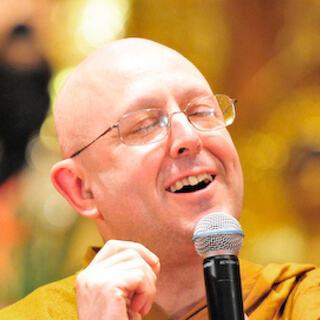
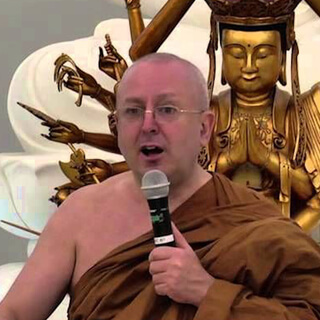
And for those of you who find it difficult to smile,
Maybe you can do that exercise which my first meditation teacher taught me.
Believe it or not,
When I was a young student,
I had a very miserable looking face apparently.
And what my teacher told me to do every morning was go to the toilet,
Relieve yourself,
But in the bathroom there will be a mirror.
And when you see that mirror,
Look at yourself in the mirror,
Put your two fingers on the side of your mouth and push up.
Exercise your smiley muscles.
And I thought that was a stupid idea,
But I had enough respect for ancient wisdom to try that.
And I did that for two years,
Never missing any morning.
And sometimes,
You know what it's like when you first get up in the morning,
Bluuuuuuuuuuh,
You feel terrible,
Bluuuuuuuuuuuh,
What am I going to do today,
Bluuuuuuuuuh.
Does that bluuuuuuuuuh sound convincing?
Probably not because I have a happy life.
But anyway,
I learned how to smile.
These days if you want to play tennis or you want to be fit,
You've got to exercise.
People exercise their hands,
They exercise their legs.
Me,
I exercise my mouth.
Believe it or not,
It works.
And you look at yourself in the mirror,
This young man or this little girl,
And of course you laugh.
And that saves hundreds,
Thousands of dollars from having to go to see psychologists.
Who needs to go see a psychologist when they can do that in front of your bathroom mirror?
But anyway,
I've got a reputation of being smarty,
The fat happy monk,
And not only that,
Actually that's important too.
Because I said this,
I went to the cancer group,
The Solaris Centre,
Just last Tuesday.
And I just mentioned this,
This is just a point of science,
That when you are happy and start laughing,
Your actual blood vessels expand.
It's well known.
If you're negative and miserable,
Then your blood vessels contract.
And that answered an important question which had been bothering me for so many years,
Why all chubby people are happy.
Have you ever seen a fat miserable person?
And the reason is,
Because all fat miserable people died out a long time ago.
They've got so much gut going through their arteries and their arteries are very small,
That's why they have the traffic jams called coronaries.
But if you're happy and smile,
I've been doing this for such a long time,
My arteries and veins,
They're just so wide.
They've been expanding for years.
So anything can go through here,
It never gets any problem.
Anyway,
That's not what I was going to talk about this evening.
What I was going to talk about this evening was,
And one of the things which happens to you by understanding some of Buddhism,
Especially when you get into some meditation,
You get some insights coming up,
You start to look at life in a different way,
In a very more useful way.
And one of the things we were talking about last week with some of our committee members was gratitude and thanks.
And sometimes we're almost taught,
If someone helps you,
You say thanks.
But when I tried doing that when I was a young monk,
I heard that,
No,
What are you talking about?
You don't need to say thanks to me.
Where I first learned this was,
As monks we go on arms round.
So we have our bowl and we go walking on arms round and have every morning in Thailand to get arms food from the villagers.
And these are very,
Very poor people.
And I thought that this is a bit of an imposition.
I got a good education,
Even my family were poor,
But I had a good job even as a school teacher before.
What am I doing begging for my food every morning?
This is not right,
I thought.
But that was our custom,
So I did it.
And what happened after a couple of months,
We never went into the village one morning because we were being fed in a house and having a celebration for something.
So we went there,
We never went into the village for arms food.
And later on that afternoon,
The whole village led by the head man of the village came into our monastery to ask forgiveness of us.
I thought,
What are you asking forgiveness for?
You had a nice free day,
You didn't need to feed the monks.
You didn't need to waste all that rice and that money on us.
I said,
No.
We must have offended you that you didn't come in our village and give us the opportunity to do some good karma for you,
To serve.
And that's when I realized that giving,
In this particular case,
Food or giving breakfast when it's more than breakfast that we could ever eat,
It's not that we need your food,
But you need to give it to us.
And this was where something clicked in me,
An article which I never understood years ago,
That when a journalist was following the Dalai Lama,
This was in Tibet,
I don't know how he got in there,
Must have been a long time ago,
That whenever the Dalai Lama would go to village to village in the countryside of Tibet,
People would line up to give him things.
And this journalist was just watching and just getting more and more angry because there were many,
Many,
Many poor people were scraping by and they managed to save up or get something they could give to the Dalai Lama.
And once,
According to this journalist's diary or article,
Sorry,
He saw a really,
Really poor woman just line up and she gave the Dalai Lama a skirt,
A woman's skirt,
And the journalist got so upset,
You call yourself a holy man,
You call yourself a religious leader,
You live in a big palace,
You eat so well,
You get whatever you want,
And that lady,
She needs that skirt much more,
You're a man,
You don't wear skirts,
Why have you taken that skirt from this really poor lady?
And the Dalai Lama,
In just his character,
He would listen first of all and was quiet and he replied with what I heard,
This changed a lot of the way I look at things,
He said,
Yeah,
That's true,
I don't need a skirt,
I'm a leader,
I get many things and I don't need a woman's skirt,
But that woman needed to give it to me,
She needed to give,
That's why I accepted.
And that just changed a lot of what I understood about generosity,
Serving,
Being with other people,
It's not that the person you live with needs any sort of service,
But sometimes we need to give it to them,
To help them,
Look after them.
We get more out of it than they do.
They are the time when I was at university studying hard,
Not studying that hard in those days,
But a couple of my friends were Christians,
I just talked with them over a cup of coffee,
They said,
Oh,
They were volunteering to serve in the local hospital for those who had emotional problems.
They said they were doing this because that's what Christians are supposed to do,
To help the needy.
And I got embarrassed,
I was a Buddhist,
I knew I was a Buddhist,
We had some wonderful discussions and I said,
Well,
If these Christians are doing it,
I suppose I'd better do it as well.
Just keeping up with the opposition,
That was all.
So I volunteered to go there and I learned so much.
I went there for the wrong motives,
But what I learned from that place was amazing.
I was there,
Used to go every afternoon for two years,
And I loved it.
Why did I love it?
Because I needed to serve,
I needed to give,
And I got so much more out of it than anything I ever gave.
I learned so much.
And this is one of the reasons why,
That even today,
Because this is one person I'm thinking,
Good job they're not here today,
Sometimes they look after me and the other monks and they do much of the driving for us.
You know what happens,
We ring them up,
They took us from Bodhinyana monastery to this temple today,
To Nollamara,
And you ask them,
Can you drive us?
And there was very busy traffic for them.
And they came and when we got here,
Said,
Oh,
Thank you.
They said thank you to me,
For taking up about three hours of their time,
A lot of petrol from their car.
Why are you saying thank you to me?
Thank you for giving me the opportunity to serve,
To offer,
To give.
Because there's a lot of joy which you get in contributing to something which is good.
They're not here this evening,
But maybe they might see something in the internet of this talk,
But they certainly know it's here,
And they appreciate all the wonderful things which this center gives for them.
And if I said to them,
Thank you for driving me here today,
They'd be looked at as an insult.
Would me thank you?
It's we who,
It's the driver who thanks our monastery for calling them up,
Giving them the opportunity to do this.
The opportunity to serve and give is an opportunity rather than an obligation.
And to that point that sometimes I get this through to the monks which I train in Bodhinyana Monastery,
Sometimes they don't really understand,
But if they do any extra work,
Something like working in the afternoons when they're only supposed to work in the months,
We have a very easy schedule as monks,
What we do together to keep our monastery reasonably looking good.
Mornings,
Tuesday,
Wednesday,
Thursday,
Friday,
There's many other things we do as well.
But often you find the monks doing more.
What are you doing that for?
You say,
For the love of it,
For the care of it,
I just want to do it.
There's many of you who go to Dhammasara Monastery,
Who go to Bodhinyana Monastery,
Jhana Grove,
Or here,
And you help out.
It's not your job to help out,
But you need to give,
You need to serve.
And that giving and serving is for a good cause.
That is where you do get lots of joy and happiness from.
You know,
Sometimes when I was a young monk,
I get the time wrong,
And the chores were supposed to be done at three o'clock in the afternoon.
I got up at two o'clock,
And I didn't get the time right,
And I started doing the chores at two o'clock,
All by myself.
Finished the whole lot by myself,
When the belt went for the other monks to come up,
So monks,
I've done it all.
That's a bit so selfish,
Because I enjoyed that so much.
And I said,
Even these days,
Monks,
Don't just wait for other people to do it.
See if you can take the advantage.
Get there to the dirty rags,
First of all,
And clean them up with yourself.
Have the joy of it,
The happiness of doing it in a totally different way than I ever thought before.
You need to give.
And of course,
One of the biggest examples of that,
We have this ceremony,
These flankings know this,
Of washing the monk's feet.
You've seen that.
And even if you are being in a car to your house,
And as soon as I get to your house,
My feet are really clean.
I'm wearing shoes in your car,
But as soon as you walk into the house,
Because you take your shoes off,
In the Buddhist ceremonies,
Then they get some water and a cloth to wipe your feet.
What are you doing that for?
I don't need my feet clean.
They're already perfectly clean.
And of course,
It's not that I need my feet cleaned,
It's they need to do that.
Whether dirty or not,
The opportunity.
And I again learned that when first becoming a monk in Thailand,
An Ajahn Chah,
This really strong,
Famous monk,
And in the morning after alms round,
We'd go on this beautiful alms round every morning,
And it wasn't because we needed extra food.
The people enjoyed giving it to us.
Really,
They got so much fun and happiness of being part of what we were doing in our monastery,
In our huts,
In our caves,
Meditating,
Being part of this,
And seeing just the results.
When I was a young monk,
I was really thin and scrawny,
Not very smart.
But seeing now just how far these teachings go,
It's about the whole world,
And what they've done for other people.
I was really touched that question last week,
Was it two weeks ago,
When somebody put on the.
.
.
Grady actually put this on the questions.
It wasn't a question at all.
The last sort of comment was from a person in Europe.
Saying,
I just needed to tell you this because I'm celebrating.
It was one year ago.
One year ago,
They said,
When I listened because I had anxiety and depression.
And what you said,
Ajahn Brahm,
In that talk,
Twelve months earlier,
Was,
This is what they wrote,
It's okay to be depressed,
Nothing wrong with it.
They said that changed the whole idea of what was happening.
That depression vanished almost immediately.
And every one year without depression,
It never came back again.
Thank you so much.
That was unsolicited mail.
They're probably listening to this this evening,
Thank you.
Should I say thank you to you?
Or should you say thank you to me?
Which way should it go?
I think you all should say thank you to both of us for inspiring.
And so a lot of times when we say thank you to someone for helping us,
I don't need that.
It's just so wonderful,
You're given the opportunity to do something good and wonderful in life.
It's not business.
We're not getting paid or anything.
That's again one of the other wonderful things.
I hope you notice about our Buddhist center,
We don't take your names,
We don't send you bills,
We don't harass you,
Or maybe sometimes I harass you,
Please join our Buddhist society.
But it's all done,
It's beautiful,
If you want to,
Fine.
If you don't want to,
Yeah,
We'll get by.
So without any force,
With gentleness,
We're inclining,
We're encouraging people to realize just how wonderful it is just to serve.
Even though it's not your job,
You see something which needs to be washed,
You just wash it.
I really try and do that.
The last time I saw there was not many people in our kitchen at Bodhinyana monastery to wash up after lunch,
So I went in there to pick up a tea towel to help wipe the dishes.
You know what happened?
This Thai lady gave me this terrible look.
Ajahn Brahm,
You're not supposed to be in here.
I grabbed the tea towel,
Pulled it out from my grasp.
Oh,
I'd really like to do that.
A lot of times I like to do that because it's an opportunity of serving,
Of giving.
You don't need to thank me for these talks,
I enjoy it.
I'm exploiting you,
Ajahn Brahm,
Of course,
That's what I'm here for,
To be exploited.
That's the meaning of my life,
To serve,
Be exploited.
Sometimes I get tired,
That's my body just reacting,
But my mind always loves to give,
To serve.
You don't need to say thank you.
I say thank you to you for giving me the opportunity to do chanting for your relations,
To teach whenever I can,
To actually to serve and just to smile at you,
To give you that opportunity to have some happiness.
It's my joy to give.
I don't get anything back in return.
The only thing I get back in return is a headache and tiredness.
That's not a problem.
So a little body talk,
The idea of thank you,
It turns around,
It's not that I need to teach.
I love to teach.
It's not that when you're in a house,
Living together with your partner,
It's not you have duties to perform,
It's just you want to give to one another.
You want to just make a beautiful home.
So whoever has the opportunity,
Oh,
I was going to say about my teacher,
That when we went on alms round every morning,
When we came back,
The feet were a bit dirty,
Because it was a very clean path through the forest.
When we came back,
We had this little place where we'd wash our feet,
And then we'd dry them and then we can go inside the hall to have our meal.
But when Ajahn Chah came back from alms round,
He had all these monks would jump up,
About 10 to each foot,
About 20 monks,
10 on the left foot,
10 on the right foot,
To wash his feet for him.
Now remember where I came from,
Cambridge University.
We don't wash other people's feet.
My thought was that Ajahn Chah is old enough to wash his own feet.
My thought was that crazy.
And if he did need someone to wash his feet,
A roster.
That's where we'd have a roster.
This month on Monday,
That on Tuesday,
That on Wednesday and Thursday.
That's what I thought.
Because then we'd have so many people just on the same old foot.
I was really upset about that.
This is totally irrational illogical.
I didn't understand it at all until I realised,
Because I was trained as a scientist,
What do scientists do?
Have an experiment.
My experiment was,
Okay,
Let's see what it's like to wash Ajahn Chah's foot.
See what it feels like.
So that morning,
I was really walking fast on alms round to make sure I got back early enough.
And having got everything ready,
I was like poised.
Isn't it like a cat waiting for the mice to come out?
I was poised.
And as soon as I saw Ajahn Chah coming round the corner,
I jumped up and ran to the foot wash block.
I got a toe all by myself.
I did.
I got a whole toe all by myself.
And I was washing it.
What the heck is going on?
I got so much happiness and joy out of washing my teacher's toe all by myself,
Just one of them.
I'm going mad,
I'm going crazy.
No,
It wasn't crazy or madness.
It was this wonderful idea of service,
Of giving.
And once you get into that,
You get a monastery where people are just rushing round,
Trying to serve each other.
It's not whose turn it is to wash the floor.
It's who can get there first to do the duties.
It's not,
I did it yesterday.
And I said,
Well,
I'm going to do it again today,
And the next day,
And the next day,
And the next day,
And the next day.
At the end of those two years,
Looking after people with Down syndrome,
That's my main job in that place.
I got so good at it.
And I had no training at all,
It's just kindness and just two years every afternoon.
Actually,
I was the longest lasting person there because what happened was,
This is one of those beautiful stories I remember,
So sometimes I indulge when I give talks because this is beautiful memories which taught me so much and I try and share it with others.
That I was there just one afternoon and there's two classes of people there and they made me look after one group of the Down syndrome people for the first hour.
And it's occupational therapy,
Just doing all sorts of things,
Having fun together and just,
Obviously,
Being with a kind person,
Being with other people,
So we had lots of fun.
And then,
Being England,
Afternoon tea,
So just have a cup of tea for 10 or 15 minutes and then they go back and say,
Oh,
Can you do another class,
The next hour?
And they told me for me,
I was so stupid because when I was doing the one class,
The other group,
They were making presents for me.
And when I did the second group,
The first group was making presents for me.
And just 10 minutes before we finished,
They all came together and the people looking after this,
This occupational therapy for the Down syndrome residents said that,
You know,
That you've been by far the longest volunteer coming from the university,
We want to say thank you to you because your exams are coming up,
You know,
It's the final exams for you.
And I was teary-eyed receiving these presents.
They weren't very much,
But where they came from was so important.
And then afterwards,
Very,
Very,
Very,
Almost like ashamed,
I said,
Look,
My exams aren't going to start for another 10 days.
Can I please come back next week,
Please,
Please?
Because I really wanted to.
I enjoyed that.
It wasn't service at all,
It was giving me the opportunity to grow my emotional part of my life.
Other students might have been just studying more to get their brain bigger and other people might have been doing sport to get their sporting prowess better,
But I just loved getting my heart bigger.
There's so much more joy in serving and giving and you don't need to.
Yeah,
Valentine's Day has passed,
But it doesn't matter your partner.
Get them another Valentine's Day card,
Another bottle of,
A bit of flowers or whatever.
In other words,
Just the opportunity to give,
To serve,
To share your heart with other people,
Basically why not?
But it's not just giving,
Because sometimes people do want to give back and they do want to say their appreciation to you.
And that's one of the reasons why that we're very,
Very good at receiving criticism.
We're hopeless at receiving praise.
Someone says,
Thank you,
Oh,
It's nothing,
Nothing,
No,
It's just.
.
.
They criticize you and say,
Why didn't you come on time?
Where's the traffic jam?
They don't understand that,
Do they?
It's one of the reasons why in my life,
I suppose if you do this job long enough,
Someone's going to say thank you.
I have received a few prizes,
But one of those prizes I got years ago was this John Curtin Medal.
How long ago was that?
2005 or something.
It's actually the John Curtin University.
They try and make an outreach to others in the community doing something good.
And so I got this invitation and said,
Ajahn Brahm,
We want you to receive the John Curtin Medal this year.
And so,
Oh,
That's amazing,
For what?
And when I hear that,
I think,
What,
What have I done?
I'm just doing my job,
I'm just a Buddhist monk.
That's how I thought.
But you had to go there,
So you went there for the ceremony.
And at that ceremony,
They start to say all the wonderful things you've done.
You know,
In their little video,
And then the Vice Chancellor,
It was always her name at that time,
She was an occupation,
She was an occupational therapist,
I think,
Teaching there,
Professor,
It was Professor Hackett.
She became a really good friend in the end.
I remember seeing her at another function somewhere,
And she said she was retiring.
And she said,
Ajahn Brahm,
I've known you for such a long time,
This is the Vice Chancellor at that time,
Please let me do this,
Because she's retiring.
You know what she did?
I confess it.
She gave me this big hug.
Monks are not supposed to receive hugs.
But,
Okay,
It wasn't so sensual at all,
It was just like kindness.
So anyway,
That's from the Vice Chancellor.
Anyway,
At this ceremony,
They said all these things,
And it was supposed to be given for three qualities,
For vision,
Leadership and community service.
And so I thought about it for vision.
I've got to wear spectacles,
My vision's not that good.
Community service,
That's usually what you do when you're released from prison.
It's true,
Isn't it?
So it must be leadership.
Okay,
Fair enough.
And of course,
You have to give a speech when you receive any award.
So my speech at that time was,
Thank you very much,
But I couldn't have done this job all by myself.
There's all the other people who helped me out,
All the people in the Buddhist Society who feed me,
I'll commit to you,
Make sure everything is run properly,
Just all the friends,
The other monks,
Everybody drives me all over the place.
Without them I wouldn't have been able to do anything.
Thank you so much other people.
And then,
I said,
And also,
To be honest with you,
There's other people in the community who do things much better than I do,
Who do much more work for the community than I do,
But anyway,
Thanks anyway.
And so I went away with that speech.
And then the next year,
There was this Professor Jofi,
He was over at Charlie Gardner's.
And I went to his ceremony and I really enjoyed listening to what he had done.
I'll never forget this,
He was a top oncologist.
This was many years ago,
But for him,
He noticed that treating people with cancer in Charlie Gardner,
Yeah,
It was Charlie Gardner's,
They were missing one thing.
They were giving excellent radiation therapy,
Excellent chemotherapy,
Excellent surgery,
But when that was over,
They were just out.
They weren't given a sense of respect or kindness.
The nurses and the consultants,
They didn't have that time.
Just they say,
Are you okay or how are things going?
So he started at that time in Charlie Gardner,
Sponsored by Brown's Dairy at the time,
The Brown's Alternative Therapy Centre.
And as he said or they said in his presentation,
Anything weird,
Anything strange could be done in that place.
Things like,
This is what they thought was weird or strange in those days,
Things like homeopathy,
Acupuncture,
What was it called,
Reiki therapy,
Anything like that,
He made sure you could do it in there for free,
Sponsored by Brown's Dairy.
And he put his reputation on the line,
Because people thought he was going weird and crazy,
He was a top scientist,
Is there any evidence for this?
And anyway,
He went ahead and did it and saw the results of it.
For me anyway,
I know from my own practice,
On my own life,
It doesn't really matter whether these things actually physically work,
Someone is being kind to you for half an hour,
Giving you reiki or like a massage or reflexology,
Someone is really caring for you.
And that I know is very,
Very powerful therapy.
So all the people who actually went to this place,
Their results,
Their getting better results,
Skyrocketed.
He put his reputation on the line,
Took a risk,
And it worked wonderfully well.
How many of you have been to a hospital and you go in,
You go out,
You've got no one to really talk to or just have a bit of kindness for half an hour.
So anyway,
That's why he got this prize.
And of course,
When he was given the prize,
He had to give his acceptance speech,
And that's where he said,
He said,
I don't know why you've given this prize to me,
There's more people in this community who do much better work than I do,
And anyway,
I couldn't have done this without the help of all my friends.
And that's when I say,
Hey,
That was my speech.
And of course,
It's everybody's speech,
Isn't it?
You get given some award in your company,
In your university,
In your monastery or whatever,
Someone says,
Thank you so much for your service.
You say,
Well,
Why me?
There's other people who do much more.
I couldn't have done this by myself.
That same old speech,
Why not instead?
Say,
Well,
In university,
They're pretty smart people.
So many people in university thought that Professor Chofee deserved this.
And I sit in the audience,
Certainly thought he deserved it.
And I started thinking,
Hey,
That medal I got,
Maybe,
Maybe,
Maybe just,
Maybe I did deserve it.
Or why would I reject some praise?
That's one of the reasons why now,
When anyone praises me,
Maybe I might think I don't deserve it.
But you think I do.
So I will say,
Yes,
Maybe you're right.
Can you receive praise?
I couldn't receive praise for many years because I thought I'd get a big head.
My head isn't big,
My tummy is.
You don't get a big head when you receive praise.
Instead,
Actually,
You just want to do whatever that was again.
You want to do more of it.
Somebody you're realizing,
It really works.
And it creates some more happiness and peace in this world.
So if ever you see anyone doing wonderful work,
Creating a better world,
You see many people doing stupid,
Selfish work,
But you see people doing wonderful work,
Please say thank you,
Praise them,
Great job.
Because then you're encouraging that goodness more and more and more and more.
And when anybody praises you,
Please accept it.
When they say,
What a wonderful job it is you've done being Vice President of Our Buddhist Society,
Being our President at the back,
Dennis always hides,
I don't know.
He comes up here and just gives a speech.
Is he still there?
Here he is.
You don't need to go in the back,
Dennis.
You've done an amazing job over these years.
One of the best presidents we've ever had,
So often,
Always there for everybody.
Yeah,
Do you deserve that,
Dennis?
I'm sorry,
I've been wrong.
I guess so.
So it's hard to accept praise.
There's Boon in the back there,
Our ex-Treasurer.
Thank you for all that work you've done for years and years and years.
Do you deserve that,
Boon?
But when actually we people accept that praise,
You actually want to do more.
It creates a better society that way,
A happier society.
And it's not just,
Why him?
It's a,
Yeah,
Well done.
We have this other thing in Buddhism we call mudita,
Which is rejoicing in other people's goodness.
So you see someone else really doing a good job,
You say,
Wow,
That's wonderful,
I want to do something similar.
Now whatever I can do,
Maybe not be Professor Jyothi,
Who's not got all these degrees in this and the other,
Not Ajahn Brahm,
Who's got lots of cups of tea,
Not Dennis who's just got so much experience in our body of society,
But you always can do something good.
And when you do something good,
Please rejoice in it.
And if other people say,
Thank you so much,
What would happen if you say,
Yeah,
I deserve that?
And sometimes that's pretty radical,
Isn't it?
To even think that way,
But you do.
There's people in universities,
Smart people,
They did their research,
Great,
Yeah,
Maybe I did deserve that medal,
But I always thought I didn't.
Why?
So a little mudita,
We learn that we need to give,
To serve,
To help,
To forgive other people.
And when we do things like that,
We become a much,
Much happier person.
To this day,
I already mentioned about people with depression.
One of the best ways of overcoming depression is volunteering to some service,
Helping others,
Whether it's in a hospital,
An old people's home.
And sometimes I don't like it when there's so many rules and regulations,
You can't go to this old people's home unless you're trained and all,
Because people need to give and serve and help.
Even if we don't need it,
We accept it.
That's also what happened here.
Some years ago,
This one of our members,
Sri Lankan,
I don't mind saying who was this,
For those of you who remember Lakshmi,
It was Lakshmi Sena Wuratala,
I think,
Surname.
But anyway,
One day she made some socks for me.
She knitted them herself,
Some socks.
And she gave it to me in the reception area before I gave the talk.
She said,
I shall buy my knitted socks just for you.
Now,
For those of you who have been mindful,
How many times you see me wearing socks?
I don't wear socks,
I've got really good circulation in my feet.
Even if it's cold,
I don't wear socks.
Nicholas,
You've been monitoring me,
How many times have you seen me wearing socks?
Yeah,
Because I don't wear them.
So anyway,
She gave them to me.
So of course I put them on,
But she didn't see me put them on.
So what I did during the talk,
I just moved this thing away a little bit and just was going on the talk and I just started moving my foot out,
Exposing my socked foot.
And she was sitting over there somewhere.
Now remember,
I could hear her,
He's wearing my socks,
He's wearing my socks.
And then I got back to monitoring and I gave them to another monk,
Because I don't wear them.
So the point was,
I would never ever,
She gave me a sock and say,
No,
No,
No,
I don't need socks.
Imagine you did something like that.
That would be just totally offensive.
She spent all that time making me socks.
Oh,
Thank you so much.
And I wear them and then give them away to someone who can make use of them better than I can.
But nevertheless,
She needed that so much.
It was wonderful to be able to receive it and see her.
I still remember that,
So the smile and excitement.
He's wearing my socks,
He's wearing my socks.
Disturb the talk,
But never mind.
So that's one of the wonderful things about the kindness in our hearts and how we just give to one another and how we just,
We're not talking about money and stuff or socks,
What we're talking about is the kindness,
The generosity.
To this day that many people don't know Buddhism,
They ask us,
Why is it that monks have got lots of land,
It's not all that fertile land or mountains,
But some places there we could very easily grow our own food.
Monks,
Why don't you grow your own food?
Why do we have to come and give it to you every day?
And the answer when I first heard this,
I thought,
Wow,
I never saw it that way before.
If we grow our own food and became independent,
You'd be saying,
We don't need you.
The Buddha made it quite clear that we're not allowed to grow our own food,
Which means we need you.
It's the monk's and the nun's statement,
Loud and clear,
Deliberately we'll become dependent on you,
Our supporters.
And obviously you're here,
Some of you every week,
Some of you heard every talk I've given and heard every joke so many times,
But I tell my monks I've heard my jokes much more than anybody else.
But why do we do this?
Because you need the example of monk's and nun's,
The kindness,
Non-judgmental,
Allowing everyone to come in,
Fun,
A bit of wisdom,
But also we need you.
That's why we're not independent,
We're not self-sufficient.
If any of you ever decide to be self-sufficient in your life,
Well you're saying,
I don't need other people.
And that causes a lot of loneliness,
A lack of loving kindness and love.
So that's why we do what we do.
So anyway,
I wanted to finish a little bit earlier this evening because the monsters are supposed to come around this time.
Any sign of the monsters yet?
And the monsters here yet?
Sorry?
They're here.
So let's get maybe one or two quick questions and then we get the monsters.
You got a question there?
Yeah.
I am coming to man because I love you and you speak against me.
But it was for you,
It was a strong feeling.
I need you to support me because I am Spanish here.
But I need you,
Power,
And that's for me because I am very a good friend of the police inside in my family.
I am supportive of my daughter because she is a very young granddaughter.
I need you to support and give me feelings and support.
Oh yeah,
Certainly.
One of the beautiful ways of doing any healing for you and for your daughter is to give you a little blessing,
Blessing chant.
The chants are very powerful.
So can I give you this blessing and chant for you?
Here we go.
It's coming right now,
Fresh.
I just get myself calm and focus my energies.
SABBA BUDDHA NUBAVENA SABBA DAMMA NUBAVENA SABBA SANGGA NUBAVENA BUDDHA RATANANG DAMMA RATANANG SANGGA RATANANG TIN NANG RATANANG ANUBAVENA CHATURASITI SAHASADAMMA KANDANUBAVENA PITAKATAYANUBAVENA JINA SAWAKANUBAVENA SABBE TE ROGA SABBE TE BAYA SABBE TE ANTARAYA BHIMNA SANTU CHATE JASA JAYASIDI DANANG LABANG SOTI BAGAYANG SU KANG BALANG SIRI AYU CHAWANO CHABOGANG WUDDHI CHAYASAWA SATAWA SACHA AYU CHA JI VA SIDHI BHAWANTU TE SADHU SADHU SADHU SADHU Hong Kong.
Problems often overwhelm me and it seems like my mind has a habit of latching on to problems to obsess and worry about,
Make me not able to sleep and let go properly.
What can I do?
Learn how to meditate is very great because that's how we learn how to let go of the past and future,
Just like that little visual experience,
Imaginary experience,
Mental exercise of putting down the two bags,
That helps a lot.
Some other little things,
Instead of telling you what to do,
Like showing people what to do,
Is how heavy is my cup of tea?
The longer I hold it,
The heavier it feels.
If I keep holding it like this for ten minutes,
My arm will ache and I'm a very stupid monk.
What should I do when it starts to get heavy?
Yay!
You don't need to throw it away,
Put it down for a while,
And that's when we want to go to sleep,
Put down the worries for half an hour,
An hour,
Two hours,
Have a really good sleep.
And obviously we all know that if we have a good sleep,
We pick up the worries first thing in the morning,
We can find new solutions for them.
So sometimes people always feel they need to think to find solutions.
The best solutions come out of rest and silence.
So also a nice little thing.
The last thing,
You latch onto problems and of course that's the whole simile of the hand.
How big is my hand?
So big I can't see anybody in this whole universe.
It's not my hand's fault,
It's because it's too close to me.
Put it where it belongs,
At the end of my arm.
It hasn't diminished in size,
The problem is still the same,
But now it's the right perspective,
I can see my hand on each one of you as well.
So when we put things in perspective,
That is when the problems get seen properly.
Quickly from Indonesia,
Is gratitude going through practice?
How do you practice gratitude?
If so,
When mind focuses on worries,
Does it mean we still have no gratitude?
If you focus on worries,
You're focusing on what's wrong.
Remember the two bad bricks in the wall?
Simile,
First wall I made over in Bodhinyana monastery,
Two bricks were crooked and I wanted to destroy that wall.
That wall is actually still there and it never got destroyed because somebody pointed out there was 998 good bricks in that wall.
Why is it we always see the bad mistakes?
Someone points out,
How about looking at the beautiful things in the wall?
Of your life,
Of your friends.
And then what happens is you have gratitude,
It's a beautiful wall.
It's never perfect,
It's beautiful.
Singapore,
The clergy of other religions serve their community and a Buddhist monk expects to be served.
Do I expect to be served?
The other way around,
Is that a true clergy?
I don't know,
But whoever wrote that has never actually seen.
Do I expect to be served?
How much work do I do?
Huge amount of work,
Serving,
Serving,
Serving,
Serving,
Looking after other people.
But when it comes to some things,
Give people the opportunity,
If they want to.
Don't expect to be served.
Quite often,
You know,
It would be wonderful if even with my food,
I would sometimes have something simple.
There was many,
Many,
Many,
Many,
Many,
Many,
Many years ago,
Over in Bodhi Nana monastery,
We didn't have much food.
So one of the people there was making food in the kitchen,
They made beans on toast,
That was all.
One meal a day,
Beans on toast.
It was so simple,
Yay,
Wonderful.
We said,
Oh no,
You can't have just beans on toast.
If you're a big monk,
You have to have something better than that.
And whenever you come and give food,
Why do you give such special food?
Just ordinary food is great.
So sometimes monks,
I'm not just talking about myself,
Monks and nuns,
Sometimes simple stuff,
Ordinary stuff.
Don't need to go five star cuisine.
Like this guy,
I hope he's listening,
His father passed away,
I hope he's listening,
Andrew,
Andrew Lam from New York.
He really respected me,
So he invited me out to this restaurant,
A really fancy vegetarian restaurant over in Manhattan somewhere.
He obviously did the research wrong because it was closed.
And I've gone wrong.
And so we were walking around looking,
There's a pizza joint.
So let's go in there,
He said,
I can't take you to a pizza joint.
You're too important to go to a pizza joint.
So I said,
Look,
There's not much time,
It's getting close to noon,
Let's go to the pizza joint,
It's delicious,
Simple.
So anyway,
That's why I serve or am I serving others?
By letting you be kind.
It's changing the idea of what service is.
Okay,
So anyway,
Thank you for those questions.
I'm sorry if I just did them in very briefly,
But now we do have the line lines.
It's from the Tshung Wa Association,
Is it,
I believe?
So what we need to do,
We need to actually make a central area here so that the monsters can perform.
So those of you who need to go back now,
You're missing something fantastic,
Which is these lines that have come here to serve our Buddhist life,
But please make a space in between here and see the monsters perform for the end of the Chinese New Year.
Would you like to tell me,
Just say a few words?
Okay,
I don't know what to do.
Excellent.
So sometimes,
I know the kids might be tired,
But the kids love seeing monsters.
Okay,
Monsters.
This way monsters.
Come,
Come,
Come,
Come,
Monsters.
You see any monsters out there?
Yes,
Certainly,
Yes.
Good evening,
Ladies and gentlemen.
Now this weekend,
You know that there's double demerit points as we go out,
But for this evening,
It is very special.
You will get double merits.
I have here what we call red packets or Ang Pao or Hong Pao,
And we will distribute it out to everyone,
Those who are interested.
So make a little contribution,
And the first merit you will get is when you give it to the lion or the monster's mouth.
That's the first merit.
The second merit is when after it's been swallowed by the lions,
It goes into the Buddhist society,
And that is the second merit.
So when the lions,
After the lions come in,
We will just distribute this,
Whatever contribution you have,
Put into this little red packet,
And wish all happiness,
Good luck,
Good fortune,
And good merits.
Very good.
So where are the lions?
Anyone see any lions escaped from the zoo?
Quite.
I like to tell some of the monsters I saw in the jungles of Thailand.
See many,
Many amazing creatures.
Now one of the scariest creatures I ever saw in my life was a big tiger.
Ever seen a tiger?
The tiger was huge,
And it wasn't that far away from me,
Maybe about two foot in front of me.
This huge tiger,
He was looking at me,
I was looking at the tiger.
Was I scared?
I wasn't scared at all.
It was amazing,
Because that tiger was in the zoo.
These are real lions,
And they're coming in.
Can you see them Eddie?
They're coming,
Be prepared.
Yeah,
They're scary,
But no need to cry,
Because they don't eat kids,
They eat just red packets.
But it's a good idea if you come to the lion dance,
Don't wear red,
Otherwise they might eat you.
Ah,
Here we go.
Whoa,
That's a very hairy lion there,
With a big head.
Yes,
Please come in,
Thank you for coming.
Here they come.
We've got some small tigers too.
Okay,
Here come,
How many?
Five tigers,
Wow.
Okay,
Here we go.
Okay,
Here we go.
Okay,
Here we go.
Okay,
Here we go.
Three.
Two.
Two.
Three.
Two.
One.
Two.
Three.
Two.
One.
Two.
Three.
Two.
One.
Two.
Three.
Two.
One.
Two.
Three.
Two.
One.
Two.
Three.
Two.
One.
Two.
Three.
Two.
One.
Two.
Three.
Two.
One.
Two.
Three.
Two.
One.
Two.
Three.
Two.
One.
Two.
Three.
Two.
One.
Two.
Three.
Two.
One.
Two.
Three.
Two.
One.
Two.
Three.
Two.
One.
Hello,
Everybody.
The lion dance troupe,
They are from the Chum Waa association,
Perth.
A big hand from the Chum Waa association in Perth.
Hello,
Everyone.
Hello,
Everyone.
Hello,
Everyone.
Hello,
Everyone.
Hello,
Everyone.
Hello,
Everyone.
Hello,
Everyone.
Hello,
Everyone.
Say a few words.
Introduce yourself.
Good evening,
Ladies and gentlemen.
I'm the president of the Chum Waa association.
On behalf of the Chum Waa association,
I wish you all the best and safe year of August.
Thank you.
Thank you.
Thank you.
Thank you.