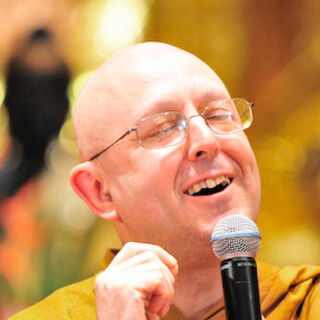
Very good and welcome to the last meditation class of the year.
So,
Usually I announce that the beginners class is to the room on my right.
But now there's no beginners class.
After one whole year of meditation everyone is expected to be experts.
So,
But anyway,
For those people who have come for the first time,
Bad luck.
You're going to have to sit down here anyway.
So what we usually do,
Anyone here for the first time expecting just short meditations,
We usually give a little introduction.
After the introduction we do about 45 minute guided meditation,
Mostly guided but much of it is by yourself.
So if you are here for the first time,
Maybe not the first couple of times and you feel a bit stiff,
You know,
When you are after 10,
15,
20 minutes,
Then all you need to do is just open your eyes,
Just maybe stretch your legs.
I mean,
Not go up and walk,
But just stretch things a little bit as quietly as you possibly can.
And then just after five minutes just close your eyes and carry on for another period of meditation.
So that's something you can do if,
You know,
That the 45 minutes feels a bit long for you.
But don't worry because,
You know,
People usually watch movies for over an hour or football matches or cricket matches all day.
So,
You know,
45 minutes shouldn't be that long for you.
So we're going to be meditating here for about that time.
But to begin the meditation we usually,
You know,
Talk about some of the ways which we can meditate.
I know that sometimes if people do make a sound or a disturbance,
You know,
Sometimes we get distracted by those sounds or disturbances.
It could be that there's a siren of an ambulance just down the Maury Drive.
There could be an aircraft going over,
Above us.
There could be a North Korean missile on its way to Fremantle.
I'm not sure what was,
Noises happen in this current age.
But nevertheless,
The way we deal with disturbances is understanding what I call the simile of the screen.
So you can imagine a screen and when you watch the screen,
You usually watch the middle of the screen and everything on the edges and beyond the edges tends to disappear.
And of course that's very clear to me because I've just been travelling again,
Even yesterday just coming back from Penang in Singapore and you have to watch these in-flight safety announcements,
Whatever it is,
Even though you've seen it many times before.
They say that because every aircraft is different.
I haven't seen them different,
Pretty much the same,
But anyway,
I do what I'm told,
I'm a good monk,
Behave,
Get set a good example.
So there you are,
You're watching the screen.
And when you watch the screen,
As you tend to,
I notice this,
Your mind actually goes inside the screen and the upholstery of the chair in front of you,
Then the little plastic border of the screen all vanishes.
You actually zoom in.
And what's on the edges you're just not aware of.
And that idea of zooming in is how to deal with distractions.
So what happens is you may be just watching your body or watching your breath,
Say,
In the meditation,
And then there's a noise,
Don't bring that noise into the centre of your screen,
In the sense that,
This is really important,
Who did that,
I have to do something about that in the future.
Don't make it important,
Because if it's important,
It comes right to the centre of your screen and the breath falls off.
So if you keep the centre of your screen,
This is the metaphor of what you're aware of,
Keep the centre with the breathing,
Say,
Or if you're loving kindness meditation or watching your peace ommat,
Or whatever it happens to be,
What your main object is,
Keep in the centre.
So you can hear the sound,
But it's over here somewhere,
To your right,
To your left,
Never in the centre.
Because if you centre it,
It's the most important thing.
It means the disturbance is what occupies your mind and the other things,
Like the breath just falls off the screen,
It disappears as you're focused and just consumed with the problem.
So instead,
Always keep the centre,
In the screen of vision,
On,
Say,
The breath.
And then you will be able to hear other things,
You will be able to feel an itch on your knee or an ache or something,
But it's not central,
It's not the big problem,
The breath is here and that's on the edge somewhere.
So if you keep everything other than your main meditation object on the edge of your screen,
You don't need to forcefully get rid of it,
Just make sure it doesn't come to the centre,
Then you'll find that it just vanishes by itself.
It falls off the screen as you naturally just focus in on something.
And that idea of like focusing in on something,
Going in,
In,
In,
In,
Is the main part of what meditation is.
We focus in,
In,
In,
Keep the centre on the right thing,
And then you go deeper and deeper in,
You fall in,
And all the other things on the edge of the screen tend to disappear.
And that is the basis for that simile of meditation,
Which I've often given,
But mostly during retreats,
Of the thousand petal lotus.
And that simile is that the lotus is closed up at night time,
And when it's closed up at night time,
The outermost sheath of the lotus is very,
Very rough and dirty and not fragrant,
Not beautiful.
But when the warmth and light of the sun strike the outermost sheath of the lotus in the early morning,
The warmth and the light open up the outermost sheath,
So that the next layer of petals can also receive the warmth and light of the sun,
So they can open up.
So the next layer of petals can receive the warmth and the light of the sun,
So it opens up.
So the petals open up one after the other.
One opens up,
Allows the light and warmth of the sun to hit that inner level of petals,
So they can open up.
That's how the lotus opens up.
That simile is that you are that lotus.
And the light of the sun stands for the mindfulness,
And the warmth stands for the kindness.
With the mindfulness and the kindness hitting this body and mind,
You open up.
So what that actually means in practice,
You're sitting here,
You're aware of your old body,
Aching,
Itchy,
Not as comfortable as it could perfectly be,
But it's good enough.
So it is kind,
Aware of your body,
It relaxes,
It gets easy,
And you go inside towards the emotional world,
The mind.
And when you first go into that world,
There's lots of disturbance,
Especially carrying the past and the future around.
And then you don't try and get rid of the past or try and obliterate the future.
All you do is just to stay in this present moment.
You just go in with the warmth and light of the sun,
And mindfulness and the kindness,
And soon you go into the center of time,
Which is the present moment.
And you're in the present moment,
Shining the warmth of the mindfulness and kindness onto this present moment,
And soon the present moment becomes quite okay,
Quite satisfying,
Quite full of contentment.
And when you have that contentment,
You find you don't need to give a commentary,
You don't need to say anything.
So you go into the silence of the present moment.
You just keep going in.
And in the silence you usually find your breath,
Whether you look for it or not,
It just usually comes up.
When you're aware of the breath,
Soon you keep going in.
Into the breath,
You have the full awareness of the breath,
From the beginning of the in-breath to the end of the in-breath,
Beginning of the out-breath to the end of the out-breath.
You just keep going into that,
And soon it becomes so delightful,
So happy.
You go deeper into your lotus,
The delightful,
Beautiful breath,
And then you just keep watching that delightful,
Beautiful breath,
Having a wonderful time,
And soon you hear,
You feel lights in the mind,
These beautiful nimittas,
You're just going deeper in.
And then what do you do next when you get these beautiful lights in the mind?
You're just mindful and kind,
You don't do anything,
You just go into them.
And after a while you go into these beautiful,
Amazing sort of experiences of the nimittas,
And then what do you do?
You keep going in,
In,
In,
All the way to the centre of your lotus,
And that's where you find the jhanas,
And all this amazing stuff.
And there is a whole journey from basic meditation to the deepest of stages.
So,
So easy.
And some people say,
Oh,
I can't do that.
What are you talking about you can't do that?
Just don't go thinking about it,
Don't go doubting,
Don't go putting yourself down.
All you need to do is just be aware and kind.
Can you be mindful?
Can you be kind?
Then you can do it.
So,
Off we go into the journey of inner space.
I gave this,
Oh,
Just years ago,
I went to Adelaide,
And this radio producer,
He just asked me,
He came to my retreat,
It's only a weekend retreat,
And just recorded everything I said.
And he used it in a radio program,
Adelaide Radio's Inner Space,
With opening your chakra music,
And it was like always done late at night.
People said it was mostly music to smoke marijuana by that sort of program.
But anyway,
I don't know,
But anyway,
I just gave a few of these little sayings on it.
But anyway,
I did do that inner space,
And you're going inner and inner and inner and inner.
See what's right in the center of you,
Right now.
Just be mindful and be kind and explore inner space.
Are you ready to take off?
Ten,
Nine,
Eight,
Seven,
Six,
Okay,
Let's get going.
So if you want to get yourself ready in your nice meditation posture,
As best you think you can.
And close your eyes.
One of the reasons we close our eyes is because we get less distractions.
More of our brain capabilities is made available just for feeling and for hearing.
We're not so concerned with smelling and tasting.
Sight is so easy to turn off.
Close your lids of the eyes and soon you're not seeing anything.
So as you focus on my voice and then also on your bodily feelings,
First of all check your legs.
I know people say I keep doing this over and over,
But it's important,
Good guided meditation to make sure that you enter the meditation slowly,
Methodically,
With some body awareness.
In this case,
Feeling any sensations in the lower part of your body.
And it's not just knowing,
It's also doing something about it,
Caring for that part of the body,
Which means if necessary,
Move,
Adjust.
Adjusting your legs until they're the most comfortable position you can find.
Whenever you move those legs mindfully,
The awareness allows you to get feedback,
To see if having moved them,
They're more comfortable.
If they're not,
Then go back to the first position.
A bit of trial and error,
Always being mindful,
Soon gets you into the best posture as you feel it.
Not following guidebooks or experts,
But following your own mindfulness.
What do you need?
You need to know what you're doing,
What you're doing,
What you're doing,
What you're doing,
What you're doing.
Once your legs are well adjusted,
Then you move up to your bottom,
Your butt,
If necessary.
You've got to sit like this for 45 minutes,
You must make yourself comfortable to begin with.
Don't be heedless,
Be aware and kind.
Once you've fidgeted enough and you find the best position for your bottom,
Then go up to your back.
Move and adjust that until it becomes as comfortable as you can make it.
Remember it's a type of comfort that you can maintain for 40 minutes.
Not just momentary comfort,
But just a comfort which is strong,
Long lasting and stable.
What do you need?
You need to know what you're doing.
Once the back is comfortable,
Then check the hands.
Be aware of that part of the body.
The awareness allows you feedback as you move it this way and move it that way,
To find the most comfortable position.
A lot of you do that automatically.
But now I'm pointing out that the mindfulness and the kindness is what produces the most comfortable position.
It allows you to relax.
Later on we'll use that to really get deep into our meditation.
Feedback and the kindness.
Then up to your shoulders,
To relax the shoulders.
Huge bundles of muscles which are being pulled both directions.
Stretched and astray.
And now we imagine letting go of both hands.
There's some muscles in the back,
Relax.
Good,
Pure.
Then come to Leviathan.
Now up to the neck,
Making sure that's relaxed.
Just to put attention there,
Give some kindness,
And you find that the muscles tend to relax by themselves.
You can feel those muscles relaxing.
The awareness focus on that part of your body gives you incredible insights on how to relax,
What causes a lot of the pain,
Not all of it,
But much of it,
The way we respond,
And the way that we can overreact to an itch in the throat.
The mind does have power,
We're sending it to our neck and throat,
Mindful and kind.
Being aware of the face,
Especially the muscles around the eyes,
To loosen them.
The awareness allows you to feel them relax,
So there's no tension on the face.
When you are sitting,
Be aware of the whole body,
Relax the knees.
I enjoy what I would call the delight of bodily relaxation.
When it comes,
When it's there,
Enjoy it.
It takes you into a deeper state of bodily relaxation.
Another important insight to know,
The way you focus on the beautiful pleasures of the body and the mind,
Not the sensual ones but the relaxing ones,
And you go deeper.
Some pleasures are a vehicle to go deeper into meditation.
The delight of a relaxed body is one of those.
Let's work with each other.
.
.
And then see what causes the peace to increase.
And see what makes for disturbance.
The way we react,
Or the way we're kind.
If you put your awareness on that peace-o-meter,
You learn wonderful things.
What makes you agitated?
What makes the mind become so calm and still and peaceful?
You're learning a skill by using the feedback coming from mindfulness.
You do fine when you let go of the past,
And you realize that now is where your future is being made.
So you're concerned about the future by being in the present.
The only place you can do anything for your future.
In the center of time,
You'll find the present moment.
All you ever do is be aware and be kind.
And disturbances,
Don't bring them in the center to your field of inner vision.
Keep them on the edge.
You know them,
But you don't center on them.
I'll now be quiet to the end of the meditation.
Thank you.
.
.
.
.
.
.
.
.
.
.
.
.
.
.
.
.
.
.
.
.
.
.
.
.
.
.
.
.
.
.
.
.
.
.
.
.
.
.
.
.
.
.
.
.
.
.
.
.
.
.
.
.
.
.
.
.
.
.
.
.
.
.
.
.
.
.
.
.
.
.
.
.
.
.
.
.
.
.
.
.
.
.
.