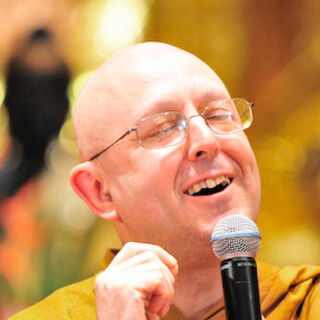
.
Welcome everybody to the meditation class.
We'll just wait for a few more minutes as a couple of late-comers are just drifting in.
But I may say,
As I usually have to,
This is the ongoing class for meditation,
For those who have meditated before,
For those who are just beginning their path of meditation.
That class is in the room to my right.
So,
Any of the beginners,
Please,
If you'd like to go in the room to my right,
Because on this class we do go deeper into meditation and we meditate for far longer,
So it might be a bit difficult if you've never meditated before.
You've got the nobody t-shirt.
Here we go.
Okie dokie.
Ok,
I think there's enough people coming in,
There's the usual stragglers coming in a bit late.
But,
Again on this class always focus on one part of meditation to the exclusion of everything else.
And one of the most important parts of meditation is to stop your mind moving around and thinking too much.
And instead of using force,
Because force has got no place in meditation,
We're trying to calm our mind down and every time we use force you find out you just make yourself more stressed.
And that's the opposite of what we're supposed to be doing.
In meditation we're supposed to be calming down,
Becoming more peaceful,
Bodily and mind.
If you put too much force or even a slight bit of force into your meditation,
You just get more tight,
More tense.
So in order to actually understand or calm your mind down,
The whole part of meditation does depend upon wisdom power,
Not will power.
So don't just look upon,
Oh it's not working therefore I must try harder.
Instead,
If it's not working,
It must be doing something which is not correct.
So use your wisdom instead.
If you start to contemplate why is it that the mind wanders off,
When?
I could be watching a movie,
I could be watching a cricket match,
I could be just going off just by the beach and watching the waves come in and go back out again.
I can do that without my mind wandering off.
Why?
If you're watching a movie,
You don't have to say,
I must concentrate.
You just turn the TV or whatever you're watching the movie on and you sit there.
And the reason why your mind doesn't wander off is because you have joy and happiness with what you're doing.
The movie is interesting.
The sports match is what fascinates you.
Whatever you're doing,
If you're reading a book,
It actually grabs your attention because it is interesting and enjoyable.
So with meditation,
The only way to be able to keep your mind stable,
Sustaining the attention on the object,
Is to make sure whatever you're doing is actually enjoyable.
If not just enjoyable,
At least really important for you.
So that interest and enjoyment is the most important part of meditation.
So that's what I'm going to focus on in this beginning talk,
How to arouse this interest and enjoyment.
And of course,
First of all,
As long as you can sit in a comfortable position which is enjoyable for you,
Then you won't get so restless.
Imagine many of you have been driving around,
Busy working,
Doing stuff on a Saturday afternoon.
Now you finally come here.
Hopefully it's not too hot for you in here.
It's boiling hot outside apparently and it's not too cold either.
So it's comfortable.
So you look at this place and now I can relax.
I don't have to struggle to get somewhere to reach a place.
I'm here now.
Relax.
Sometimes I think,
Because I have given meditation retreats in hotels,
And you know one of the best hotels I ever gave a retreat in was a Disney hotel in Hong Kong,
Because we knew the owner.
That was really cool.
And I did all my,
The big hall we used for the meditation for people sitting for 9 days was the,
What was it,
The Cinderella room.
And I gave all my interviews in the Prince Charming room,
Which I thought was very,
Very apt.
It would be much better if it was not the Prince Charming but the Venerable Charming or the Monk Charming,
But that was close enough.
But in these hotels you can see people by the beach in their recliners.
Sometimes if you really can't meditate on a cushion,
You can't meditate on a stool,
You can't meditate on a chair,
Get one of those recliners like they have in Bali by the beach.
And lay down on that so your body is really comfortable.
And of course if your body is comfortable,
It doesn't cause you any problems.
So it's hard to get recliners in this joint,
I don't think our committee would let me spend the money on those.
But nevertheless,
You can do something to make your body comfortable.
So these are not bad seats,
But if they're not good enough,
You can always get a cushion from here and a cushion from there,
Pad this,
Pad that.
Some of us,
We don't need cushions because we've got our own upholstery.
It's called fat.
That's why I don't need a cushion when I go places,
Carry my own on my bottom.
So anyway,
I really feel for thin people.
You know,
Whatever,
They've got so many bones,
It must be very tough to meditate.
So anyway,
When you are in a comfortable position,
Then you can let the body disappear.
Because it's comfortable.
So please don't force your body,
Don't try and discipline your body,
Don't try and beat up your body,
Say you're going to become still no matter what.
You find your body will just throw a tantrum and you'll be restless throughout the meditation.
So number one,
Just get some comfort with your body.
And number two,
If you've got sicknesses,
Because many people meditate when they've got sicknesses,
Like cancers.
And that's a brilliant thing to get some interest in what the meditation is.
Because if you've got a cancer and it's life and death,
You get really,
Really focused.
Simply because you have to,
This is important.
And this is where you soon find out I do this body awareness,
It's part of the body,
Get really into it,
So you can really know your own body.
And even if you haven't got a cancer,
You haven't got sort of heart problems,
You haven't got arthritis,
You haven't got all these other stuff which you get,
At least you know that you're likely to get that or can get that.
So you go to parts of the body which are sore,
Which are aching,
Which are irritating,
Which are unbalanced,
You really focus your mind on it.
Because it's important.
Really important.
So you find it's not a matter of trying to force the mind onto the object.
It's important,
It's interesting,
So you have to.
And then it's amazing just how you can learn to be able to be aware of parts of the body and really,
Really,
Really relax.
Even last night,
Just giving a talk,
I don't know if you noticed that,
Venerable,
You were sitting next to me last night,
Before I started giving the talk on Friday night,
I have hay fever and this really big itch in my throat makes it very difficult to speak.
If you're a public speaker and you've got a big itch in your throat,
It's really hard to keep on going because you're trying to focus on what you're trying to say and you've got this big irritation which is trying to stop yourself coughing.
And so that was hard during the premeditation but during the meditation,
I noticed how to deal with these things,
You just really focus on it.
You put your whole mind just on that irritating part of your body,
Which for me last night was my throat from hay fever.
Because over here it's not so bad but where we live in Serpentine,
I mean that's in the south of Perth,
There's farms all around and they're making their hay right now.
So it's the worst possible time of the year and we're right in the centre of it,
So you get lots and lots and lots of pollen,
Not so much here.
So,
Very itchy throat,
Focus on as much as you possibly can.
And when you're really mindful of it and it's important for you,
Ah,
I wasn't restless,
No thoughts coming up,
Let's think about something else.
No,
You're right in your throat.
And when you're right there,
You can actually relax it.
I call it relaxing it,
You can call it whatever you like,
But what it is,
Is just applying a bit of kindness,
Just letting it be,
Not fighting it,
Opening the door of your heart to it.
All these words which if you've been here long enough,
You know better than I do,
Because you've heard it so many times.
But those attitudes,
The whole thing just calms down and disappears.
So I can give a talk afterwards without too much problem.
So that's my tricks which is great if you're a public speaker and you need to actually to have colds or flus or aches and pains and you need to put them aside while you focus on the talk.
But it'd be even much more important if you have a really life-threatening disease or a really big injury,
An ache somewhere,
To be able to focus on that and just take the pain away.
That's what you can do,
So it makes it interesting.
You can't call that part happy,
But at least it's interesting and you focus the awareness on it.
And then when you get to your mind,
You're all here just because you want a bit of peace of mind.
Have you ever noticed that when you're really irritating,
Angry,
Fed up,
You've got really a big problem in your life,
Just how,
Let alone what the problem is,
How unpleasant that is,
How tiring,
How stressful and how painful stress is in your mind.
It's an emotional pain.
And you can't see that emotional pain by a scar or a rash or if somebody puts something down my throat they'd see some pollen or some sweating down there.
You can actually see physical pain or the cause of physical pain but the emotional stuff,
No one can actually see that except for you.
And so sometimes that emotional pain is much,
Much worse in my experience than any of the physical pains.
So that when you're actually starting to look at your mind and see that tightness,
That stress there,
It really does become vitally important for you to be able to know how to deal with that.
So you can really learn how to relax it away.
A great disappointment has happened to you.
Someone really close to you has died.
A terrible thing has happened.
If you don't get your head together,
As they say,
And create some peace,
Oh,
It causes so much stress for days and days and days,
Months and years sometimes.
So this is where it's vitally important.
We use this importance as the reason why we can focus.
This is something well worth learning.
Or in my case,
When I was doing my Year 12 exam,
Or no,
Not the Year 12 exams,
When I was doing my final exams at university at Cambridge,
That was really important to me.
So people said,
They said,
If you pass your exams at university,
Then you're set for life.
Ha ha ha!
Total waste of time.
I was going to become a monk.
What good is a university degree?
And I often say,
If only someone had told me I was going to become a monk,
I wouldn't have needed to study so hard.
But I didn't know at the time,
So I really worked hard.
But then you had an hour before exams.
What are you going to do?
Study?
No way!
I had enough understanding of how I worked.
When my brain was really relaxed,
Then I could perform.
Have you ever noticed that?
When your brain is really calm,
It's energized,
And ideas come out,
You can remember what the answers are,
You can write an essay,
And the ideas,
They just flow.
But when you're tight and tense,
The ideas don't come up.
The solutions just do not appear in your brain.
They're in there,
But you can't get to them because you're tight,
You're stressed.
So I realized that,
And so before every exam,
I would meditate for half an hour.
That was in 1972.
It was a brilliant skill to have learnt.
That's why I did really,
Really,
Really,
Really,
Really,
Really,
Really well.
Simply by calming the mind down,
Peaceful.
So you know this is absolutely true,
Because my friends told me this afterwards.
They told me that I was the only student who went into the final exams smiling.
I had a smile on my face.
Everyone else was just so tense,
You can't be anxious and smart at the same time.
I wasn't anxious,
I was smiley.
The reason was because I was relaxed.
And of course when you're so relaxed,
Ideas come up,
Solutions come up.
It was like theoretical physics,
Quantum physics,
Astrophysics,
All that sort of stuff.
It's easy when you're relaxed.
So that's what I learnt.
So because it was important to me,
Half an hour before exams,
My mind never wandered at all,
Never fell asleep,
Because it was important.
So we start off using the importance of meditation as why we focus,
Why we don't just go fantasizing,
Dreaming,
Planning,
Because it really is important for your mental health,
Your physical health,
And for your success in your careers to learn how to be still,
To be peaceful,
To be relaxed.
But then what happens next is that you get to a stage in meditation that's not that deep,
When you start to really enjoy the meditation.
And many of you keep coming here week after week,
You've been coming here for years,
Some of you.
You must be enjoying it,
I hope,
Unless you're all masochists and you come here,
Ooh,
I remember the Buddhist Society,
I suppose I should meditate.
Well,
I teach others,
Therefore I suppose I better turn up.
So if that's the case,
You're missing the boat.
Real people,
They enjoy the meditation.
Have you ever tried to figure out why?
Why is meditation enjoyable?
Because when your mind starts to become a little bit still,
It gets joy and energy,
Mindfulness.
When it gets strong,
It becomes aware plus joyful.
Okay,
Quick story before I finish off and start talking about the meditation,
For those of you who have been to where I live,
In the monastery in Serpentine,
It's on a hill.
The reason it's on a hill was because when we were looking for places to build a monastery,
We thought we had to follow traditions.
And the tradition in the West is all holy people live on top of mountains.
So we tried Mount Lawley,
Mount Hawthorne,
Burman,
That wasn't really a mountain.
The only mountains they have around here is the hills.
Not much of a hill,
But that's the best they got,
So that's where we chose to build a monastery.
So we can be holy men living on top of a mountain,
Sort of.
It's not that much of a mountain,
It's only 2 km,
Actually 2.
2 km from the bottom of the road to the gate of the monastery.
And this experience was for 7 years,
I've been in there for 32 years now,
33 years,
Forget now,
But a long time.
For the first years we'd always go up and down that monastery in a vehicle,
In a car.
But one day is a beautiful summer's,
No,
Actually spring day,
No flies yet,
Warm and sunny,
But not too cold.
And I came back early from an appointment and I decided I was going to walk up that hill.
So for the first time in 7 years I walked up the hill where I lived.
And that was an amazing experience because I could not recognize my surroundings.
Now I'd been up and down that road for 7 years.
Now I was walking for the first time and it looked totally,
I mean,
Absolutely different than what I remember seeing through the window of the car.
It was far more beautiful and I saw so many more details.
And that shocked me so much that I stood perfectly still and looked again.
And then it changed once more.
I saw things I never ever suspected to see,
The beautiful stream in the valley down below,
Rocks,
Trees and little flowers,
And everything looked just so beautiful.
I've missed that before.
And I thought,
Wow,
What's going on?
Has somebody put something in the cup of tea I drank this morning?
Have I been drugged?
What's happening?
And then I soon figured it out.
Basic biology.
When light hits the back of your eye,
The retina,
It's a chemical reaction.
When you look through the window of a car speeding,
The image doesn't have time to properly form on the back of your eye before another image comes,
Dislodges the first,
Then another image,
Then another image.
Too many images come too fast,
None fully form.
So you don't really see everything.
And the colours aren't fully formed.
But when you get out of the car and walk,
Just even the light has more time to complete its work on the back of your eye,
On the retina.
The images are fuller with more detail.
You actually literally see more.
And the colours are richer,
But nothing beats standing perfectly still and staring.
Then all the colours come out,
All the detail is there.
And your brain has time to explore everything.
That is when the hillside looked the most beautiful.
And that simile is about how meditation becomes so beautiful.
Your life,
Admit it,
Is like going in a speeding car,
Running from one thing to another.
And you think you can see the world,
Even admire its beauty?
No way.
You only get a portion of it.
But once you slow down,
You start to see more,
Feel more,
Smell more.
Everything you sense gets more beautiful,
It's richer.
But when you get very still in meditation,
Wow,
That is when everything looks so delightful and beautiful.
This is where you get the happiness in the meditation.
And that's always what I want meditators to experience,
That happiness.
Because once you see the happiness of meditation and joy,
Then you come here every week.
If you're not here,
You meditate at home.
It's one of the most enjoyable,
Profitable,
Wonderful things you can ever do.
And once you have that joy,
No effort is needed.
Having a wonderful time,
Not watching a movie,
Two hours go by so quickly.
No aches and pains because you're enjoying yourself.
So this is bringing joy and happiness into the meditation.
Da da da da da.
So there we go.
So now if you'd like to get yourself in a comfortable position,
If you're not already.
Uh oh.
And then close your eyes.
Having one less of the five senses you have to bother about.
Life is more peaceful if you're safe with your eyes closed.
You have less things to process in your brain.
And once your eyes are closed,
You think you may be in a good position in your body?
No.
Check again.
Can you move your body to make it more comfortable?
Final adjustments with your eyes closed.
How is your bottom?
Does it need to be adjusted on the cushion or the chair?
Please fidget now.
A fidget in time stays nine fidgets later on.
How are your legs if they're crossed on the floor?
Are they comfortable?
Is there tightness there you can lessen?
How is your hands and your arms?
Are they really comfortable?
Honestly,
Are they comfortable?
Do you need to adjust your hands and your arms?
What about your back?
Do they need to be stretched or loosened?
Do you need to lean back against the chair or forward?
Experiment.
Use some trial and error to find out what is the best position for you today.
Don't think this is my usual position,
It works every day.
Try new ones.
And discover what's the best.
At the very least,
You are practicing mindfulness and kindness.
Mindfulness,
Your feeling,
Sitting straight up,
Leaning back,
How do both of those feel?
Which is the best?
Mindfulness gives you the feedback to know which is the best.
And kindness moves your body to the best position.
This is the two key skills of meditation,
Awareness and compassion.
Compassion going to you for a change.
And then lastly your head.
Sometimes people get neck aches because they don't put their head in the proper position on top of their neck.
With the eyes relaxed.
Personally I always finish off with the muscles around my eyes.
Making sure they're loose.
You know you can,
Just by willpower,
You can scrunch up those muscles around the eyes,
Just like you're angry or serious or you can loosen them.
Just by awareness and feedback from mindfulness,
You can learn how to control muscles around your eyes.
Now I'm asking you to use that facility and relax the muscles around the eyes.
So the two ends of a muscle,
Neither end is pulling.
Both ends are letting go.
So you relax your body part by part by movement.
But of course there's only part of your body can be affected with movement.
There's other parts especially inside which don't really respond to physical movement.
They do respond to changing attitudes.
So this is the point I ask people to focus on any one part of the body which is aching or irritating or just in pain.
It could be an irritation in the throat or the nose if you have hay fever.
It could be a headache or stomach ache or irritable bowel syndrome.
So many aches and pains which we can have in the body even when we're young.
Focus on one of them.
By focus I mean zooming in on it like Google Maps,
Zoom in.
Until that irritation fills the whole field of your awareness.
This is counterintuitive because if it is irritating we want to run away from it.
We have to run towards it first to know it before we can control it.
So once you're totally with that irritation,
Now you can use some insight meditation.
What makes it worse?
What makes it better?
See it come and go and find out the causes,
Why the irritation gets more itchy,
The pain gets sharper,
The ache just gets more intolerable or why it goes in the opposite direction.
And the itch soothes the ache,
Becomes less.
The pain numbs.
Find out why.
Because once you learn how your body works,
Especially how your body reacts to your mind,
The way we look at things,
You soon have great control of your physical body,
Not just through movement but through attitude.
I'm taking a lingering imitation in my throat,
Changing the attitude to letting it be,
Embracing,
Opening the door of my heart to it totally,
Just watching it soothe and the itch begins to vanish.
Do that with the part of the body which is aching or painful.
It's important that you learn this technique so when you really are sick,
Big time,
You can use this.
Awareness of a part of your body which needs your help and learning how to help it just by the way your mind interacts with it.
Once you relax your body enough,
I never stop until my body feels that relaxed,
Like it's just been through a massage,
Everything,
There's no tight places I can find.
There is a tight place left,
Just focus on it until it too relaxes.
Then I go to my mental world,
My emotional world.
After being listening to my recent talks,
I've introduced concepts gradually which I call noticing being mindful of the peace-o-meter in your mind.
Give it a name,
The peace-meter,
But people now call it peace-o-meter.
That which shows you how peaceful or how agitated you are.
And to allow you to get some more mindfulness of what I mean,
Ask yourself to give a rating,
A number from 1 to 10.
1 means really peaceful,
10 means very agitated.
Give yourself a number from 1 to 10.
How peaceful or agitated are you?
How do you know that number?
It's a feeling somewhere which tells you how peaceful your mind is or how agitated.
Now see what you need to do just by changing attitudes to bring that number down,
A 5 to a 4,
A 4 to a 3.
What makes your mind more peaceful?
This is really important for you to know for meditation.
The way you look at your mind,
If you're trying to control it,
Change it,
If you have some goals,
You'll find that stresses your mind,
Agitates it.
If you just let things be,
Let go of the past,
Understand now is where your future is being made,
You just let go.
Your mind becomes more and more peaceful.
You learn how to make peace.
When you have enough peace in the mind,
Then is the time to start watching your breathing.
You breathe in,
You can say the words,
You're soft,
Breathing in peace,
Breathe out,
Let go.
Breathing in peace,
Breathe out,
Let go.
Know your breath but also keep a little indicator,
A little eye,
Sorry,
On your peace-o-meter to make sure your peace-o-meter is always getting more and more calm,
More peaceful.
And eventually soon your breath will start to appear delightful,
Just like the hillside,
But really,
Really beautiful when I went slower,
When I stopped,
Which is a good cue for me stopping talking now and letting you meditate.
Okay.
.
.
.
.
.
.
.
.
.
.
.
.
.
.
.
.
.
.
.
.
.
.
.
.
.
.
.
.
.
.
.
.
.
.
.
.
.
.
.
.
.
.
.
.
.
.
.
.
.
.
.
.
.
.
.
.
.
.
.
.
.
.
.
.
.
.
.
.
.
.
.
.
.
.
.
.
.
.
.
.
.
.
.
.
.
.
.
.
.
.
.
.
.
.
.
.
.
.
.
.
.
.
.
.
.
.
.
.
.
.
.
.
.
.
.
.
.
.
.
.
.
.
.
.
.
.
.
.
.
.
.
.
.
.
.
.
.
.
.
.
.
.
.
.
.
.
.
.
.
.
.
.
.
.
.
.
.
.
.
.
.
.
.
.
.
.
.
.
.
.
.
.
.
.
.
.
.
.
.
.
.
.
.
.
.
.
.
.
.
.
.
.
.
.
.
.
.
.
.
.
.
.
.
.
.
It's getting very close to the end of the meditation now.
.
How do you feel?
.
What number is on that peace-o-meter?
.
How relaxed is your body?
.
Please know that these are the results of meditation.
The more skilled,
The more peace,
The more physical health and relaxation.
.
I'm now going to ring the gong three times.
When the gong finishes sounding for the third time,
Please come out from your meditation.
.
.
.
.
.
.
There we go.
.
So that's a little meditation for you.
Hopefully that using that peace-o-meter just gave you that beginning part of meditation where you can really relax and become peaceful in your mind enough so that eventually the mindfulness can be strong enough,
You can watch the breath and you don't have to struggle.
Because the reason we follow the breath,
It gives us something to focus on.
Sometimes the peace-o-meter for many people is a little bit too refined.
But using the breath,
We can actually feel when we lose the breath,
We know when we're with the breath and it can soon become really,
Really peaceful.
So we do have some questions from overseas because this Saturday afternoon is streamed live all over the world.
And we have a couple of questions here.
It is one from YS Park,
That must be Korean.
Is disappearing own body totally is a jhana too,
So shift jhana is that?
Okay.
This,
I think I understand the question here,
Is that as you meditate deeper and deeper and deeper,
You'll find that many things start to vanish.
First of all,
Your sense of sight vanishes.
So it's not as if you're not seeing blank,
You're not seeing anything at all when you shut your eyes.
And then,
When you are,
Because there's no smells or tastes here,
Those two senses shut down pretty quickly.
And you're left with two senses which are quite hard to shut down,
The sense of hearing and the sense of physical touch.
But as long as we stay in the centre,
Which doesn't have to be totally quiet,
There are the sounds of the fans above you and the birds outside and the traffic in the distance.
But because these don't change that much,
Soon the sense of sound turns off.
You don't actually hear anything,
Unless there's a sudden bang or an aircraft goes overhead or something.
But the ambient sound remains constant,
Which means after a while you don't hear anything.
Now you've got the feelings in our body.
We try and sit still so nothing is moving in our body,
Comfortable so there's no aches and pains.
We deal with any discomfort at the beginning so everything is nice and relaxed.
And then you find your body actually can vanish and disappear.
Literally,
You don't feel your hands,
You don't feel your legs,
You don't know what your back is up to,
It's just fallen off the radar,
As it says.
You can't feel it.
But the next thing which is the hardest thing for you to let go of is your breathing.
When everything else goes,
That's the last thing which is left.
When I first came to Perth 33 years ago,
We were staying in a small house in North Perth,
I was number 2 monk and Ajahn Jharkhar was number 1 monk.
And so when we had an invitation to try out the very first flotation tanks to come to Australia,
These are sensory deprivation chambers,
Where like a big tank,
Almost like a coffin but plastic,
And the water inside the tank,
We had to wear bathers,
Was salt water so you actually floated,
You didn't touch anything.
And it was body temperature,
So you couldn't even feel the water.
It was actually,
So your sense of touch,
You've never been so comfortable,
Like floating in some salty water,
No pressure on any part of your body.
It was totally light proof and it was also soundproof.
So there's no sensory impingement from outside.
And I thought this would be a great place to meditate.
There's no aches and pains in your legs or anything,
Everything just really,
Really,
Really nice and peaceful.
But Ajahn Jharkhar went in there first because we have this seniority,
And then I was due to go in there the next day,
But the very morning after Ajahn Jharkhar went into that sensory deprivation chamber,
Someone pointed out an advertisement in the West Australian newspaper,
Sensory deprivation chambers as used by Buddhist monks to meditate.
We've been tricked and exploited.
And so Ajahn Jharkhar said,
Okay,
No more,
So I never got to go in the sensory deprivation chamber.
I didn't mind being exploited,
I just wanted to have a try.
But when I asked him what was it like,
He said,
You don't need to go in there because what it's like is yes,
You can't see anything,
Your body's just floating there,
It's warm,
You can't hear anything,
You can't see anything,
Your eyes open,
It's totally black.
But he said,
Well you could hear and fear was,
Aaargh,
Aaargh,
Aaargh.
Your breath became so pronounced because everything else had been taken away,
It was the last thing which was moving.
And because there's nothing else there,
That really became so obvious.
And I use that as an understanding of how your body actually disappears.
Most of your body disappears,
But to get the awareness of the breath to disappear is a very tough one,
But the way it works,
When you get into the deeper meditations,
Most of the body's vanished,
All you have is your breathing,
Just going in,
Going out,
Going in,
Going out,
Because you've been meditating a long time,
Not thinking,
Just watching your breath,
Because thinking takes a lot of energy,
If you're not thinking,
Your mind is peaceful,
Just watching your breath,
Your brain is hardly using up much oxygen at all.
Your metabolism goes way down,
And because you're not metabolising very much,
Your breath gets less and less and less and less,
It doesn't need oxygen,
Until it gets so soft and so light,
And it gets very smooth at that point,
The in-breath and the out-breath become almost indistinguishable,
Just a smooth,
Even movement.
And after a few minutes of that,
That too goes off the radar.
The feeling of the breath vanishes.
You haven't stopped breathing,
But the breathing is so refined,
It's basically not a problem,
You don't notice it anymore.
And that is the point where your body vanished.
The five senses,
Seeing,
Hearing,
Smelling,
Tasting,
Touching,
Have disappeared.
And that is very pleasant.
Compared to,
I don't know about you,
It's a bit hot for me,
For some it's a bit cold,
So you can never get the right temperature,
There's always an itch somewhere on your ear,
On your nose,
There's always something going on in the body.
When it totally vanishes,
It's such a beautiful experience.
Freedom at last.
So what are you aware of?
The sixth sense,
The mind.
So when your body disappears,
The mind appears.
That's not just jhanas,
That's getting close,
But it's not the jhanas yet,
Because what usually happens,
You see this beautiful light comes up in your mind.
That is how a person perceives the sixth sense,
Namely the mind.
We call that in meditation nimittas,
A sign of the mind.
And it is just how we usually see things.
So it comes to the stage where people are just so peaceful,
Breath has almost disappeared,
You see these beautiful lights appear in the mind.
Now when that usually first happens,
Sometimes the breath is still there,
Sometimes they can still hear sounds,
But like a hundred miles away,
Basically the five senses which make up your body are just getting less and less and less and less and less.
And the mind is getting stronger and stronger and stronger,
Until it gets to the stage where the mind is strong enough that you can see it,
Even though you've got some remnant of the five senses still active.
But after a while,
Those last bits of the five senses,
Like hearing,
But a long way away,
Just a slight feeling but just almost going,
They totally vanish,
You've just got this beautiful light in the mind.
And if you think you've had a happy time so far,
You ain't seen nothing yet.
Those nimittas are incredibly beautiful and very,
Very enjoyable.
And that's actually just the pre these very deep meditations called the jhanas.
So it's very close but not quite there yet,
But the nimittas,
That's the stage,
Just pre the jhanas.
And when you get into those stages,
Wow,
You're really having a very happy time.
A lot of times,
It's good I ask this question because sometimes these things come up and people are terrified,
They don't know what's going on.
Because in every deeper stage of meditation,
It's like you're giving another test,
Another exam.
Just like at school,
In math,
You get to a certain stage,
You pass that,
Then the next test is a bit harder,
And a bit harder and a bit harder.
And the test is always letting go.
How much can you let go?
So when this nimitta arises,
You're getting very peaceful,
Very still.
What you're going to let go of is controlling stuff.
So it comes up and you go,
Ahh,
What the hell is this?
Ahh,
I can't feel my body.
Ahh,
I'm going to die.
Ahh,
I'm not breathing.
Ahh.
And then you just mess up.
Getting really nice and peaceful,
And then you don't pass the test,
You can't let go.
You want to control again.
So you get this little test when the body is about to disappear.
Can you let it go?
Have you got enough confidence?
I've been teaching this for many,
Many years,
I'm internationally well known,
It is totally safe.
Please excuse me,
But there's some Chinese traditions who say,
Ooh,
Be careful,
Spirits are going to get into you.
Spirits do not get into you at that stage of meditation.
That is a total lot of bullshit.
I'm saying that,
The real word for it,
And it deserves that word.
So you're totally safe,
Absolutely.
You're going to have a wonderful time.
Enjoy it.
When you come out afterwards,
You haven't felt the body.
I was just talking about this at the retreat recently.
Sometimes,
You know what it's like,
45 minute meditation,
Are you stiff?
You're stiff,
You've got ache here because you've been sitting without moving,
You've got to scratch this.
If you get into those nimitta stages,
Sit for a couple of hours,
You come out afterwards,
And you think,
Oh my God,
I sat for two hours,
This is going to hurt.
It doesn't hurt at all.
No aches,
No pains,
Nothing.
Your body feels just like a million dollars.
This is actually the powerful part of those deep meditation states.
Aches and pains,
Totally gone.
Even some sicknesses and diseases.
By that stage,
Your body has great ability to heal,
And you're so relaxed,
There's no aches and pains afterwards.
So that's the first thing,
You don't have to worry about anything.
And when you come out afterwards,
Whoa,
You really feel good.
So you go into these real nimittas,
Don't be afraid of them,
Just see what happens.
Many different colours at first,
They move around all the time because you're not still yet,
You have to have the test.
Once you can let go of the body,
Then you've got to let go of being afraid or excited about these lights in the mind.
Just leave them alone.
Relax.
Let them be.
Don't control them.
And then they get very still.
And when they get still,
Wow,
They get really powerful.
Really powerful.
And you've got to,
The next test you have is can I take so much bliss,
So much pleasure.
I love saying this because people think that monks,
Why are you a monk?
You can't have this,
All the pleasures of life you can't have.
You can't go watch Harry Potter,
You can't just go and have a really nice dinner this evening like you're going to have,
You can't have sex,
You can't have kids.
It's only stuff you can't have,
What on earth are you doing this for?
You must be weird.
But once you actually experience some of these great nimittas,
Then you understand why,
Why we have such a beautiful time.
And this happens to a lot of people.
I like saying this because it's so true.
Sometimes you wonder,
Can a human being endure so much pleasure?
And my great insight is,
Yes,
You can.
Are you interested now?
Do you want to test out how much pleasure you can endure?
How much joy lasts for long periods of time?
Wow,
This is brilliant.
So that's what happens when the body disappears.
So,
This is more to come,
Yeah,
After that,
This is just scratching the surface of meditation,
The deep stuff.
This is what the monks are into.
So,
And the nuns as well.
So this is actually what happens,
The body does totally disappear by the time you get into the deep nimittas and the jhanas,
But it also starts to vanish a little bit beforehand.
It's such a wonderful.
.
.
Don't worry about,
Oh maybe why are you talking about this?
It's way beyond me.
Every one of you sitting here will one day see that beautiful light.
When you die.
You see people,
They say,
When you die you go towards the light.
What do you think that is?
Exactly the same what you do in deep meditation.
Only you do that and you come out again,
You're totally okay.
No sort of damage at all.
So this is just preparing.
Cos you know what happens in death?
Your body disappears,
Your five senses,
They turn off cos your brain dies and you go floating towards the light.
But here you do that,
Perfectly healthy,
You don't have to die,
You don't have to arrange your funeral before you get into the deep meditations.
You just go in there,
Come out again and you get a taste of what it's like to let go of your body.
Woohoo,
Amazing.
Okay,
Any questions from the floor?
That was just only one question from YS Park.
I imagine it was from Korea,
I don't know but anyway.
Yes?
We've got to wait for a moment cos the microphone is coming towards you.
Faster Michael,
Faster Michael,
You need to get some exercise.
Yes,
Very good.
You also mentioned that in the initial stage of meditation,
If life speaks in pain or whatever,
Sickness is something,
So focus on that.
And just not eventually but control.
Aha,
Yes,
I thought that somebody would pick me up on that.
On the initial stages of meditation I said about being able to focus on some of the feelings in the body,
Especially if you've got an irritation or pain and the sense of controlling it there,
Yes,
But really the only way you can control it in the sense of you want it to become peaceful,
You want it to become less painful,
Less irritating,
Yeah we use the word control but what you're actually doing is letting it be.
But it feels like you're controlling it.
The very thing which you exercise control for,
It happens when you just let things be.
Okay.
If you put your attention on the breathing too early,
You find you can't hold it,
Except with force.
So this is one of the reasons why noticing that many meditators have a very difficult time,
If you just say,
Okay sit down,
Watch your breath go in,
Watch your breath go out,
They fall asleep or they just wander off.
So preparation first,
Really prepare your mind.
And that peace-o-meter is a very good way of developing enough stillness,
Enough relaxation,
Peace,
So that then when you go to watch the breath it's easy.
So just to be honest,
If the pain or the stillness is still not completely gone away,
And we are getting to this pretty decent state,
Is it okay?
Yes it is okay just to forget about the body,
It's got an ache or pain there but you're getting peaceful enough.
If you can't ignore it,
Then just ignore it and the body will just disappear,
Just like when you're watching a football match.
You get an ache or pain there,
But they're on the attack,
Liverpool's about to score a goal,
So you don't even feel the pain.
So you can ignore it.
But if it keeps coming up,
Then do something about it.
Very good.
Okay,
So that is 80 minutes past 4,
That's 3 minutes overtime.
I'm going to charge the Buddhist Society overtime this afternoon.
No,
I'm not.
So let's pay respects to Buddha,
Dhamma,
Sangha and then we can go and do what we need to do.
Thank you.
Thank you.