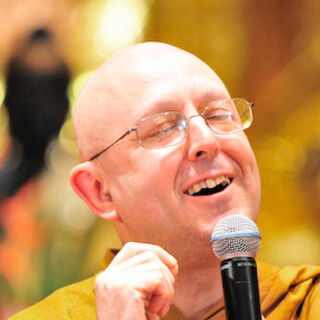
Why do we have to think such useless thoughts which don't serve any purpose,
You don't solve problems,
You don't get great answers to the meaning of life,
All you get when you think is headaches,
More thoughts.
So that's why there's an old story of why,
Why is there no aspirin in the jungle?
Parasitamol,
The parasitamol,
Parasitamol,
Oh come on.
Anyway,
Maybe after the meditation when you're more awake,
You may be able to get these jokes,
Obviously sloth and torpor is what I should be talking about,
Not thinking too much,
But when we think too much,
We always have the idea it's going to get us somewhere,
But all it really is,
Is just trying to escape and not being really happy where we are,
Because all thinking comes from discontent,
Wanting to escape,
Wanting to be somewhere where we're not,
Always assuming that in thoughts we can have more control,
If you fantasize,
You find you're the one who scores the winning run in the test match,
You're the person who kicks the gold in the grand final,
You're the person who finds the perfect match in life,
You're the person who wins the lottery,
In your fantasies you're always a winner,
But in real life you always lose.
That is why we feel that we can control that world.
And it gives us some false fake happiness,
But in the real world you don't have to be a winner to start off with.
In fact,
It's much better to be a loser than a winner.
I found that out when you started doing examinations,
Shouldn't tell this to your kids,
Because you're trying to get them to pass their year 12s and stuff,
But if you pass one exam,
What happens?
Another exam next year.
You do your year 12s and then you do your university,
And you get your bachelor's degree and then you get the masters.
The masters,
The PhD,
The PhD,
Another PhD.
Now what happens is always another exam afterwards.
That is why what you call PhD,
Permanent head damage.
That's what it stands for.
It's about thinking.
So instead,
Instead we learn how to be calm.
And see,
There's always something next.
No matter how much you win,
You always have to re-win your title,
Pass the exam again next time.
There's no ending to that.
So instead,
We try and understand just right now,
This moment is good enough.
Even it might be a bit hot,
A bit cold,
You may be a bit sick,
You may be whatever,
But you can always make peace with this moment.
So this is actually where we learn how to get underneath that thinking.
Always comes from discontent.
So we have this little method of meditation,
Which is whatever you're experiencing right now,
Whatever it is,
Right now,
This moment,
Give it importance.
This comes from that old story of the Empress,
Three Questions.
Right now,
This moment,
What's happening?
Give it importance.
It may not be what you expect,
It may not be what you like,
But it's important for you.
For example,
Now is the time in Serpentine for the flies.
And I remember,
There's no flies in this room at the moment,
I don't know what has happened,
But I remember in the old days,
Sitting in the old community hall,
And then talking about,
If a fly lands on you,
Just let it land,
It's not toxic,
It's not going to kill you.
And so as soon as I said that,
We started meditating.
What is karma?
A fly came and landed right on me.
And of course,
Just like now,
These teachings are always videoed and streamed live around the world.
So if I did,
People would see that and say,
Hypocrite.
So it landed on me,
And I had to practice what I just taught.
And it was important,
I got great insight out of this,
Because that fly landed right underneath my nose.
It must have been a Buddhist fly,
Because I'll say why in a moment.
And then it decided to do a circumambulation around my mouth.
And honestly,
It did go around three times.
That's why,
On the third lap,
It got to the starting point and then it flew off.
That's why I knew it was a Buddhist fly,
Because in Buddhism that's what we do,
We go around things three times,
Circumambulation,
Then we fly off,
Just paying respect.
And one last thing I found out,
Which very few people know,
That actually,
That this part of your mouth,
That is the most sensitive.
If you get past this point,
Then you're fine.
But when it comes back,
It's very tickly.
And the other thing I've found is,
So what,
Does it hurt?
You don't die.
It's not going to give you post-traumatic fly syndrome.
It's,
Whatever it's called.
But anyway,
What it's really doing is just,
Why are we so upset about these things?
But it's so easy to think about them,
To escape instead of be with life.
So when we give importance to this moment,
No matter what it is,
We're just kind to it.
You know,
When you're kind to things,
Your reaction to life just calms down.
It just gets soft and you find it's the reaction to what you're experiencing.
That's what creates the thoughts and keeps them going.
It's we're overreacting to life.
Just like,
You know,
This is now fortunately the end of the hay fever season.
What is hay fever anyway?
Just an overreaction,
You know,
Of the immune system to pollen.
It's not going to kill you,
But you overreact and the nasal passages get inflamed and you start sneezing or coughing,
Whatever it is.
It's just an overreaction.
That's like thinking.
Thinking is like the hay fever of the mind.
It just keeps on overreacting to what we're experiencing.
So we learn how to calm our reactions to things.
That's where a bit of mindfulness comes in.
So we see how we react.
It's only a bit of heat,
It's only a bit of a fly,
Doesn't kill you.
But we overreact to it,
Which means that it drives us into a state of nowhere,
Instead of,
What's it not,
Nasal mucus.
I was going to say the ordinary word's not,
But that's not really polite for a monk to say that.
It's very difficult being a monk.
In private,
That's what I would say.
But anyway,
The nasal mucus,
Whatever it is,
Coming down your nose,
It's just like that's like thoughts,
Same sort of stuff.
One is mental,
The other one is physical.
So instead of the snot running through your mind,
Which is the thinking,
Instead we just calm it down,
We're peaceful.
We don't react.
In other words,
The way we don't react,
We are kind,
Instead of trying to cure this moment.
Just be with it and be kind to it.
You ever notice that if you try and cure things,
Get rid of things,
Change things,
It always gets very tense and it actually disturbs the flow of nature.
If you can learn how to still be calm,
She'll be right,
Mate.
You don't need no worries,
Leave it alone.
As Ajahn Chah used to say,
If you're sick,
You'll either get better or you'll die.
No worry.
Which means that you don't need to overreact and think too much.
In fact,
You learn how to not think at all.
This moment is important.
Don't react to it,
Be cared for it,
Cuddle it,
Be kind to it,
Embrace it.
Open the door of your heart to this moment,
No matter what it is.
You learn from it.
And one thing you learn is just how these things are not that important anyway,
They will soon vanish by themselves.
This too will pass.
When we don't overreact,
We find that the mind does become very peaceful.
You're undermining the cause of those thoughts,
The reactions,
The lack of contentment,
Always thinking things should be different and I'm going to make them different and I'm going to plan how they are different.
So this learning how to be calm and content,
Kindness,
The same word,
That undermines the thoughts.
So often you say that thoughts are like the waves on the ocean,
Or let's make it a bit smaller,
Waves on a lake.
And those waves on the lake,
If you get your hands and try and pat down those waves,
Or rather pat down the crests and smooth out the water,
You just make more waves.
So instead,
Why are those waves happening in the first world?
What's underneath those waves causing it?
What's causing it is discontent,
Overreaction,
Just shhhh,
Calm down.
And then you find the mind becomes peaceful all by itself.
This is learning how to be aware of the causes.
Don't worry about the symptoms.
The symptom is the thoughts,
The cause is discontent,
Overreaction.
A good example of that is always when people sort of bang the doors,
They cough,
They make sort of weird noises.
If they do,
The noise vanishes within a second.
But the reaction can keep going on for half an hour.
Who was that?
Why did they do that?
They should be banned.
I'm going to find out who they were.
And I am going to blacklist them,
Blacklist them from the meditation hall at Dhammaloka every Saturday,
Have a whole list of people with their pictures on the front there.
The snorers,
There's no pictures on there,
But those people who make too much noise.
Or those who come in late or go out late.
So those are the.
.
.
We don't do things like that because that is allowing just a small little noise to echo in our minds way past the time the noise has stopped.
So instead,
We don't react.
How we don't react?
Relax,
Be content.
Your mind is like a string.
When it's taut and tense,
Stretched at both ends,
You just ping it and it makes a high pitched sound which resonates for many seconds,
Like a guitar string.
But you loosen the tension of that guitar string.
You loosen it and soon it's quite loose,
You ping it,
It makes a boom,
A low pitched sound.
So when there's no tension on the string at all,
That is when things hit it,
Things happen and it doesn't react at all.
It doesn't resonate.
So you have a mind like a loose string,
No tension on it at all.
Whatever happens,
It doesn't react which means it doesn't start generating all these thoughts.
Shhhh,
It's calm at last.
So anyway,
There we go.
So enough talking,
Now let's Ajahn Brahm just to practise what he preaches.
Ajahn Brahm,
Shut up.
So now's the time to get into the meditation posture,
So if you can adjust your body,
So it is as comfortable as you can possibly make it within the what's possible,
Here he is.
Chilly Willy.
That wasn't my bones,
That was this thing here.
So close your eyes,
We close our eyes in Buddhist meditation because it's one less thing we have to be disturbed with,
With the senses.
Our goal if you like in meditation is to calm down the five senses so much that we strain them,
Soften them,
So they get so weak that the sixth sense,
The mind,
Starts to dominate.
That's when we see these beautiful lights in the mind which we'll talk about later.
So we don't want to encourage the senses,
We want to calm them down.
So when you close the eyelids,
Soon you don't see anything,
Not even the inside of the eyelids.
It's one less thing to be disturbed by.
We try and find a comfortable position so that our body is not going to disturb us too much.
It's really worthwhile being meticulous,
Taking a lot of care into making sure you're in a good position.
So you can just have a general scan of your body,
Just to see if there's anything which stands out,
Which is uncomfortable,
My belt is a bit tight.
So I loosen it.
And then I,
Part by part,
Go through my body,
Making sure my legs are comfortable to begin with.
This is getting mindfulness,
Awareness.
And the mindfulness is on just the comfort level of my legs,
Make sure they're all relaxed,
In the right place.
And it's not just mindfulness which sees a problem and just neglects it.
If I see that something can be improved,
I will do it.
Just adjust my posture.
And once my legs are comfortable,
I go to my bottom,
The buttocks,
To make sure that they are well adjusted on the cushion,
As best I can make them.
So I won't need to fidget later on.
Then I check my back,
Make sure that is as comfortable as possible.
Many people have back pain because they have bad posture.
Check your back,
Make sure it's as comfortable as you possibly can get it.
If you're leaning against the chair,
The backrest,
That is supposed to be very comfortable.
You may prefer to push your back away from the backrest,
Feel it,
What do you really prefer?
What's good for you?
What feels right?
And then check your hands,
How are they?
You can move them if you wish.
The mindfulness gives you feedback,
Gives you the information and when you move them,
It changes,
That's how obviously you find out what's the best position.
The awareness and the kindness,
Working together,
Get you to find the most comfortable position for every part of your body.
When you relax your shoulders,
Again not holding anything tight,
Letting both ends of the shoulder muscles relax,
Let them go.
With your awareness you soon feel,
You can easily know whether that part of the body is tight or relaxed.
When you're looking in the right place,
You get the correct information.
Then move up to your neck,
If you've got an irritation in your throat,
Please cough.
Any aches or pains in the neck,
Usually because the head is wrongly positioned.
And making sure that the front of the head where you can notice the sensations around your eyes and your mouth,
Make sure those are all relaxed.
It's not that difficult to notice tightness around the eyes and to relax that tightness so everything is loose.
It's a little exercise to scan through your body at the beginning of the meditation.
First of all it serves the purpose of getting into a good posture and secondly it's a preliminary exercise to establish some awareness and mindfulness and it associates kindness,
Mindfulness and kindness working together to get you into a really good position.
And also to generate this mindfulness and compassion so we can use it on our mind.
Before we go to the mind,
The emotional world,
I want to just check my body one more time and see if there's any tightness or tension anywhere,
Especially inside the body.
And I got into the habit of choosing one part of the body which is the most irritating.
To me today my throat is a bit irritating so I focus on that exclusive of everything else.
Once I have mindfulness of that irritating part of my body,
You can choose another part of your body which is irritating.
Once I've established awareness there,
I'm kind to that feeling,
I don't react to it,
I soften my attitude towards that feeling.
If I do this properly,
I can notice the feeling change,
It starts to get eased off.
The overreaction which caused that disturbance in the first place starts to ease off.
In other words I'm relaxing,
I'm healing that irritation,
I'm settling it.
And as I work with that irritation more and more,
Not trying to get rid of it but just being kind to it,
If the irritation gets worse,
My mindfulness picks that up and I go another route.
If the irritation gets less,
I continue on that same path of kindness and awareness.
Once your body is really relaxed,
Your mindfulness should be able to pick that up,
So at ease.
Then you can move on to calming down the mental world,
To go below the level of thinking,
What causes disturbance and what causes peace.
To know that,
I ask people to start focusing on what I call the peace-ometer.
How calm are you or how agitated,
A number from 1 to 10,
1 peaceful,
10 really agitated.
It just serves the purpose of focusing your attention on what is really important,
How peaceful or how agitated you are.
Once you can be aware of the correct thing,
The level of peace or agitation in your mind,
Then the next step is noticing what brings that needle down closer to 1.
And the opposite,
What agitates the mind and takes that needle closer to 10.
You are learning cause and effect,
How to bring basic calm and peace to your own mind.
The same skill which you can use to calm and heal your own body,
You use to calm and bring peace to your mental world,
Awareness and kindness.
You are taking away the tightness of your mind,
So that when something hits it,
It doesn't resonate with thinking,
It's loose.
Keep being aware of the peace-ometer.
Try this beautiful kindness,
The door of my heart is open to this moment.
This moment is important and my only reaction is to care for it.
Just like a mother cares for a child who is sick,
Strokes it,
Reassures it,
So the child can relax and be at peace.
This moment is important and my only reaction is to care for it.
.
.
.
Once the mind has been calmed down sufficiently,
You may notice you don't need thinking,
Naming,
Proliferation.
When the mind is not agitated it doesn't overreact.
So you don't need to stop the thoughts.
You look at the underlying cause,
The lack of peace,
Contentment.
It's happy to be here right now.
For those who need something to just focus on and anchor,
You may use your breathing.
Just notice the breath as it goes in.
How it goes in,
Where it goes in is not important.
Your job is not to control the breathing but to be its best friend.
So you can hang out together.
Breath goes in,
Breath goes out.
You're always side by side.
Your awareness and your breathing.
I'm now going to be quiet until the end of the meditation.
.
.
.
.
.
.
.
.
.
.
.
.
.
.
.
.
.
.
.
.
.
.
.
.
.
.
.
.
.
.
.
.
.
.
.
.
.
.
.
.
.
.
.
.
.
.
.
.
.
.
Okay.
So now is the opportunity for some questions on meditation.
I was lucky to actually ask me one just before I came in here,
Just a bit busy.
So it was somebody asked the difference between the jhana meditations and the opening of the kundalini type meditations.
And there's a very big difference there because in this type of Buddhist meditation,
We calm the senses down,
The five senses of seeing,
Hearing,
Smelling,
Tasting and touching.
Until they get so soft,
We don't feed them,
That they disappear.
And then we have the sixth sense just opens up,
Which is the mind.
And when that sixth sense sort of is more powerful than the mind,
Sorry,
That sixth sense,
The mind is more powerful than the five senses,
We can't feel the body anymore.
So that Buddhist meditation is actually transcending the body totally.
It's not getting energy in the body,
It's keeping that energy in the mind.
So you can't feel the body,
The body's gone.
It's just a great relief.
It also creates a lot of insight into how heavy this body is,
In its five senses.
Many times when you realize,
I've got to be very careful not to make personal claims,
But I remember this monk I know very well,
Who had a very bad fever,
He was scrubbed typhus and his body was just so heavy and painful.
If you've had a fever for three or four weeks,
Of course,
You know,
You've just got no energy at all.
And still you can actually let go of the body,
Go into these really deep meditations where you can't feel the body.
What a relief that is,
Just a physical sense of feeling,
Totally gone,
So you can have a bit of space.
And you realize,
Even in the best of times,
How heavy this body truly is.
So that's actually one of the things we get.
The Kundalini is still in the body there,
And just having energy stuff in the body.
It's just missing a great opportunity to free the mind from the body.
I don't mean travelling astral,
Travelling,
Leaving the body with a mind-made body.
It is just the body just vanishes in this beautiful space of the jhanas.
There's a very fundamental difference there.
And if anybody wants to know more about that,
That is said very clearly in that book which I wrote,
The Mindfulness,
Bliss and Beyond.
So anyway,
We have some questions here from overseas.
We'll see what we have over here.
From Sri Lanka,
Indonesia and Canada.
When you were in Sri Lanka,
I was there recently,
I took my child for your blessing to have the best school,
But unfortunately the name was not on the list.
Wife is now worried,
I told her that the chant will work.
How do we let go of this wanting?
There was a case here of a Malaysian girl who came to us for some chanting just before the university exams,
Maybe just about in November.
And I did some chanting for her and afterwards she never came back again.
And the reason was that she failed the exams.
And I only got this back from her friends and said,
She keeps blaming you,
Ajahn Brahm and the monks at Serpentine,
The chanting is no good.
But the Malaysian friend said,
Well,
You don't have to worry about that,
Ajahn Brahm,
Because she was doing no work all year,
Partying around and she thought at the last minute when she should have been doing some work,
That the chanting would sort things out for her.
So it's the same that you took your child for your blessing,
Have the best school and the chanting together because there's other factors as well.
You can't just expect chanting to do everything.
So otherwise,
Imagine if the chanting would always get people to go to the best school,
Would always make you win the lottery,
Would always make you get the best job,
Would cure all of the cancers in the world.
My goodness,
I would have no peace at all.
People would be lining up not to learn any meditation but to get some chanting.
So your name was not on the list,
Maybe it was because there's other factors involved there.
So how do we let go of this wanting?
By meditating.
Sometimes we don't know why these things happen but sometimes always happen for the best.
Indonesia,
Can mindfulness cure severe anxiety and depression with therapy of medication as well as katavagal karma?
Of course it can,
But mindfulness has to be done also with some kindness.
Just being aware is not enough.
There is a sutta and it's the Manibhadaraka Sutra,
It's in the Samyutta Nikaya.
I often quote this because sometimes people think,
Oh,
Ajahn Brahm makes this up,
But this is actually the word of the Buddha where this deva comes along and just says how great mindfulness is and you should practice mindfulness every day and through mindfulness you can overcome anger.
And the Buddha replies,
Yes,
Mindfulness is very good,
You can practice it every day,
But just through mindfulness you cannot overcome anger.
You need kindness as well,
Compassion.
That's the word of the Buddha.
It's not exactly the translation,
I'm just remembering it,
It's not word for word,
But that's the essence of it.
Even the Buddha said mindfulness is not sufficient by itself,
You need the kindness as well.
So anxiety and depression,
Mindfulness is good,
But also positive attitude,
Kindness,
A bit of wisdom,
All those things work together and together with the medication in terms of severe depression,
Put them all together and it's very,
Very effective.
Lastly from Canada,
My posture is fine sometimes,
But other times the same posture that's comfortable at first eventually makes my legs fall asleep.
Is this connected to how would I meditate or just physical?
Just physical is a nice good question because during my meditation,
Which hopefully you were looking at,
Tracy,
My right leg fell asleep,
It went numb,
But that's not sattva and torpor,
I just let it go numb,
It just comes back again afterwards,
It's no big deal.
But I went through that fear a long time ago when I was young and stupid even before I became a monk.
I would meditate and my leg would go numb and I think I'd better move it.
And it was just through fear because I thought if your leg's going numb,
It shows you how much I knew at the time,
I thought that means there's no blood circulating through your legs,
Which means it will start to get gangrene.
And by the time I get out of my meditation,
I'd have to go to hospital and have my leg removed.
You know,
Just fear,
That was the stupidity.
And then later on,
What I did,
I had enough of this,
Always going to sleep,
I don't care,
I'm going to carry on meditating.
And so I carried on meditating and that leg was numb and I was meditating and it just came back again,
It was just fine,
I didn't even move.
It was just fear and just the fear sort of creating anxiety and worry and just leave it alone,
The body looks after itself,
It's very good.
And of course now,
A little bit more informed that it's not the blood not going through your legs,
It's only just through the,
Not sort of supplying the nutrients to the nerves on the surface of the skin,
It's not dangerous at all.
So it's not the first sign of any disease,
It's just nature.
So it just comes back by itself and afterwards anyway,
After meditation you can move and it all comes back again,
It's no big worry.
So if your legs fall asleep,
Fine,
As long as you don't fall asleep,
Yeah,
Your legs can do whatever they want but usually with meditation it's perfectly safe.
But the interesting thing in meditation,
I always like the weird stuff that you can sometimes,
You sit for like half an hour now,
Your leg may go to sleep,
May have an ache or a pain here but when you really do the long sits,
The first time you do a long sit,
I can't remember this time when I was travelling all day from one monastery to another monastery,
It was really hot and sticky and I was tired and just we were crowded into,
You know in Asia,
This was pretty much the same but three seats,
Three seats were only just big enough for like two people but people crammed in there and you really crammed and squashed for hours on end and you finally get to your destination and just really tired,
Just wanted to have a shower or it would be wonderful to have a cup of coffee or a cup of strong tea,
There was nothing there in that monastery and as soon as we got there,
The other monks said,
Oh this is a very strict monastery,
You've got about quarter of an hour and then we're going to start our evening meditation,
Four hours.
So there I was,
Tired,
Exhausted,
Hot and you're going to face a four hour meditation,
Oh my goodness.
So I just had a chance for a shower,
That's all,
Throw some water over you,
Get the sweat and change your robes so it's really stinky and then in the hall to meditate and of course you know this is going to hurt if you don't meditate properly,
I love those situations when your back's against the wall so you're not really lazy anymore,
I'm a lazy monk sometimes,
If you don't have to,
You don't,
So okay,
Here we go,
And so it was great.
So the end of the four hours actually I complained because it didn't last,
It was only three hours and forty five minutes,
They took fifty minutes off,
I said,
What did you do that for,
It's having a good time,
Zoh,
And there's no aches and pains in the body at all when you really do some nice meditation.
If it's half an hour,
An hour,
My body will be sore,
The longer,
The less sore,
It's a weird thing in meditation,
When you really relax the body and you don't pay any attention to it,
It looks after itself,
Much better than when I worry about it.
So if your leg goes to sleep,
Let it go to sleep,
It's what we call these days,
Nanya.
I made a talk about that,
I said that a few times because at a retreat,
Oh,
I don't know how long ago,
That was about six months ago,
Nine months ago,
One of the meditators there,
I think she was from Melbourne or Sydney,
She said her young son,
Whenever she asked him,
Have you finished your homework,
He replied,
Nanya,
When,
It's actually a nice range retreat,
Longer than that,
Yeah,
When she said have you cleaned up your room yet,
He'd say Nanya,
And when she asked him if taking the trash out,
He'd say Nanya,
And her mother never heard that before,
So what does it mean,
It's a short mum for Nanya business.
That's a rude word,
Say to your mum,
Nanya business,
But you know what kids are like,
Slang.
So anyway,
I thought that was a wonderful thing to use in meditation.
So your leg goes to sleep,
Nanya,
Nanya business,
The body's business,
Leave it alone,
It'll take care of it.
So what else can happen,
You get an ache somewhere,
Nanya,
Nanya business,
Body will look after it.
The breath goes in,
The breath goes out,
How it goes in,
How it goes out,
It's Nanya,
Nanya business,
Your business,
The past and future especially,
Nanya,
Nanya business,
Afterwards you do your business,
So your work,
They're not paying you,
You know,
Just when you're in the meditation hall to do work,
Even me,
I don't get paid at all,
Any time by the way,
So anyway,
It's none of my business,
So that means you can let go.
When it's your business,
You can't let go,
When it's Nanya business,
You can leave it alone.
So there goes the sleep,
This is connected to how what I'm meditating or just physical,
It's just basically physical,
And it just looks after itself,
So basically Nanya business.
If it always goes to sleep and it causes you lots and lots of trouble,
Then maybe just change your posture,
You know,
Just make sure there's no sort of problem there at all with your body,
There's always lots of different ways you can meditate,
On a chair,
Just on the floor,
Leaning against the wall,
If you really need to,
You can actually,
We should actually get some better chairs,
These are really just such old-fashioned chairs,
We should actually get these lazy boy chairs,
And so you can actually press the button,
So the thing comes up,
Or you can have these massage chairs which they have,
So if your leg goes to sleep,
They can pummel them,
Just press the button,
That would be very good,
Really meditating.
What I would like is a cushion,
Which is like air-conned,
So it blows cold air during the hot weather all around me,
So I can get nice and sort of cool,
Because I like the cold weather.
So anyway,
In my dreams,
But in the meantime,
It's okay,
No problem at all.
So,
Anyone,
Any questions from the floor today?
Or from the chairs?
Or from anywhere?
Could you know this happened once?
Oh,
You go on,
Carry on.
You wanted to know,
That's more wanting,
So best to let,
Sorry,
Carry on.
Questioner In this form of Buddhist meditations,
Can you do,
Or do you do any ancestral form of meditation,
To go through the ancestral?
Ajahn Brahm Ancestral,
What does that mean?
Questioner And your ancestral family?
Ajahn Brahm Ancestral?
Questioner Family.
Ajahn Brahm Family.
Questioner So you can go back through.
Ajahn Brahm Oh,
You mean,
Well,
You mean just past life?
Questioner No,
No,
I mean like,
You know when you pour the water,
We're in the other room there,
And you pour the water and do blessings.
Ajahn Brahm How the transference of merits.
This is something a little bit different,
But sure,
This is the well-known fact that if something,
You have a connection between people you love and have known.
That's quite sort of very common.
That story,
Which I like to quote because it's very clear,
Was in the Melbourne Age,
When I was staying in Melbourne some years ago.
A veterinary surgeon on the weekend was on,
He was a single guy,
He was going into country Victoria for a weekend party,
Basically with his friends.
So he finished work driving along some motorway or freeway,
Whatever they called it over there,
And halfway on the journey,
He was overcome with his incredibly strong emotions,
I mean really strong.
He started weeping for no reason whatsoever.
And so it was so intense he had to pull over to the side of the road,
Park in the emergency lane,
Because he was totally overcome,
He couldn't drive.
And so he waited there for about half an hour until he could settle his emotions and wipe his eyes so he could see,
And then carried on his journey very carefully at first.
When he got to the country house where the party was,
That's where there was a message for him.
At exactly the time he was overcome by grief,
At the time his dog had been hit by a car and killed in Melbourne.
And it was maybe 60 kilometers different,
There's no way that he could have known that by any science,
But he was so obviously connected to his dog,
When his dog was injured,
His emotions just hit him,
Just immediately.
So badly he couldn't drive.
So many of you may have had experiences like that,
There was an intense experience,
But maybe you've had experience like that,
You do have connections between people you've lived with,
Known,
Loved,
So you feel that something's wrong somewhere.
What happens?
You just get a call,
You call somebody and you find,
Yeah,
It's true.
So we use that sort of channel,
Understanding that that is real.
So if we care about somebody,
We want to give them a bit of a boost,
Then we think about them and just say,
You know,
Mum,
Dad,
Loved one,
So this merit,
The energy,
The goodness,
Which I've been building up today,
It's all yours,
It's my gift to you.
So you can do that.
And what about like your great grandparents and going down the line?
Great grandparents,
Going down the line,
They've probably been reborn now,
So you know,
Probably it's like sometimes sending a donation,
It's nice to send donations at Christmas time to worthy causes,
But to send a donation to say Mr Bill Gates,
I mean it's just not going to really be effective,
Is it?
You know,
It's just a drop in the ocean.
So if anyone's been reborn,
You know,
The connection is really extended,
You can't really get through to them a number,
So anyway,
Does a person really need it if they're just in some sort of beautiful place?
So that's what usually happens.
So it's usually people are very close to you because you've got a strong connection to those.
Your great great great great grandparents,
You don't even know them,
They never sort of met you,
Sometimes it's a bit too far to get a connection.
And the bloodline?
Sorry?
And the bloodline?
Even the bloodline,
No,
Because the blood is something material,
Physical.
We're talking about things which are mental,
Spiritual,
In terms of the world of the mind,
Not the body.
Thank you.
There we go.
Weird stuff,
But it's true.
I like weird stuff.
And if you ever want to try this out,
Your own little experiments,
Sometime,
I've done this when sometimes when people have got really nice meditations,
You think of somebody who's not here,
Not in this room,
And really blast them with your metta,
May they be happy and well,
May they be free of this,
Or I really care about you right now,
Just please,
And you zap them.
Obviously the more strong you are,
The more peace,
The more energy you have,
The stronger you can zap them.
And then just to prove it for yourself,
You'll notice a time,
What time is it?
4.
20.
And this evening you just give them a call,
Hey,
Just how are you,
And where were you about 4.
20,
What were you doing?
It's amazing just how many times I said,
Wow,
It's amazing.
It was about that time I was thinking about you.
And actually you can prove it to yourself.
It's not just a coincidence,
People can connect.
So it's amazing when people actually do that,
And they just say wow,
There's something going on there.
And of course the most important thing is,
Unfortunately it's when it's a tragedy,
We can connect pretty easily.
But when there's something really wonderful happening,
Can you connect then?
That's the best time.
Weird stuff but true.
I like weird stuff.
I don't know why people are afraid of weird stuff.
Weird is great.
Okie dokie,
So we can now pay respects to Buddha Namsanga and then we can go back to the normal life,
Boring of science and stuff.