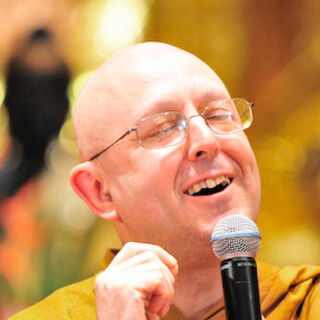
Welcome everybody to this afternoon's meditation class.
To remind everybody that this is the ongoing class for those who are coming for the first time.
To make sure that you go to the beginners class which is the class on the room.
To my right,
Or as you are coming from the reception area,
The little room on the left where we have the beginners meditation class.
Because on this class we sit meditation for about 45 minutes which is a long time for those who have never meditated before.
In this class every week as usual we do 15 minutes of introduction followed by the 45 minutes of personal sitting.
A lot of times the first few minutes of meditation is perhaps the most important.
Because at that time when you are either going to get on the road to a nice quiet peaceful meditation or those first 5 minutes you are going to start drifting off and the whole 45 minutes just becomes a blur of memories or thoughts or fantasies or just sleepiness.
So it's really important to get those first 5 minutes very very sharp and peaceful.
The reason I say this is I recall on one occasion as a young monk,
About 5 years I'd been a monk and travelling all day and founding myself in a monastery in the very north of Thailand,
A very beautiful monastery.
When I arrived there the monk said,
You are just in time because in about half an hour's time we are going to have our evening meeting which consists of a 4 hour meditation.
We just have to sit still for 4 hours,
No moving.
It might not be so bad if you had a good rest that day but when you've been travelling in a very hot climate you felt so tired,
Oh my goodness how am I going to do this?
I didn't have enough time for a cup of tea so all you did was have a quick shower,
Pack your stuff,
Get into the hall and then face the 4 hour meditation.
Because I knew that that's going to be 4 hours of absolute torture unless I really got those first 5 minutes really perfect,
That I really put forth a bit of extra effort in those first 5 minutes and I got a lovely meditation and was actually disappointed when they rang the bell.
15 minutes early I complained,
You namby-pamby cream puffs,
We only sat for 3 hours and 45 minutes,
One should have done the 4 hours of having a good time.
But the first 5 minutes was so important.
By which I mean to really get the mind centred in those first 5 minutes.
I don't mean centred in the deeper levels of meditation but centred in your aim,
What you are doing and why you are doing it,
To have that clarity.
This is not the time for thinking,
This is not the time for fantasising,
It's not the time for planning,
It's not the time for dredging up your old memories or even your recent memories.
Put all that aside,
It's meditation time for goodness sake.
So you make that clear commitment to the task of the next 45 minutes.
And for those first 5 minutes,
Be very very careful.
Say,
I really got to centre my mind,
Present moment awareness and silence and get on to this breath and stay there.
Because once you get into like a channel,
A stream of meditation,
A stream of focusing and letting go.
The other obstacles such as past and future thinking and all these other disturbing thoughts,
They just can't get in because you beat them to the goal.
And so those first 5 minutes you should try and be very very careful.
Even put a little bit of effort in those first 5 minutes.
I know that when I teach meditation,
Sometimes I give effort a bad name.
And that's especially the case later on in meditation where you are very very focused and you want to get deeper,
You really have to let go some more.
But maybe in the beginning part of the meditation,
Just to make the mind a bit more focused.
To get that sort of energy at the very beginning,
Rolling.
So you sit down there and you make the body comfortable.
This is not just you've done this before,
So here we go again.
It's not just like a mindless just going through the motions.
It's not just going through the motions without much mindfulness,
Without any care.
Again,
You just get into a dull state,
You've got to be careful.
So that's why sometimes when people get into dull meditations and not get any progress,
I tell them just to do simple things like sit in a different position,
In a different posture.
Put yourself in a different position,
Not the same old posture,
The same old place you always sit in this hall.
Just slightly different,
Just to make the mind a little less conforming to old habits.
If you get to be a creature of habit,
Especially in meditation,
Just go through the same old process and the mind doesn't engage,
There's no clarity there.
The difference say between driving in somebody else's car and driving your own car.
Your own car you know it,
So you can relax and sometimes become heedless.
If you're doing something different,
Going in a new car on a different road or whatever else is somehow different than the normal,
It makes you more alert,
More awake.
It's one of the other reasons why very often people say to me,
When they first started meditation they got some really nice deep states and so peaceful.
Yeah,
Because now you just take it for granted too much.
It becomes like habitual meditation rather than using that clear mindfulness at the very beginning.
So,
However you've been doing the meditation,
The first five minutes,
Do something different or make it more alive.
Even if you do have a commentary,
Keep the commentary,
Something to do with the breath but have a little commentary there.
Whether it's just breathing in,
Breathing out,
Breathing in,
Breathing out,
Little commentary or that commentary which I used to do about being oxygen from the plants and the flowers and breathing out the carbon dioxide which is my gift back for all that's green outside,
Connecting you with nature,
It's making meditation green and environmentally friendly,
Whatever else it is,
Just to make it a little bit more interesting so that the first five minutes the mind engages fully in what you're doing.
You understand what focusing is and how you become engaged in an object.
You have to get something out of it,
Be,
Like listen to music or listen to the last five minutes of a tennis match or something.
Really get involved in it because it's interesting,
It's fascinating,
It draws you in and then you're concentrated on it.
So somehow we have to manage to find a way of really getting on into the task at hand in the first five minutes,
Making it interesting,
Making it fascinating.
And getting that present moment when it's getting the silence and getting on to the breath.
So you got something really to focus on.
And even if you go on to the breath too fast,
You still got some thoughts of the past or the future and just got some commentary,
Doesn't matter,
You can just get on to the breath and maybe just go backwards a little bit.
Just,
Okay,
I'm on the breath but no past and no future,
Come on,
Focus a bit more sharply in the moment.
Come on,
Just get rid of all these extraneous thoughts.
I don't need to comment on everything,
Don't need to give everything a name and open my mind's mouth,
The mental mouth,
Always speaking and commenting on things.
You need to focus very quickly in the early time.
If you can do that,
Get that focus going and then after five minutes,
You just let go,
You already just got the momentum going.
Sometimes I used to use a simile of the old toy cars I used to have when I was a kid.
These toy cars,
They had little gears on them and to get the cars moving across the floor,
You had to get hold of them and rub them against the ground again and again and again to wind up the gears and to get them moving and then when you released it,
The car would shoot all across the room.
Obviously the more you got it going,
The further it would shoot.
That's sometimes a good simile for what we're doing here in the meditation.
By starting with a little bit of effort,
Getting the mind going on the path of meditation,
On the path of peace,
On the path of letting go,
We actually do release it because the whoosh goes into some nice powerful peaceful meditations.
So this will be a piece of instruction in this class today.
Put a little bit of effort into the first five minutes to make it very sharp,
Very clear,
Exactly what you're doing and don't mess around and then you can relax for the next 40 minutes.
You'll find that you don't go drifting off.
Anybody had comments about that?
Ok,
Let's give it a try then.
So,
If you'd like to get yourself comfortable again in your meditation posture.
Be really careful.
Imagine this is your last meditation and at 4 o'clock you're going to be executed.
So you better get your act together or else.
Imagine that you are competing in the meditation Olympics.
You might get a gold medal,
The best meditator.
Or imagine that I had a machine which could read your mind and I would broadcast the results to everybody at 4 o'clock.
So be careful what's going on between your ears.
First of all,
Let's look after this body.
Care and commitment.
How can I make this body more comfortable?
But still feeling inner strength,
Inner physical strength.
Guy.
.
.
.
.
.
When the body is set up,
Go to the present moment,
Really focus the mind in this moment,
No messing around.
.
.
.
.
.
.
Focusing with everything you've got on the present moment.
.
.
.
.
.
.
.
.
.
.
.
.
.
.
.
.
.
.
.
.
.
.
.
.
.
.
.
.
.
.
.
.
.
.
.
.
.
.
.
.
.
.
.
.
.
.
.
.
.
.
.
.
.
.
.
.
.
.
.
.
.
.
.
.
.
.
.
.
.
.
.
.
.
.
.
.
.
.
.
.
.
.
.
.
.
.
.
.
.
.
.
.
.
.
.
.
.
.
.
.
.
.
.
.
.
.
.
.
.
.
.
.
.
.
.
.
.
.
.
.
.
.
.
.
.
.
.
.
.
.
.
.
.
.
.
.
.
.
.
.
.
.
.
.
.
.
.
.
.
.
.
.
.
.
.
.
.
.
.
.
.
.
.
.
.
.
.
.
.
.
.
.
.
.
.
.
.
.
.
.
.
.
.
.
.
.
.
.
.
.
.
.
.
.
.
.
.
.
.
.
.
.
.
.
.
.
.
.
.
And to continue now more gently,
Focusing silent,
Being deeper and deeper wherever you are as you go through the stages of meditation by going always inwards,
Inwards,
Inwards.
Never onwards.
.
.
.
.
.
.
.
.
.
.
.
.
.
.
.
.
.
.
.
.
.
.
.
.
.
.
.
.
.
.
.
.
.
.
.
.
.
.
.
.
.
.
.
.
.
.
.
.
.
.
.
.
.
.
.
.
.
.
.
.
.
.
.
So it's coming close to the end of the meditation now.
It's time to reflect on how you feel inside.
To know what's happened and what it feels like.
To know what worked and what didn't work.
To know what worked and what didn't work.
This is the place where you do your learning about the goal of meditation as well as the path.
.
.
.
.
.
.
.
.
.
.
.
.
.
.
.
.
.