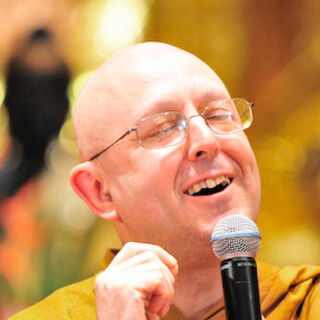
But every Saturday afternoon I do say a few words about meditation and I wanted to just mention a few things about insight as part of this meditation we're doing here.
I know that many of you,
If you're exposed to other ways of meditation,
May have come across,
Some people call a particular type of meditation insight meditation and think that that's,
Describes one method of meditation and no others,
But in all parts of meditation there's not one practice or method of meditation which does not involve insight.
The meaning being that as you are meditating,
As you are practicing,
Whether you're doing things right or you're doing things wrong,
This quality of mindfulness,
Which is the awareness focused inside,
Will give you feedback.
So as you're mindful of what's happening in your meditation practice,
That you will notice things change,
You will notice yourself getting more aware or more sleepy,
You'll see yourself getting more peaceful or more agitated,
You'll see yourself getting more relaxed or more tense.
So these are things which are indicators on the path of meditation.
And you have to be the equivalent of blind Freddy inside the mind not to notice those things.
So it's mindfulness,
Can see the change in your mental makeup during the meditation,
You can see if you're getting more peaceful,
You can see if you're getting more relaxed,
You can see if you're getting more alert or you can notice you're going the opposite direction.
Now that is a basic insight because once you see,
Have feedback,
Then you can make that connection with what you're doing.
So if you are getting more dull and sleepy,
It must be you're going in the wrong direction,
So you turn around.
If you find you're getting more agitated,
More tense,
Then obviously that you're doing something wrong,
That's not what meditation is supposed to do,
So again you relax some more.
If you find that you're getting more frustrated,
Then again that's not what meditation is supposed to give you,
So you do some more letting go,
Making peace with things.
So you find as you go through this journey of meditation,
The change in your mental condition will give you feedback,
It will give you what we call data.
And then the job of insight is to connect that data,
That change in your mental condition,
Connect that to what you are doing or what you're not doing,
To your attitudes.
And this is where the insight will come up that when you try hard,
Then you get tense.
That when you are very tired,
Then you get dull.
And when you aspire and expect something,
Then again you lose your sense of peace because peace,
Contentment only happens in the moment.
And in particular,
One of the great insights of meditation,
When you want something more,
It means you cannot enjoy what you already have,
This happiness of meditation is lost.
You sacrifice it because you want something more.
And those are insights which you should be able to notice yourself.
The reason why I speak in the beginning of the meditation is twofold,
First of all to settle you down after coming from the journey,
From your home or work to this place,
To settle you down,
But also to point out some areas where you get deep insight into what's happening with your meditation.
Because meditation success,
The peace,
The bliss,
The heightened awareness which results in very,
Very good meditation,
That never comes about through willpower.
You can try,
Try,
Try,
Try,
Try and that doesn't give you the goods.
It always comes about not through willpower but through wisdom power,
Which is my word for insight.
I use wisdom power because it just connects with this opposite willpower.
So those are the two things which can drive the meditation forward.
Willpower drives it in the wrong direction,
Wisdom power drives it in a good direction.
So use your wisdom power,
Use your insight which is based on what's happening,
The data of your own experience as you go through this meditation.
And all you really need to access that wisdom power is just keep your mindfulness,
Not just checking on your breath or whatever else is your object during this meditation,
But just checking up how you're going.
You know like you've got a good friend and they come up to you and say,
How are you going today?
And they really are concerned.
You know maybe in your life they check up on you every few days,
How are you going with that problem you have in your life?
You may be sick in a hospital bed and the nurse comes,
How are you feeling?
And they need that insight of how you're feeling,
How you're progressing because according to what you say then they can maybe help,
Maybe do something for you,
Get some food or just wash you or something to make you better because without that insight you don't know how to move forward.
So you're asking yourself during the meditation,
Now every so often,
How am I going?
Now I'm not saying you interrupt this with verbal speech but it becomes a habit of the mind,
Just always checking up on yourself just to make sure you're going in the right direction.
So you're not going into sort of more frustration,
More trouble,
More sort of dullness or whatever.
You're always going in a good direction.
And for those of you who have meditated enough,
You can feel whether you're going in a great direction or not or whether you're going in the opposite direction.
Your experience of all those meditations you've done so far,
The accumulation of your wisdom of the process of meditation becomes so good that you can actually feel whether you're going in the right direction or not.
It's just like these very,
Very skilful artisans,
They can actually feel whether that sculpture they're doing is going in the right direction or not.
Sometimes they can't put into words or they're,
Say,
Sailing their yacht.
They can just feel,
They know exactly how to do these things or whether you're playing tennis,
You know how hard to hold a racket and just how to move it through the air.
It's sub-verbal,
It's a skill which is based upon so much experience,
Finding what works,
Finding what doesn't and being aware of this feedback mechanism called mindfulness.
So you become wise,
You know how things work and how to get the job done.
And this is where your insight sort of is honed during this meditation period.
So when you are meditating,
Just don't just,
Okay,
Sit down,
Close your eyes and fall asleep or go off fantasising or dreaming or planning.
Remember what the goal of meditation is,
That peace,
That stillness,
That great sense of freedom when there's nothing pulling or pushing you or demanding that you do something or go somewhere or get something.
This beautiful sense of freedom,
Freedom as I say,
Freedom from desires,
The freedom from wanting,
The freedom from any pressure on you at all.
This wonderful sense of just being like a bird with no baggage,
Just flying in the sky.
Now those are the sort of goals of deep meditation and to be able to get those goals you can notice whether you're going closer to that direction,
To that goal or away from that goal.
Just like if you're going to Serpentine Monastery or to Dharmasara Monastery,
You know you can see the hills coming closer,
You must be going in the right direction somehow or other.
So that feedback which you get from meditation is what we mean by the insight.
It's that part of insight which drives the meditation deeper and deeper and deeper.
From the experience you know what you're doing,
You know what's happening.
And that insight is incredibly important the deeper you go in your meditation because once you get past the initial stages,
You just can't make forth any effort.
Any effort just disturbs the mind so much.
You've got to navigate your way through this great wisdom and insight around these little obstacles,
Things like fear,
Things like excitement which come up in the deeper stages of meditation.
You're getting some powerful states now,
It's finally happening.
And unless you're very wise,
You get stopped by fear or you get stopped by excitement.
What happens is you just start controlling again,
Everything's going very,
Very well and just as you're about to step into the deep meditation,
You slip on the doorstep simply because you don't continue what's already been working,
You change your course and you just do things again.
You know you spot it at the end and this is where great insight is needed.
Now not only does this give great insight into the way of meditation but when you come out of meditation it gives you a lot of hints about how to live a more peaceful life.
Number one,
You get insight,
You get understanding,
The wisdom of what letting go means because you've done that in meditation.
The path of letting go is what leads you to this very beautiful,
Peaceful,
Relaxed states of inner freedom.
So you think that when I'm at home or when I'm sort of at the red traffic lights,
Why don't I practice that then?
Because you do exactly the same attitudes which you did in meditation,
Just being here,
Letting go,
Not thinking,
Being where you are which means you can find so many opportunities to relax and be at peace during your daily life.
And not only that,
You get this incredible state of peace and happiness inside and then it starts giving you insights into what the nature of real happiness is,
This thing which you've been searching for your whole life.
What is happiness?
What is peace of mind?
And there you are,
Sort of facing peace of mind in these steep meditations and so you're getting experience of what these states really are.
I always sort of use a simile,
It's like understanding what Paris is.
You can see videos of Paris,
You can see movies set in Paris,
You can get books about Paris and you can actually get all the details of Paris but nothing beats actually going there,
Sniffing the air and walking the streets.
When you've been there you know it pretty well,
The same way of peace.
You may write,
Read all sorts of books about peace,
Go to many lectures on peace but actually experiencing peace is the only true way you have insight into what peace of mind is.
So the insight not only drives the process of meditation which you practice here every Saturday afternoon but it also gives rise to even more fantastic insights.
If Buddhism creates wise people,
That wisdom does not come from the books nor does it come from listening to all of the talks.
The wisdom comes from actually practicing what those talks are pointing to,
To sitting down and becoming still and understanding for yourself what peace of mind feels like.
You're there,
You have an experience of freedom or what the Buddha called,
And this is the classic Buddhist term,
The taste of freedom in meditation.
You may get that taste of freedom,
That insight into what freedom truly means,
What peace is,
What real happiness is.
That's why the meditation which you do here is riddled with insight practice and leads to great insights.
So please never get confused by some mischievous people who say this is one type of meditation,
This is another type of meditation,
This is peace meditation,
This is insight meditation,
The two will always go together and you cannot separate them.
Where there's peace is insight,
Where there's insight is peace.
That's just the nature of meditation practice.
So there we go,
That's the introduction to having some insight during the next 45 minutes.
But first of all using your wisdom power,
If you want to stretch your body or scratch something,
Please do so to get this body comfortable because you will find out after many meditations if you don't get your body comfortable at the very beginning,
It's going to cause you trouble in the middle.
So through wisdom we make sure our body is comfortable at the very beginning.
So,
Closing your eyes,
And bringing your mindfulness onto your body.
To do that I ask myself,
Body,
How do you feel?
And if I ask that question,
My mindfulness starts looking to find an answer,
Starts experiencing the various sensations in my body.
And usually the most prominent sensation,
The sensation which comes up first of all is a painful one,
Which is telling me that I'm not in the best position.
When I hear that advice from my body,
Then I move,
I adjust.
In meditation you work with your body,
You don't try and control the body and dominate it.
You work with it as a friend,
Not as a master or mistress.
So,
Now just getting out of the system.
Stay with your body,
Aware of sensations in your body,
Calming them,
Pacifying them as best you can.
When you come to that point,
Adjusting your body is not going to improve the comfort.
Then you let go of the moving part of settling the posture.
If there's some disturbance,
Some ache or irritation inside,
Then put your mindfulness on that irritation and just soak that place in your body with kindness,
With metta.
Just like my mother could visit me when I was sick and just smiling or stroking my hair would take a lot of the ache and pain away,
No matter what little sickness I had as a child.
From those experiences I realized just how love,
Kindness could ease nearly all pain.
So I give that same intensity of kindness to these areas inside my body which are tight and tense and achy and painful even.
And the feedback given by mindfulness shows me them relaxing and the tension easing,
The tightness loosening,
The power of kindness focused within your own body.
Once the body is being dealt with as best you possibly can,
Then just leave it alone.
Start locking your car as you park it,
Walking away.
You don't have to be concerned with your body from now on.
Instead we go to learning how to relax the mind,
To find peace,
Inner peace and a sense of freedom,
Freedom from all this pushing and pulling of craving and desire.
So you can find inner contentment of mind.
We do that,
We begin.
By this stage I call present moment awareness.
Much of the tightness of the mind,
The tension is caused by carrying the past or worrying the future.
So the past is being burdened like a backpack.
I call it a backpack because it's behind us but we still keep carrying it.
We take that backpack off,
We put it on the ground to be free of all of our past.
And as for the future,
What we're facing,
The future is being made now.
Our ability to succeed and be peaceful and happy in the future depends on what we're doing right now.
With a bit of reflection you'll know the very,
Very best you can do for your future is by looking after the present,
The place where your future is being made.
That gives you an incentive not to linger on any past,
Certainly not what's happened earlier on today,
Last week,
Not to jump into the future,
Not even a moment from now,
Let alone after you finish the meditation.
Being totally free of past and future so one can rest in the present moment.
Get insight into what this present moment is and how it is the first stage of freedom,
Freedom from the past and freedom from the future.
Thank you.
.
.
.
.
.
.
Are you in the present moment or not?
Use mindfulness and its feedback to keep you on task.
What you are in the present moment,
Know how it feels.
.
.
.
.
.
.
.
.
As you go deep in meditation,
You go to the stages of silence and onto the breathing.
In each path,
Each step,
Mindfulness gives you insight into how to be more peaceful,
How to feel more free,
How to have this wonderful happy alertness of a mind which does,
Or rather a mind which hardly moves.
So see if you can aspire towards the silence and then watch your breathing.
Allow the breath to take you very deep.
.
.
.
.
.
.
.
.
.
.
.
.
.
.
.
.
.
.
.
.
.
.
.
.
.
.
.
.
.
.
.
.
.
.
.
.
.
.
.
.
.
.
.
.
.
.
.
.
.
.
.
.
.
.
.
.
.
.
Not reading about Paris or looking at movies about Paris,
But being there.
Not thinking about peace of mind,
But being in peace of mind.
.
.
.
.
.
.
.
So there we are.
Nice meditation so you can have insight into what the peace,
Freedom really mean.
The more you experience those insight into what peace is,
What freedom is,
Those are insights which do change your life.
For one thing you realize you don't need that much to be free.
In fact,
When you want something,
You aren't free.
You are what peace is.
Peace is when we keep making peace with so many moments and after a while we have peace.
Why?
Because we've created it by making peace moment after moment after moment after moment.
Peace is what grows.
It grows like,
I've been watching those pictures in the newspaper or somebody actually sent me a picture of snow in Toronto and also in London.
That snow doesn't suddenly appear,
Just one snowflake at a time.
It builds and builds and builds until you have this wide covering.
Just like every snowflake of peace as it were,
Until the whole mind is covered with peace.
And I see insight into how these things actually happen,
How it all works.
You know the people they come to,
Centres such as this,
They ask monks like they have up here today,
They ask how do you meditate?
And all we can really do is just like the Buddha to show the way and let you learn how to meditate.
Just like I listen to so many teachings but it was only when I sat down and experienced and reflected on those experiences you actually understood what meditation is all about.
I was just in Thailand recently and I related one of Ajahn Chah's stories.
It's a story when a professor from Sweden came to see him.
And the professor from Sweden had been charged by his government to find out about meditation.
This was 30 years ago at least.
And the government of Sweden paid all his expenses.
He'd already gone around to many of the great gurus in India and now he's working his way through Thailand,
Reaching all the great meditation masters and asking them the same question,
Which was this,
Although the same set of four questions.
Number one,
What is meditation?
Number two,
How do you meditate?
Three,
Why do you meditate?
Number four,
What do you get out of meditation?
Just like professors even today,
They standardise their questions so that they can present their findings in the so-called logical way.
So these were the questions he'd already asked so many great gurus in India.
What's meditation?
How do you meditate?
Why do you meditate?
What do you get out of meditation?
And Ajahn Chah gave the following four answers which he actually wrote on a piece of paper and had translated.
He'd never done that before.
We knew when he asked for the paper and pencil he was up to one of his tricks.
And the answer to the first question,
What is meditation?
Ajahn Chah answered,
What is eating?
And how do you meditate?
Ajahn Chah's answer,
How do you eat?
Why do you meditate?
The answer was,
Why do you eat and what do you get out of meditation?
His answer was,
What do you get out of eating?
And the professor I remember got very angry.
He said,
I can't take that back to my government.
And Ajahn Chah was adamant,
He said,
That's all you're getting,
Take it or leave it.
It's one of those funny stories,
But it wasn't just a joke.
The only thing which made you laugh was always pregnant with so many insights and truths.
No,
It's such a good answer.
When you meditate,
How did you ever learn how to eat?
You practice and you got insight into eating,
Into just how much to eat,
How to chew,
How to swallow,
What food was good for you,
What food wasn't good for you.
And this is how you meditate.
And so,
Just like food is good for the body,
So meditation is health food for the mind.
You feel healthy and strong for your mind when you meditate.
And how do you do that?
You learn just as you practice.
You know,
You got a lot of insight through eating for so many years.
So next time you have a meal,
It's this insight eating practice,
To learn how to eat even healthier and with more satisfaction.
And of course,
That's what you get out of eating,
You get health,
Health of body.
In meditation,
You get health of mind.
And there's great answers which Ajahn Chah gave.
It shows that only did he have understanding and insight into what meditation was.
One of his great assets was that insight into how to teach.
So the sign of insight is the power you have to actually to do things.
When you see things very clearly,
You understand how things work,
You can actually get things done.
When you understand how to drive,
You can get from place to place without having any accidents.
When you understand how to play footy,
You can win games and perform well.
When you understand how to meditate,
When you have insight into meditation,
You can get peaceful.
This is why I've been telling,
Especially the monks over in Bodhinyana for many years,
The sign of insight,
The sign of really got wise is that you can be peaceful.
The sign of peace is that you can get wise.
So those people think the sign of great insight is you can say amazingly profound things around the coffee table.
Many people can say profound things and they're really damn stupid in their life just because you can say profound things and just incredible powerful words doesn't mean you know what they,
That you've actually done the job and actually know what they really mean.
A lot of times wise words are just imitating other people what they said.
But the real sign of wisdom is peace.
So the sign of insight is your ability to be still,
To let go.
And the sign of stillness,
You really have got deeper meditation,
Is that the insights flow.
Your eyes are clear,
Your downward eyes as I say,
The eyes inside are very clear.
That's what happens with stillness.
Just like in the lake or the pond,
When our ripples on the surface,
When the water's not still,
The reflection of the moon or the stars is distorted.
Only when the surface of the lake is perfectly still,
Without a wave or a ripple,
Only then can you see the image of the full moon and the stars without any distortion.
Only when the mind is still,
Can you reflect the truth.
Just one thought or one movement and the truth of things is distorted,
Is bent.
So you cannot trust it.
So that's why stillness is a cause for insight.
Or as the Buddha said,
Because sometimes people think I'm just making this up,
As the Buddha said,
Samadhi pachaya yathā bhūta yanadhasana,
From stillness,
From the cause of stillness,
You see things as they truly are.
Samadhi,
Stillness.
Pachaya,
Cause.
Yathā,
Bhūta,
Yanadhasana.
Yathā,
As,
Bhūta,
They are,
Yanadhasana,
You see things.
From stillness,
You see things as they truly are,
Said the Buddha many,
Many,
Many,
Many times.
So there you go,
You've just done insight meditation and still meditation and every type of meditation is all the same.
So any questions which you have on today's meditation?
So now you know how to eat.
So this evening,
Go do some practice.
Any comments or questions before we finish off?
Going,
Going,
Okay.
This is one of the comments,
One of the insights I've had from teaching for so many years.
You ask people to go any questions and everybody is silent and as soon as I ring the bell and we dismiss,
There's a whole line of people coming to ask their questions.
Such is life.
Okay,
So that's Pemul's Feta Pada Dhamma Sankar and then you can ask your questions.