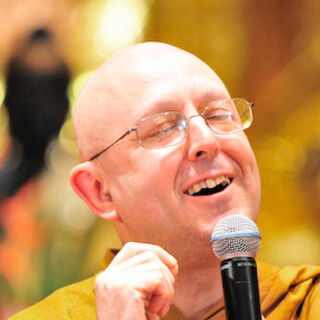
Welcome to the ongoing meditation class.
For those who come to the introduction to meditation class,
Where we learn the basics of meditation,
That's being held in the room to my right.
This class is the ongoing class of people who have learned the basics,
Who want to proceed further with their meditation.
And the major difference is that in this class,
We sit for about 40-45 minutes,
Which is a longish time.
So those people who have just started meditation,
40-45 minutes is a long time for the beginning.
So those of you who come for the first time to the introduction to meditation class,
That is in the room to my right.
Sometimes all of the success in meditation can come down to one's attitude.
What is the underlying theme of the meditation?
And if you have the attitude right,
The underlying place or goal correct,
Then it makes the meditation far more successful.
One of the similes or metaphors which I've been using over the last couple of months is a simile going back to a very old metaphor of life being a journey.
And understanding that one's life is always going on to the next thing,
Always moving on to something new,
A new attainment,
A new goal,
A new thing to achieve.
Whereas what meditation is,
It's not achieving something new or something more,
It's like finding this bench on the journey of one's life and stopping and sitting down on it.
It's not going anywhere,
Because going anywhere just continues the agitation and restlessness of the mind,
Which is what we're supposed to be calming down in this process of meditation.
But instead of trying to go anywhere,
It's like sitting down where we are,
Resting in the moment,
Just being here.
In fact,
I often say that meditation is learning to be more fully where you already are,
Deepening that experience of being where you are.
It is literally a stopping of the mind,
A stopping first of all in time,
Because you can understand how the mind moves backwards and forwards in time,
Planning the future and recording the past.
And that's very important in other times of one's life,
When one is journeying,
But in the time one wants to just sit down and rest on this bench by the side of the path called your life,
We have to learn how to let that go,
To resist the temptation,
To plan,
To expect,
Anticipate the future,
And to avoid all of this bringing up what's already gone past.
The past is literally the dead moments,
And if we think of the past,
It's just like carrying the coffins of those dead moments on top of our head.
So instead of carrying the coffins of the past,
We put them aside,
We leave them alone,
Because we don't want to stop this travel through time,
Stop travelling in the past,
Stop travelling in the future,
And we stop where we are,
Which is this present moment.
It takes quite a lot of skill to stop in the moment.
The reason is because we are not used to that.
In so much of our life,
We always had to plan or to figure out what went wrong in the past,
But in meditation,
We are doing something completely different.
We just stay where we are.
So understanding that this meditation begins with stopping in this moment,
Should make it quite clear you are not going to aspire for something in the future.
You are not going to some peaceful,
Ecstatic,
Nibbānic state of mind sometime in your future,
Later on in this meditation.
One should never just move the mind to that sort of goal.
Instead,
The mind should always be moving into where you already are now,
Not anticipating,
Expecting or planning,
Because that's never going to give you any rest or peace.
It's actually staying put where you are,
Stopping in time,
In this moment.
Once you get the hang of how to stop,
How to stay still in this moment called now,
It becomes a very useful aptitude of the mind,
Which you can employ at any time,
Even for those people who suffer from insomnia.
I'm not quite sure why,
But just recently,
Quite a few people have come up to me and said they find it hard to sleep at night.
And you don't have to have that anxiety and the problem of must get to sleep,
Must get to sleep.
So often just developing this ability to be in the present moment,
To stop in this passage of time,
Just to be here now.
When you are in this moment,
Who cares about the future,
About whether you are going to get to sleep or not get to sleep.
It's in this present moment when you stop the journey through time,
And all anxiety,
All worry,
All concern disappears.
The present moment is here.
It's only the future which creates this worry and this burden,
And this anxiety and the tension of life.
So please don't be anxious about your meditation,
How many minutes there are to go,
What you are supposed to do next,
What's going to happen next,
How are you going to plan it all out.
Please don't do that,
Stop.
Stop in time.
The next thing we do is stop this thinking mind.
I would call it the thinking mind but maybe we should call it the measuring mind.
Always assessing how you are doing,
Measuring other people,
Measuring yourself,
Measuring the place you are in,
Measuring your progress.
Because when you stop measuring things,
There is nothing much to say.
The rest of language being descriptive is measuring and comparing.
But when we stop all of that,
Whatever moment we are staying in,
There is nothing much to say about it.
This is learning how to experience life rather than describing it with words.
It's like tasting the food rather than reading the menu,
Like looking at the stars at night without knowing their names.
It's a completely different experience just to know without words.
If you want to test out what I mean,
You can just be aware right now of the feeling in your buttocks pressing against the chair or the stool.
I use that example because I'm looking at an English dictionary,
I've never found a word to describe that feeling of a buttock pressing against the chair.
I have a feeling without a name and so much more of life.
There are experiences which haven't been named yet.
Why do we want to name them anyway?
We just stay with the experience.
And in that experience without the words,
Without the descriptions,
Without the measuring,
We are stopping,
We are stopping this movement of the mind which tries to describe and capture things.
We know without the description.
The mind stops moving.
So we stop.
We stop this inner conversation and instead we feel life,
We hear life.
Sometimes I've called this waiting in the moment.
In the same way that you wait for something to happen because you're waiting for it to happen,
You're alert and you're empty.
The same way that in this silence,
Just waiting in this moment,
We're not putting in any conversation or description which might block the reality of now.
We're just here,
Fully alert,
Waiting silently in this moment.
This is stopping the mind.
However,
Because you have five senses in this underlined sixth sense of the mind,
Those five senses are the nature of you to go from one sense store to the next sense store,
Listening to things,
Feeling the body.
There's many things to experience in the world of sound and touch.
And to stop the whole process even further,
We focus on one tiny part of the five sense experience.
You usually choose to watch the breath,
The sensation of the air coming in and out of our bodies.
Focusing on that so that we can stop the mind jumping backwards and forwards to an itch on the nose or an ache in the legs.
You'll find if you learn to focus,
It's the nature of focusing,
That everything other than the object on which you focus tends to disappear.
That's the same way when a person is reading a book,
And they really get into that book,
All the rest of their surroundings disappear.
They forget time,
And they forget the ache in their legs or the fact they need to go to the toilet.
When you're really into that book,
Turning page after page,
You can't feel anything else.
You're just right there with the storyline of that book.
That's what happens when you focus.
Focus on one thing excludes everything else.
Until time comes,
That's all you have.
Just the book,
The movie,
Or in this particular case,
The breath going in and out.
You're stopping the mind from going backwards and forwards.
And as you focus the process of meditation,
The inward path going more and more into the centre of things starts to roll forward with its own momentum.
Of course you can only focus,
The reason why people find it hard to focus on things is because there are too many distractions.
You can only focus on the breath successfully if you spend sufficient time in present moment awareness and silence,
Which is why I put so much emphasis on those two stages.
Develop the stopping in the moment,
Develop the ability to know something,
To experience it without having a conversation about it.
And then when you watch the breath,
It's quite easy to do.
The main obstacles to watching the breath,
Planning and remembering,
As in a commentary called Thinking,
Have been removed,
At least mostly removed before you start watching your breath.
And then the breath is clear,
The mind is reasonably still and it's easy to do.
And then because of your focusing,
You're building up the energy of the mind.
It builds and builds slowly until the breath becomes very beautiful,
Very peaceful and still.
You're stopping many things.
And within that stopping,
There is a peace.
And in that peace,
There is the joy,
The happiness born of peace.
The clear awareness and alertness of the calm,
Silent mind.
So that's how we meditate again.
Remembering to stop,
Stop going somewhere,
Stop trying to get somewhere,
Stop going on to the next thing,
Instead of being in this moment,
More fully in this moment,
In silence and then focusing on the breath.
That's this meditation path.
Okay,
That was just the introduction to get you started.
And many of you have already meditated,
So you can just carry on.
For those of you who haven't adjusted their body yet,
You can close your eyes and get your body in the meditation posture so we can start the actual practice rather than the introduction to meditation.
Okay.
And with your eyes closed,
Making sure your body is comfortable first of all,
With caring attention,
A combination of mindfulness and metta,
Loving kindness.
Just on your body.
Okay.
And don't rush the body awareness.
Okay.
Okay.
Okay.
Okay.
Okay.
Okay.
Okay.
Okay.
Okay.
Okay.
Okay.
Okay.
Okay.
Okay.
Okay.
Okay.
Okay.
Okay.
Okay.
Okay.
Okay.
Okay.
Okay.
Okay.
Okay.
Okay.
Okay.
Okay.
Okay.
Okay.
Okay.
Okay.
Okay.
Okay.
Okay.
Okay.
Okay.
Okay.
Okay.
Okay.
Okay.
Okay.
Okay.
Okay.
Okay.
Okay.
Okay.
Okay.
Okay.
Okay.
Okay.
Okay.
Okay.
Okay.
Okay.
Okay.
Okay.
Okay.
Okay.
Okay.
Okay.
Okay.
Okay.
Okay.
Okay.
Okay.
Okay.
Okay.
Okay.
Okay.
Okay.
Okay.
Okay.
Okay.
Okay.
Okay.
Okay.
Okay.
Okay.
Okay.
Okay.
Okay.
Okay.
Okay.
Okay.
Okay.
Okay.
Okay.
Okay.
Okay.
Okay.
Now I suggest you just look at the quality of your mind,
How much peace,
How much freedom,
How much inner happiness is in your mind right now.
To know where this has come from,
How by stopping,
Not going anywhere,
The energy of the mind increases.
And with it comes the peace,
The freedom,
And the happiness we call peace of mind.
Now I'm going to ring the gong three times.
Please listen to every sound from the gong.
And only after the third sound has disappeared,
Only then come out from your meditation.
GONG GONG Here we go,
The joy of stopping.
You'll probably realize from your own meditation,
The more we try and control and do and make it happen and try and get somewhere or try and get rid of things,
The more that we keep screwing up our mind,
The more business we have,
The less peace we'll experience.
Instead of trying to settle the business first of all,
Get it all right,
Get it all fixed up and then we'll be at peace,
We say no.
Peace can only happen now with what we have.
So we develop this mind which can stay still because we embrace this moment.
You're using that simile of the bench by the side of the road and your job is to notice that bench and just sit down on it to stop the journey of life.
Sometimes when you first sit down on the bench,
It's cold and hard.
In other words,
The present moment is not always attractive.
Sometimes it's the sound of dogs,
Sometimes it's the pain in the body,
The aches.
But this is all we have to sit down on,
This present moment.
So we accept this moment for what it is without complaint.
We realize we can stop here.
We don't have to go somewhere else,
More comfortable,
More silent,
More conducive.
This moment is good enough for us.
So we sit down in this moment which is good enough.
This is a metaphor in our mind.
We sit down,
We stop,
We remain here.
And in the way of meditation,
Using that metaphor of the stone bench,
The longer you sit on it without moving backwards and forwards,
The softer it becomes.
The stone becomes like upholstery and upholstery becomes as soft and as smooth as you could ever want.
When you stop in the moment,
The moment stops with you.
And this moment becomes one of the most beautiful things you ever experienced.
Peace,
Stillness,
Stopping,
It's happiness.
You realize that all of the work we have to do in life,
I don't mean what you do in your office or in your trade or place of employment.
I'm talking about the work of life,
What drives you from moment to moment,
Day to day,
Makes you get up in the morning and move and work and do things,
And which makes you think and plan.
All of that can stop in this meditation.
You're not going anywhere.
You're not trying to achieve anything.
You're not wanting anything.
You're staying here and realize in stopping in this moment,
The most peaceful,
Beautiful place,
It transforms.
So one doesn't really need to make the meditation work.
The more you try and make it happen,
The less likely it is to be peaceful.
When you get this understanding,
Meditation will become so simple,
So easy.
It doesn't matter what you start with,
What mood you're in,
Even what state of physical health or sickness.
You just stop there.
You stop there with what you're experiencing.
And the stone bench becomes the most beautiful divan.
This moment changes because you are still.
This is a way of peace.
When you equate meditation with peace of mind,
It's obvious you cannot create peace with all this striving and agitating and fault finding and trying to make it different.
The only place you can find that peace is with what you have.
In the place you're sitting now,
With the noise of the dogs,
The sunshine,
The cold,
Whatever you have,
The cough,
To be able to be at peace with this by not going anywhere,
Abandoning all concepts of time,
No future,
No past,
No minutes,
No hours,
No days,
No years,
No centuries.
And abandoning this thing which we always try and capture reality with our words,
And then it will go.
.
.
Shhh.
And in that way,
The mind becomes still.
So training to be done is not easy at first.
But the more times that we talk like this,
The more likely it is that the message comes.
The penny drops as they say,
And the mind can turn to that peace,
That quietness and stillness.
And enjoy the meditation to the max.
This is actually how we go inward,
Into the stillness of the mind,
By not making it move.
Are there any comments or questions about all of this?
Yes,
Go on Chris.
No,
I think a lot of experiences,
Which is specific experiences,
Mean that you are alive,
In danger,
And you describe how things,
Which is very interesting,
Like this video,
Meditation in your mind,
Is very easy to see,
It's that special moment,
Showing up on the horizon,
And the rest of you,
Just wiggle away,
And it feels good,
And it's very great.
There is the light that drives the light,
And the other is one that is very interesting,
Especially in the meditation,
When you are experiencing the light,
The light is just moving through your head,
And you're experiencing it.
You're saying when things are really going well in your life,
You're having a good time.
You've been there many many times,
It's not going to last.
Be careful,
You're heading for a fall,
When things go really well in life,
Everything is just nice and rosy,
At last I've got it right,
You own your success,
That's the problem.
And then when things disappear,
When the success goes all pear shaped,
When your partner comes up to you and says,
No I don't like you anymore,
I found another guy,
Or when you solve your business,
Stock market plunges.
Whatever happens,
You know that's always coming,
So you should never look for your happiness in things which are uncertain,
Impermanent,
Not belong to you.
You don't own that happiness,
The world you've lived in that world long enough to know it's changeability,
Things go well for a while,
Then they go badly,
Then they go well again,
Then they go badly,
Welcome to life.
So after a while be careful of the delusion of success,
It's completely temporary.
If you buy into it too much and think that it's because of you,
When you own your success,
You'll tend to own your failure as well,
Which makes you very depressed and very anxious.
So instead we just don't own anything,
That's our escape.
Success has nothing to do with me,
Failure has nothing to do with me,
But the peace,
The attitude has everything to do with you.
You can use meditation on death,
But just use your reflection on your life so far.
Gee,
I've been here before,
And every time I think I've got it,
It all falls apart.
Every time I think I'm healthy,
Then I get sick again.
Every time I find that magic bullet,
The perfect partner,
The perfect medicine,
The perfect sort of whatever,
It all falls apart.
The nature of things,
So when we look at that impermanence,
Insubstantiality,
The fact that whatever happens is out there,
Is very very fragile.
Death is only one aspect of that fragility,
So the passing away is the other aspect which is more important.
So people are always looking for some sort of certainty,
Some security,
Some place where they can really trust there'll be a peace and happiness and fulfilment,
Which doesn't pass away.
And that's actually what you touch in meditation.
Because it's a peace,
One of letting go,
One of getting things,
Achieving things,
Being at peace with wherever you are,
Whatever you're experiencing.
See because it's independent of where you are and how you're feeling,
That's why it's stable.
Any sort of happiness which is dependent upon others,
Or dependent upon the stock market,
Or depending on your footy team winning,
You know it's not going to last.
Successful people are the ones who get the most depressed.
They've been successful and they get the illusion it's because of them,
How good they are,
How smart they are,
How clever they are.
When it all goes wrong,
What did I do wrong?
When did I make the mistake?
You didn't make any mistake,
You didn't do anything wrong,
You're part of life.
It wasn't your success anyway,
No it's not your failure.
It's life.
So I do the reflection on impermanence and also the non-self,
Nothing to do with me.
Not my business,
That's one of the reflections which I was teaching last week.
When you meditate,
No matter what you're experiencing,
Not my business.
Experiencing a thought,
Not my business,
Nothing to do with me.
Dog's barking,
That's not my business.
Someone coughing,
That's not my business.
Getting enlightened,
That's not my business.
Never happens,
Not my business.
It's not your business,
You ignore it.
It's not my business,
You've got nothing to do.
You've got an ache in your leg,
Not my business.
So you let go.
It is wisdom arising,
First of all it's just,
Sometimes it's initiating that wisdom,
Reminding yourself,
This is just nature.
It's the nature of the dog's debacle.
I've never seen a dog yet which is absolutely silent.
I've never known a body which is perfectly healthy without pain.
So any knee aches,
That's what knees do.
That's what dogs do.
People hear that,
They cough.
There we go.
It's the nature of things.
It's not my business,
I can't control these things.
When you say not my business,
It's like a cure to theatre when you forget your lines.
You say,
Yeah,
Remember it's not my business,
I don't have to worry about it.
So my question is,
We've always talked about wisdom,
Last night we talked about having compassion without wisdom.
I'm trying to explain how wisdom arises.
Wisdom actually first arises from stillness.
When you're still you see deeply.
When you're moving,
There's too many things going on,
You can't see deeply into anything.
You're too scattered.
So wisdom comes from stillness.
This is an old wisdom.
Sometimes it's a wisdom which you read in the books,
Maybe you've experienced some of it yourself,
But you're just reminding yourself.
Look at this moment as if it was not your business,
As who happens.
You get peaceful.
If anyone wants to know,
That was the,
Not the essence,
But that was one of the most essential teachings of the second sermon of the Buddha,
The Anathalakkhana Sutta.
Five candas,
Not my business.
Which means that the five monks who first heard that all got enlightened.
The first people who got enlightened after the Buddha.
Not my business.
Isn't that wonderful?
I've got nothing to worry about.
Ah freedom at last.
I.
.
.
Good.
Now as you see that sounds like a nimitta experience starting to come.
These colours which arrive in the mind,
Really very peaceful and still.
I see these colours,
Just the mind is becoming bright and the breath has done it strong.
Coming to the realm of the mind.
It's not a distraction,
But you just allow the mind to do what it needs to do.
That's how you just watch,
It's not your business.
So just,
Yeah,
Then it stays.
If it becomes your business,
You tend to interfere with it.
And when you interfere with it,
You make it much worse.
So not my business is a nice little thing to remember which keeps everything nice and still.
Yeah.
It's good because Australians especially love being lazy.
This is a wonderful thing,
Being lazy,
Not my business,
The meditation.
Oh isn't it great,
Sit there and just not my business.
Have a great time.
This is real laziness.
People really want to know how to be lazy,
Poppy,
Sit there,
You don't even think.
You don't even do anything.
That's real laziness,
That's enlightened laziness.
But now when you come out of meditation,
You got to do things.
So now it is your business,
It's my business to end the meditation,
To bow three times and to let you go.
So let's end the meditation now.