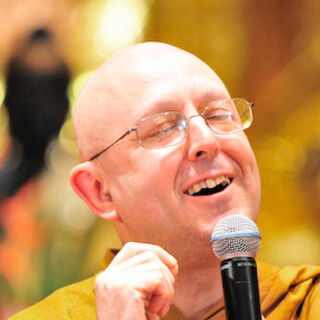
So good afternoon everybody.
As you see that I have a very deep throat and I found out the cause of it half an hour ago.
It's the pony virus.
The pony virus,
It makes you a little horse.
For those of you who have already had enough of the bad jokes,
The introduction to meditation class is in the room to my right.
So those who come to learn meditation for the first time,
You'll find that class is in the room to my right.
So this is the ongoing class where we meditate for about 40,
45 minutes.
And we usually just go a little deeper into the meditation.
And as we go deeper into the meditation,
This is the same practice to start off with.
You learn how to be still by letting things go,
Putting them down so that life is nice and easy and peaceful,
At least during a meditation.
It's learning how to rest the body and let it go.
Rest the body and learning how to rest the mind.
And when you're resting the body and resting the mind,
It's not a case of going to sleep because a lot of times the sleep process,
You've already slept enough,
And what happens is when the mind gets really peaceful,
It gets alert,
It gets awake,
Which is a wonderful process to be part of.
So you get energy coming into your mind,
You get alive.
And so that when you get alive,
You become much more aware of your body and much more aware of your breath and much more aware of everything.
So it's the case that when you start meditating,
You do the best you can to be still,
Just to relax the body and then to relax the mind.
There's still some of the reasons why we keep thinking of the past and the future,
Even though the past and the future have got nothing to do,
You know,
With what we really are here for.
We're here to take some time out,
To relax,
To get some peace in our mind.
So what happens is as we get a little bit more peaceful,
We become more aware and we can see the reason why we think.
And a good example of that is that,
Oh,
For those people who meditated and you start to watch your breath at a certain stage,
Sometimes when people started to be aware of their breathing,
Breathing in,
Breathing out,
Breathing in,
Breathing out,
Sometimes it got to the case that you're always wandering off and then you bring the mind back again,
It wanders off,
Bring the mind back.
And that became just repetitive and counterproductive.
So what happens is sometimes you get into more peaceful meditation and then you can see why,
Why does the mind wander off,
Why can't it stay with the breath?
And for the first thing is,
You often haven't prepared ourselves enough yet.
We've been too busy thinking too much or too many things going on in our life,
We haven't put things down yet.
So first of all you get wise to the fact that preparation is important.
You make sure that you're sitting comfortably,
Not too cold,
Not too hot,
It doesn't really matter if it's on the floor,
You can be leaning back against the chair or against the wall or however you can put your body within reason so that it's comfortable because if the body is not comfortable you can see that disturbs the meditation.
So you see the importance just of a comfortable body.
Once your body is comfortable then again a comfortable mind.
If you go on to something like the breath too soon you have to hold it there because the mind is still worried about past or future,
About the election or about the Waisak ceremony tomorrow,
Which is by the way something which no one in their right mind should ever miss,
A beautiful wonderful occasion tomorrow.
And if you don't want to come to the Waisak tomorrow there's always a Waisak one day retreat here run by the nuns which is on Monday,
Which is a lovely place to come and do some more meditation,
And that's to be run by Ayahasapanya.
So,
But instead of thinking about the future like that,
Instead we put the future down,
Put it down,
Leave it alone.
And the past,
Put the past down,
Leave it alone.
So sometimes you've got to focus on that before you even start to watch the breath.
And you notice when you're aware enough preparation is really important.
Even as a Buddha said,
You give mindfulness,
The awareness,
So much importance before you even go and try watching things like the breathing.
So once you get the mind all comfortable and reasonably peaceful sometimes it's good to grant yourself permission to be peaceful.
Because sometimes people in our Western world feel guilty that they should be going and doing something,
Something really important.
You've got to call your father or your mother because they may be sick or you've got to worry about,
There's an endless amount of things to worry about.
But you grant yourself,
Doesn't matter,
Leave it alone,
She'll be right.
Just let this moment be and trust that with you here,
Just being here,
Is one of the best possible things you can ever do to create peace and happiness in this world.
What was it years ago?
There was a young mother who came and told me that she tried to meditate at home but every time she tried to meditate she sat down,
Her two young kids would shout out,
Mummy,
Mummy,
I need a glass of water.
Mummy,
Mummy,
Johnny needs to go to toilet.
Mummy,
Mummy.
And so she'd always try and avoid and just resist that temptation to look after her two little kids.
And if she didn't sort of get up and the kids only wanted attention,
They would crawl all over her and pour her her,
Mummy,
Mummy,
Mummy,
No,
Johnny needs to have a poo,
No never.
And then she just sat there,
Realising her meditation was more important.
But then the kids took it to a whole different level.
She told me,
It's amazing,
There's only about four or five year old children,
Just the inventiveness of a kid.
Mummy,
Mummy,
Carol's got out the kitchen knives.
Mummy,
Mummy,
Johnny's turned on the gas.
But mummy just sat there with the resolution,
Even though Johnny cups up her sister with the kitchen knives,
Even if a Carol just blows up our house,
It doesn't matter,
I'm going to meditate.
So she just sat there.
And of course,
She was really good that she could even just sit there and not worry about anything,
Just causing the bluff of fear about the future.
She meditated about half an hour,
She told me,
And when she opened her eyes,
The kids were all in one piece.
They hadn't sort of cut each other up with the knives and the gas wasn't turned on,
The house hadn't blown itself up,
The two kids were just playing quietly in the corner.
And she knew from that,
That that is an extreme of children trying to grab your attention so you can't find any peace.
There's all sorts of other stuff in your mind,
Come on,
Do this,
Come on,
You have to meditate,
Come on,
You can't meditate,
You have to do something else.
All those plans and worries,
She decided,
No,
I'm going to meditate and I can deal with those afterwards.
And that's what she did and found it was fine.
And from that time on,
She was free.
And the kids saw her sitting down to meditate and they realized,
Mom is having her time now and she deserves her time.
So she could sit down and the kids were just amused themselves without any problem at all.
That is the same with our mind.
We have to have that sort of strength and trust,
Not to follow fear,
And say,
Oh,
If I don't do this,
I don't sort out this problem,
I don't think about this,
I don't think about that,
It's all going to go wrong.
Leave that alone.
And instead,
We just stay in this moment.
And after a while,
We can trust that letting go is not irresponsibility,
But letting go is one of the wisest and most effective things we can do.
It re-energizes us,
It gives us our own time,
Real precious time,
Where we can find out about our body,
Relax it,
Find out about our mind,
Free it,
And get some energy and perspective up.
So that's one of the reasons why,
That if one can deal with the body and the mind and the worries and the fears first of all,
And to get the mind peaceful,
Reasonably peaceful,
Not deep peace,
Then it's easy to watch the breath.
Watch the breath going in,
Breath going out.
And the next thing with the meditation is to give it some joy.
Because I was telling people in Indonesia where I got my cough from,
That when I was first year as a monk,
We used to meditate one day a week,
We used to meditate all night.
I got to about 10 or 11 o'clock and I was tired.
I was really tired and I thought,
This is just ridiculous because only 12 months previously,
When I was still a lay person,
I was going to all night rock concerts,
All night parties,
And when you're going to like a party or a rock concert,
You don't feel tired at 11 o'clock or 12 o'clock as a 22 year old young man,
You're just really getting into it.
But why is it that now I'm meditating,
It's only 11 o'clock,
I'm really tired?
What's the difference?
Of course the difference was that you weren't enjoying it,
It wasn't engaging you.
Rock concerts,
Of course you're getting engaged.
And not so much in parties,
I wasn't getting engaged because I was afraid of that part of the relationships,
But I was certainly involved.
But when it came to the meditation,
There's not enough joy in it.
And so that's where you start looking for the joy and the happiness,
The peace of meditation.
And one of the things to do is to be mindful,
To notice things which are missing when you're meditating.
Not what you have there,
But what's missing.
So for example,
When I am meditating,
Getting some nice and peaceful and deep,
What I'm missing,
What's not there is having to give talks.
Yay,
I'm free.
I don't have to ask questions,
Yay,
I don't have to ask questions.
I don't have to make decisions,
Yay,
I don't have to make decisions.
There's a lot of work and busyness which I don't have to do,
Which is wonderful.
So you can just sit there and nothing to worry about.
That by itself is a sense of freedom.
So I'm grateful for what I don't have to do when I'm meditating.
I don't have to prove anything to anybody.
I'm in my own little world,
Just peacefully just watching the breath go in,
Go out.
There's nothing to worry about in the whole world.
If you can recall that when you're meditating,
What happens is you appreciate it.
Yeah,
You know,
I've got a small cough at the moment,
That will soon go.
I always remember what Ajahn Chah said,
Either you get better or you'll die.
But either way the cold goes,
It's only a joke,
I'm not going to die.
People here won't let me.
But anyway,
We've got a defibrillator now in the Buddhist Society.
So they haven't tried it yet,
You know,
Defibrillator.
So if anyone wants to try and have an out of the body experience,
Which is really cool,
You know,
We've got a defibrillator.
Where's Bill?
Is he around?
Okay,
I'm only joking,
So don't sort of take away the sewers or something.
But anyway,
When we just realize how little we have to worry about in meditation,
It gives us a sense of freedom.
Like when you're sick,
Have you never noticed the time you feel the healthiest is after you've just got over a sickness?
Because you just have something to compare it with.
We take health for granted because we forget what it's like to be sick.
So just after a sickness has disappeared,
That is when you appreciate,
Wow,
This is so nice to be healthy.
In the same way that once you remember just how far you've come away from busyness,
You have a peaceful mind,
You really appreciate peace.
You don't take it for granted,
It's wonderful,
It's lovely.
So that means you enjoy the peaceful mind.
Just all you have to do in the world,
You just watch the breath go in and the breath go out.
Because once that delight starts to come up,
The energy starts to come up,
It's interesting,
And it's better than a rock concert.
You know,
I used to,
As a young man,
I used to like loud music and later on you used to like softer music,
Classical music.
Then later on you just liked to listen to the sounds of nature,
Like the wind in the trees or the sound of like a stream after a heavy rain.
And later on you started to go into even more silent sounds which were even more delightful.
And eventually when all the sounds stopped,
The stillness,
Which was to me the most beautiful music,
And going out into the bush and nothing moves,
Everything is so still.
Little by little you appreciated the finer parts of music and I could never get further and beat the stillness and the disappearance of sound,
That was the best.
But only if I could appreciate the disturbance and the irritation which had now vanished.
The same when you're watching the breathing,
Everything else has vanished.
It's like you're in your own little cave in the bush,
A place of silence and peace when no one is asking anything of you.
No one is harassing or disturbing you.
It's right inside in your meditation,
Just watching your breath.
So I really appreciate it.
When I appreciate it and value it and see the delight in it,
Then it stays,
Stays for long periods of time and grows and develops.
You have a wonderful time,
Which is of course what we wish for all of you in meditation,
A wonderful time.
So okay,
So I've talked enough.
So now if you'd like to get into your meditation posture,
Whichever that happens to be.
Bring your attention to your body first of all.
With my body,
I just make sure by scanning the body,
Sweeping up from the toes to the feet,
Just making sure everything is in its proper place.
And it's not going to cause me discomfort.
Even my butt,
Sometimes it gets sore if I don't position it carefully at the beginning.
And then my waist,
Push the waist in and just stretch,
Curving my back enough to get this rush of endorphins.
The stretch delight.
Relaxing my shoulders.
Checking that my hands are comfortable.
The neck is well balanced,
Rather the head well balanced on the neck.
And checking my throat.
Just making peace with it.
Being kind.
And checking my face,
Relaxing the muscles around my eyes and my mouth.
My whole body,
Here I've got irritated throat,
But it's only one bad prick in my wall.
The rest is fine.
So I delight in a relaxed body.
And I check my peaceometer.
How peaceful am I?
Or how agitated?
Giving it a number from one to ten.
One meaning very peaceful,
Ten meaning really agitated.
I observe like the needle of the peaceometer as it goes up and down.
I find out the causes.
Why does my mind get disturbed?
What lets you become peaceful?
When I die for my sins while you they die,
What makes your soul hold up for good?
.
.
And as you become peaceful,
Usually the breath comes to you.
If you are aware of your breathing,
Just make it interesting,
Breathing in peace,
Be that out echo.
Just keep in mind all the things which are missing,
All the things you don't have to do.
Just like you're simplifying this moment to the maximum.
Nothing else to do or worry about,
Except just breathing in,
And breathing out.
.
And don't worry what other people do.
Remember that amazing woman had all these threats to her little children.
She could hear them,
But she paid them no attention.
This was her time,
Just being with her breath,
From the beginning of an in-breath to the end,
And the beginning of an out-breath to ascend.
I'm now going to be quiet,
And turn off the microphone until close to the end of the meditation.
.
.
.
.
.
.
.
.
.
.
.
.
.
.
.
.
.
.
.
.
.
.
.
.
.
.
.
.
.
.
.
.
.
.
.
.
.
.
.
.
.
.
.
.
.
.
.
.
.
.
.
.
.
.
.
.
.
.
.
.
.
.
.
.
.
.
.
.
.
.
.
.
.
.
.
.
.
.
.
.
.
.
.
.
.
.
.
.
.
.
.
.
.
.
.
.
.
.
.
.
.
.
.
.
.
.
.
.
.
.
.
.
.
.
.
.
.
.
.
.
.
.
.
.
.
.
.
.
.
.
.
.
.
.
.
.
.
.
.
.
.
.
.
.
.
.
.
.
.
.
.
.
.
.
.
.
.
.
.
.
.
.
.
.
.
.
.
.
.
.
.
.
.
.
.
.
.
.
.
.
.
.
.
.
.
.
.
.
.
.
.
.
.
.
.
.
.
.
Getting close to the end of the meditation.
How do you feel?
How was that?
What were you free of during the 45 minutes?
How does that feel for your body and for your mind?
Where we appreciate the freedom and peace which meditation offers us,
It allows the meditation to go deeper.
How about now,
Bring the gong.
Very good.
That was nice.
Okay,
There are some questions.
First of all from overseas.
From Germany,
What is the best way to meditate when the body is sick?
Focusing on the stillness is hard to do when the body is irritated.
Then focus on irritation.
As I mentioned last night,
Apparently the internet didn't work for some places.
So whatever is in front of your mind right now,
When you are sick and ache,
Pain and irritation,
That's your meditation object.
It's happening now.
Don't try and get rid of it.
Don't indulge in it.
It's here.
Be with it and then care for it.
When you care for it,
It just tends to vanish.
What is the meditation of release and how to do this?
And how you,
Actually I have another question afterwards.
How can we meditate a full day without having to pee?
So that's too different.
Don't do the meditation on release if you're having to pee.
Meditation of release,
Freedom.
Get some idea of what freedom really is.
Release your mind from the past and the future.
Release your mind from the prison of thought.
Thought isn't freedom.
It encases you in worry and doubt and memories and judgments.
So see if you can release yourself into peace and stillness.
And then you go deeper into release.
Freedom of want.
Not wanting anything in the whole world.
Free of all wishes and desires.
Go to that meditation first of all and see just how liberating it is.
And all those things one thought,
One needed.
One didn't need them.
One wanted them.
So see the difference between need and want.
Just see how little you can possess.
And a full day without having to pee.
If you are full,
Then you're going to have to pee.
So don't meditate a full day.
Meditate an empty day.
The whole idea,
A full day,
Are you trying to break a record?
Are you trying to surpass your personal best?
So instead of doing that,
What one does is just hit the moment.
And if you need to go to toilet,
Off you go.
Because even the last range retreat,
There was a retreatant at Bodhinyana monastery.
And she was meditating two or three hours at a stretch.
And we thought she had a stroke.
I wasn't there at the time I was in Bodhinyana monastery or retreat or something.
And what happened was they took her to the hospital just in case.
And they found it wasn't a stroke that she had,
She'd been dehydrated.
Because she wanted to meditate a long time and she didn't want to have to get up to the toilet to urinate.
So she thought the best way of not urinating was actually not drinking.
And of course that's really bad for your health.
So there's really some silly things which people do thinking that's how to meditate.
So if the body really gets still,
Really gets peaceful,
Then it's fine.
It looks after itself.
But don't force it.
You can drink whatever you need to drink.
Enough water and so you don't get dehydrated.
So how can you meditate a full day without having to pee and get into deep meditation and jhana?
And it happens naturally,
Fine.
But don't force it.
If it comes from your sense of self and ego trying to force it,
Trying to make it happen,
Again trying to attain or achieve something,
It will never work.
I always recall the words of Maiti Jirajan Jha who keep on saying this again and again and again.
We meditate not to attain.
We meditate to let go.
Very good.
So any questions from the floor here?
Anyone here?
Anyone from the floor from the chairs?
It's a bit higher.
No?
Yeah.
Where?
Okay,
How are you?
Can't see you because of the.
.
.
Yeah,
Hello.
I was actually going to ask you this question afterwards.
I'll ask you now.
Other people I find interesting.
Yeah,
Look,
Actually two weeks ago I was here and you mentioned that meditation isn't about concentrating.
It's about letting go.
And prior to being here two weeks ago,
I've always,
You know,
When I've done meditation,
I've always focused on the breath coming in out of the nose.
So over the last two weeks at home,
What I've been doing when I'm meditating and thoughts arise,
I tell myself to let go now.
But I find myself then I just go back to focusing and concentrating on the breath.
So it's like I'm sort of in a wishy-washy state here where what I'm doing in the meditation is a blend of focusing and concentrating and also letting go,
If that makes sense.
I feel like I'm letting go and also concentrating at different points in the meditation.
It's the habits of the mind.
If one is being trained in that way to concentrate,
Then that's almost like a default position for your mind,
Habitual position.
But once you notice that,
Once you are mindful that you are concentrating,
And concentrating does mean force,
And you realize that it feels unpleasant and it sort of usually hinders any progress.
So after a while,
One notices all this concentration.
And if it's at the beginning of a meditation,
It's not so harmful.
But the deeper you go into peace,
The more you really need to let go more and more and more.
So it's a retraining,
A recalibrating of the mind and its responses.
So it is for a human being who's maybe achieved a lot in life and whatever they've achieved is through hard effort.
The whole idea of letting go,
Of not concentrating,
But letting the mind settle,
Is a totally different ballgame.
It does take a lot of trust to actually try to let go.
Sometimes your breath is not at the tip of the nose.
If it happens to be,
They're fine.
But you don't watch the tip of the nose,
You watch your breath.
So sometimes I was fortunate because I do have allergies and had hay fever,
My father had asthma,
And so that sometimes I could not watch the breath at the tip of the nose.
There's no breath coming out there.
My nose was blocked.
And that was a great benefit.
Well sometimes people call it like an affliction,
Sometimes you make use of,
And you realize you don't need,
I'm still breathing.
So where was my breath?
And every time I tried to force it,
I found the breath became unnatural.
And it wasn't pleasant,
When I just let go and allowed the breath to come to me.
So these are things,
Experiments,
But give it time.
Yes,
So it's not so much focusing and concentrating,
It's literally just awareness that we need to be conscious of,
Just the awareness of the breath.
Because a lot of the time,
Even when I've read books,
They say to focus on their breath.
But I guess focusing and concentrating are synonymous with one another,
So you would say not to even focus,
Just be aware.
Just be aware.
And the breath just comes to you,
Instead of you just going searching for it.
Yes,
Yes.
You know what it is sometimes,
If somebody goes searching for you,
They grab you in and tell you to do this and tell you to do that,
After a while you rebel.
And that's what the breath does.
Is there a difference in meditation techniques between the Theravada and Mahayana traditions?
Because they have a technique called single-pointed concentration.
That's one of their techniques.
Yes,
What is,
There is only,
Doesn't matter if you are a Mahayana or a Christian or a Tibetan or a Bhutanese,
The human mind is the same.
So the different techniques of meditation are just,
There is no different real techniques of meditation,
Because we're all dealing with the same mind,
The same sort of,
If like,
Organism.
And you just find,
Just little by little,
A lot of the time with focusing and concentration,
It's just really poor translations.
And so it's very wonderful to,
Sometimes you get very frustrated.
You do everything and you just do it all the right way,
And then you find it's not working,
And then you come across someone like an Ajahn Chah,
Who didn't study that much,
But had a great insight into the nature of his mind.
And once you were with him,
And you realized just how he was meditating,
And the wisdom which came up,
And then you went back to the books.
And of course,
Being a Westerner,
Not sort of like a traditional,
Please excuse me,
This is stereotyping,
Asian Buddhist,
You don't believe your teachers,
You argue with them.
That is a no-no in Tibetan tradition,
In Chinese tradition,
And even in just many other Chinese traditions.
What your teacher says is almost like coming from the Buddha.
So it's marvelous that we have a time now,
When people from different sort of cultures look at this Buddhism,
And they sort of take it much deeper.
They can argue.
It's one of the reasons why,
Just we have nuns now,
Fully ordained bhikkhunis,
Teaching at an equal level.
We do that because we look at what the Buddha said,
Or we argue with the teachers.
So thank you for discussing this.
I don't believe what I say.
No,
I believe it.
I'm just curious.
But that makes me answer.
Thank you very much.
Yeah,
Okay.
Very good.
I'll just leave you with just one little saying.
This was for a master's advice to their disciple.
It was,
And the master said,
The disciple asked,
Please,
Master,
Give me some words of advice.
He said,
Never argue with a fool.
And he said,
That's not compassionate.
And the master said,
Yes,
I agree with you.
That's only a joke.
Okay,
Let's go now.
Okay.
Okay.