Meditations for Deep Living.
Today,
Peace of Mind in Troubled Times.
Part 2.
Welcome.
I'm G.
S.
Renfree,
And this is session two of a three-part series dedicated to helping you cultivate and sustain peace of mind,
No matter what challenges life presents.
In part one,
We explored the nature of the human mind and why we are prone to distorted perceptions.
We discussed how our distress is not actually caused by personal circumstances or world events,
But rather by how we think about them.
You were then guided through a brief meditation to help you experience the difference between dwelling on a disturbing event and grounding yourself in mindfulness.
Finally,
I shared a psychological technique that can often dispel distressing thoughts and emotions in a matter of seconds.
Today,
We'll focus on practices that,
Though challenging,
Are essential for peace of mind.
First,
We'll explore how to better discern the true state of affairs in our personal lives and the world around us.
Then,
We'll look at how to cultivate equanimity in the face of legitimate concerns,
Thereby preventing unnecessary distress and perceptual distortions.
In troubled times,
It's important to accurately determine just how troubled the times are.
As we discussed in session one,
It's easy to feel like the world is unraveling,
And it's no wonder why.
News used to be a public service dedicated to informing people about important events with a high standard of journalistic integrity.
Unfortunately,
That has changed.
These days,
News is a profit-driven industry,
One where truth and accuracy often take a backseat to what will attract the largest audience.
Take,
For example,
Any simple report on a world event from United Press International or the Associated Press,
Both sources of relatively unbiased news,
Then watch how popular news networks spin that same story.
You might be surprised at just how distorted things become.
Social media can be even worse,
Often lacking any pretense in providing objective,
Accurate information.
Social influencers do make money from their content,
And sadly,
Many seem willing to say just about anything to boost their numbers.
There are two biases in human perception that news networks and social influencers exploit to maximize their audience,
The negativity bias and the confirmation bias.
Bad news sells,
Good news doesn't.
Our negativity bias makes us pay more attention to bad or threatening news than positive news.
This bias stems from our evolutionary past.
If we were out looking for food and misspotting a source,
There was a chance it would still be there tomorrow.
But if we missed spotting a predator,
We might not have had a tomorrow.
In the modern world,
This built-in bias rarely serves us well,
But it's a goldmine for politicians and news networks that use it to grab our attention.
That's why,
If you live in a big city and watch the local news,
You'll often hear about a car accident where someone was injured or killed,
But you won't hear about the hundreds of thousands of people who drove home safely.
You might hear about someone who was a victim of crime,
But not about the countless others who weren't.
Have you ever noticed that competing news networks often present extreme and opposite positions on the same contentious issue?
Or that influencers sometimes claim to reveal some real or hidden truth about an important topic,
Often quite convincingly,
While other influencers present the opposite view?
When you take the time to dissect these highly opinionated narratives,
Very few of them hold up to rational scrutiny.
Yet they're pervasive because news networks and influencers also prey on the second bias as well,
The confirmation bias.
We're hardwired to believe information that aligns with existing beliefs,
And to dismiss information that contradicts them.
News networks and influencers carefully identify their target audience,
Then craft their narratives to grab attention by highlighting potential threats,
And presenting information that confirms their audience's fears and biases.
Politicians have been doing this forever,
And the polarization of political and economic opinions has always been a problem.
In the past,
We relied on news to cut through the nonsense and give us a sense of what's really going on.
But the days of trusted journalism,
Like that of Walter Cronkite,
Are largely behind us.
With news networks and influencers bombarding us with disinformation that feeds our fears and biases,
Is it any wonder that people are increasingly polarized and at odds with one another?
If you want to stay informed about what's happening in our communities and on the world stage,
How do you do that without falling victim to distortion and polarization?
One strategy is to avoid mainstream news networks in favor of those with higher journalistic standards,
Outlets that convey information without bias.
Limiting exposure to social influencers,
Who focus on social and political issues,
Can also help.
Finding these alternatives will take time and effort,
But they are out there.
The following are two questions you can ask yourself when evaluating a news source.
1.
Does it simply present information without judgment or emotional appeal?
If not,
Be cautious.
2.
Does it fairly present both sides of a contentious issue?
And if opinions are offered,
Do they reflect a careful consideration of both sides with a sound rationale?
If not,
Again,
Be cautious.
Despite our best efforts,
We're bound to be exposed to distortions and disinformation.
So how do we protect ourselves from those?
Disinformation is like a psychological toxin.
The longer it lingers,
The more harm it can do.
The best defense against it is to immediately challenge new information with intellectual rigor and honesty.
So what might that look like?
Whenever you hear news or an opinion you don't like or find doubtful,
Ask yourself,
How do I know this is false?
What are the facts?
Could there be some truth to it,
If only partial?
At the same time,
Whenever you hear news or an opinion you like or agree with,
Ask yourself,
How do I know this is true?
What are the facts?
Could this be misleading or false in some way?
For certain,
This can be very challenging at first,
Because it likely goes against ingrained habits and can feel intuitively wrong.
But this kind of questioning is an effective way to guard against both the negativity bias and the confirmation bias.
It's a powerful method for objectively assessing the information you're exposed to,
Emotionally distancing yourself from it,
And calmly deciding what to tentatively hold as true.
Why tentatively?
It's important not to take our personal perceptions and beliefs too seriously because,
Ultimately,
They're just our best guesses about the world and they're always imperfect.
By keeping an open mind,
We remain free to adjust our perceptions and beliefs as new experiences and information come our way.
Over time,
This approach helps us develop increasingly accurate and beneficial views,
And this is a key to personal growth.
This is what intellectual rigor and honesty look like,
And in today's world,
They are both essential for peace of mind and developing equanimity.
So what exactly is equanimity?
It means staying mentally and emotionally calm in the face of life's events.
Reducing exposure to agitating and polarizing information and challenging the sources you can't avoid are important steps.
But there's one more indispensable practice that builds on the skills we developed in session one.
This practice is beautifully illustrated by an ancient parable that you might be familiar with.
Long ago,
There was a farmer who had a horse that helped him plow his fields and bring his crops to market.
The villagers often told the farmer how fortunate he was to have such a fine horse,
But he would always reply,
Maybe,
We'll see.
One day,
The horse ran away,
And when the villagers heard about it,
They expressed their sympathies.
You've lost your horse,
How terrible for you!
But the farmer replied,
Maybe,
We'll see.
A few days later,
The horse returned,
Accompanied by six wild horses.
The villagers exclaimed,
How fortunate!
Now you have seven horses,
You are indeed a lucky man!
But the farmer simply said,
Maybe,
We'll see.
The next day,
The farmer's son tried to ride one of the wild horses,
But he was thrown off and broke a leg.
How unfortunate,
The villagers said.
Now your son can't help you with the harvest,
What bad luck!
But the farmer again said,
Maybe,
We'll see.
The following day,
The king's army marched through the village,
Conscripting all of the young men to fight in a war,
Except for the farmer's son,
Who had broken his leg.
The villagers,
Now distraught over their sons being taken,
Said to the farmer,
You are a lucky man,
Your son has been spared,
How fortunate for you!
And the farmer,
As always,
Replied,
Maybe,
We'll see.
In this tale,
The farmer practices equanimity by not allowing life's changes to lead him into fantasies about how great or terrible the future might be.
Staying present with what is happening in the moment,
Without imagining a future we can't predict,
Is fundamental to equanimity.
If you receive a notice of job termination,
A mindful response might be to breathe,
Smile,
And say or think,
This seems challenging,
I guess we'll see.
Similarly,
If you were to win a lot of money in a lottery,
A mindful response might be to breathe,
Smile,
And say or think,
This seems promising,
I guess we'll see.
To cultivate true equanimity,
It's just as important not to get carried away with positive fantasies as it is negative ones.
While practicing optimism has its place,
Dwelling on positive fantasies is not it,
And it compromises your ability to live in equanimity.
As the saying goes,
What goes up must come down,
And by letting your imagination run away with positive expectations,
You'll be more vulnerable to having it run away with negative ones.
In today's session,
We'll practice equanimity,
Much like the farmer did.
While your initial results may not be as complete as his,
Remember,
This is a practice,
And progress comes with time.
We'll begin as we did in session one,
With a grounding exercise,
Focusing on your breath and tuning into body sensations.
Then you'll think about something you heard recently that you distressed about because of its anticipated consequences.
After you've entertained those thoughts for a few moments,
You'll release them with a phrase such as,
Maybe,
We'll see,
And then reground yourself in the present moment.
We'll repeat this process several times,
Giving you the space to practice letting go,
And embracing the now.
So,
If you please,
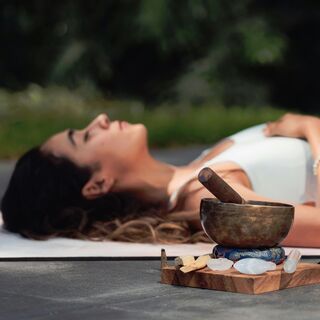
Sit or lie in a comfortable position,
Close your eyes,
And relax.
It's time to be present,
Here and now.
As always,
Feel free to make any small adjustments in how you're sitting or lying,
To ensure that you're completely comfortable.
Take in a full breath,
Counting to three,
Feeling it fill your belly and chest.
Now,
Gently release it to the count of three.
Breathe in to the count of four.
Pause,
Then release to the count of four.
In to the count of five.
Pause,
And release it slowly to the count of five.
Repeat this a few times at your own pace,
Imagining that every out-breath is carrying away any lingering tension or discomfort.
Release control of your breath,
And simply observe it in its natural rhythm.
Take notice of any subtle sensations in your body as you breathe.
Perhaps there's a slight tension in your chest as your muscles engage to breathe in,
Or a gentle wave of relaxation as you breathe out.
Continue this for a few moments,
Simply being aware of these sensations,
Without analyzing or thinking about them.
Just be present as you observe the ebb and flow of your breath.
As we did in the first session,
Let's take a few moments to imagine the sensations that accompany a deeply relaxed state.
Begin by imagining how it would feel if every muscle in your body became heavy and soft,
Like warm clay.
How would your legs feel?
Warm,
Soft,
And heavy.
Your torso?
Warm,
Soft,
And heavy.
How would your arms and shoulders feel?
Warm,
And soft.
And finally,
Your face.
How would that feel?
The muscles turning into warm,
Soft,
And heavy.
Gently return your attention to the natural rhythm of your breathing,
And continue this on your own for a few moments.
Take a moment now to recall something you recently heard on the news or social media that troubled you.
Perhaps it's a thought,
Or a thought,
Or a thought,
Or a thought,
Or a thought,
Or a thought,
Or a thought,
Or a thought,
Or a thought,
Or a thought,
Or a thought,
Or a thought,
Or a thought,
Or a thought,
Or a thought,
Or a thought,
Or a thought,
Or a thought,
Or a thought,
Or a thought,
Or a thought,
Or a thought,
Or a thought,
Or a thought,
Or a thought,
Or a thought,
Or a thought,
Or a thought,
Or a thought,
Or a thought,
Or a thought,
Or a thought,
Or a thought,
Or a thought,
Or a thought,
Or a thought,
Or a thought,
Or a thought,
Or a thought,
Or a thought,
Or a thought,
Or a thought,
Or a thought,
Or a thought,
Or a thought,
Or a thought,
Or a thought,
Or a thought,
Or a thought,
Or a thought,
Or a thought,
Or a thought,
Or a thought,
Or a thought,
Or a thought,
Or a thought,
Or a thought,
Or a thought,
Or a thought,
Or a thought,
Or a thought,
Or a thought,
Or a thought,
Or a thought,
Or a thought,
Or a thought,
Or a thought,
Or a thought,
Or a thought,
Or a thought,
Or a thought,
Or a thought,
Or a thought,
Or a thought,
Or a thought,
Or a thought,
Or a thought,
Or a thought,
Or a thought,
Or a thought,
Or a thought,
Or a thought,
Or a thought,
Or a thought,
Or a thought,
Or a thought,
Or a thought,
Or a thought,
Or a thought,
Or a thought,
Or a thought,
Or a thought,
Or a thought,
Or a thought,
Or a thought,
Or a thought,
Or a thought,
Or a thought,
Or a thought,
Or a thought,
Or a thought,
Or a thought,
Or a thought,
Or a thought,
Or a thought,
Or a thought,
Or a thought,
Or a thought,
Or a thought,
Or a thought,
Or a thought,
Or a thought,
Or a thought,
Or a thought,
Or a thought,
Or a thought,
Or a thought,
Or a thought,
Or a thought,
Or a thought,
Or a thought,
Or a thought,
Or a thought,
Or a thought,
Or a thought,
Or a thought,
Or a thought,
Or a thought,
Or a thought,
Or a thought,
Or a thought,
Or a thought,
Or a thought,
Or a thought,
Or a thought,
Or a thought,
Or a thought,
Or a thought,
Or a thought,
Or a thought,
Or a thought,
Or a thought,
Or a thought,
Or a thought,
Or a thought,
Or a thought,
Or a thought,
Or a thought,
Or a thought,
Or a thought,
Or a thought,
Or a thought,
Or a thought,
Or a thought,
Or a thought,
Or a thought,
Or a thought,
Or a thought,
Or a thought,
Or a thought,
Or a thought,
Or a thought,
Or a thought,
Or a thought,
Or a thought,
Or a thought,
Or a thought,
Or a thought,
Or a thought,
Or a thought,
Or a thought,
Or a thought,
Or a thought,
Or a thought,
Or a thought,
Or a thought,
Or a thought,
Or a thought,
Or a thought,
Or a thought,
Or a thought,
Or a thought,
Or a thought Dismiss them with the phrase,
Maybe,
We'll see,
And gently return your attention to the breath.
Recognize that there is nothing wrong here and now.
Once again,
Eyes open or closed,
Bring your mind to the troubling news you selected earlier.
Take a moment to think about it,
Label it,
And take note of the impact your thinking is having on you.
When ready,
Take a deep breath and say,
To yourself or aloud,
Maybe,
We'll see.
As before,
If any negativity persists,
Take another deep breath,
Repeat the phrase,
And gently refocus your attention on the present moment by tuning into your breathing.
So,
How has this worked for you so far?
Have you been able to detach from distressing thoughts and experience how this calms your emotions?
If not,
Be patient.
This is a very effective practice,
But it usually takes repetition for it to start breaking through habitual thought patterns.
Let's do that one more time.
Bring your mind to the troubling news you selected,
Think about it,
And notice how your thoughts and emotions are affected.
Now label that,
Take a deep breath and say,
Maybe,
We'll see.
Again,
If negativity lingers,
Take a deep breath and repeat the dismissing phrase,
Then refocus on the present moment through your breath.
In a moment,
We'll be winding the session down.
In a moment,
We'll be winding the session down.
But before we do,
Take a moment to reflect on how well you've been able to dispel negative thoughts about the news you selected.
When you're ready,
Take a few deep cleansing breaths,
And when you feel prepared,
Gently open your eyes.
How was that experience for you?
When you shifted from allowing yourself to dwell on a troubling situation to grounding yourself in the present moment,
Did you notice a change in your mental state or emotions?
If not,
I encourage you to repeat this process until you do.
You might find it helpful to build a foundation of mindfulness through a daily meditation practice over the next few weeks.
A brief daily practice can make a huge difference in your life,
And there are many excellent guided meditations on Insight Timer that can help you do this.
If you're new to meditation,
You might check out a free 10-session course I created,
Entitled,
A Course in Meditation.
It's true,
We do face significant challenges in our world today,
But this has always been the case.
Every generation has grappled with serious issues,
Often far more daunting than what we face now.
In fact,
There's good reason to believe that these days might actually be the best in modern times.
Sound unlikely?
Consider this.
According to well-done and validated analyses,
Proportionately fewer people worldwide are affected by crime,
Violence,
War,
And poverty than at any time in recent history.
While there are occasional upswings,
The overall trend has been downward.
One analyst even described the current era as an unprecedented time of peace and prosperity.
Perhaps a fitting mantra for the present can be borrowed from a song of the 70s.
These are the good old days.
Because no doubt,
In the future,
Many will look back on this time in history and think just that.
Why not get a jump on it,
And try this as a mantra for a few days?
I hope you found this session helpful.
In our next and final part of the series,
We'll focus on how to maintain your hard-won peace of mind and equanimity,
Especially if you become an advocate for positive change in the world.
Thank you for taking the time to meditate with me today.
May you be warm and safe.
And may you live in peace and happiness.