A Simple Course in Meditation Session 7 Part 1 Introduction to Yoganidra Hi,
I'm GS Renfri.
Welcome to Session 7.
Today we cover the art of Yoganidra with sankalpa,
And I've divided it into two parts.
The first is a brief introduction to give you a needed background and preparation.
Part 2 will provide a guided practice without any explanatory preamble to make repeated listening a better experience.
Yoganidra,
Also known as yogic sleep,
Is an ancient practice that dates back to the foundations of yoga itself.
Unlike the asanas or postures most often associated with yoga,
Yoganidra is a form of deep meditation.
According to some,
It was once considered too powerful to be safely practiced without extensive preparation.
We now know it to be perfectly safe and with repeated practice it can be a powerful tool for personal and spiritual growth.
Keep in mind,
However,
That Yoganidra can open access to the deeper reaches of the mind,
So any thoughts you entertain during the practice can permeate the deeper levels of consciousness.
Accordingly,
It's important to keep your thoughts to a minimum,
And keep them positive when you practice.
Much of the power of Yoganidra lies in its capacity to induce a transitional state between wakefulness and sleep,
And hold us there for an extended period.
In psychology we call this a hypnagogic state,
A state we experience every time we fall asleep,
Only it normally lasts but a few fleeting moments and we usually pass through it unnoticed.
When we experience this state for an extended period,
We can gain mindful access to deeper levels of consciousness.
Sometimes this leads to spontaneous insights and greater self-awareness,
But whether or not that happens,
Yoganidra always gives us an opportunity to implant a desire or directive for our lives,
Very much like a hypnotic suggestion.
This component is called sankalpa.
In the teachings,
Sankalpa refers to one's deepest truths or intentions in life.
It's not a statement of some desire you have for yourself in the moment,
Such as,
I want to lose 10 pounds,
Or I want to succeed in my job.
As worthy and life-enhancing as those may be,
They don't likely reflect your soul's deepest desire,
A core value,
Or your purpose in life.
At the same time,
Your sankalpa doesn't have to be something deep and profound.
It can simply be an intention for yourself that supports or otherwise brings you into closer alignment with the way you want to live your life or perhaps even with your chosen life purpose.
But what if,
Like so many,
You're uncertain of your purpose for being here?
What if that's something you're still searching for?
If that's the case,
Then practicing sankalpa mindfully,
Regularly,
Can help you move forward on a path of discovery.
If you don't have a clear sense of higher purpose yet,
You can ask yourself if there are changes you feel drawn to make in your life.
Perhaps you find yourself attracted to a new career or to move to a new location.
These types of desires may be drawing you along your life path.
Do you want to enhance your health or diet,
Improve your social connections,
Meditate or practice yoga more regularly?
How about being kinder and less judgmental in your perceptions of self,
Others,
And the world?
Such desires are life enhancing and universally supportive of any grander purpose you might have or create.
Whatever intention you decide upon for your sankalpa,
It's best to state it simply and as though it's already manifesting in your life.
So a statement like,
I want to be healthy,
Might become,
I grow healthier each day.
I want better relationships with others,
May become,
My connections with others are becoming stronger each day.
When you practice yoga nidra,
You can bring to it a long standing or otherwise clearly identified intention for your sankalpa,
Or you can allow one to spontaneously emerge in the moment.
If all else fails,
You can't go wrong with a simple statement of well wishing for yourself or others.
A phrase derived from the practice of metta,
A meditation form to be covered in session eight would be perfect.
A simple metta phrase might be,
May I be warm and safe,
May I be happy and free of suffering.
So how is yoga nidra practiced?
What's the process you'll be guided through in part two of this session?
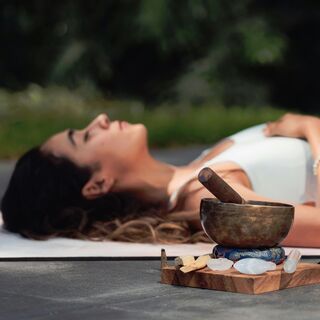
Yoga nidra is usually done in a comfortable lying position.
As with all forms of meditation,
It's best to select a time and place for your practice where you're least likely to be interrupted.
If you practice during the daytime,
Doing so in a darkened room or using an eye pillow is recommended.
Yoga nidra usually starts with a few simple relaxation techniques such as deep breathing to relax the body,
Still the mind,
And prepare you for the practice.
After this brief relaxation phase,
You'll be invited to identify your sankalpa and then repeat it to yourself several times.
Following this,
You'll be directed to attend to a series of perceptions and body sensations.
Unlike the body scan and sensory rotation meditations you explored in sessions five and six,
However,
The directions will be more frequent with relatively little time spent focusing on any one perception or body part.
The purpose of this is twofold.
It helps prevent your awareness from becoming too absorbed or attached to any one set of sensations or perceptions,
And the relatively frequent instructions help anchor you to the awakened state.
It would be easy for most of us to otherwise fall asleep during practice.
In other words,
The rhythm of our shifting focus is what draws us toward a sleep state,
While the voice of the guide helps maintain the awakened state.
The intended result is a state of mind suspended between the two.
Near the end of the practice,
You'll be invited to repeat your sankalpa to yourself several times.
This is the point at which it's very much like implanting a hypnotic suggestion.
After that,
You'll be guided to slowly come back to a fully awakened state.
So what can you reasonably expect on your first practice of yoga nidra?
One possibility is that you'll fall asleep.
It's not uncommon,
And in fact,
Some yoga nidra protocols are designed to help you slip into sleep at night.
If that happens to you,
Then perhaps you were sleep deprived or otherwise needed rest.
Another possibility is that you'll remain in a relaxed but fully awake state.
If that happens,
Rest assured that you're still benefiting from the relaxing meditative practice.
Slipping into a hypnagogic state sometimes takes several sessions to occur.
A little patience and non-judgment will help ensure that you experience this amazing state of mind.
During yoga nidra,
You may become deeply relaxed and only vaguely aware of your surroundings.
At the same time,
You may become conscious of some of the subtle workings of the mind,
Workings that usually elude our awareness because of the busyness of our day-to-day thinking.
It's in this conscious sleep that the benefits of yoga nidra are manifest.
During the process,
If you ever become lost,
Confused,
Or momentarily fall asleep,
Simply take a cleansing breath and refocus on the voice of your guide.
If you have trouble focusing on any body part or sensation,
Don't struggle with it.
Simply remain relaxed and shift your attention when the next direction is given.
Finally,
Yoga nidra is not at all how some people view hypnosis to be,
Wherein the guide takes control of you.
You're always in control.
Though an essential part of the process is to relax and surrender yourself to it,
This is not the same as surrendering your will or giving over control to the guide.
At any time,
You can end the session by taking a deep breath and opening your eyes.
Yoga nidra can be a highly rewarding practice and it can be tailored to specific goals such as sleep induction and even treating traumatic distress.
The practice that follows in part two of this session is a general one that can be repeated as often as desired and it's adequate in itself to help promote self-awareness and personal growth.
Enjoy the practice.