Welcome to your meditation today.
My name is Gil Elhart and I'd like to give a little Dharma talk as well as a meditation on one of the Yoga Sutras of Patanjali.
This sutra comes from the sadhana pada,
The second of the four legs,
Pada means foot,
That represent the Yoga Sutras.
It's the portion on practice,
Sadhana means practice.
And it's the thirty-third of the Yoga Sutras from this second pada,
Vitarka-bhadane pratipaksa-bhavanam,
Which means when we're disturbed by negative thoughts,
Try to cultivate thinking the opposite.
I think this is very nice advice from Patanjali on how we can work with our mind and we can start to obstruct the thoughts that we don't want.
We can't control our thoughts entirely and it's natural that we will have some disturbing or negative thoughts from time to time.
If we,
For example,
Have hate in our mind,
If we can start to shift towards thoughts of love,
What is something that we love dearly?
Something that's simple,
Doesn't have a lot of extra baggage to it,
Like the love of your child or the love of a pet.
That's one example of how we can use this Yoga Sutra.
It's also a great way to stop the after effects of a negative thought.
We can literally think of what if I continue to think about this?
Where will I go with my actions and where will my emotions go?
It will tend to take us down a more of a negative spiral and we'll start to feel more hot anger type emotions versus more cooling,
Calming emotions.
So again,
If we think of this Yoga Sutra and we think of maybe being in a fight with someone that we care about but tensions rise and we might be having that moment of saying something that we don't want to say,
Just think if your loved pet or beloved child came into the room and you were able to embrace them and think about them.
This is a great Yoga Sutra to apply and we can use it in our meditation as well.
So we'll shift towards a meditation practice now.
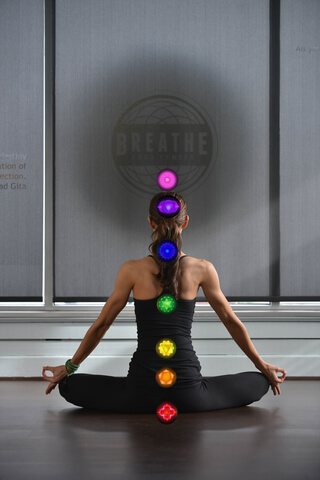
Go ahead and create a comfortable seated posture.
Lengthen your spine and relax your arms,
Relax your shoulders.
Just gently set your hands onto your thighs.
In this meditation,
When thoughts arise,
You can start to shift towards maybe the opposite of thinking if it's just a neutral thought.
What's the opposite of these thoughts just flowing through my mind of not thinking?
Or if you have thoughts that are just disturbed in any way and feels like it has some negative energy behind it,
Then consciously cultivate the opposite thought.
For example,
If you're unhappy with your job,
Then just envision that you're really having a lot of fun with the work that you do,
That you're experiencing joy in the work that you do.
So try this out as your meditation.
Let's begin.
Connect to your breath.
The exhale can be an excellent way for you to release the thoughts that come or make that shift from letting go of that previous thought and manifesting the positive or counter thought.
Près de l'âme de contrôle et le plus.
.
.
.
.
.
.
Slowly return your attention to the breath now.
Serving once again as a reminder to come into this present moment more fully.
I hope that this practice has helped you in training the mind to let go,
To cultivate a more positive attitude or approach.
It's not always easy to simply shift from one thought to another or from one thought to its opposite.
I consider this a practice,
Something that you develop over time.
And I hope that you consider building this practice in your life.
It can be a great way to shift negative feelings,
Negative emotions,
Negative thought patterns.
I recently have experienced some of these things in my own life and applied this practice when I remembered.
It doesn't always work so well,
But when I remembered and used my breath to help,
It can be very,
Very valuable.
And I see this as an extension,
An expansion really,
Of a Vipashana style meditation where you label a thought and move on.
This just adds an element of cultivating the positive thought,
Cultivating what you do want to bring into your life and how you want to move through your life authentically.
Sitting up tall,
To conclude this meditation,
Draw a deep breath in and gently sigh it out.
Thank you for choosing to meditate with me today.
Namaste.