Welcome.
This is a beginner yoga nidra practice.
Thank you for being here.
My name is Danielle Henry,
And I am grateful that I can share this deep relaxation practice with you,
Designed to help you achieve deep relaxation and inner peace.
In this guided meditation,
You will be led through a series of steps that will allow you to release physical and mental tension,
Calm your mind,
And connect with your innermost self.
No prior experience is necessary,
And all you need is a comfortable place to lie down and a willingness to let go and surrender.
To get started,
Find a peaceful and comfortable space where you can either lie down or sit in a relaxed position.
Ensure that the room is quiet and consider covering your eyes or turning off the lights to create a more serene environment.
Adjust the temperature to your liking and have a blanket within reach if needed.
If you are lying down,
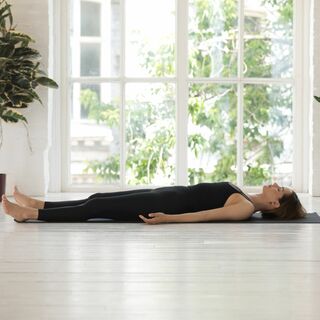
You can place a pillow or blanket under your knees to feel more comfortable in the Shavasana position.
You can use various props to make yourself even more comfortable,
Or a soft pillow under your head.
Once you are settled,
Take a few deep breaths,
Inhaling through your nose and exhaling through your mouth.
Feel your body relax with each exhale.
As you inhale,
Visualize a sense of calm and relaxation entering your body.
As you exhale,
Release any tension or stress you may be holding in your body.
Simply breathing in and breathing out.
Allow your entire body to sink into the ground beneath you.
Be patient with yourself.
Let go of any thoughts,
Worries,
Or distractions from the outside world.
This is your time to fully relax and focus on yourself.
Take a few moments now to settle in and scan your body from head to toe.
Noticing any areas of tension or discomfort.
Breathe deeply into these areas,
Allowing them to release and relax and become settled.
You may want to repeat a simple phrase to yourself,
Such as,
I am calm and relaxed,
To help you let go of any thoughts or distractions.
I am calm and relaxed.
As you settle into your position,
Become aware of your surroundings.
Feel the support of the ground beneath you and the warmth of any blankets or props you may be using.
Notice the sounds around you,
Whether they are from inside or outside the room.
Allow yourself to fully surrender to this practice,
Knowing that you have created a safe and comfortable space for yourself.
You are ready to begin your journey of deep relaxation and inner focus through Yoga Nidra.
Now that you have found a comfortable position,
Let's begin the process of relaxation.
Begin by taking a few deep breaths,
Inhaling through your nose and exhaling through your mouth.
Allow your breath to become slow,
Deep,
And effortless.
We will begin to consciously relax each part of your body,
From the toes to the crown of your head.
It's important to try to remain motionless for the duration of the practice.
But if you become uncomfortable,
Of course,
You may move.
Remember that Yoga Nidra is a conscious relaxation practice,
Not just a nap.
Your awareness will rest between waking and sleep as I guide you through each body part.
Bring your attention to it and allow it to relax.
During this process,
Your mind may begin to wander,
And that's okay.
Simply acknowledge your thoughts and bring your attention back to your body and breath.
The goal is to achieve a state of complete relaxation while remaining fully awake and aware.
Although it's normal to feel sleepy during the practice,
Try to stay alert and awake.
If you do fall asleep,
Know that your body will still benefit from the relaxation.
Begin to consciously relax each part of your body now.
We'll begin at your toes.
Feel your feet becoming heavy and sinking into the ground.
Relax your ankles,
Your calves,
And your knees.
Allow your thighs to soften and release any tension.
Feel your hips and lower back becoming heavy and sinking into the ground.
Relax your abdomen and your chest.
Feel a softening with each exhalation.
Release any tension in your shoulders and your arms,
Allowing them to become heavy and sinking into the ground.
Relax your neck and your jaw.
Soften your forehead.
Soften all the wrinkles and relax into your scalp.
If you notice any tension,
Simply bring your attention to that area now and release it consciously.
Take a few more deep breaths and allow yourself to sink even deeper into relaxation.
It's now time to set a Sankalpa.
A Sankalpa is a Sanskrit term used in Yoga Nidra and refers to a personal resolve or intention that is made during the practice.
It is a positive statement that is repeated to oneself,
Either mentally or verbally,
With the aim of bringing about positive change in one's life.
It is said that the power of the Sankalpa comes from the deep state of relaxation and receptivity achieved during the practice of Yoga Nidra.
The Sankalpa should be simple,
Positive,
And expressed in the present tense,
As if it is already happening.
It should also be made with a sense of heartfelt conviction and belief.
A short,
Positive statement in simple language that reflects your innermost desires and goals.
Here are a few examples that you can use or you can create your own.
I am at peace.
I am loved.
Or I am worthy.
Your Sankalpa should feel true and authentic to you.
Take a few moments now to set your Sankalpa.
Here are a few more examples of a Sankalpa.
I am calm and focused in my mind and body.
I am capable of achieving my goals and dreams.
I trust myself and the journey I am on.
Repeat your Sankalpa three times to yourself.
Now,
Guide your attention through each part of your body for a rotation of consciousness,
Bringing awareness and relaxation to every muscle and joint.
As you lie in Shavasana,
Take a deep breath in and exhale slowly out.
Direct your attention down to your toes.
Visualize them in your mind's eye and repeat the word toes silently to yourself.
As you focus on your toes,
Consciously relax them,
Feeling the tension melt away and allowing them to become heavy and completely relaxed.
Slowly move your attention to your feet.
Visualize them in your mind's eye and repeat the word feet silently to yourself.
Consciously relax your feet,
Feeling the tension melt away and allowing them to become heavy and completely relaxed.
Repeat the name of each body part silently to yourself as you focus your attention on it,
Visualizing it in your mind's eye and consciously relaxing it.
Allow each part of the body to become heavy and completely relaxed,
Feeling tension and stress melt away.
If your mind begins to wander or you start to feel sleepy,
Simply bring your attention back to the part of the body that it is being focused on and continue to repeat the name silently to yourself.
Move your attention to your ankles,
Calves,
Knees,
Thighs,
Hips,
Lower back,
Abdomen,
Chest,
Shoulders,
Arms,
Hands,
Neck,
Finally your head.
You may be feeling a deep sense of relaxation at this point throughout your entire body,
Helping to release physical tension and calm the mind.
Now bring your awareness to your breath.
Observe the natural flow of air in and out of your body.
Notice the gentle rise and fall of your belly with each inhale and exhale.
We will now count down from 27.
This is a common technique used to bring the practitioner into a state of deeper relaxation.
Counting down from 27 serves as a simple yet effective technique to deepen your relaxation and prepare the mind and body for the deeper stages of yoga nidra.
Now begin to count the movements of your navel,
Starting with 27.
Count down with each exhale.
So with each exhale,
Silently say to yourself,
27,
And then with the next exhale,
26,
And so on.
If you lose track of your count,
Simply start over again at 27.
As you continue to observe your breath and count your navel movements,
You may notice your mind starts to wander.
You might find yourself getting lost in thoughts or daydreams.
Don't worry.
This is normal and natural.
Simply notice where your mind has gone.
Without judgment.
And then gently guide your attention back to your breath and your counting.
The goal is not to achieve a certain number or to force your mind to be still.
Instead,
Be the observer.
Simply watch your breath and count your navel movements as they naturally occur.
Trust that with practice,
Your mind will become more calm and focused.
Now we'll start to explore different feelings and sensations.
As we explore these pairs of opposite sensations,
You can release emotional tension and promote a sense of inner balance and harmony.
Allow yourself to experience different sensations and emotions without judgment or attachment.
This can help cultivate a sense of inner peace and tranquility.
Remember to remain still and awake throughout the practice.
If you find your mind starts to wander or you become drowsy,
Simply bring your attention back to your breath and continue with the practice.
Now I will guide you to recall pairs of opposites.
Visualize a bright light filling your body and notice how it feels.
Shift your attention to the sensation of darkness,
Imagining a dark space or absence of light.
Feel both sensations and allow them to come and go without holding on to either one.
Bright light and the sensation of darkness.
Now visualize heat.
Feel it radiating through your body and notice how it feels.
Shift your attention to the sensation of cold.
Experience cold in your body.
Allow both sensations to come and go without holding on to either one.
Heat and cold.
Focus your attention on the feeling of weight in your body.
Imagine yourself sinking into the ground.
Notice how it feels to be heavy and supported.
Shift your attention to the sensation of lightness,
Imagining yourself floating or feeling weightless.
Experience both sensations and allow them to come and go without holding on to either one.
Now recall a time when you felt truly happy and allow yourself to experience that feeling in your body.
Notice where you feel joy in your body and how it feels.
Shift your attention to the sensation of sadness,
Recalling a time when you felt down or upset.
Allow yourself to experience that feeling in your body.
Experience both sensations,
Joy and sadness.
Allow them to come and go without holding on to either one.
We will now move through a visualization practice.
The goal of this visualization practice is not to create a detailed mental picture,
But to evoke feelings of relaxation and tranquility.
Allow yourself to fully immerse in these images.
Let go of any mental chatter or distractions.
Trust yourself.
Trust that this visualization practice will help you release any remaining tension or stress in your body,
Promoting a sense of inner peace and calmness.
Take a deep breath in and as you exhale,
Allow yourself to sink even deeper into relaxation.
In your mind's eye,
Visualize a calm body of water.
See the surface of the water and notice how still and peaceful it is.
Take a moment to really feel the sense of calmness and tranquility that this image evokes.
Now visualize a mountain range with snow-capped peaks rising up towards the sky.
See the details of the mountains,
The ridges and valleys,
And the colors of the rocks and soil.
Take a deep breath in and feel the expansiveness of this image.
I would like you now to picture a garden.
See the different flowers and plants and notice the colors along with the scents.
Feel the warmth of the sun on your skin and the softness of the grass beneath your feet.
As we come to the end of this visualization practice,
I would like you to focus on an image that brings you a sense of peace and tranquility.
It can be anything that resonates with you personally.
A place you love,
A person or even an object.
Allow this image to fill you with feelings of relaxation and calmness.
It's now time to return to your Sankalpa,
The positive statement that you selected at the beginning of your practice.
This powerful tool that helps to reprogram your subconscious mind with positive and uplifting thoughts.
Repeat your Sankalpa now three times that you started with at the beginning of your practice.
Repeat your intention with full awareness to help reinforce its power in your mind.
Let's shift back now and become aware of your physical body and the sensation of your breath.
Take a few deep breaths and feel the connection between your breath and your body.
Allow your awareness to expand to your surroundings.
Keep your eyes closed,
But listen to the sounds around you.
As we come towards the end of our practice,
It's important to slowly and mindfully bring your awareness back to the external world.
Take your time here.
Be sure not to rush the process.
When you feel ready,
Slowly start to move your body.
You can wiggle your toes and fingers,
Stretch your arms and legs,
And take a few deep meaningful breaths.
Bring some gentle movement into your body.
And when you feel fully awake and present,
You can slowly open your eyes.
The benefits of your Yoga Nidra practice can be felt long after the practice has ended.
Take some time to reflect on how you feel and notice any changes in your body,
Mind,
And emotions.
As always,
Remember to treat yourself with kindness and compassion as you move through your day.
Thank you for being here.
I would love to hear from you in the comments below.
And if you would like to support this community,
Please like,
Share,
And subscribe to my channel for more yoga and deep relaxation practices.
May you be happy,
May you be healthy,
And may you live in peace.
Namaste.