All right,
Well,
Let's get started.
And as people join us,
If they do,
They can join in with wherever we are in our practice.
So first,
Let me welcome you all.
Thank you for coming.
Thank you for joining us all electronically and keeping this beautiful community alive.
Today's practice is yoga nidra.
And I know some of you have done yoga nidra.
Some of you are old hands at it.
Others maybe not so much.
So I'll take a moment,
Just a few minutes,
Actually,
In another moment to begin to explain what yoga nidra is.
In the meantime,
What we're going to do,
Let me just explain to you,
We'll start with 10 or 15 minutes of just very gentle seated movement just to kind of wake up the body.
Work out a few kinks if you have any kinks.
Let go a little bit of tension by moving around a bit.
You do not need a yoga mat.
Just stay seated is fine.
We're not going to move much more than that.
After that,
We'll begin our yoga nidra practice.
For the yoga nidra practice,
You'll be laying down on your back.
So face up.
And I recommend that you not lay down on your bed because that,
As I told Carmen earlier,
Tells your body that it's time to go and your mind that it's time to go to sleep,
Which often will be the result if you lay down on your back on your bed.
So lay on a floor.
If you have a blanket,
You can use a blanket to lay on or if you have a yoga mat,
You want to lay on that,
That's fine.
Our object in yoga nidra is to remain as motionless as possible.
And so we'll be laying down for probably half hour,
Maybe 35,
40 minutes.
And that can become a little bit difficult to remain motionless during that period.
So if you do need to move,
Go ahead and move,
Adjust your body,
And then come back to stillness as quickly as you can.
Also props.
What I recommend,
You probably don't have a bolster handy,
But you may have a blanket.
So you can roll a blanket up.
I should have one,
But I don't.
You could roll a blanket up into a roll about that big and prop it under your knees,
Which is kind of nice.
So that little bend in the knees takes some pressure off the low back and can be very conducive to a very pleasant yoga nidra experience.
The other thing is people often want to put a pillow on their head or rest their head rather on a pillow.
I don't recommend that because when you do that,
What happens is you then jut your chin forward and that doesn't work very well.
You want your chin just nicely tucked in so that your spine is in a nice vertical position with the head right over the shoulders.
What does work nicely is a little roll,
Maybe about that big,
A couple inches of a blanket,
And then you can put that in.
You can rest your neck on that little roll of a blanket so that can feel good too.
We'll get to the props in a moment.
For now,
Let's remain seated.
One other thing I wanted to mention was earbuds.
If you're not already using earphones or earbuds,
That can be really nice because it will localize my voice sort of in the middle of your brain.
That will weed out a lot of the distractions that you might otherwise have in the space that you're occupying now,
Physical space.
So if you have earphones,
Earbuds,
Feel free to hook those into whatever device you're watching and listening to me on now.
Let's talk a little bit about Yoganidra for those of you who aren't familiar with the practice.
Yoganidra means yogic sleep.
It's not the kind of sleep that you would ordinarily encounter where you lay down and close your eyes and riff off into slumber.
This kind of sleep is a sleeping of the conscious mind.
What that allows to happen is the subconscious will emerge.
So a lot of times people report that in their Yoganidra practice,
They have gone to sleep,
But that's almost never the case.
What's happened instead is that the conscious mind has shut off and the subconscious mind is still active and aware of what's going on.
So if you think you fall asleep,
Probably not the case.
It means that you were probably doing Yoganidra exactly right.
The ancient yogis,
And I'm going back at least a thousand years and probably two or three thousand years,
Although the information isn't completely accessible to us,
But the ancient yogis believed that humans had different aspects and they called those aspects bodies or sheaves.
There were five of them that were identified in the ancient writings,
And I'm not going to what they are,
But what I want you to understand is that Yoganidra is a practice,
A type of meditation that is intended to reach,
To touch all those different aspects of what it means to be human.
For example,
The physical aspect,
The physical body,
The mental,
The thinking aspect and the sensations that we experience and others.
And so in the Yoganidra practice,
You'll notice that we're touching those different aspects as I work through the verbalization that will accompany the Yoganidra practice.
There have been a lot of studies done,
Scientific studies on Yoganidra,
And the consensus seems to be that a Yoganidra practice is the equivalent of actual sleep.
You get the same benefits by about a factor of somewhere between three and five different studies show different things.
So if you do Yoganidra for an hour,
That may be equivalent to a three hour sleep or even a six hour sleep.
So it can be very beneficial and very refreshing.
The other thing that,
The last thing I want to mention about Yoganidra is that it moves you through different brainwave patterns.
So normally in your waking state,
The predominant brainwave pattern are beta waves,
And these are frequencies,
How long the waves are that are produced by your brain.
And then you move into theta and then from theta you move into,
Sorry,
You move into alpha waves and then you move into theta waves,
Which are what you normally give off the predominant wave while you're sleeping.
And then when you get really,
Really deep into sleep,
You get into delta waves.
And those are the longest waves.
And the really interesting thing is that Yoganidra produces or stimulates the delta waves almost from the very beginning.
And that's why you get such a deep,
Restful feeling from Yoganidra.
All right,
Enough talking.
Let's move a little bit.
Find a comfortable seat.
Just reach your arms up and overhead,
Stretch up high.
Bring the palms together,
Interlace the fingers,
Invert the palms,
Stretch the palms towards the sky.
No,
You can't see my hands.
Press down on the sitting bone,
Press down on the tailbone and reach up even higher.
Really stretch.
So you feel a big stretch in the armpits.
Now release that and bring the arms out to a T with the palms facing up,
Reach the hands apart from one another.
Take a deep breath.
Then as you exhale,
Take a gentle twist to your left.
When the right hand of the left knee,
Left hand drops down behind you,
Just find a gentle twist looking towards the back of the room.
Breathe in deeply.
One more deep breath.
Draw the navel in now.
Then as you exhale,
Slowly come back to center,
Engaging the core.
As you come back to center,
Reach the arms high and then exhale the hands to heart center,
Pressing the palms together.
Take a deep breath in.
Then as you exhale,
Bring your chin to your chest,
Draw your navel in and bring your forehead down towards the mat.
Keep your chin on your chest as you slowly rise.
Feel the abdominal muscles engage and reach the arms high.
Stretch out.
Exhale the arms behind you this time.
Press the palms into the floor behind you and lift your chin high.
Bring the shoulder blades together.
Press your chest up towards the sky.
Find a nice deep back bend.
Now slowly lean forward so the weight comes off the hands.
Let the arms float up and overhead.
As you exhale,
Bring your hands to heart center,
Pressing the palms together.
Take a deep breath.
Let the breath lengthen your spine.
And then as you exhale,
Draw your navel again.
Bring your chin to your chest,
Round the spine forward,
Bringing the forehead down towards the mat.
As you inhale,
Slowly rise.
Remember to draw the navel in as you come up,
Reach the arms high.
Then exhale the arms out to a T again with the palms facing up.
Reach the hands apart from one another.
Take a deep breath in.
Then as you exhale,
Take a twist to the right and drop the right hand down behind you.
Left hand comes to right knee.
Look over the left of the right shoulder.
Take a deep breath.
Let the spine lengthen as you breathe in.
And then exhale,
Let it go.
Come back to center.
Reach the arms high.
Palms together.
Second time,
Interlace the fingers and stretch the palms towards the sky.
Press the sitting bones down and roll back on the sitting bones.
So you're engaging the back of those hitting bones.
Now draw your navel in and then reach up higher.
Really stretch.
Release the hands,
Bring them out to a T.
Drop your right hand down,
Reach your left hand up and over,
Stretching the side body.
Bend your right elbow a little bit if you like as you reach with that left hand.
Then inhale,
Rise back up.
The core engages as you come up.
And then bring the left hand down,
Reach up and over with the right hand.
Stretch it out.
Really reach with the right hand.
So you feel a big stretch on the whole right side body from that right hip through the armpit.
And on an inhale,
Slowly rise.
Remember the core engages as you come up.
Bring your palms together,
Interlace the fingers and bring the hands to the back of the head.
Reach your elbows apart from one another.
Take a deep breath.
As you exhale,
Drop the right elbow down,
Reach the left elbow up.
Keep your gaze forward.
Keep your chin in neutral position.
Inhale slowly rise and over to the other side.
Reach the right elbow up,
Left elbow pulls down and inhale,
Rise back up.
Reach the arms back up and overhead and release them out to a T.
Let's flow side to side.
Right hand down,
Reach the left hand.
Inhale,
Rise back up.
Big breath in,
Exhale.
Bring the hand down,
Reach with the right hand.
Inhale,
Rise back up.
Exhale the right hand down and inhale,
Rise back up.
Left hand down,
Right hand reaches.
Stretch it out.
Twice more on each side.
Right hand down,
Left hand stretching.
Inhale,
Rising left hand down,
Right hand reaching,
Stretch it out.
One more time on each side.
Right hand down,
Reach with the left hand.
And inhale,
Rise back up.
Now bring the left hand down and reach,
Stretch it out.
And inhale slowly,
Rise back up.
Reach the arms high.
And as you exhale,
Bring the hands down in front of you.
And then see if you can walk your hands forward,
Keeping your spine long.
We're going to come down into a forward fold,
Seated forward fold.
Let your forehead rest on the floor of the mat if you can.
And if this is too uncomfortable on the knees or the legs,
Just come into a kneeling position with the feet behind you.
Walk the hands forward a little bit more and reach the tailbone towards your heels so that you're stretching out the spine,
Finding lots of length.
Let's find two more breaths here.
Now slowly begin to walk your hands over to the right.
We're going to stretch out the left side body.
Try not to cross the hands over one another.
Walk the hands out just a little bit more,
Really stretching.
Now walk the hands back through center and over to the other side.
Keep the spine nice and long,
The forehead reaching down towards the mat.
Maybe the forehead rests on the mat,
Maybe not.
Stretch it out.
Feel that big stretch in the side body all the way from the armpit to the hip.
And then back to center.
Slowly walk your hands back up.
Let your palms rest on your knees.
Find a cross-legged position again.
I'm just going to take a couple of breaths here.
Breathe in through the nose and out through the mouth.
Again,
In through the nose and out through the mouth.
And one more,
In through the nose and out.
That's it.
All right,
Lay down.
Let's find Shavasana,
Which is the position we're going to use for our Yoganendra practice.
So take a couple of moments to get situated.
And remember the use of the blankets.
Now begin to settle into this posture,
Into Shavasana.
And begin to bring your awareness to your body,
Your physical body.
And now perhaps say to yourself,
Now I am going to practice Yoganendra.
Feel your body settling in.
And now begin to take a quick scan all the way from the top of the head to the tips of the toes.
And as you notice any areas of tension anywhere in the body,
Just pause on those areas and just notice they're there.
You don't need to do anything about it for the moment.
Just notice if you feel tension anywhere.
Likely suspects,
The jaw often clenched.
We don't even know that,
But we often have our jaws clenched to some extent.
And the neck,
Of course,
Common area for tension.
The shoulders,
Many of us store lots of tension in the hips.
Surprisingly the calves are often an area where we store tension.
And then the fingers and the toes.
Now bring your awareness to whatever area of the body feels most tense.
And if you feel no tension anywhere,
Just ignore this.
But if you felt any tension anywhere,
Bring your awareness there.
Now begin to draw a deep breath in.
And as you exhale,
Release just 10% of the tension you feel in that spot.
And do that twice more.
Breathe in deeply.
And exhale and just release a little of the tension.
Don't try and let it all go at once.
And then one more time.
Now make final adjustments to the position of your body.
So if you need to move your arms a little bit,
Go ahead and do that or the legs or the feet.
I do recommend you flip your palms so that they face up so you don't have a lot of tactile sensation in the fingertips.
Just have the hands gently out by your side.
Now I'll begin what's called a rotation of consciousness.
I'll name parts of the body.
And just let your awareness drift from part to part as I name it.
Try not to discern or worry about any particular pattern or anticipate a pattern.
Just let your awareness flow with the words,
With my naming parts of the body.
Let's begin with the thumb on the right hand.
And the first finger on the right hand.
The second finger.
The third finger.
The little finger on the right hand.
The palm of the right hand.
And the back of the hand.
Now the right wrist.
The thumb on the left hand.
The first finger.
The second finger.
The third finger on the left hand.
And the little finger on the left hand.
The palm,
Back of the hand.
The left wrist.
The right shoulder.
The left shoulder.
The right armpit.
The left armpit.
And the right hip.
The right knee.
And the back of the right knee.
The left hip.
The left knee.
The back of the left knee.
The right ankle.
And the left ankle.
Top of the right foot.
The heel of the right foot.
In step of the right foot.
And the ball of the right foot.
The top of the left foot.
The heel of the left foot.
In step.
Ball of the left foot.
Right big toe.
Second toe.
Third toe.
Fourth toe.
And the pinky toe on the right foot.
Left big toe.
And second toe.
Third toe.
The fourth toe on the left foot.
And the pinky toe on the left foot.
Bring your awareness now to the top of your head.
The forehead.
Eyebrow center.
Right eyebrow.
Left eyebrow.
Right eye.
Left eye.
Right cheek.
Left cheek.
Right ear.
Left ear.
Tip of the nose.
Right nostril.
Left nostril.
Upper lip.
Inside the mouth.
Palate.
Back of the throat.
Tongue.
Teeth.
The whole mouth all at once.
Lower lip.
Chin.
Throat.
Heart.
Solar plexus.
Navel.
Pupic bone.
The bottom of the spine.
Tailbone.
The mid part of the back.
Between the shoulder blades.
The back of the neck.
The top of the head.
The whole right leg.
The whole left leg.
Both legs together.
The right arm.
The left arm.
Both arms together.
The right side of the body.
The left side of the body.
Now bring your awareness to your whole body.
Become aware all at once of your whole body.
Awareness of the whole body.
Bring attention now to the nostrils.
And notice as you breathe in through the nose the coolness at the base of the nose.
Imagine the breath warming in your body as you breathe in.
Feel the pause as the breath turns and the inhale becomes an exhale.
Now feel the warmed breath flow out through the nostrils.
Breathe in through the nose,
Feel the coolness.
Feel the breath coming in and then turning.
Imagine it warming in the body and then exhale the warmed breath.
Breathe in feeling coolness.
Breathe out feeling warm.
Breathe in the cool and breathe out the warmth.
Breathe in now through the left nostril only.
Just letting your mind direct the breath.
And breathe out through the right nostril only.
Then breathe in through the right nostril and breathe out through the left.
Continue that pattern.
Breathing in from the left and breathing out to the right.
And then breathing in from the right and breathing out to the left.
Again breathe in from the left and breathe out to the right.
Breathe in from the right and breathe out to the left.
Now breathe in equally through both nostrils.
Keep drawing the breath in.
Now hold the breath in for two counts.
And then exhale,
Just let the breath go.
Breathe in again through both nostrils.
Keep breathing in.
Hold the breath in for two counts.
And then exhale and let it all go.
Let your breath settle now into its natural rhythm and just observe the rhythm of the breath.
Follow the natural rhythm of your breathing.
Try and let go of everything except for your awareness of the breath.
Focus your mind completely on breath awareness.
Noticing the breath flow in.
Pay attention as the breath turns in the body and then flows out.
Notice the breath turn and become the next inhale.
Noticing the flow of the breath in and out.
Now release your attention from your breath and bring your awareness to the tips of the fingers on the right hand.
Perhaps you begin to feel a little buzzing,
Just a very subtle vibration in the fingertips on the right hand.
Now begin to imagine that subtle vibration becoming a luminous ball of light or energy.
And feel that luminous ball of light or energy right at the palm.
The next time you breathe in,
Imagine the ball of energy rising up to your right shoulder.
And when you exhale,
Feel the ball of energy return to the palm of the right hand.
Again feel the ball of energy rising from the palm to the right shoulder on the inhale and then returning from the shoulder along the arm to the palm on the exhale.
Now inhale,
Feel the ball of energy rise to the shoulder and then exhale.
The next time you inhale,
Feel the ball of energy come to the back of the neck.
Then as you exhale,
Feel the ball of energy move down the left arm to the palm of the left hand.
The next time you breathe in,
Feel the energy rising from the palm to the shoulder and the exhale brings the luminous ball of energy back to the palm of the left hand.
Now inhale,
Feel the energy rise to the back of the neck.
And as you exhale,
Imagine the ball of energy cascading down your back to your tailbone.
Now inhale,
Feel the ball of energy rise back to the neck and exhale and feel the energy descend to the tailbone.
Now inhale,
Feel the energy rising to the back of the neck.
Leave it there as you exhale.
Now inhale and feel the luminous ball of energy rise to the very top of the head.
You may feel a brightening or maybe a lightness that comes into your awareness at that moment.
Exhale,
Breathe in and feel the brightness increasing.
And as you exhale,
Just let it go,
Really still.
Feel the energy dissipate and come back to the natural rhythm of your breath.
Just feel your body gently breathing in and breathing out all on its own without volition,
Without your conscious intervention.
Now bring your awareness to the bones in your body,
Particularly the bones of the arms and the legs,
But maybe also the skull.
We begin now to cultivate a sensation of heaviness in the bones so that your skeleton feels heavy.
Begin to feel weighed down,
Noticing gravity very deeply.
Even noticing that gravity may be increasing,
Pulling down more and more on your body so you feel heavier and heavier.
This is the sensation of heaviness.
Now cultivate a sensation of lightness.
Imagine all the bones in your body becoming lighter and lighter,
Almost as though the bones have become hollow.
And now the whole body feels light,
Light like a feather.
You may begin to experience a sensation of floating.
If that happens,
Just allow it to occur.
Recognize it as part of the sensation of lightness in the body.
And now return to the sensation of heaviness and feel weighed down again.
And come back to the sensation of lightness,
Feeling light as a feather,
Almost floating above your mat or blanket.
And return to the sensation of heaviness again.
And then back to the sensation of lightness.
Imagine now your arms outstretched in front of you.
Don't move your physical body.
Just imagine with the palms facing up and the hands open.
Imagine in the left hand you have the sensation of heaviness.
And in the right hand you have the sensation of lightness.
In the left hand,
Heaviness.
In the right hand,
Lightness.
Left heavy,
Right light.
Begin now to cultivate a feeling of sadness.
Imagine a time in your life when you felt sad,
Perhaps profoundly sad.
And let yourself experience that feeling.
Recall what it felt like physically and mentally to feel deeply sad.
Sensation of sadness.
Now remember a time when you were really,
Really happy.
Remember the sensation of happiness,
What it felt like in your body to feel happy.
What it felt like in your mind to feel happy.
The sensation of happiness.
Now return to the sensation of sadness.
And then go back to the sensation of happiness.
Then back to sadness.
And then back to overjoyed happiness.
Now let go of the sensations and the feelings.
I'm going to name certain scenes.
Just allow your mind to process the scene,
To imagine it,
To visualize.
A very dense,
Dark jungle.
A hot desert.
Imagine a flowing river.
And now imagine a stagnant pond.
Imagine a beautiful flower.
And now a rock.
Imagine a roaring fire and a smoldering flame.
Visualize a newborn child.
And now an old person near death.
See waves breaking on a beach.
And now see the waves flowing out to the sea.
See waves breaking on a beach.
And waves flowing out to the sea.
See the waves flowing in to the beach.
And the waves flowing out to an endless,
Peaceful sea.
Now imagine that you were in the mountains at night,
In a forest,
With a very peaceful,
Calm pond in front of you.
It's dark.
Keep watching.
And now at the far end of the lake,
Or the pond,
And just above it,
A light appears,
A very bright light.
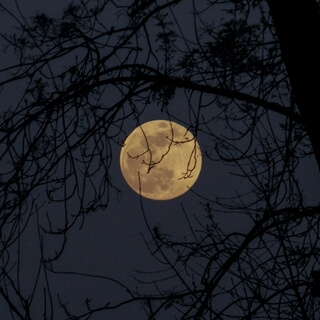
And you realize it's the moon rising.
Watch the moon rising.
See it rising above the horizon,
Above the trees.
And see it also moving towards you in the pond.
Follow the moon as it rises higher and higher into the sky.
And the reflection of the moon moves closer and closer to you in the pond.
Keep watching.
Following the moon,
Getting higher and higher until it's now directly overhead.
And you see the beautiful reflection of the moon in the pond.
Almost on the shore near you.
Now see little ripples in the water.
See how the ripples affect the reflection of the moon.
Now the moon rises overhead and moves out of view.
And its reflection is out of view as well.
Pause for a moment,
Still watching the pond.
See the darkness in the trees.
And now let the visualization go.
Bring your awareness now back to your body.
Feel your breath flowing in gently and flowing out.
Notice how smooth your breath has become.
Notice that your body is breathing on its own.
Feel the profound sense of peace and relaxation.
Know that this is your natural state.
This beautiful peacefulness.
It's always there for you to experience.
Bring your attention now to the right hand.
And begin to notice as the fingers on the right hand start to move almost on their own,
Almost without your conscious intervention or volition.
Now bring attention to the fingers on the left hand and notice as they too begin to move gently.
Almost without your involvement.
They're moving on their own.
Now begin to remember the room that you're resting in.
Remember the space and what was to the left of you and to the right.
Remember what's in front of you and what's above you.
Now take control of your breath.
Breathe in for five counts.
And then breathe out for five counts,
Keeping the breath even.
Breathe in again,
Five counts.
And exhaling for five counts.
Again,
Breathing in five counts.
Now open your mouth and exhale.
When you're ready,
Begin to bend your knees.
And keep your eyes gently closed.
Once the knees are bent,
Roll to your right side if you can.
Then cradle your head in your right arm.
Keep the eyes still gently closed.
Now just notice the experience of resting on your side with your knees bent and your head cradled in your arm.
Take a moment just to see what,
If anything,
Arises for you in this position.
Maybe a memory or a thought,
Maybe an emotion or a sensation,
Or maybe nothing at all.
Whatever it is,
Just notice it as part of the experience of resting on your side.
Remember also that this experience,
Like all experiences,
Is unique.
It does not repeat in this way.
This is the only opportunity you have to pay attention to this experience,
To really feel it.
Take a couple more breaths,
Deepening your experience of this moment.
Now slowly bring yourself to a seat and keep the eyes closed down if you'd like.
As we move towards completing our practice of yoga nidra,
I'd like you to begin to rub your palms together.
Now generate a bit of heat.
When you feel the warmth in the palms,
Then open the palms and bring the palms to your eyes closed.
Feel the warmth in the eyes.
And now slowly open the eyes and then let the hands come down.
Take a deep breath and let it go.
Bring your hands now to heart center.
I'd like to finish this practice by offering you loving kindness.
May you be happy and well,
And may you be safe.
May you be peaceful and may you be at ease.
Namaste.