There's a way that we can use our mindfulness meditation practice to address the physical tension in our body and actually start to release it.
So a typical mindfulness meditation session,
You'll sit down,
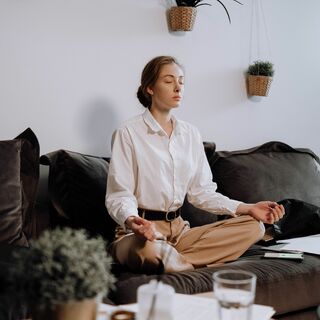
Get your posture and enjoy your attention to the sensations of the breath entering and leaving the nose.
When your mind wanders,
You gently acknowledge it,
Enjoy your attention back to the breath.
Now,
That's the traditional way to practice mindfulness meditation.
But over time,
You'll start to develop the ability to direct that mindfulness onto different areas of your body.
Or you'll find that certain body tensions just sort of pop up in your awareness.
So when you find yourself in a position to be able to sit with those physical sensations,
What I suggest you do is just observe them,
Look at them and accept them for what they are.
Sort of allow the body to show you where it's sore,
Where it's tense,
Where it's in pain for lack of a better expression.
And sort of invite it to share with you what it's holding.
There's a suggestion that a lot of mental anguish is the direct cause of physical tension in the body.
You know,
This is like the cold shoulder or the sore lower back or the tense legs or the clenched jaw.
Basically,
We all sort of have an area or areas in the body where we tend to hold our tension.
And,
You know,
Physical therapies or yoga or exercise do a lot to actually release those tensions and heal us.
But another approach we can take is to invite our body to relax,
To open up and to let go of that tension.
Almost like saying to you,
It's like,
Hey,
You're safe.
You can show me what you're holding there.
What I've found when I do this practice is that there's a physical tension that's holding an emotionality.
In the sense that,
Let's say I am feeling pain in my shoulder.
I investigate it mindfully.
I look at it and I invite it to release.
I invite it to let go.
I sort of say,
Hey,
We're safe,
We're calm.
I'm ready to feel what you've been holding on to.
It's almost like I'm sort of coaxing my shoulder to open up and then gradually or sometimes very quickly,
An emotion will sort of appear.
And when it does,
I basically have to turn and face it and accept it and feel it.
And once I felt that emotion,
The physical pain,
The tension in my shoulder tends to release.
And what I've realized is that it's like my body's holding onto things that I didn't address in the moment.
So by turning and facing,
By looking,
By addressing it,
I can start to release it.
So from a practical perspective,
You can do this during your meditation by setting the intention.
So you sit down,
You start your mindfulness practice and you focus on the breath.
And when you find your mind in a calm,
Controlled,
Mindful state,
You start searching or you just let the physical tension appear.
And when you acknowledge it,
Just look at it and observe it for what it is.
How big is the feeling?
How strong is the feeling?
Are there any colors,
Emotions or thoughts attached to those feelings?
How big is that shape?
Where is it specifically located?
And once you put an overall grasp for the totality of the feeling,
You can start inviting it to open up and to let go.
And then when it has let go,
You can choose to move on to another sensation,
Another tension in the body,
Or to return your focus back mindfully to the breath.
I invite you to try this technique now.
So we're going to end this talk with a little practice of this technique.
I invite you to close your eyes,
Get into your meditative posture and take a long,
Slow breath.
In through the nose and out through the mouth.
And this audio is going to go silent for one minute.
And during that time,
I want you to just let any sensations that arise,
Arise.
And turn your mindful attention to them.
And just tell that sensation,
Tell that tension that it's okay.
That you accept it and you want it to let go and just open up.
Let's begin.
Let's begin.
Great work.
So how'd you go?
Just remember with any sort of meditation practice,
It is just that,
A practice.
So if you didn't quite get it this time,
There's a couple of things you can do.
The first one,
And the most obvious one,
Is to try it again.
But I'll suggest you spend some time with it.
You might find that one minute isn't nearly enough time to really dig down and investigate and let these feelings open up and blossom and release.
If that's the case,
Maybe spend five minutes or ten minutes,
Or as long as you feel it takes to acknowledge,
Address,
And feel out the feelings that you're feeling.
Some parts of your body might take quite a few sessions,
Other parts will release straight away.
But just remember that when the feeling comes,
Accept it.
Happy meditating.