Hey everyone,
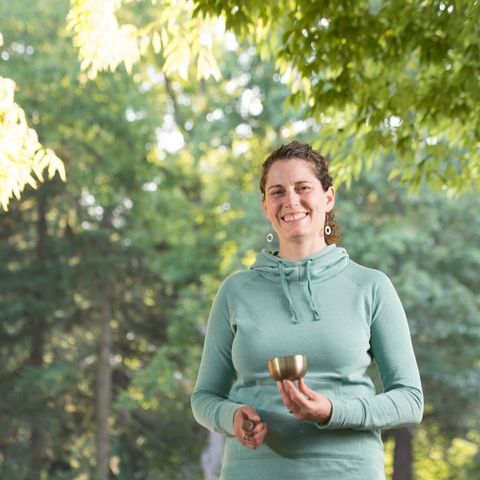
This is Dr.
Tia H.
Ho with Finding Mindful Now,
Guiding you out of your head and into your life with applied mindfulness.
Finding Mindful Now is about starting with a mindfulness practice and then seeing the capacity for us to tune in and be present with life more of the time,
Whatever we're up to.
And these series of recorded talks and guided invitations are from my weekly newsletter through my business,
Finding Mindful Now.
And today we're focusing on when stress hides wholeness.
So I like to start all of these with an arrival practice.
And today's arrival practice is to support feeling the sensations of your body as you gently flex them and then let them go,
Release them.
And any arrival practice is really to support attention arriving in the space between us here,
Back into this moment.
Sometimes our mind might be busy with yesterday or jumping forward into tomorrow.
And in these invitations,
You are welcome to adapt them,
Change them.
I might go into one spot of the body and you feel better about staying in another spot.
It might be that this particular invitation doesn't feel like what you wanna do right now.
So I just invite you to notice where your attention wants to rest.
It might be that attention wants to focus on a pattern,
Maybe a visual pattern on the ground or outside a window.
It might be that you want to feel into your belly as you breathe.
It might be that you want to gently do some stretches and that bringing attention into the body as you stretch each limb is what feels good to you right now.
So I'm gonna begin with a series of flexing and releasing different parts of the body.
You know,
Sometimes I don't realize that the body is holding tension until I gently flex and release and then I can feel how much let's go.
And I'm going to start with feeling into the belly,
Just bringing attention as I take an inhale and an exhale and just noticing as a couple more breaths happen,
How the chest and stomach move as air enters and exits.
I'm gonna start with bringing attention to my hands and I'm gonna pretend that my fingers rolled up into a ball are like squeezing an orange.
I'm just gently as I breathe in gonna squeeze my hands like I'm squeezing an orange and then I'm gonna let go with the exhale and notice any sensations in my hands and you're welcome to do this with me.
So I'm gonna inhale and squeeze.
I'm gonna exhale and release that orange.
This isn't,
We're not trying to kill the orange.
It's just a firm flex.
It's not painful.
It's just a gentle squeeze of like juice coming out of an orange.
And if it hurts on your hands,
I have a carpal tunnel so I have pain in my wrist a lot.
Just modify it to a way that feels like you can feel that that flex and then that release.
And so I'm gonna move my hands to my forearms and this time I'm gonna notice as I squeeze the orange in my hands,
Just gently flexing the forearms with an inhale and then a release.
And release.
And now I'm going to bring my hands up and place them on my shoulders and I'm gonna imagine that there's an orange in between my forearms and my biceps.
And I'm gonna gently squeeze that orange between my forearms and my biceps with an inhale and gently release and let those muscles relax.
And I'm gonna repeat that one more time.
Now I'm gonna imagine that there's an orange on either side of my neck and I'm just gently gonna lift the shoulders so like if there's,
Like I had oranges for earrings.
I'm gently gonna bring my shoulders up to gently flex them against those oranges.
Like a shrug and then I'm gonna release them with a breath exhale out.
I'm gonna do that one more time.
And for this final practice,
I'm just gonna imagine the whole front of my face is one juicy orange.
And as I breathe in,
I'm gonna squinch my face up to squeeze some of that juice out of that orange and then as I exhale,
I'm just gonna let my face relax and let it just let go of that flex.
And as I breathe out,
I'm gonna wiggle my face around.
That was a big juicy release.
So I feel like I'm here now and today we're talking about when stress hides wholeness.
And I'm gonna invite you to think about if there's a go-to activity you have when your mind,
When you notice your mind going in stress loops,
Is there an activity you utilize to bring attention back into this present moment?
It's okay if the loops keep going.
It's not a,
I'm not asking for a practice that makes loops go away.
I'm just asking if you have something,
A resource,
A support that you utilize when you notice stress loops happening.
And we'll come back to that later.
So there's a truth that dominant society covers up.
And that truth is that you are a whole person as you are right now.
Reading whatever you read today,
Listening to this talk,
Doing whatever you're doing with whatever illness you might have,
Be it physical or sometimes we have emotional pain.
Whatever's happening in your life right now does not change the fact that you're a whole person.
Even if you are missing a limb or your body has certain specific limitations.
There's nothing you can do or say that will make you more whole than you already are.
And I learned this from a colleague of mine,
Anna Debenham.
And she has a TED talk if you look her up.
And you know,
When she first told me,
Tia,
Nothing you can do will make you more whole than you already are,
I didn't believe her.
But I just,
I thought,
Well,
I'm just going to hang out with that for a minute.
I'm just going to start noticing.
Did all of the seeking efforts,
All the therapy,
All the various iterations of things to try to manage,
Try to change an anxiety condition,
Did any of those make me more whole?
And as I started looking into my history in my current life,
And I started looking for the evidence of whole personhood.
So I invite you to do this.
You don't have to take my word for it.
I had been looking at my life up until she made that comment from the perspective of brokenness.
And that makes sense.
You know,
Our brain is just trying to protect us and keep the body safe.
And all of society is really focused on highlighting and emphasizing when things aren't going well.
That's what makes,
You know,
That's how ads get paid for in the news.
How social media works is clicking on the more clicks on really intense things,
The more money gets made.
So it makes sense that that perspective of brokenness would be one of the big storylines of my life.
And there was this expectation that something must be wrong with me because of trauma,
Because of childhood poverty,
Of emotional health and mental health and physical health conditions.
I also had a whole series of car crashes.
There was a period of my life where I was in about a dozen different car crashes.
None of them were what would be considered really major,
But all of them left me with having to recover in different ways,
Physically and emotionally.
And I started asking as I was looking back through this history from this different perspective,
Is a person less of a human being if they have experienced trauma,
If they are diagnosed with mental or physical health condition,
If they're going through grief?
And in asking those questions,
I wasn't discounting challenges embedded in those life experiences.
I mean,
I definitely know from experience how difficult they feel.
And I use a whole collection of supports to contribute to ongoing healing.
And as I was asking these questions,
I noticed that these hard experiences did not make me less human.
In fact,
It almost started to seem like my mind had a habit of going into stress and then this habit was covering up seeing that wholeness.
And I started to realize that sometimes this brain-body system kicks up thoughts and in relation to them,
A bunch of feelings kind of out of this fear that maybe there's the possibility of being less than.
In fact,
That the self-identity is on a continual search to fill a perceived lack.
And dominant society doesn't encourage us to see wholeness.
Your brain-body is doing its best to keep you safe all the time.
Sometimes it can use a support,
A reminder of your wholeness when this fact gets covered up.
And as I started exploring,
I realized that all of the patterns that are often marginalized in dominant society are part of this whole.
There's a saying,
I can't remember who said it,
It's something to the effect that if everybody on the planet piled all of their problems,
Their challenges,
Their struggles in a big mountain and stood back and you could choose which ones you would pick back up,
I would pick mine back up.
And that part of this wholeness is just as much the trauma,
It's just as much of the pain being experienced,
It's just as much the ongoing challenges that the brain-body learns as a way of being part of life,
Of life living us.
So I'm just going to remind you right now that you're whole right now as you are.
If someone in your life said at some point that you're broken,
Even if that someone is the thinking of your mind,
I'm just going to invite you to notice if that wholeness is more true than that statement of brokenness.
You don't need to fix an imagined lack and I'm going to invite you this week,
Today,
The rest of the week to look for evidence of your whole personhood.
And if you haven't found an activity when your mind is going through stress loops,
The next time it happens,
I just invite you to turn attention back to the body and see if there's a spot in the body that feels neither unpleasant or pleasant.
And we'll come back to that in Arrival Practice on another talk.
So I would love to hear what you notice in your exploration of your whole personhood.