The sequestered situation of this church seems always to have made it a favourite haunt of troubled spirits.
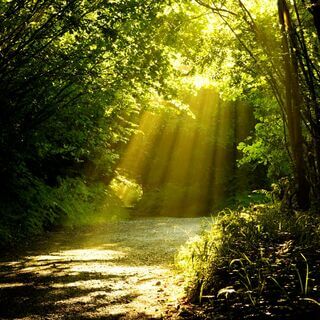
It stands on a knoll surrounded by loch trees and lofty elms,
From among which its descent whitewashed walls shine modestly forth like Christian purity beaming through the shades of retirement.
A gentle slope descends from it to a silver sheet of water,
Bordered by high trees,
Between which peeps may be caught,
At the blue hills of the Hudson,
To look upon its grass-grown yard.
Where the sunbeams seem to sleep so quietly,
One would think that there at least the dead might rest in peace.
On one side of the church extends a white woody dell,
Along which raves a large brook among broken rocks and trunks of fallen trees.
Over a deep black part of the stream,
Not far from the church,
Was formerly thrown a wooden bridge,
The road that led to it,
And the bridge itself,
Where thickly shaded by overhanging trees,
Which cast a gloom about it,
Even in the daytime,
But occasioned a fearful darkness at night.
This was one of the favorite haunts of the Headless Horseman,
And the place where he was most frequently encountered.
The tale was told of Old Brewer,
A most heretical disbeliever in ghosts,
How he met the horseman returning from his foray into Sleepy Hollow,
And was obliged to get up behind him.
How they galloped over bush and break,
Over hill and swamp,
Until they reached a bridge,
Where the horseman suddenly turned into a skeleton,
Threw Old Brewer into the brook,
And sprang away over the treetops with a clap of thunder.
This story was immediately matched by a trice marvelous adventure of Brom Bones,
Who made light of the gallop in Hessien.
He affirmed that,
On returning one night from the neighboring village of Sing Sing,
He had been overtaken by this midnight trooper,
That he had offered to race with him for a ball of punch,
And should have won it too,
For the daredevil beat the goblin horse all hollow.
But,
Just as they came into the church bridge,
The Hessien bolted,
And vanished in a flash of fire.
All these tales told in that drowsy undertone,
With which men talk in the dark,
The countenances of the listeners,
Only now,
And then receiving a casual gleam from the glare of a pipe,
Sank deep in the mind of Ichabod.
He repaid them in kind with large extracts,
From his invaluable author,
Cotton Martyr,
And added many marvelous events that had taken place in his native state of Connecticut,
And fearful sights,
Which he had seen in his nightly walks about Sleepy Hollow.
The revel now gradually broke up.
The old farmers gathered together their families in their wagons,
And were heard for some time rattling along the hollow roads and over the distant hills.
Some of the damsels mounted on pillions behind their favorite swains,
And their light-hearted laughter,
Mainly with the clatter of hoofs,
Echoed along the silent woodlands,
Sounding fainter and fainter,
Until they gradually died away,
And the late scene of noise and frolic was all silent and deserted.
Ichabod only lingered behind,
According to the custom of country lovers,
To have a tete-a-tete with the hearers,
Fully convinced that he was now on the high road with success.
What passed at this interview I will not pretend to say,
For in fact I do not know.
Something however,
I fear me,
Must have gone wrong,
For he certainly sallied forth,
After no very great interval,
With an air quite desolate and chop-fallen.
Oh,
This woman,
This woman!
Could that girl have been playing off any of her catty tricks?
Was her encouragement,
Of the poor pedagogue,
All a mere sham to secure her conquest of his rival?
Heaven only knows,
Not I,
Let it suffice to say,
Ichabod stole forth with the air of one who had been sacking a hen-roost,
Rather than a lady's heart,
Without looking to the right or left to notice the scene of rural wealth,
On which he had so often gloated,
He went straight to the stable,
And with several hearty cuffs and kicks,
Roused his steed most uncociously from the comfortable quarters in which he was soundly sleeping,
Dreaming of mountains of coarse and alts,
And whole valleys of timity and clover.
It was the very reaching time of night that Ichabod heavy-hearted and crestfallen pursued his travels homewards,
Along the sides of the lofty hills which rise above Tarry-town,
And which he had traversed so cheerily,
In the afternoon the hour was as dismal as himself,
Far below him the Tappan Sea spread its dusky and indistinct waste of waters,
With here and there the tall mast of a sloop,
Riding quietly at anchor under the land.
In the dead hush of midnight he could even hear the barking of the watch-dog from the opposite shore of the Hudson,
But it was so vague and faint as only to give an idea of his distance from this faithful companion of man.
Now and then,
Too,
The long-drawn crowing of a cock accidentally awakened would sound far,
Far off,
From some farmhouse away among the hills,
But it was like a dreaming sound in his ear,
No signs of life occurred near him,
But occasionally the melancholy chirp of a cricket,
Or perhaps the guttural twang of a bull-frog,
From a neighboring marsh,
As if sleeping uncomfortably and turning suddenly in his bed,
All the stories of ghosts and goblins that he had heard in the afternoon now came crowding upon his recollection,
The night grew darker and darker,
The stars seemed to sink deeper in the sky,
And driving clouds occasionally hid them from his sight,
Yet never felt so lonely and dismal.
He was,
Moreover,
Approaching the very place where many of the scenes of the ghost stories had been laid.
In the center of the road stood an enormous tulip-tree,
It towered like a giant above all the other trees of the neighborhood,
And formed a kind of a landmark.
Its limbs were gnarled and fantastic,
Large enough to form trunks of ordinary trees,
Twisting down almost to the earth,
And rising again into the air.
It was connected with the tragical story of the unfortunate André,
Who had been taken prisoner hard by,
And was universally known by the name of,
Major André's Tree.
The common people regarded it with a mixture of respect and superstition,
Partly out of sympathy for the fate of its ill-starred namesake,
And partly from the tales of strange sights and doleful lamentations thought concerning it.
As Ichabod approached his fearful tree,
He began to whistle.
He thought his whistle was answered.
It was,
With a blast sweeping sharply through the dry branches.
As he approached a little nearer,
He thought he saw something white hanging in the midst of the tree.
He paused and ceased whistling,
But on looking more narrowly,
Perceived that it was a place where the tree had been scattered by lightning.
The white wood laid bare.
Suddenly he heard a groan.
His teeth chattered,
And his knees moored against the saddle.
It was but the rubbing of one huge bow upon another,
As they were swayed about by breeze.
He passed the tree in safety,
But new perils lay before him.
About two hundred yards from the tree,
A small brook crossed the road,
And ran into a marshy and thickly wooded plain,
Known by the name of Wylie Swamp.
A few rough logs,
Laid side by side,
Served for a bridge over this stream.
On that side of the road,
Where the brook entered the wood,
A group of oaks and chestnuts,
Scattered thick with white grape vines,
Threw a cavernous gloom over it.
To pass this bridge was the severest trial.
It was at this identical spot that the unfortunate entree was captured,
And under the cupboard of those chestnuts and vines where the sturdy yeoman concealed who surprised him.
This has ever since been considered a haunted stream,
And fearful are the feelings of schoolboy who has to pass it alone after dark.
As he approached the stream,
His heart began to thump.
He summed up,
However,
All his resolution,
Gave his horse half a score of kicks in the ribs,
And attempted to dash briskly across the bridge.
Instead of starting forward,
The perverse old animal made a lateral movement,
And ran broadside against the fence.
Igapod,
Whose fears increased with the delay,
Jerked the reins on the other side,
And kicked lustily with the contrary foot.
It was all in vain.
His deed started,
It is true,
But it was only to plunge to the opposite side of the road,
Into a thicket of brambles and older bushes.
The schoolmaster now bestowed both whip and heel upon the starveling ribs of old Gunbowder,
Who dashed forward,
Snuffling and snorting,
But came to a stand just by the bridge.
The suddenness that had nearly sent his rider sprawling over his head.
Just at this moment a plashy tramp by the side of the bridge caught the sensitive ear of Igapod.
In the dark shadow of the grove,
On the margin of the brook,
He beheld something,
Huge,
Misshapen,
Black and towering.
It stirred not,
But seemed gathered up in the gloom,
Like some gigantic monster ready to spring upon the traveller.
The hair of the affrighted bedock rose upon his head.
What was to be done?
It was now too late,
And besides,
What chance was there of escaping,
Ghost or goblin,
If such it was,
Which could ride upon the wings of the wind,
Summoning up,
Therefore,
A show of courage he demanded in stammering accents.
Who are you?
He received no reply.
He repeated his demand in a still more agitated voice.
Still,
There was no answer.
Once more he guttured the sides of the inflexible Gunbowder,
And shutting his eyes,
Broke forth with involuntary fervour into a psalm tune.
Just then the shadowy object of alarm put itself in motion,
And with a scramble and a bound stood at once in the middle of the road.
Though the night was dark and dismal,
Yet the form of the unknown might now in some degree be ascertained.
He appeared to be a horseman of large dimensions,
And mounted on a black horse of powerful frame.
He made no offer of molestation or liability,
But kept aloof on one side of the road,
Jogging along on the blind side of old Gunbowder,
Who had now got over his fright and waywardness.
Ichabod,
Who had no relish for the strange midnight companion,
And bethought himself of the adventure of Brambone with the galloping Hessian,
Now quickened his teeth in hopes of leaving him behind.
The stranger,
However,
Quickened his horse to an equal pace.
Ichabod put up and fell into a walk,
Thinking to lag behind.
The other did the same.
His heart began to sink within him.
He endeavoured to resume his psalm tune,
But his parched tongue glowed to the roof of his mouth,
And he could not utter a state.
There was something in the moody and dodged silence of this pertinacious companion that was mysterious and appalling.
It was soon fearfully accounted for on mounting a rising ground,
Which brought the figure of his fellow traveller in relief against the sky,
Gigantic in height,
And muffled in a cloak.
Ichabod was horror-struck on perceiving that he was headless.
His horror was still more increased on observing that the head,
Which should have rested on his shoulders,
Was carried before him on the pommel of his saddle.
His terror rose to desperation.
He rained a shower of kicks and blows upon Gunpowder,
Hoping by a sudden movement to give his companion the slip.
But the spectre started full jump with him.
Away then they dashed,
Too thick and thin,
Stones flying and sparks flashing at every bound.
Ichabod's flimsy garments fluttered in the air as he stretched his long,
Lank body away over his horse's head.
In the eagerness of his flight,
They had now reached the road which turns off to sleepy hollow.
But Gunpowder,
Who seemed possessed with the demon,
Instead of keeping up it,
Made an opposite turn and plunged headlong downhill to the left.
This road leads through a sandy hollow,
Shaded by trees for about a quarter of a mile,
Where it crosses the bridge famous in Goblin Story,
And just beyond Swell's,
The green knoll on which stands the whitewashed church.
As yet the panic of the steed had given his unskillful rider an apparent advantage in the chase.
But just as he had got half way to the hollow,
The girds of the saddle gave way,
And he felt it slipping from under him.
He seized it by the pommel,
And endeavored to hold it firm,
But in vain,
And had just time to save himself by clasping old Gunpowder round the neck,
When the saddle fell to the earth,
And he heard it trampled underfoot by his pursuer.
For a moment the terror of Hans Van Ripper's wrath passed across his mind,
For it was his Sunday saddle.
But this was no time for petty fears.
The goblin was hard on his hanches,
And unskillful rider that he was,
He had much ado to maintain his seat,
Sometimes slipping on one side,
Sometimes on another,
And sometimes jolted on the high ridge of his horse's backbone with a violence that he rarely feared would cleave him asunder.
An opening in the trees now cheered him with the hopes that the church bridge was at hand.
The wavering reflection of a silver star in the bosom of the brook told him that he was not mistaken.
He saw the walls of the church dimly glaring under the trees beyond.
He recollected the place where Brom Bones's ghostly competitor had disappeared.
If I can but reach that bridge,
Thought Ichabod,
I am safe.
Just then he heard the black steep panting and blowing,
Close behind him.
He even fancied that he felt his own breath.
After a convulsive kick in the ribs,
An old gunpowder sprang upon the bridge.
He thundered over the resounding blanks.
He gained the opposite side,
And now Ichabod cast a look behind to see if his pursuer should vanish,
According to rule,
In a flash of fire and brimstone.
Just then he saw the goblin rising in his derps,
And in the very act of hurling his head at him.
Ichabod endeavoured to dodge the horrible missile,
But too late.
It encountered his cranium with a tremendous crash.
He was tumbled headlong into the dust,
And gunpowder,
The black steed,
And the goblin rider passed by like a whirlwind.
The next morning the old horse was found without his saddle,
And with the brittle under his feet,
Soberly cropping the grass at his master's gate.
Ichabod did not make his appearance at breakfast.
Dinner hour came,
But no Ichabod.
The boys assembled at the schoolhouse,
And strode idly about the banks of the brook.
No schoolmaster,
Hans van Ripper,
Now began to feel some uneasiness about the fate of poor Ichabod.
An inquiry was set on foot,
And after diligent investigation,
They came upon his tracers in one part of the road leading to the church,
As found the saddle trampled in the dirt.
Tracks of horse's hoofs,
Deeply dented in the road,
And evidently at furious speed,
Were traced to the bridge,
Beyond which,
On the bank of a broad part of the brook where the water ran deep and black,
As found the hat of the unfortunate Ichabod,
And close beside it a shattered pumpkin.
The brook was searched,
But the body of the schoolmaster was not to be discovered.
Hans van Ripper,
As executor of his state,
Examined the bundle which contained all his worthy effects.
They consisted of two shirts and a half,
Two socks,
Two stocks for the neck,
A pair or two of worsted stockings,
An old pair of small clothes,
A rusty razor,
A book of psalm tunes full of dog's ears,
And a broken beech pipe.
As to the books and furniture of the schoolhouse,
They belonged to the community,
Excepting Cotton Martyr's History of Witchcraft,
The New England Almanac,
And a book of dreams and fortune-telling,
In which,
Last,
Was a sheet of foolscap,
Much crippled and blotted,
And several fruitless attempts to make a copy of verses in honor of the heiress of Van Dassel.
These magic books and the poetic scroll were fortuitously consigned to the flames by Hans van Ripper,
Who,
From that time forward,
Determined to send his children no more to school,
Observing that he never knew any good come of this same reading and writing.
There were money the school must have possessed,
And he had received his quarter's pay,
But a day or two before he must have had,
About his person.
At the time of his disappearance,
The mysterious event caused much speculation at the church on the following Sunday.
Notes of geysers and gossips were collected in the churchyard at the bridge,
And at the spot where the hat and pumpkin had been found.
The stories of browers,
Of bones,
And a whole budget of others,
Were caught to mind,
And when they had diligently considered them all,
And compared them with the symptoms of the present case,
They shook their heads and came to the conclusion that Ichabod had been carried off by the galloping Hessian.
As he was a bachelor,
And in nobody's debt,
Nobody troubled his head any more about him.
The school was removed to a different quarter of the hollow,
And another pedagogue reigned in his stead.
It is true an old farmer had been down to New York on a visit several years after,
And from whom this account of the ghostly adventure was received,
Brought home the intelligence that Ichabod Crane was still alive,
That he had left the neighborhood,
Partly through fear of the goblin and house-one-ripper,
And partly in mortification at having been suddenly dismissed by the Harris,
That he had changed his quarters to a distant part of the country,
Had kept school and studied law at the same time,
Had been admitted to the bar,
Turned politician,
Electionered,
Written for the newspapers,
And finally had been made a justice of the ten-pound court.
Bram Bones,
Too,
Who shortly after his rival's disappearance conducted the blooming Katrina in triumph to the altar,
Was absurd to look exceedingly,
Knowing whenever the story of Ichabod was related,
And always burst into a hearty laugh at the mention of the pumpkin,
Which led some to suspect that he knew more about the matter than he chose to tell.
The old country wives,
However,
Who are the best judges of these matters,
Maintain to this day that Ichabod was spirited away by supernatural means,
And it is a favorite story often told about the neighborhood round the winter evening fire,
The bridge became more than ever an object of superstitious awe,
And that may be the reason why the road has been altered of late years.
So as to approach the church by the border of the mill pond,
The schoolhouse being deserted soon fell to decay and was reported to be haunted by the ghost of the unfortunate pedagogue and the blowboy,
Loitering homeward of a still summer evening,
A soft and fancied his voice at the distance,
Chanting a melancholy psalm tune among the tranquil solitudes of sleepy hollow.