Siberian shamanism.
Siberia is considered to be the heartland of shamanism.
In modern anthropology,
The term shamanism refers to the spiritual practice of native groups.
However,
Shamanism itself is not limited to Siberia.
It is a universal practice where all major religions are based on.
Siberia is a large area which includes a variety of cultures,
Languages,
Practices and beliefs,
Which many fall into the classification of shamanism,
And many of these ethnic groups practice shamanism still today.
In Siberian shamanism,
There are some distinctive features,
Such as worship of nature,
Belief for the world tree,
An invisible pole that is representation of the universe,
And three layers of the world,
The upper world,
Middle world and the underworld.
And it is important to notice that these different levels of the world,
They are not literal,
They represent the human subconsciousness.
Many of these ethnic groups were hunters and lived a nomadic lifestyle.
Hunting was a sacred ritual,
And in order for the hunt to be successful,
The job of the shaman was to take a shape of an animal and travel to meet the deity who was in charge of the hunting.
The shaman would dress up as animals and mimic their sounds and movements.
There is lots of diversity among the sacred animals in Siberian shamanism.
Among Samoyedi and Uralic groups,
A sacred animal was the bear,
Who was believed to be the sacred ancestor of the tribe.
In Mongolia and among Turkic groups,
Stags and horses were the most important animals.
Among the Ukip and Nenetsi and the Samis,
The reindeer was their sacred animal ancestor.
The creation myth about the earth diver is common among all groups whose roots are in Siberia,
And why the birds play a significant part in the shamanistic practice.
There is lots of diversity among the sacred animals in Siberian shamanism.
The origins of the word shaman are in Tungush,
Where it means the spiritual leader and the healer of the tribe.
In Siberian cultures,
Shamanism often has strict gender roles.
For the Tuvar,
Shaman is Tatar,
Shor or Oirat.
In the Njagakir language,
The shaman is known as Alman,
Olman or Wolven.
The Biryat shaman is known as Bö,
Derived from old Mongolian word Böge.
And for the Mansi,
Shaman was got in Njat.
Sami shaman is known as Noaiti,
And in Finnish as Noita.
These words are based on the Proto-Uralic word Noita,
Which means a witch or a shaman.
The female shamans,
In most Siberian cultures the shaman was a man,
And female shamans can be mainly found among Mongolian tribes.
For the Negida,
The shamaness is got Odogan.
And the Biryat shamaness is got Ugaadan and Evenki.
In Siberian languages,
There are many similar words meaning a shamaness,
Such as Utaakan,
Upuukan,
Itiikan,
Utuusun,
Iidan and Uduana.
Most of these words are based on ancient Mongolian earth goddess,
Ötügen.
She was also known as Ötügen Ege.
The mother earth and her name can be originated to the holy mountain Ötügen,
The mountain of earth and fertility.
Turkic shamanism is practiced by ethnic groups who speak Turkic languages.
These are Tatars,
Tuvars,
Tofalar,
Yakut and Turks who live in the Altai mountains.
Turkic shamanism covers large territories.
The practice itself has been amalgamated with Buddhist and Islam beliefs.
Area of the Yupik stretches from eastern Siberia to Alaska and northern Canada.
Therefore there is lots of diversity in their shamanistic practices.
They believe in soul dualism and recarnation.
All of a Yupik shaman could travel between different levels to the underworld realms and to meet supernatural beings and spirits and spirit guides and they could ask for their guidance.
Shamanism of the Ket is foremost totemic.
The lifestyle of the Ket is nomadic and shamanism is intertwined to bear and deer hunting.
They used lots of bones,
Skeletons and other animal parts in their rituals.
Like for many Uralic people,
For the Ket water birds were sacred.
Loon is especially important bird,
A totem animal and loon's bones were often used in ceremonies.
They were shaman's helpers in their journey.
For the Ket,
Shapeshifting is an important part of the spiritual practice.
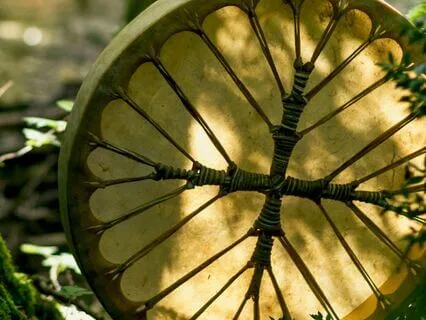
The shaman goes off on the spiritual journey while drumming and dancing.
All ethnic groups that speak Samoyedi languages have elements of shamanism in their spiritual practice.
The Siam shaman's boots,
Dress and headdresses represent bones and human organs.
The skeleton overlay of the dress symbolizes rebirth.
Like all groups whose myths are based on Uralic myths,
For the Siams,
Loon was a sacred bird and a magical helper.
Other Samoyedic tribes such as Nenets,
Enets and Selkup have different crowns and headdresses to be worn on different occasions.
When a child is born,
The proper headdress represents the upper world and for communicating with the dead,
Headdresses represent the underworld.
And reindeer is a sacred animal for many of these ethnic groups in the Northern Hemisphere.
The Sami shamanism.
Samis are native people of Scandinavia and the only ethnic group in the area of European Union.
Samis live outside Siberia,
But their language is part of the Samoyedi languages.
There are elements of shamanism in the spirituality and folk traditions and customs of the Sami.
One of the most important parts of the Sami culture is the joik.
Joiks are wordless chants that were originally sung in shamanistic rituals.
There are two types of joiks.
Clear joiks that are mostly sung by young people.
Then there are mumbling joiks that are used while casting spells.
And these joiks often mimic natural sounds.
Last but not least,
We have Finno-Ugric shamanism.
Most speakers of Finno-Ugric languages live outside Siberia.
Finno-Ugric now refers to Finnic languages,
Such as Finnish,
Estonian and Maori.
In all these cultures there are elements of shamanism in their folklore and ancient myths.
In pre-Christian Finland,
Shamanism had several phases.
Noita,
The shaman,
Was the spiritual healer of the tribe.
Later on there was a shift in the culture and Noita became more individualized and was no longer a healer of the community but an individual practitioner.
Ancient Finnish tribes believed in sole duality.
Bear and the moose were most common totem animals and there are lots of archaeological proofs found from the white-lispered bear cult in Finland.
The world was divided into three levels and they were held together by an invisible pole,
The world tree.
In Estonia the shaman was god and knight.
Like in Finland,
Also in Estonia the worship of nature was essential part of the spiritual practice.
Trees were especially worshipped as divine nature spirits.
Other speakers of Finnic languages,
Like Gomes,
Maris and Mortvan,
Also have elements of shamanism in their spiritual practice.
Finnic religion also has elements from Russian Orthodox.
Among all these groups nature worship,
Shamanic travelling and concept of the world tree are very common.
Ugric refers to Ugric languages such as Hungarian,
Kanti and Mansi.
Early ancestors of modern day Hungarians migrated from Siberia already 6000 years ago,
Settling into the area of Pannonia Basin.
Elements of shamanism have been preserved in folklore.
Elements of shamanism have been preserved in folklore.
Ancient Hungarians believed that the world was divided into three levels and shaman had the ability to travel between these levels to seek information.
In Kanti culture bear was worshipped as an important totem animal and as the divine ancestor of the people.
This was a little small touch the similarities between different Siberian cultures that practice shamanism.
Thank you so much for listening.